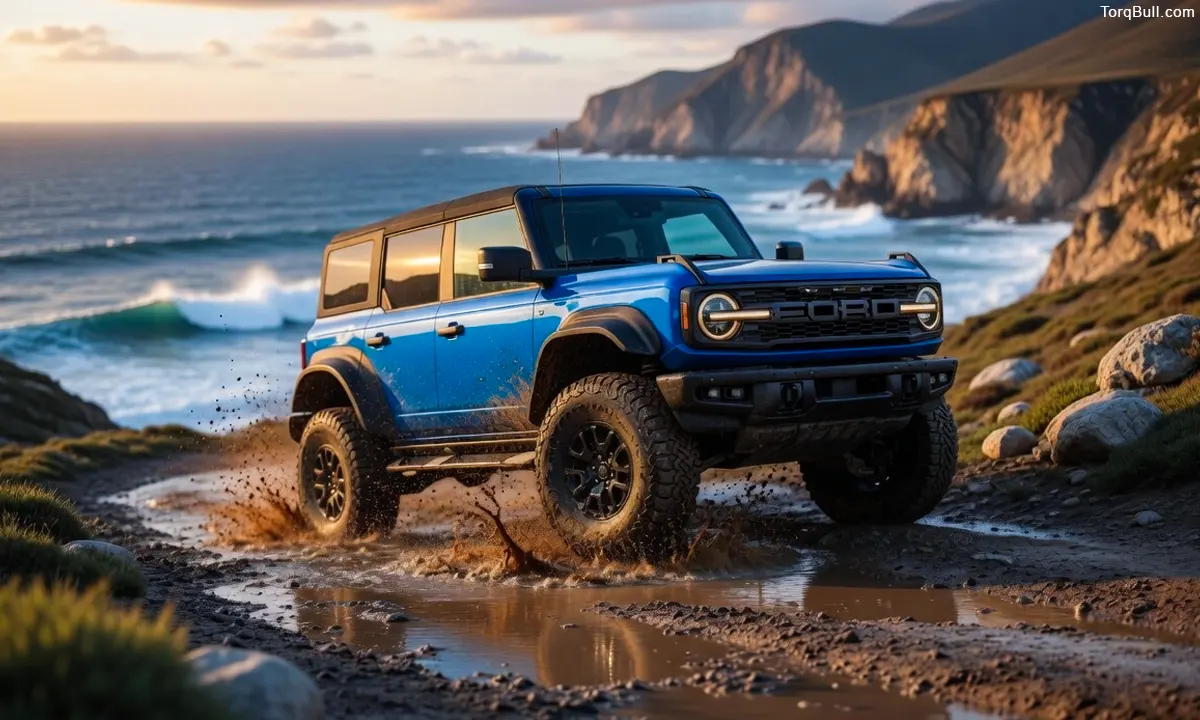
- The 2026 Ford Bronco Raptor produces 418 horsepower and 440 pound-feet of torque from its 3.0-liter EcoBoost V6.
- It features FOX Live Valve semi-active dampers, 37-inch tires, 13.1 inches of ground clearance and locking front and rear differentials.
- The Bronco Raptor represents the pinnacle of factory-built off-road capability in the Ford Bronco lineup.
The Ford Bronco Raptor is not a trim variant of the standard Bronco lineup that received an engine upgrade and a styling package. It is a purpose-built high performance desert running SUV whose development was led by the Ford Performance division using lessons from more than 50 years of off road racing history including the Baja 1000, the King of the Hammers and the Dakar Rally. The standard Bronco is already an immensely capable off road vehicle. The Raptor takes that foundation and pushes it past the point where the standard Bronco’s hardware reaches its limits — widening the track, extending the suspension travel, installing semi-active FOX dampers that process terrain inputs hundreds of times per second, fitting 37-inch all-terrain tyres as standard and tuning a twin-turbocharged 3.0 litre V6 to 418 horsepower specifically for the high-speed desert running that the Raptor’s suspension architecture was designed to sustain. This review examines every dimension of the Raptor’s off road performance in complete detail.
The Engine: 418 Horsepower Purpose-Built for Desert Speed
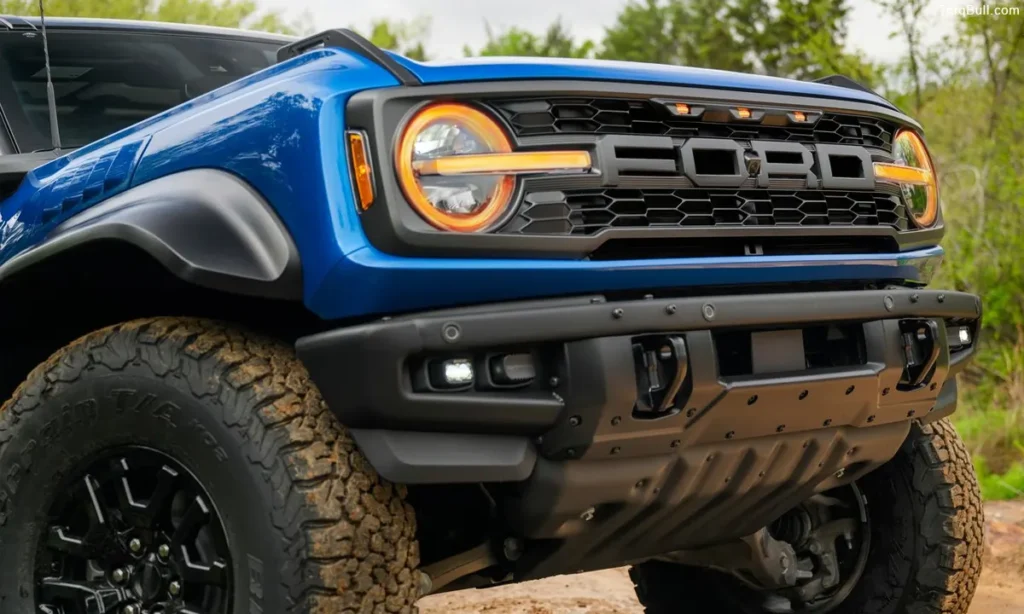
The 2026 Bronco Raptor’s 3.0 litre EcoBoost twin-turbocharged V6 is not the same engine as the 2.7 litre V6 available across the standard Bronco lineup with different software settings — it is an entirely separate engine featuring a compacted graphite iron block that provides greater thermal resistance under the sustained high-output operation that desert running demands, along with specific intercooling and air-induction system architecture tuned to Ford Performance standards.
Producing 418 horsepower and 440 pound feet of torque through a 10-speed automatic transmission to all four wheels through standard advanced 4WD with Automatic On-Demand Engagement, the Raptor’s powertrain delivers power in a sustained, progressive manner rather than a sudden surge — a specific calibration choice reflecting the desert running scenario where maintaining momentum across varying terrain surfaces requires power that is always available rather than peaky and unpredictable.
The specialised dual exhaust system provides four selectable modes — Normal, Sport, Quiet and Baja — allowing the driver to match the exhaust character to the operating environment. Baja mode is specifically designed for high-speed desert running, opening the exhaust valves fully for maximum flow and producing the soundtrack that signals the Raptor’s most serious operating state. Quiet mode reduces exhaust note for residential environments or early morning departures from campsites without mechanical compromise. Professional testing confirms the exhaust transitions between modes cleanly through the vehicle’s infotainment system without requiring vehicle stop or mode restart.
Read: Ford Bronco Wildtrak vs Outer Banks: Which Bronco Trim Is Right for You?
The HOSS 4.0 Suspension: The System That Separates the Raptor From Everything Else
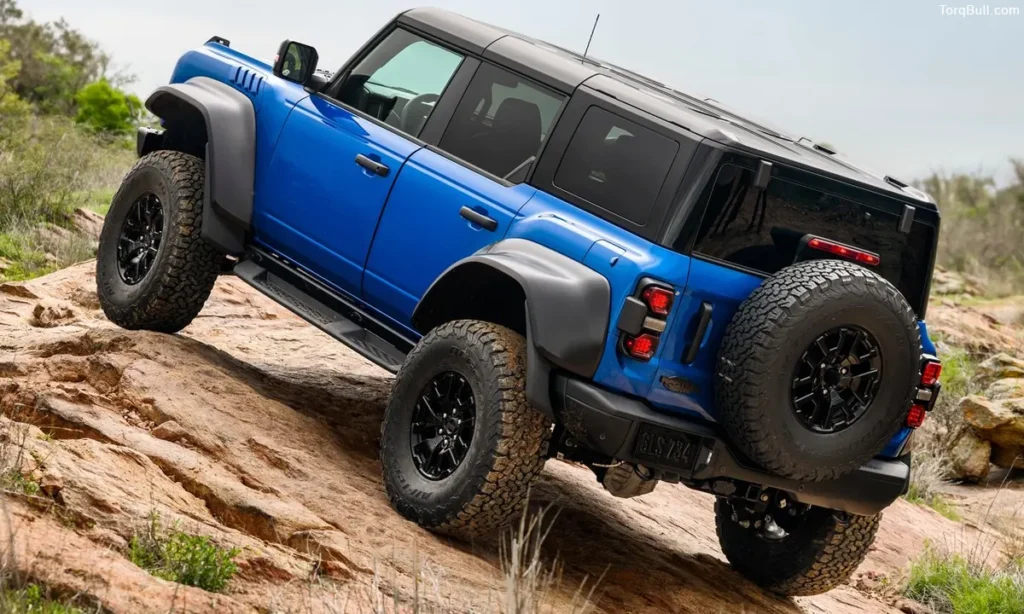
The HOSS 4.0 suspension system — High-Performance Off-Road Stability Suspension — is the engineering centrepiece of the Bronco Raptor’s off road capability and the component that most definitively explains the performance difference between the Raptor and even the second most capable standard Bronco Badlands configuration.
The FOX Live Valve 3.1 Internal Bypass Semi-Active Dampers are not passive shocks that react to terrain inputs with fixed resistance — they are electronically controlled dampers that continuously monitor terrain conditions, vehicle speed, throttle position, steering angle and weight transfer data and adjust damping rates hundreds of times per second to maintain optimal wheel contact and body control simultaneously. The result is a suspension system that provides compliance over small, high frequency trail inputs — absorbing rock clatter and surface texture without transmitting it harshly to the occupants — while simultaneously providing resistance and control on large, low frequency impacts from jumps, deep ruts and sudden terrain transitions where body stability determines safety.
The Raptor’s front wheel travel is 13 inches and rear wheel travel is 14 inches — among the highest available in any factory-built off road SUV and significantly above the standard Bronco’s travel figures. This increased travel directly enables the Raptor’s high-speed desert running capability: where the standard Bronco’s suspension would reach its travel limits and produce harsh, potentially vehicle-destabilising bottom-out impacts at high speed over rough terrain, the Raptor’s additional travel absorbs the same inputs without exhausting the available suspension range.
The wider front and rear track width of the Raptor — notably wider than any standard Bronco configuration — provides the lateral stability that high-speed desert running and sand dune navigation require. A wider track lowers the effective centre of gravity leverage and increases the cornering stability margin, allowing the Raptor to maintain composure in high-speed sweeping desert turns that would produce concerning body roll in narrower-track vehicles.
The Tyres and Ground Clearance: 37 Inches as Standard
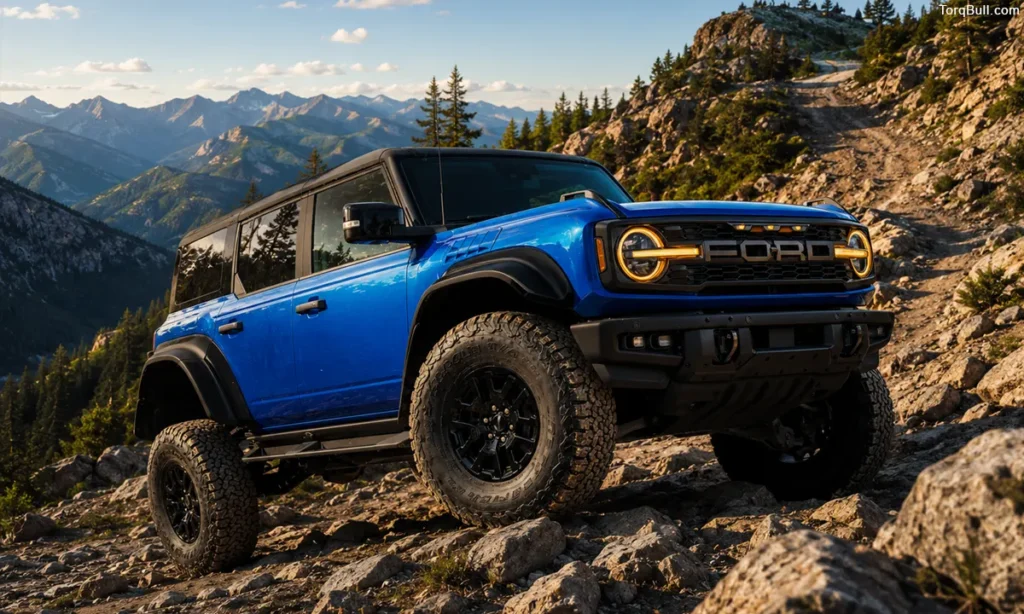
The 37-inch all-terrain tyres fitted as standard to the 2026 Bronco Raptor are the single largest stock tyre fitted to any production SUV — a specification that defines the vehicle’s ground clearance, approach geometry and traction capability across loose surfaces simultaneously.
The 37-inch tyre diameter produces 13.1 inches of ground clearance — the highest in any production Bronco configuration and among the highest available in any factory-built mainstream SUV at any price. This ground clearance elevation allows the Raptor to traverse rock formations, rut lips, embedded obstacles and terrain transitions that would contact the undercarriage of standard Bronco configurations. Combined with the wider track’s increased wheel width, the 37-inch tyres provide the traction footprint that loose sand, deep mud and wet rock surfaces require for vehicle movement where narrower or smaller tyres would spin without traction.
The beadlock-capable wheel specification is a specific technical detail that desert and trail runners specifically seek — beadlock wheels allow tyre pressure to be reduced to extremely low levels, potentially below 10 PSI for sand driving, without the risk of the tyre separating from the wheel bead. At very low pressures, the tyre’s contact patch widens dramatically and the rubber conforms to surface irregularities rather than riding over them — the specific physics that produce maximum traction on sand and loose rock surfaces.
Read: Ford Bronco Off Road Performance. Can It Still Dominate Extreme Trails?
Off Road Technology: Trail Control, Trail Turn Assist and the Locking Differential System
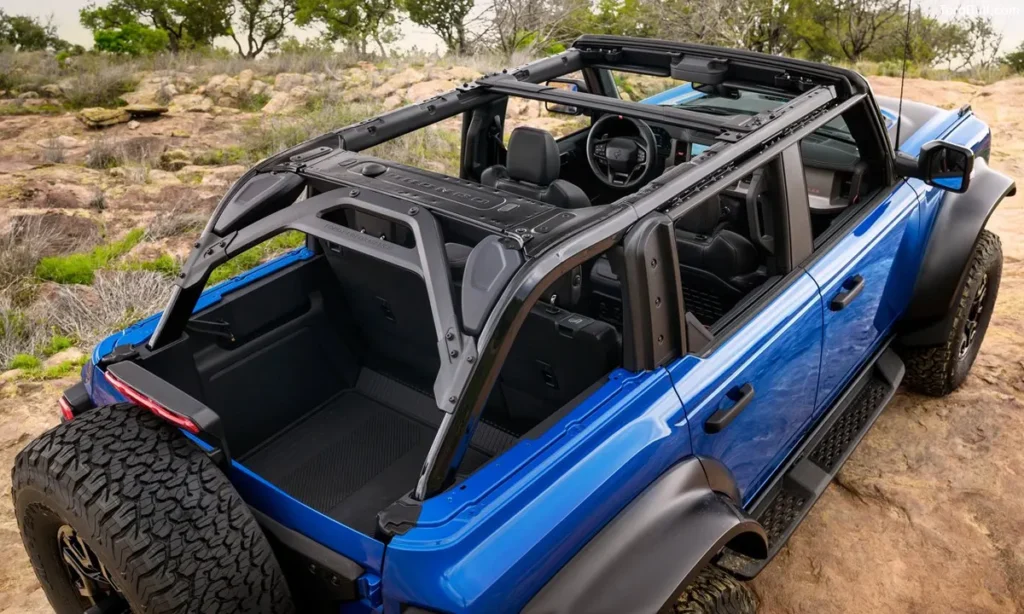
The 2026 Bronco Raptor provides the most comprehensive factory off road technology package available in any production SUV — combining trail assistance systems with locking hardware in a specific configuration that enables both technical slow speed trail work and sustained high-speed desert running.
Trail Control functions as off road cruise control — managing throttle and braking inputs automatically at driver-selected speeds from 1 to 20 MPH, allowing complete driver focus on steering inputs rather than simultaneously managing vehicle pace over technical terrain. This capability transforms the Raptor from an intimidatingly powerful desert machine into a genuinely accessible technical trail vehicle where less experienced drivers can navigate challenging terrain with confidence.
Trail Turn Assist applies brake pressure to the inside rear wheel during tight trail turns, reducing the Raptor’s turning radius below what its physical wheelbase would otherwise allow. This capability enables the Raptor to navigate switchbacks and narrow trail turns that the vehicle’s size might otherwise require multi-point turning to complete. Combined with the front anti-roll bar disconnect that improves front wheel articulation by removing the mechanical link that limits independent front suspension travel, the Raptor can negotiate uneven rock surfaces and trail obstacles that challenge even purpose-built rock crawling vehicles.
The electronic locking front and rear differentials provide mechanical traction distribution that no traction control programming fully replicates — when both are locked, all four wheels receive equal torque regardless of traction conditions at any individual wheel, providing the last-resort traction capability before a recovery strap becomes necessary.
The G.O.A.T. terrain management system provides seven mode selections — Normal, Eco, Sport, Sand, Rock Crawl, Mud and Baja — each adjusting throttle mapping, transmission shift logic, stability control thresholds and differential engagement simultaneously for the specific terrain type selected. Baja mode unlocks the full 418-horsepower throttle mapping and relaxes stability control to allow the driver to manage vehicle dynamics actively during high-speed desert running. Rock Crawl mode reduces throttle to its most linear and most moderate calibration and engages both locking differentials for technical rock navigation.
2026 Ford Bronco Raptor Off Road Specifications — Complete Performance Chart
| Specification | Detail |
| Engine | 3.0 litre EcoBoost Twin Turbo V6 (Race-tuned) |
| Horsepower | 418 hp |
| Torque | 440 lb ft |
| Transmission | 10-speed automatic |
| 4WD System | Advanced 4WD with Automatic On-Demand Engagement |
| Suspension | HOSS 4.0 FOX Live Valve 3.1 Semi-Active Dampers |
| Front Wheel Travel | 13 inches |
| Rear Wheel Travel | 14 inches |
| Ground Clearance | 13.1 inches |
| Standard Tyre Size | 37-inch all terrain |
| Wheel Type | Beadlock capable |
| Front Locking Differential | Electronic standard |
| Rear Locking Differential | Electronic standard |
| Front Stabiliser Disconnect | Standard |
| Trail Control | Standard |
| Trail Turn Assist | Standard |
| Trail One-Pedal Drive | Standard |
| G.O.A.T. Modes | 7 modes including Baja and Rock Crawl |
| Exhaust Modes | 4 modes including Baja and Quiet |
| Wading Depth | Approximately 36 to 37 inches |
| Max Towing Capacity | 4,500 lbs |
| Audio System | Bang and Olufsen 12-speaker standard |
| Starting Price | Approximately $79,995 |
Read: Ford F-150 Raptor Full Review 2026. The Complete Performance Truck Assessment
Real World Assessment: What Professional Reviews Document
Extended professional evaluation of the Bronco Raptor documents a specific performance character that the specification sheet begins to communicate but cannot fully capture. The ride quality over rough terrain at higher speeds is described as remarkably smooth for a vehicle of this capability — the FOX Live Valve dampers’ ability to process terrain inputs hundreds of times per second produces a composure that softer, passive suspension vehicles achieve by simply absorbing everything equally rather than dynamically managing the response to each specific input.
The 37-inch all terrain tyres allow smooth riding despite their size — the increased tyre diameter and volume providing compliance that smaller, narrower tyres on equivalent suspension cannot match. Despite the Raptor’s extreme off road capability and its wide stance and aggressive styling, it feels surprisingly composed in daily driving — blending rugged off road utility with real world daily driving convenience in a way that purpose-built off road racing vehicles typically sacrifice. The steering is responsive, the transmission shifts are smooth in normal daily use and the cabin provides a viable if not refined daily environment.
Honest limitations include the boxy body shape’s wind noise at highway speeds — an inherent characteristic of the Raptor’s design that the Bang and Olufsen audio system’s standard inclusion specifically helps manage — and fuel economy of approximately 15 MPG combined that reflects the 418-horsepower output and 37-inch tyre rolling resistance rather than any efficiency shortcoming in the engineering.
The Raptor is not a vehicle for every buyer — its approximately $79,995 starting price, 15 MPG fuel economy and specific performance orientation toward high-speed desert running place it in a specific and identifiable buyer category whose lifestyle regularly exercises the capabilities that differentiate it from the standard Bronco lineup. For buyers within that category, no factory built SUV at any price provides the same combination of desert speed, trail capability and technological sophistication in a production configuration.