2025 Porsche 911 GT3 RS: The Apex of Driver’s Cars
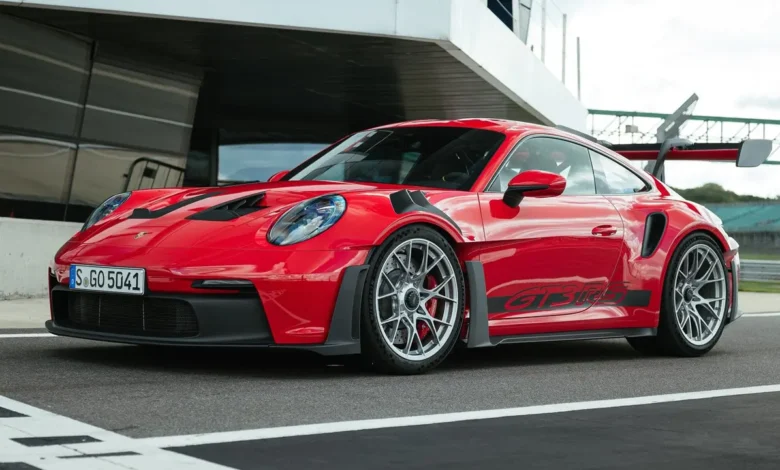
In an era dominated by hybrid systems and electric supercars, Porsche stands defiant with a machine that celebrates the raw essence of driving — the 2025 Porsche 911 GT3 RS.
This isn’t just another sports car; it’s the closest you can get to a road-legal race car straight from Porsche’s Weissach motorsport division.
With its high-revving naturally aspirated flat-six engine, mind-bending aerodynamics, and precision engineering, the GT3 RS redefines what’s possible when passion meets perfection. The result is not a car for everyone — but for those who understand, it’s everything.
Gallery: 2025 Porsche 911 GT3 RS
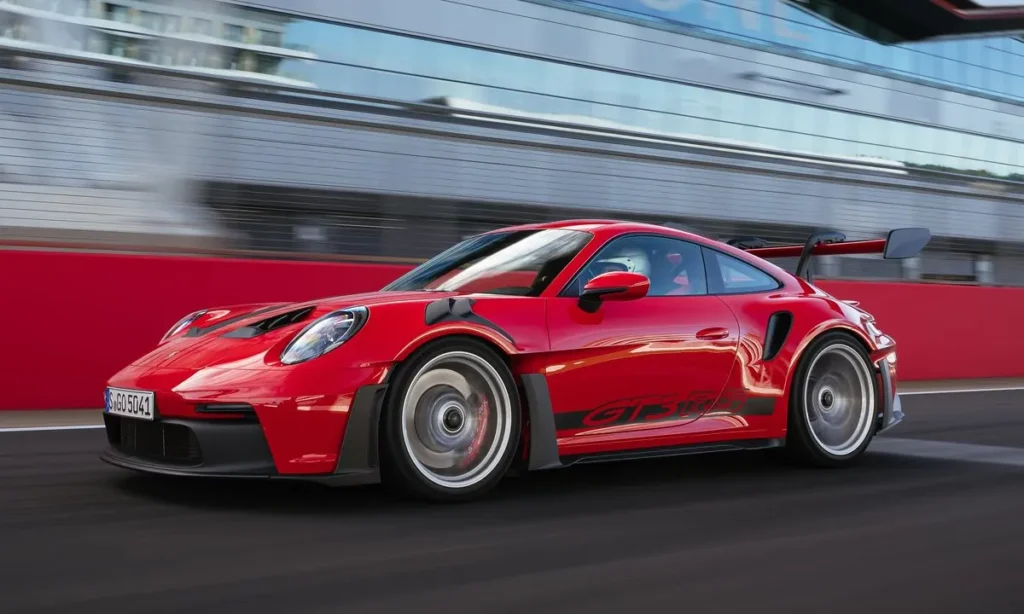
A Legacy Forged in Motorsport
Few nameplates carry as much motorsport pedigree as the Porsche 911 GT3 RS. Born from decades of racing heritage, the “RS” badge — short for Rennsport (German for “racing sport”) — signifies Porsche’s most hardcore, track-ready road cars.
Since its inception in the early 2000s, the GT3 RS has been a purist’s dream — naturally aspirated, rear-wheel drive, and uncompromising in its pursuit of lap time perfection.
The 2025 GT3 RS takes that DNA and elevates it even further. While other manufacturers chase hybrid power and computer-managed dynamics, Porsche doubles down on mechanical purity and aerodynamic genius.
Design: Form Dictated by Function
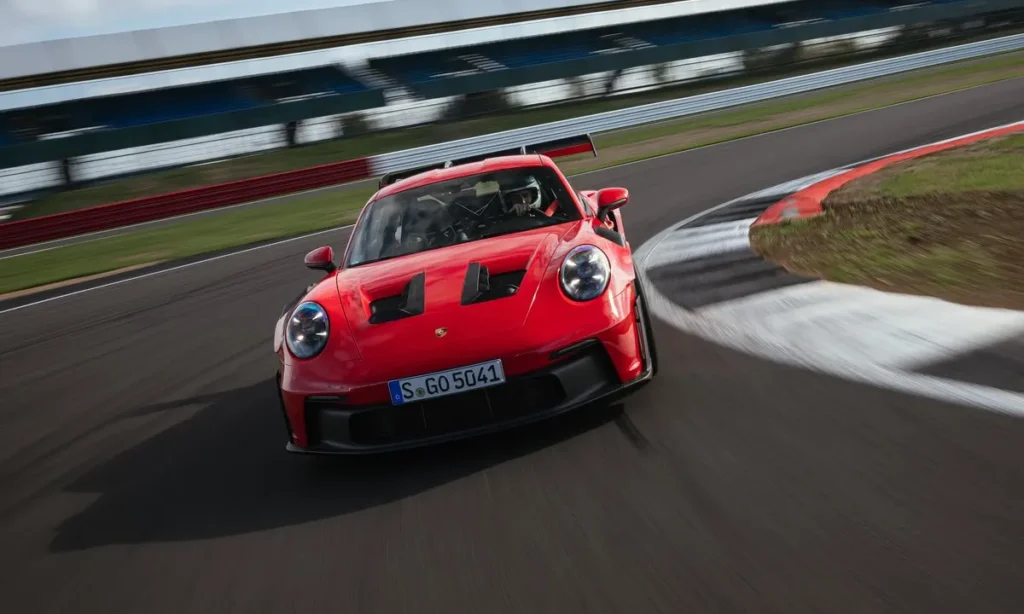
One glance at the 2025 Porsche 911 GT3 RS and you know it means business. Every vent, fin, and duct has a purpose. Nothing is decorative — it’s all aerodynamics, all performance.
Aerodynamic Masterclass
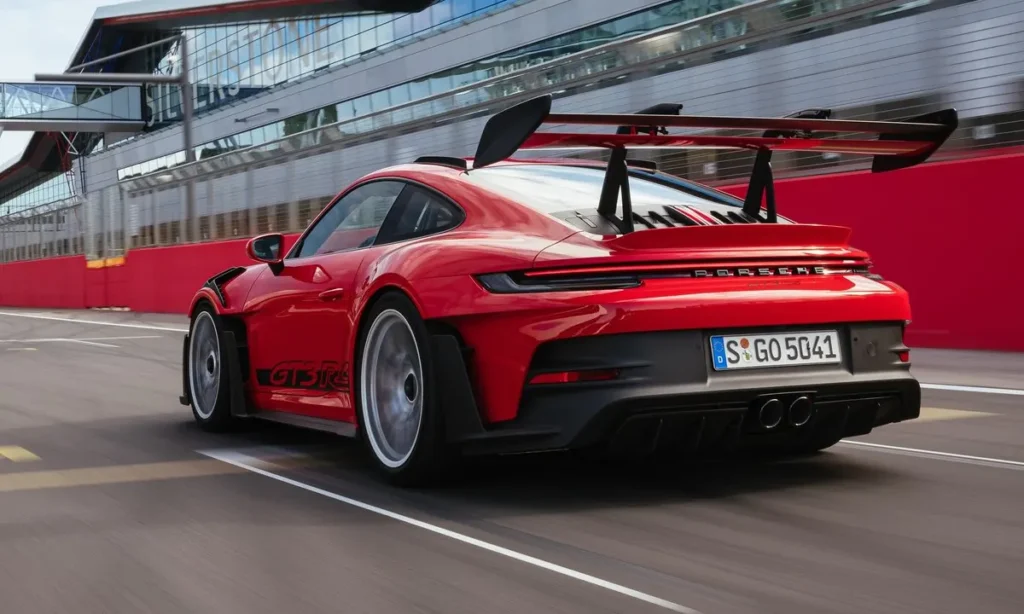
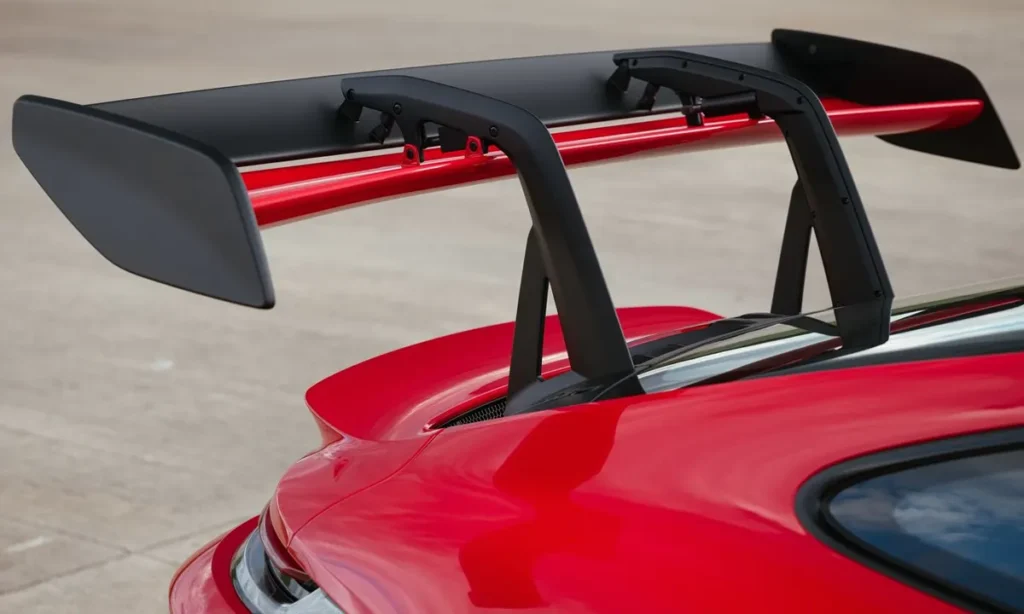
The GT3 RS wears what’s essentially a Formula 1-style aero package.
- The massive two-piece rear wing is active, featuring a drag reduction system (DRS) similar to what’s used in F1 cars. It can flatten out on straights for reduced drag, then tilt instantly for maximum downforce during cornering or braking.
- At the front, Porsche engineers replaced the traditional radiator layout with a single, centrally mounted radiator — a concept borrowed directly from the 911 GT3 R race car. This freed up space for complex active aero elements that channel airflow more efficiently across the body.
- Vortex generators, fender louvres, and diffusers all work together to generate over 900 kg of downforce at 285 km/h (177 mph) — twice as much as the previous model.
The GT3 RS isn’t sculpted for beauty — it’s sculpted by air. Yet, somehow, it remains stunning in its brutality.
Performance: Pure, Naturally Aspirated Power
While competitors embrace electrification, the GT3 RS proudly remains pure combustion — a mechanical symphony of pistons, valves, and precision.
Under its vented carbon-fiber bonnet sits a 4.0-liter naturally aspirated flat-six engine, revving to a spine-tingling 9,000 rpm.
Key Engine Specifications
- Engine: 4.0-liter naturally aspirated flat-six
- Power: 525 PS (518 hp / 386 kW)
- Torque: 465 Nm (343 lb-ft)
- Transmission: 7-speed PDK dual-clutch
- 0–100 km/h (0–62 mph): 3.2 seconds
- Top Speed: 296 km/h (184 mph)
The flat-six engine’s response is immediate — no turbos, no delay, just instant throttle feedback. Every rev is a crescendo of mechanical fury, echoing Porsche’s GT3 Cup race cars.
Despite having “only” 525 hp, it’s not about numbers. It’s about how it delivers them — consistently, relentlessly, and with a level of precision few modern cars can match.
Transmission and Driving Feel
Power is channeled exclusively through Porsche’s 7-speed PDK dual-clutch gearbox — lightning-quick, perfectly calibrated, and far more engaging than most automatics. Each gear change feels immediate, delivering crisp mechanical feedback that complements the engine’s urgency.
A manual transmission isn’t available — and for good reason. The GT3 RS is designed for outright lap-time optimization, and the PDK delivers faster, more consistent shifts on track.
The rear-wheel drive layout remains, with Porsche’s PTV Plus (Porsche Torque Vectoring) system ensuring traction and precision even under aggressive cornering loads.
Chassis: Race-Car Precision, Road-Car Soul
Where the GT3 RS truly separates itself is in its chassis. Every suspension component is optimized for track use — from the double-wishbone front suspension to the multi-link rear setup.
Key Handling Technologies
- Rear-Axle Steering: Improves agility at low speeds and stability at high speeds.
- PASM (Porsche Active Suspension Management): Continuously adjusts damping for optimal grip.
- Adjustable Suspension Settings: Ride height, camber, and anti-roll bars can all be tuned manually — like a true race car.
- Carbon-Ceramic Brakes: Deliver fade-free braking and save crucial unsprung weight.
Every detail of the suspension geometry was revised for aerodynamic efficiency and stability. Even the wishbones are shaped like airplane wings to reduce drag.
The result is a car that feels alive — razor-sharp yet balanced, predictable yet explosive. Whether carving through corners or attacking a straight, the GT3 RS offers total confidence.
Lightweight Engineering: Less Is Everything
Weight is the enemy of performance, and Porsche knows it better than anyone. The GT3 RS uses CFRP (Carbon-Fiber Reinforced Plastic) extensively across its body:
- Doors, roof, hood, and fenders are all made from lightweight carbon-fiber composites.
- The windshield and side windows use thinner glass to save grams.
- Optional Weissach Package adds even more carbon components, including carbon roll cage and magnesium wheels — reducing weight further by about 25 kg.
At just 1,450 kg (3,197 lbs), the GT3 RS achieves an incredible power-to-weight ratio, making it feel telepathic in its reactions.
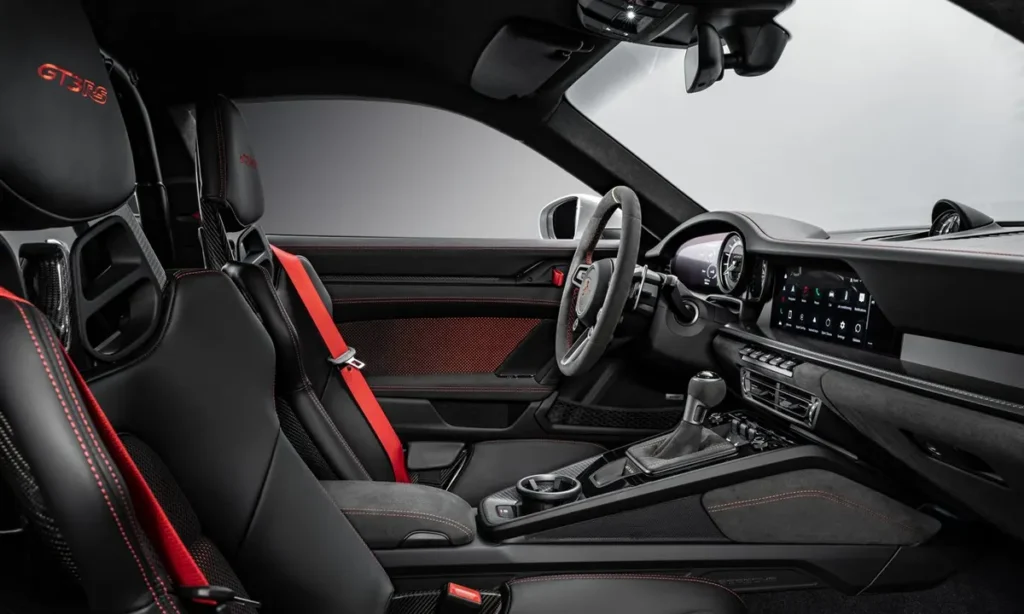
Interior: Purpose Over Pleasure
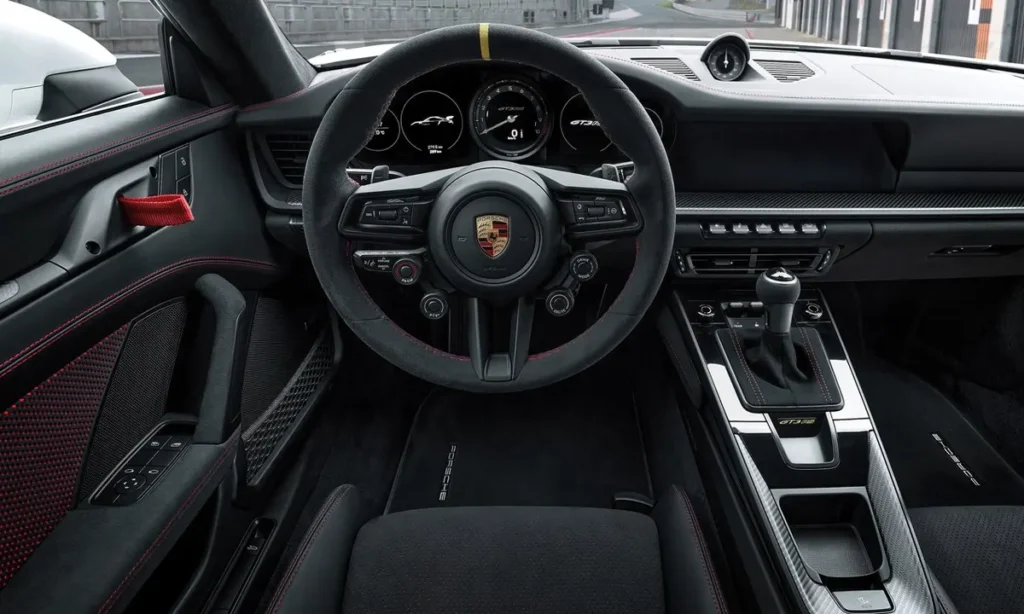
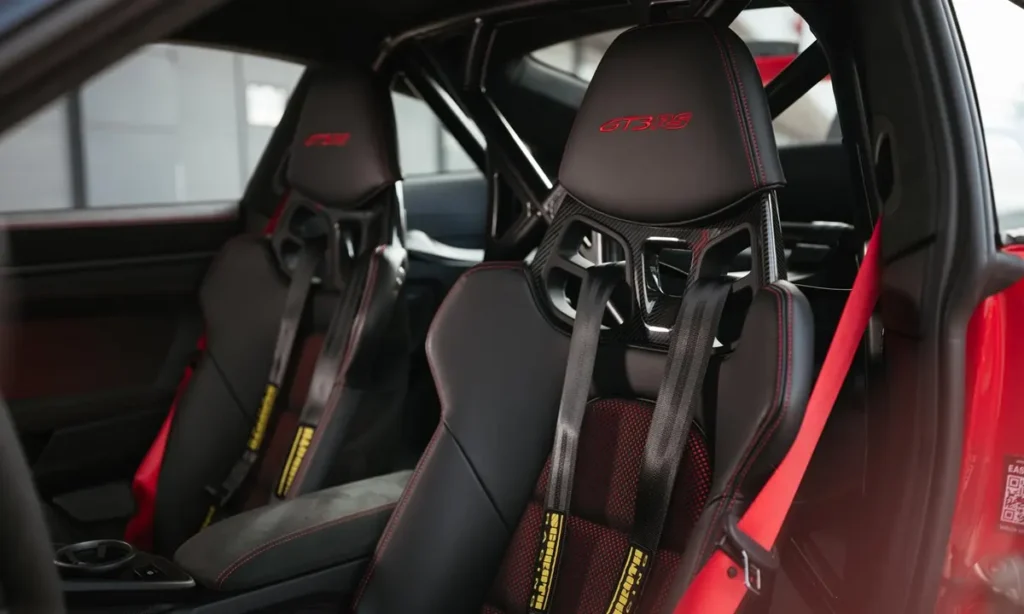
Inside, the GT3 RS is a perfect reflection of its mission — focused, minimalist, and functional.
The cabin trades luxury for motorsport authenticity:
- Carbon-fiber bucket seats come standard, designed to hold you tight during lateral G-forces.
- The dashboard features Alcantara surfaces and lightweight materials throughout.
- The steering wheel includes four rotary dials that allow the driver to adjust traction control, suspension stiffness, and differential settings — all without taking hands off the wheel.
- The Clubsport Package adds a half roll cage, six-point harness, and fire extinguisher — because yes, this car expects to see track days.
Despite its racing roots, the GT3 RS includes Porsche Communication Management (PCM) with Apple CarPlay, Bluetooth, and navigation — proof that performance and practicality can coexist.
Track Performance: The Nürburgring Benchmark
Few cars are as synonymous with Nürburgring dominance as the GT3 RS. Porsche’s engineers use the infamous Nordschleife as their proving ground, and the results are staggering.
Early testing shows the 2025 GT3 RS lapping the 20.8 km circuit in approximately 6 minutes and 50 seconds, placing it among the fastest production cars in the world.
But beyond lap times, it’s the consistency that amazes — the GT3 RS can maintain pace lap after lap without overheating or losing performance. It’s not just built for speed — it’s built for endurance.
Sound: The Symphony of a Dying Breed
Press the ignition button, and the 4.0-liter flat-six barks to life with a mechanical snarl that sends shivers down your spine.
The titanium exhaust system sings a soundtrack unlike any turbocharged or hybrid car could replicate — crisp, metallic, and gloriously organic. At 9,000 rpm, it’s not just noise — it’s art.
In a future filled with silent EVs, the GT3 RS’s wail is the sound of rebellion — a celebration of what driving once was, and still can be.
Pricing and Availability
The 2025 Porsche 911 GT3 RS starts at around $240,000 USD, but most buyers will spend significantly more after customization and options. The Weissach Package, for instance, can push pricing north of $300,000.
Production is limited, ensuring exclusivity. Each car is hand-assembled in Zuffenhausen, with bespoke customization through Porsche Exclusive Manufaktur.
Demand, as always, far exceeds supply. For many, it’s not just a car — it’s an investment and a collector’s dream.
Competitors and Alternatives
The GT3 RS plays in a rarefied segment of ultra-focused track cars, competing with:
- Lamborghini Huracán STO – Wild design and V10 drama, but less precision.
- McLaren 765LT – More power, lighter, but less emotional.
- Ferrari 296 GTB – Electrified and faster, yet not as pure.
- Mercedes-AMG GT Black Series – Fierce rival, but heavier and less tactile.
And yet, the Porsche 911 GT3 RS stands out for one simple reason — it’s the driver’s car. It doesn’t just perform — it connects.
Final Verdict: The Pinnacle of Analog Excellence
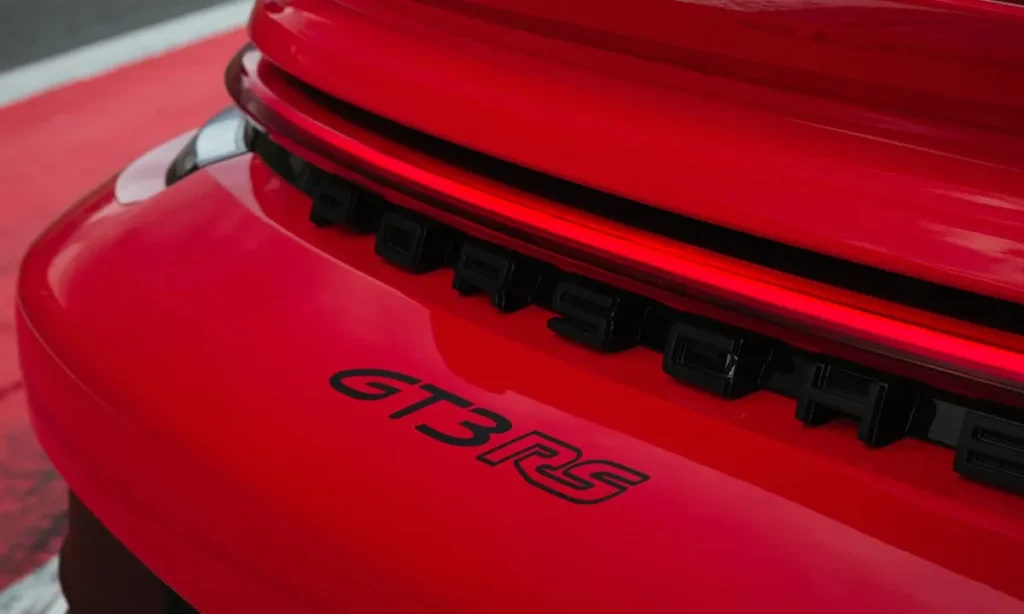
The 2025 Porsche 911 GT3 RS is more than just a performance car — it’s a declaration of faith in mechanical purity. It celebrates the driver, not the computer. It honors feel, not just figures.
Every millimeter of its design, every mechanical component, every lap it completes — all exist to remind us that driving can still be an art form.
In a world of silent EVs and automated systems, the GT3 RS is a masterpiece carved from noise, motion, and emotion.
For those who crave connection — who believe that a steering wheel should talk back, that revs should be earned, and that perfection should be pursued, not simulated — the 2025 Porsche 911 GT3 RS is the ultimate answer.
It doesn’t just carry Porsche’s legacy.
It defines it.
Read: Porsche 911 GT3 Touring “Ocelot”: The Soul of Latin Speed
Frequently Asked Questions (FAQ)
Q1: What engine powers the 2025 Porsche 911 GT3 RS?
A 4.0-liter naturally aspirated flat-six producing 525 PS (518 hp).
Q2: What is the 0–100 km/h time?
Approximately 3.2 seconds.
Q3: Is it manual or automatic?
Only available with a 7-speed PDK dual-clutch transmission.
Q4: What makes it different from the standard GT3?
More power, active aerodynamics, lightweight construction, and enhanced track focus.
Q5: How much does it cost?
Starts around $240,000 USD before options.