Charge While You Drive! Wireless EV Charging Roads – How It Works?
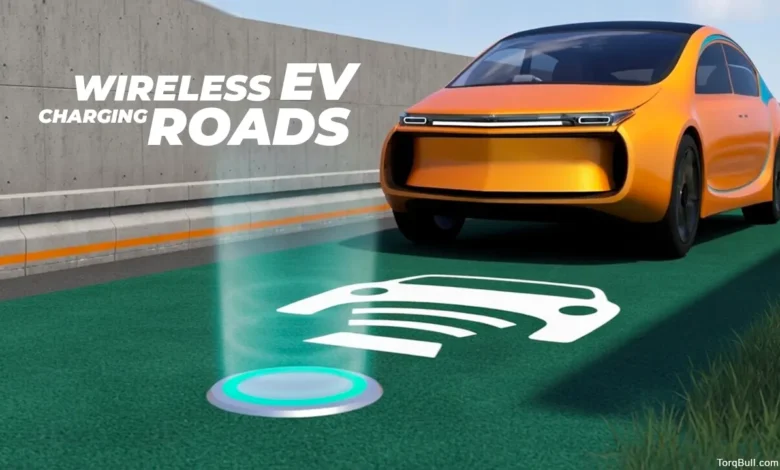
- Wireless charging via road-embedded electromagnetic induction
- Dynamic charging while driving without physical connection
- High infrastructure investment requirements
- Efficiency challenges vs cost justification
- Pilot projects proving real-world feasibility
Wireless EV Charging Roads: The fundamental constraint that has shaped every electric vehicle design decision, every charging infrastructure investment and every range anxiety conversation since the battery-electric vehicle’s modern commercial introduction is the battery’s finite energy capacity — the physical limitation whose management through larger packs, faster charging and more efficient powertrains has produced the current generation’s impressive but still range-limited production vehicles. The assumption embedded in every EV design brief, every charging network business plan and every government infrastructure investment has been that energy replenishment is a stationary activity — that vehicles stop, connect and wait before resuming their journey.
Wireless charging roads challenge this assumption at its foundation — proposing a paradigm whose realisation would transform electric vehicle range from a product specification into an infrastructure question, reducing battery size requirements, vehicle weight and charging stop frequency simultaneously by transferring energy to the vehicle continuously during normal road travel. The technology’s principle is established physics. Its implementation challenges are real engineering problems whose solution requires capital, political will and the technical coordination between vehicle manufacturers, infrastructure operators and power grid managers that no single actor can provide unilaterally. Understanding how wireless charging roads work, where they currently exist and when they might become the transportation infrastructure’s mainstream reality requires separating the established physics from the deployment challenges whose resolution timeline the technology’s advocates and sceptics disagree on most productively.
How Wireless EV Charging Roads Work: The Physics
The operating principle of wireless EV charging roads is electromagnetic induction — the same physical phenomenon that wireless smartphone charging pads, electric toothbrush charging bases and the transformer systems that distribute electrical power across national grids all employ, scaled to the power levels and operating distances that vehicle charging at meaningful rates requires.
The system’s ground-side infrastructure consists of coil arrays embedded within or beneath the road surface — typically installed 50 to 100 millimetres below the asphalt layer whose protective covering shields the electromagnetic components from traffic loading, water ingress and the physical damage that surface exposure would impose. These coils carry alternating current at the specific frequency — typically between 85 and 100 kilohertz in current implementations — whose oscillation generates the alternating magnetic field that extends above the road surface through the pavement layer toward the vehicle above.
The vehicle-side receiver — a pickup coil assembly mounted beneath the vehicle floor at the specific height and alignment position that the road coil’s field geometry requires for maximum coupling efficiency — captures the alternating magnetic field and converts its energy into the electrical current that the onboard charging system conditions into the direct current form that the battery pack requires for storage. The power electronics interface between the receiver coil and the battery management system manages the voltage, current and frequency conversion that bridges the ground-to-vehicle electromagnetic link and the battery’s charging protocol requirements.
The critical efficiency variable in this power transfer chain is the coupling coefficient — whose value depends on the gap distance between the road coil and the vehicle receiver, the lateral alignment between the two coil centres and the coil geometry whose magnetic field distribution determines how effectively the receiver captures the energy that the transmitter generates. At the 100 to 200 millimetre air gap that road installations create between the embedded coil and the vehicle receiver, current technology achieves transfer efficiencies of 85 to 92 percent — comparable to the charging efficiency that physical cable connections deliver and whose energy loss is distributed between the primary coil’s resistive heating, the magnetic field’s partial non-capture by the receiver and the power electronics’ conversion losses throughout the chain.
Dynamic vs Static Wireless Charging: Two Different Technologies
The wireless EV charging landscape encompasses two distinct operating modes whose technical requirements, infrastructure costs and practical benefits differ fundamentally — static wireless charging, which operates when the vehicle is parked over a ground pad, and dynamic wireless charging, which operates while the vehicle moves at road speed.
Static wireless charging — whose commercial deployment is more advanced and whose technical challenges are more thoroughly resolved than the dynamic alternative — provides the cable-free parking lot charging experience that reduces the physical connector interaction that some owners find inconvenient. The BMW, Hyundai and Mercedes-Benz systems already available or in development for stationary wireless charging operate at 3.6 to 11 kilowatts through the home installation’s single pad — sufficient for overnight residential charging but insufficient for the rapid replenishment that destination charging requires to match cable charging’s convenience.
Dynamic wireless charging — the technology that road-embedded coil arrays enable for moving vehicles — represents the more ambitious and more consequential innovation whose deployment requires the infrastructure investment that differentiates it fundamentally from the stationary alternative. The power transfer rates that current dynamic wireless systems achieve vary between 20 and 200 kilowatts depending on the coil design, vehicle speed and the infrastructure deployment’s power supply capacity — with higher power rates requiring shorter individual coil segments, more frequent coil switching and greater infrastructure density whose cost per kilometre rises proportionally with the power transfer ambition.
Real-World Pilot Projects: Where It Already Exists
The wireless EV charging road is not a theoretical concept — it is an operational technology whose pilot deployments across multiple countries have demonstrated both the physics’s practical validity and the engineering challenges whose resolution the commercial-scale deployment requires.
Sweden’s eRoadArlanda project — deployed on a 2-kilometre stretch of public road near Stockholm’s Arlanda airport — operates a dynamic wireless charging system whose embedded rail technology transfers power to equipped trucks at 50 kilowatts while moving. The Israeli company Electreon’s wireless road installations in Tel Aviv, Munich and Michigan’s public road section at the Michigan Department of Transportation’s test facility demonstrate the technology across geographic and regulatory contexts whose diversity validates the core technology beyond the single-country proof of concept.
South Korea’s OLEV — Online Electric Vehicle — system deployed at the Korea Advanced Institute of Science and Technology campus demonstrated 100-kilowatt dynamic wireless charging for campus buses across a 12-kilometre route — providing the most extensive early demonstration of the technology’s public transit application whose sustained operation over multiple years provided the reliability data that subsequent development has built upon.
The United Kingdom’s Highways England project — whose 18-month off-road trial tested dynamic wireless charging at motorway speeds — and Indiana’s public highway wireless charging corridor demonstration represent the English-speaking world’s most significant infrastructure authority commitments to the technology’s evaluation beyond private test facilities.
Read: Hybrid vs Plug-In Hybrid: Everything You Need to Know Before You Buy
Efficiency, Cost and the Deployment Challenge
The wireless charging road’s deployment at scale faces the cost challenge whose magnitude the technology’s physics cannot resolve — an infrastructure investment per kilometre that the current installation cost estimates place between $1 million and $4 million per lane kilometre depending on the power transfer rate, coil density and the road reconstruction that embedding the technology in existing infrastructure requires versus the new construction that greenfield installation enables.
The energy efficiency comparison between dynamic wireless charging and conventional stopped charging — whose 85 to 92 percent transfer efficiency at the coil interface is matched by the system-level efficiency losses in the power supply distribution, the vehicle-side conditioning electronics and the battery charging acceptance — produces overall system efficiencies of 80 to 88 percent that compare favourably with the wired charging equivalent’s 85 to 93 percent system efficiency, whose small advantage diminishes further when the vehicle’s inefficiency during the stop-and-start that conventional charging requires is incorporated into the total energy accounting.
The business model challenge — whose resolution requires identifying the commercial mechanism through which the infrastructure investment’s return is recovered from the vehicle operators whose vehicles benefit from the continuous charging — represents the deployment barrier whose engineering solutions are more straightforward than the economic framework whose construction requires regulatory innovation alongside technical development.
Read: Charge Smarter, Not Longer. EV Charging Time vs Battery Size Explained
Wireless EV Charging Roads — Technology Overview
| Category | Specification / Status |
| Operating Principle | Electromagnetic Induction |
| Coil Frequency | 85–100 kHz |
| Road Coil Depth | 50–100 mm Below Surface |
| Air Gap (Road to Vehicle) | 100–200 mm |
| Transfer Efficiency (Coil) | 85–92% |
| System Efficiency (Overall) | 80–88% |
| Dynamic Power Transfer Range | 20–200 kW (Current Tech) |
| Static Wireless Power | 3.6–11 kW (Home / Destination) |
| Live Deployments | Sweden / South Korea / Israel / USA / UK |
| Infrastructure Cost (Est.) | $1M–$4M per lane km |
| Vehicle Receiver Location | Underfloor Mounted |
| Lateral Alignment Tolerance | ±75–150 mm (System Dependent) |
| Speed Capability | Up to 120 km/h (Tested) |
| Commercial Timeline (Highways) | 2030–2035 (Estimated) |