The End of an Era! 2026 Bugatti W16 Mistral Caroline, The Most Emotional Hypercar Ever Built
A Bespoke Lavender Finish, Hand-Embroidered Floral Motifs, Violet Carbon Weave and a Father's Tribute to His Daughter Make the W16 Mistral Caroline the Most Profoundly Personal and Artistically Beautiful Conclusion to Twenty Years of Bugatti's W16 Legacy
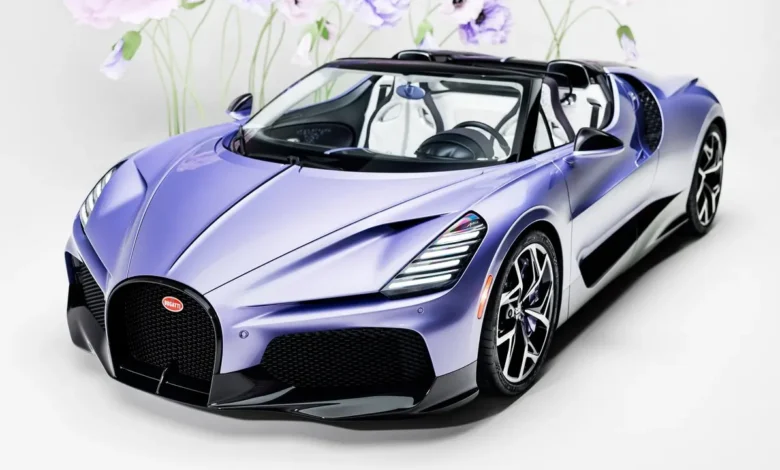
There are cars that close chapters. Then there are cars that close entire eras — machines so perfectly positioned at the intersection of history, emotion and technical ambition that their existence transcends the category of automobile and enters something closer to the realm of cultural artifact. The 2026 Bugatti W16 Mistral Caroline is precisely that kind of car. Unveiled by Bugatti on March 27, 2026, as one of the final Sur Mesure commissions to be completed on the W16 Mistral platform, the Caroline does not merely represent the bespoke customisation of a hypercar. It represents the most emotionally honest, most artistically coherent and most personally meaningful commission ever produced by Bugatti’s Sur Mesure program — a car born not from status anxiety or conspicuous consumption, but from something far simpler, far rarer and far more affecting: a father’s love for his daughter, expressed through one of the greatest performance machines the automotive world will ever produce.
Gallery: 2026 Bugatti W16 Mistral Caroline
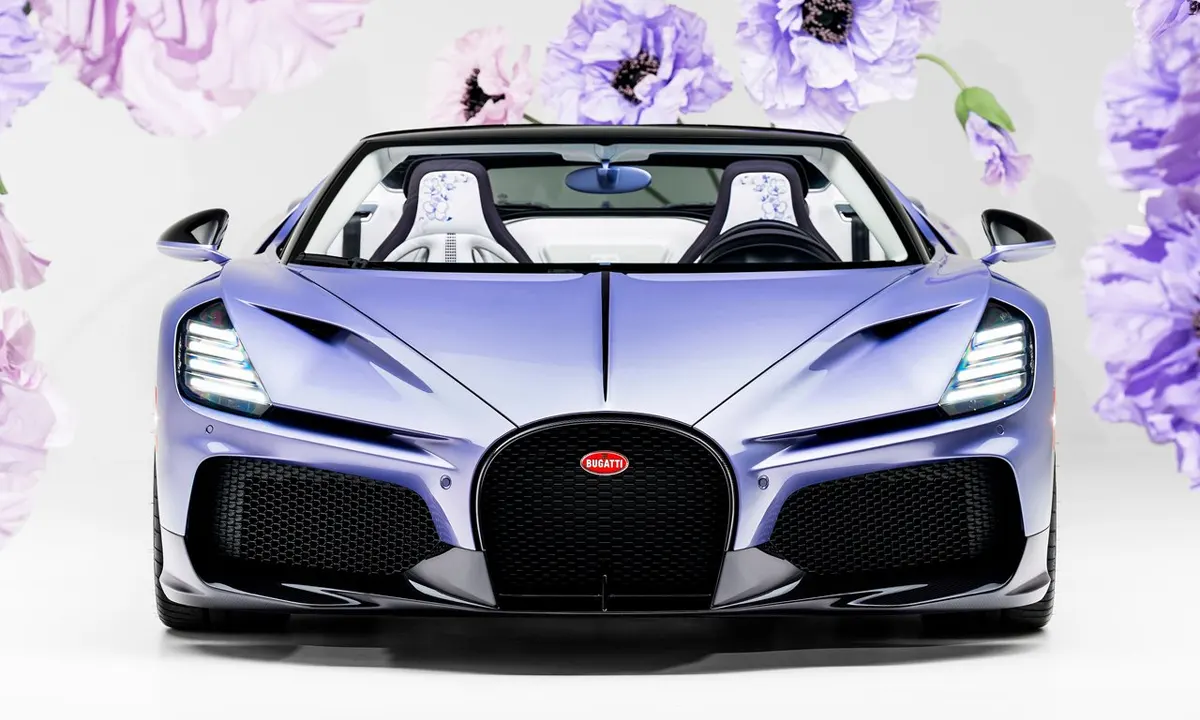
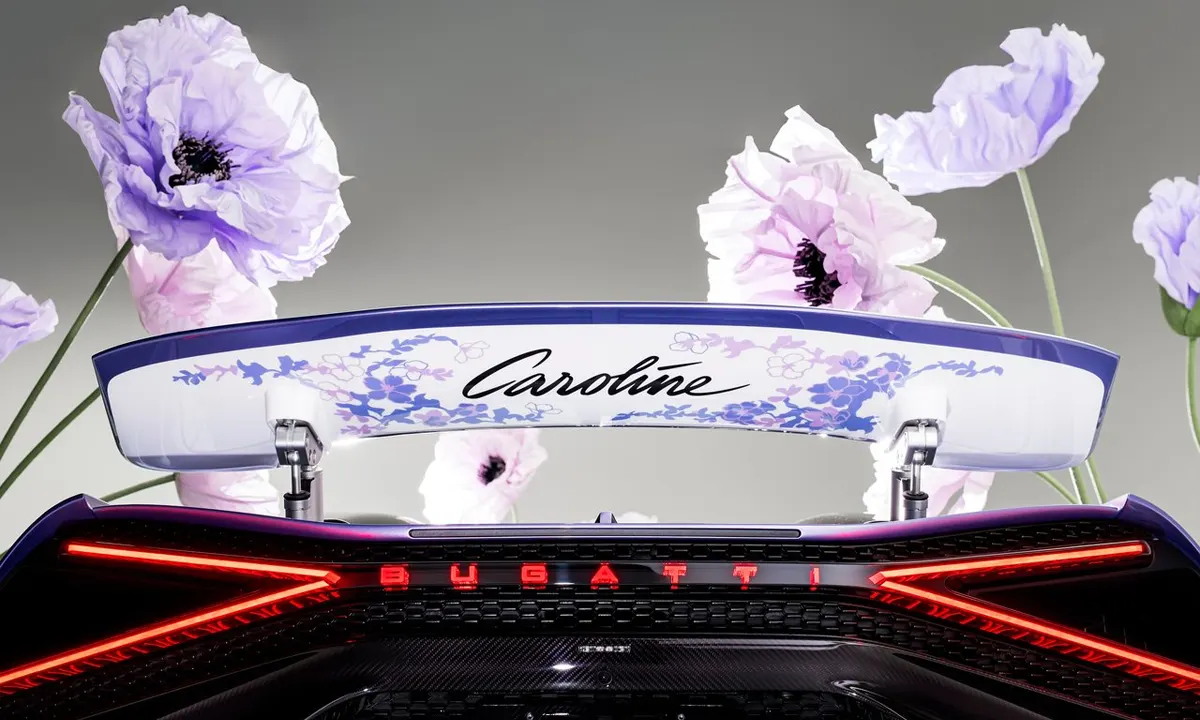
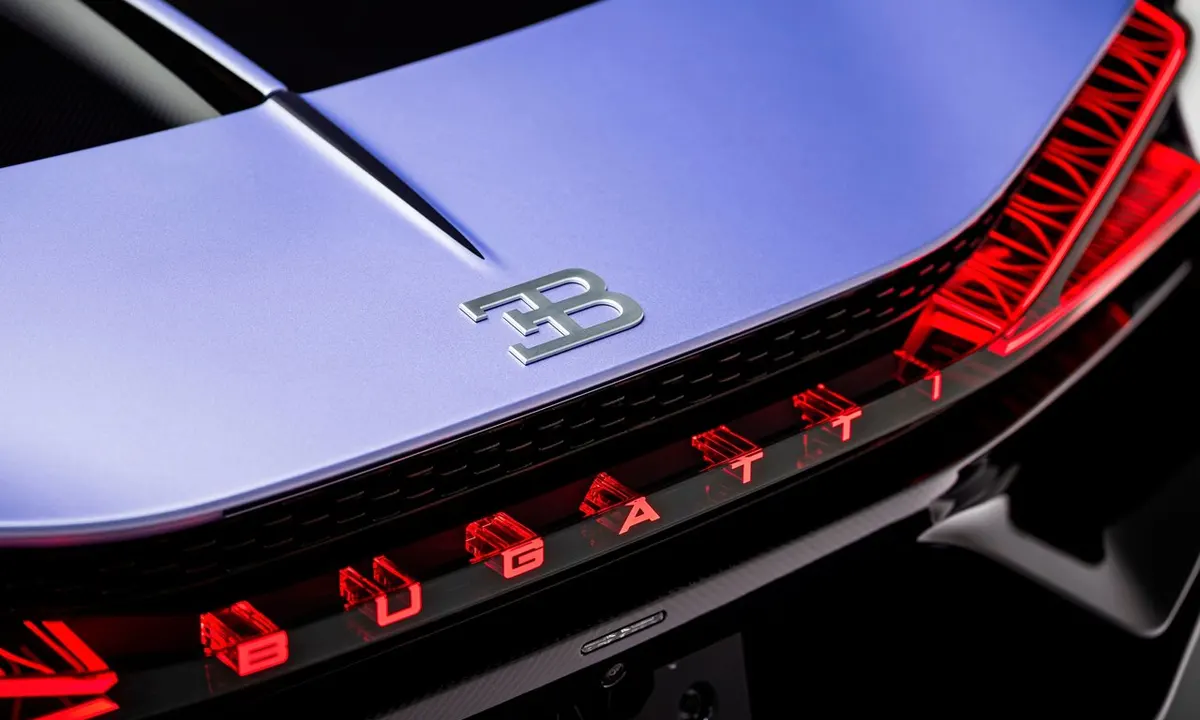
The W16 Mistral itself occupies a position of singular historical significance. It is the final road-going Bugatti to carry the legendary 8.0-litre quad-turbocharged W16 engine — the sixteen-cylinder, four-bank, four-turbocharger masterpiece that Ferdinand Piëch commissioned in the early 2000s when he demanded a production car capable of 253 mph, as easy to drive as a Volkswagen Golf. That engine debuted in the 2005 Veyron, defined the Chiron and all its derivatives, and now makes its final road-going bow in a limited run of exactly 99 roadsters, every single one pre-sold at a price of approximately five million euros before a wheel had turned in anger. That the W16 engine’s final expression in a road car is an open-top roadster is poetic in the truest sense — more than forty percent of all Bugattis ever built have been open-top cars, and Ettore Bugatti himself believed that a great machine should be experienced without barrier between driver and world. The Mistral honours that conviction completely. The Caroline honours something beyond it.
The Brief That Changed Everything: Flowers, Haute Couture and a Daughter Named Caroline
The most extraordinary aspect of the W16 Mistral Caroline is not its lavender paintwork, its hand-embroidered floral door panels or the purple-tinted glass that encases the Dancing Elephant within its gear selector. It is the clarity and sincerity of the brief that produced all of these things. A loyal, long-standing Bugatti customer approached the brand’s Sur Mesure program with a vision that was both beautifully simple and deceptively challenging to execute: he wanted a car inspired by flowers, informed by the world of Haute Couture, and named in honour of his daughter. That was the brief. Everything that followed — the months of colour development, the embroidery patterns, the Violet Carbon weave, the hand-painted rear wing — emerged from that single, emotionally grounded starting point.
Bugatti’s colour and materials team, led by Sabine Consolini and operating across Bugatti’s design ecosystem from Molsheim to Berlin, received this brief and understood immediately that its emotional directness was both its greatest asset and its most significant risk. A flower-themed, lavender-toned hypercar built around a father’s tribute to his daughter could easily have collapsed into something sentimental and overwrought — a machine decorated with visible effort and invisible discipline. The fact that the Caroline avoided that fate entirely, producing instead something of genuine delicacy and controlled artistic conviction, is the measure of Consolini’s team’s creative intelligence and craft mastery.
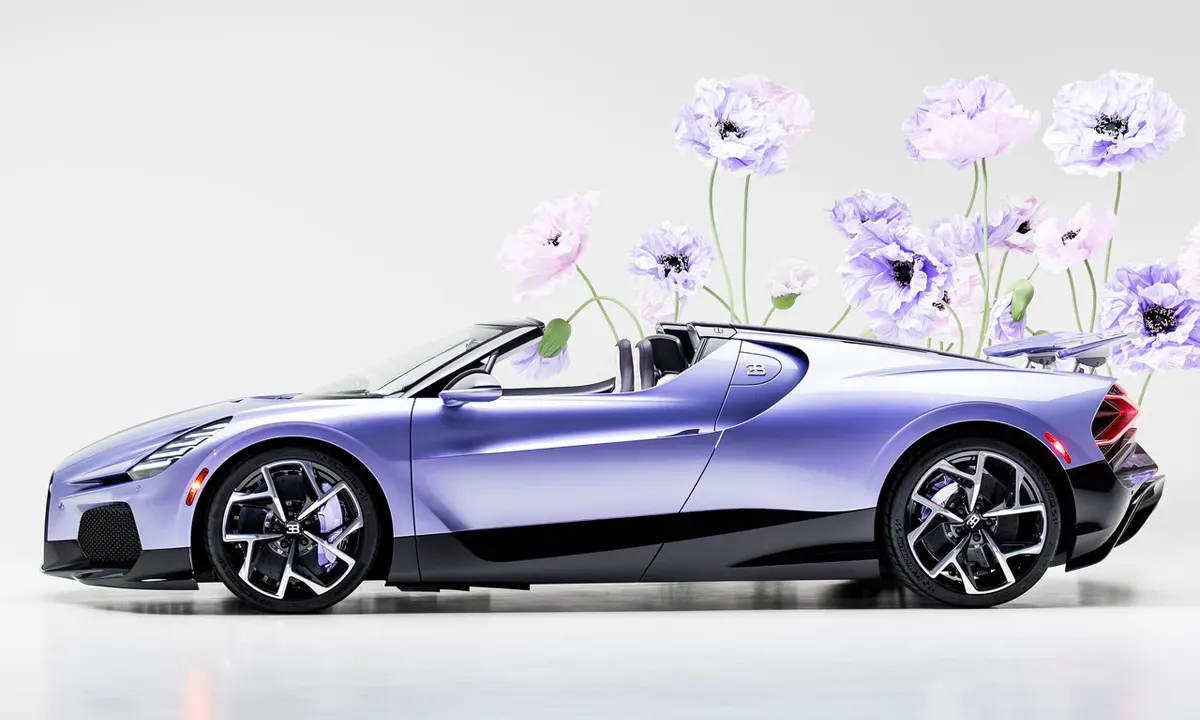
The development process for the exterior paint alone involved the assessment of dozens of floral-inspired tones applied across the Mistral’s deeply sculpted bodywork before the final balance was achieved. The challenge was considerable: the Mistral is not a subtle shape. Its surface drama, its aerodynamically driven compound curves and its aggressive aerodynamic architecture can make understated colours look washed-out or apologetic against the scale of the car’s visual presence. The chosen finish, named simply Lavender, was carefully tuned to shift in natural light between bluish and reddish violet — a chromatic movement that echoes the iridescent quality of flowers in direct sunlight and that adds visual energy to every surface it covers without relying on stripes, contrast packs or the kind of raw carbon exposure that has become the visual shorthand for performance specification rather than genuine artistic decision.
Violet Carbon and a Hand-Painted Wing: Exterior Artistry at Its Peak
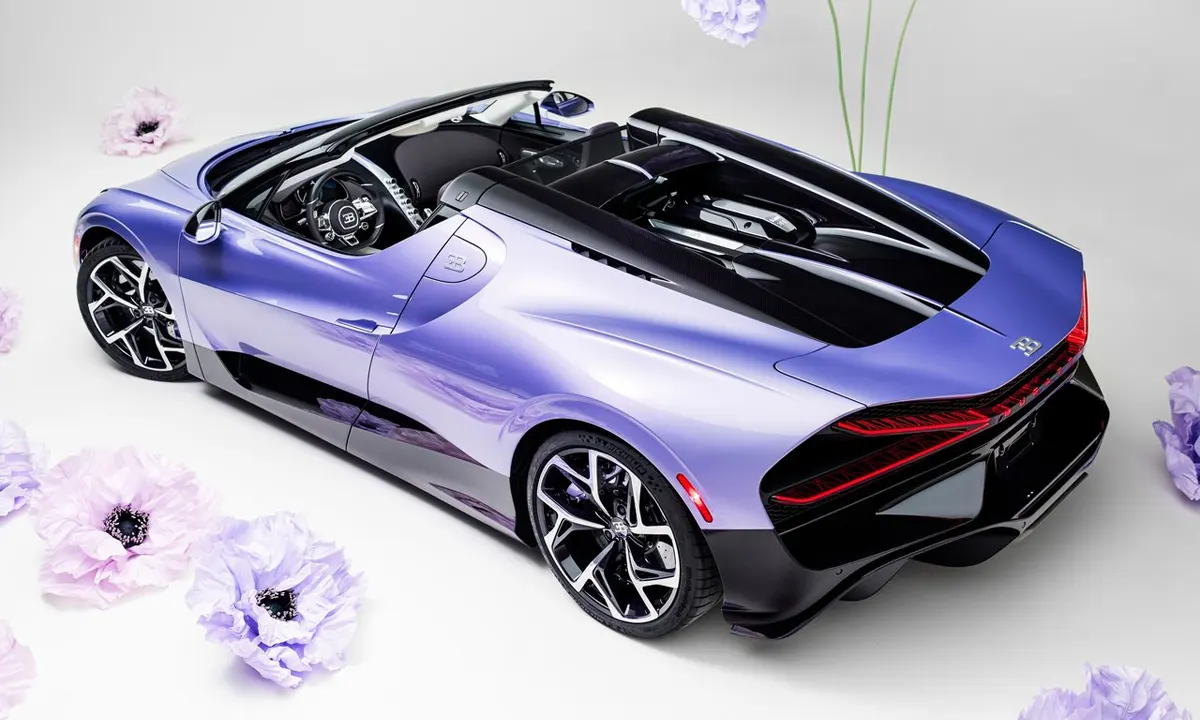
The bespoke Lavender finish that wraps the Caroline’s upper body is grounded and contrasted by a lower body treatment in exposed Violet Carbon — a carbon fibre weave tinted in a complementary violet tone that provides depth, texture and visual weight beneath the paint’s luminous shimmer. The combination of the two surfaces creates a car whose exterior reads differently at different distances and in different light conditions: from across a room, the Lavender dominates and the overall impression is of unusual delicacy for a hypercar. Closer examination reveals the Violet Carbon’s structural complexity and the precise tonal relationship between the two materials — a relationship that required the kind of iterative development process that Bugatti’s colour team is uniquely equipped to conduct.
The most dramatically visible exterior element of the Caroline, however, is found not on the flanks or the bonnet but on the underside of the active rear wing. This surface — invisible during normal driving but revealed fully when the wing raises to act as an air brake at high speed — is finished in white and carries hand-painted floral motifs alongside the name of the owner’s daughter: Caroline. The decision to place this most intimate and personal element of the car’s identity in a location that is hidden during everyday use and revealed only under the most extreme dynamic circumstances has a poetry to it that is entirely appropriate. It is a detail that belongs to the car and its owner rather than to the audience, visible to the world only when the car is working hardest — when the W16 is at full cry and the wing is deployed against 282 mph of open-air velocity.
The W16 Engine: Twenty Years of History in One Final Act
The mechanical foundation beneath all of the Caroline’s artistic achievement is, of course, the quad-turbocharged 8.0-litre W16 engine in its most powerful road-going specification — 1,578 horsepower and 1,180 lb-ft of torque, tuned to the same level as the Chiron Super Sport. The performance figures that this engine produces in the Mistral are among the most extreme in the history of road-legal automobiles. From rest, the Mistral reaches 62 mph in 2.4 seconds and 124 mph in 5.6 seconds. The electronically governed top speed stands at 261 mph for standard customer cars — a figure already beyond the reach of virtually every other production vehicle in history. The World Record Car, a unique Mistral built specifically for a top speed attempt and costing its owner fourteen million euros, was driven to 282.04 mph at the Papenburg test track in northern Germany in November 2024 by long-time Bugatti test driver and Le Mans winner Andy Wallace, establishing the Mistral as the fastest roofless road car in the history of the automobile.
The W16 engine’s acoustic character — long a subject of debate among hypercar enthusiasts who questioned whether sixteen cylinders and four turbochargers could produce the emotional involvement of a naturally aspirated Ferrari or Lamborghini V12 — is transformed in the Mistral by the simple, radical act of removing the roof. The dual ram-air induction scoops mounted behind the cockpit channel intake air with an efficiency that fills the cabin with a layered, complex soundtrack that Autocar’s reviewer memorably described as at least six distinctly different sounds, selectable almost at will through throttle position and engine speed. At low revs there is an offbeat induction gurgle; higher in the rev range, the four turbochargers’ wastegates and bypass valves provide whooshes and whistles of genuinely comic character; and when all four turbochargers are operating simultaneously above 3,000 rpm, the full ensemble of the W16 produces an acoustic event that is utterly unlike any other engine in the world and that, in the open-air Mistral, arrives at the driver’s ears with an immediacy and richness that the Chiron’s closed body could never provide. The W16 engine’s final road-going act is its greatest theatrical performance.
The Interior: Where Embroidery Becomes Architecture
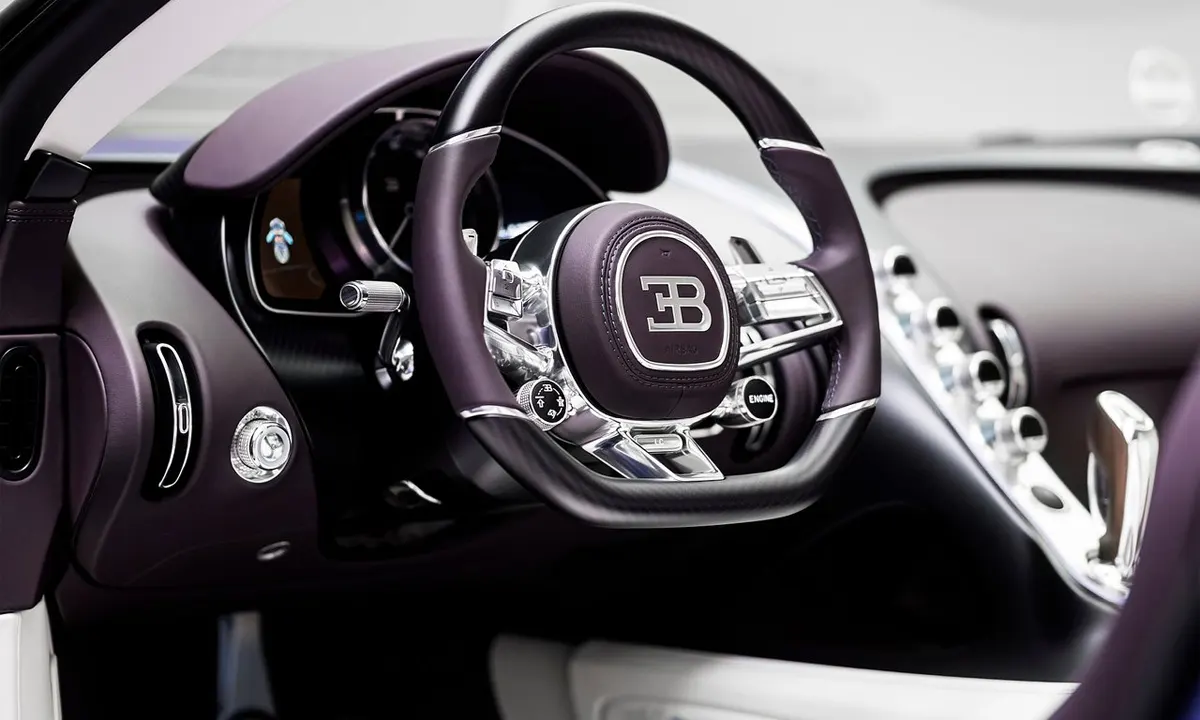
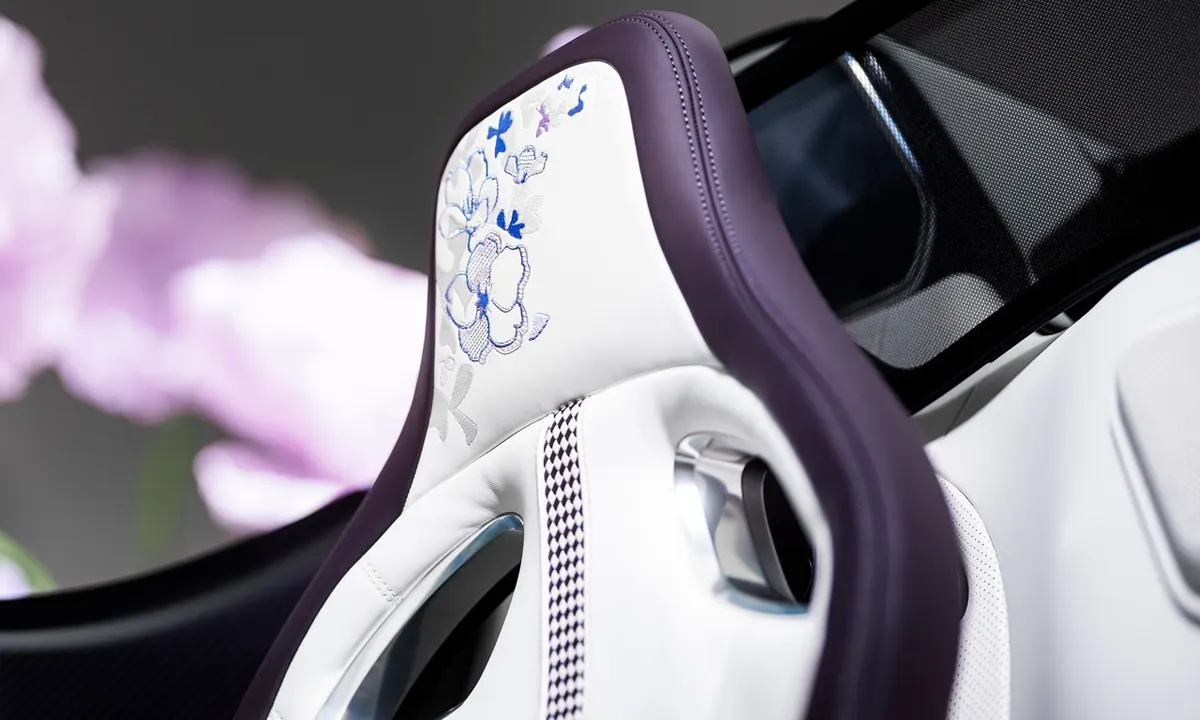
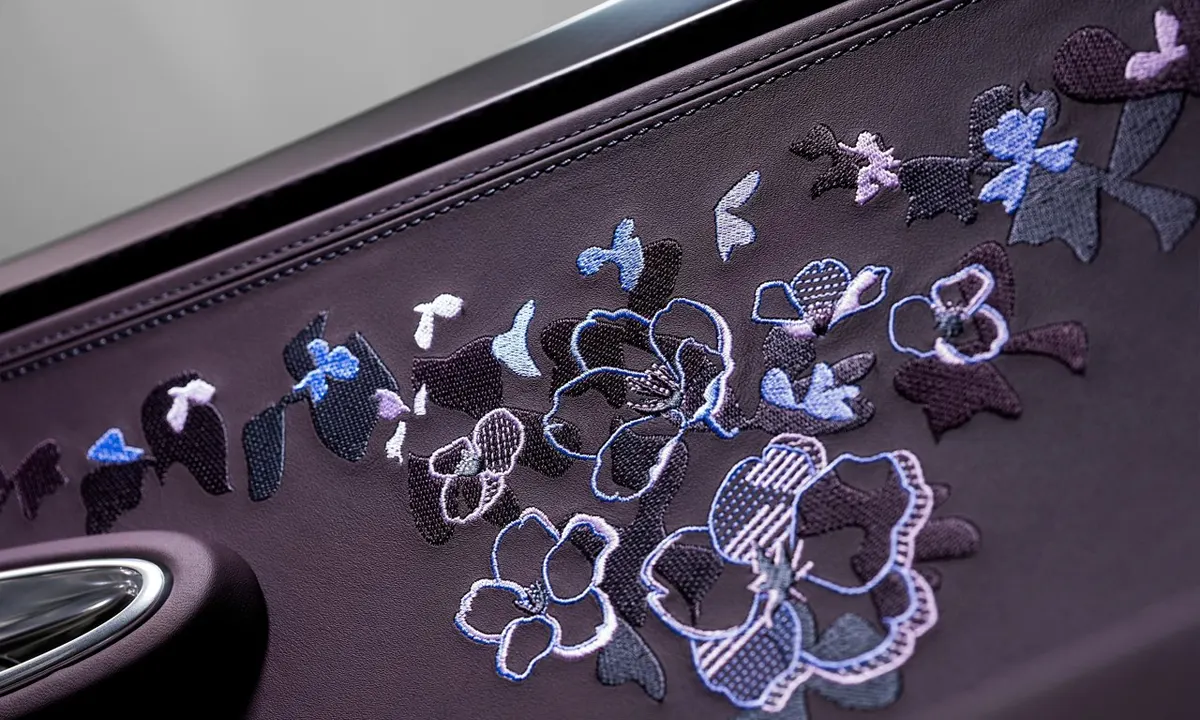
If the Caroline’s exterior achieves something unusual in the hypercar world — genuine delicacy in the service of genuine beauty — the interior achieves something rarer still: a coherent, immersive artistic environment where every individual element contributes to a single, unified visual narrative. The leather upholstery employs a two-tone treatment of white and dark purple hides, with the contrast between the two tones providing the same kind of energetic visual tension that the Lavender and Violet Carbon create on the exterior. The floral theme that defines the car’s identity is expressed throughout the cabin through hand-embroidered motifs developed specifically for this commission: flowers are stitched into the headrests, knee pads and door panels, each in complementary blues and purples that maintain the chromatic coherence of the overall palette.
The door panel embroidery deserves specific attention for the sophistication of its design. Rather than applying a static, symmetrical floral pattern — the obvious choice and the approach that would have produced something competent but generic — Bugatti’s interior artisans created a design that suggests movement and energy, with petals appearing to drift and flow across the panel surface as though carried by a breeze. The reference to movement within what is necessarily a static embroidery is an act of genuine craft intelligence, requiring the embroiderer to compose the pattern with an understanding of how the eye will read the spatial relationships between individual petal elements and interpret them as directional motion rather than decorative arrangement.
At the geometric centre of the cabin, the gear selector houses Rembrandt Bugatti’s iconic Dancing Elephant — the sculpture created by Ettore Bugatti’s younger brother, an artist of considerable reputation whose animal sculptures were celebrated in their own right — encased in glass tinted to exist in harmony with the surrounding violet palette. Rembrandt Bugatti’s Dancing Elephant appears in various forms across Bugatti’s heritage, and its presence in the Caroline’s gear selector is both an act of brand continuity and a genuine artistic decision: the violet tint of the glass transforms a familiar heritage element into something specifically of this car, unifying past and present in a single physical object at the most frequently touched point in the cabin.
Sur Mesure and the Philosophy of the Personal Commission
The W16 Mistral Caroline is, in the formal language of Bugatti’s commercial operations, a Sur Mesure commission — a vehicle personalised through the brand’s bespoke individualisation program that has produced some of the most extraordinary single examples of automotive artistry in recent history, including the La Perle Rare with its gold-and-white two-tone bodywork and white-painted interior carbon, the Brouillard closed coupé developed as the inaugural Programme Solitaire creation, and the F.K.P. Hommage that paid tribute to Ferdinand Piëch through a body redesigned to echo the original Veyron. Each of these commissions is remarkable in its execution. The Caroline is remarkable for a different reason — for the emotional clarity of its premise.
Bugatti’s Managing Director Hendrik Malinowski described the Caroline commission as defined by trust, collaboration and a shared pursuit of perfection. That description is accurate but incomplete. What the Caroline adds to the Sur Mesure canon is a demonstration that Bugatti’s program functions at its highest level not when clients arrive with lists of expensive preferences, but when they arrive with a feeling — when the brief has an emotional core that the design team can interpret, translate and amplify through their craft. A flower-themed tribute to a daughter named Caroline, executed on the last W16 roadster Bugatti will ever build, in the final months of production of the most significant engine in the brand’s modern history, is a brief of extraordinary richness. The team in Molsheim and Berlin has honoured it completely.
The Last of Its Kind: Why the Caroline Matters Beyond Its Commission
The 2026 Bugatti W16 Mistral Caroline matters beyond the boundaries of its own commission for a reason that becomes clear when the broader context of its existence is considered. The W16 engine that powers it has no successor in Bugatti’s immediate product roadmap. The Tourbillon — Bugatti’s next hypercar, developed under Mate Rimac’s leadership — employs a naturally aspirated V16 engine with hybrid assistance rather than the quad-turbocharged W16 architecture. The era of the W16 Bugatti, which began with the Veyron’s 2005 debut and produced one of the most extraordinary continuous chapters in the history of performance car engineering, ends with the last Mistral leaving Molsheim. The Caroline, as one of the final Sur Mesure commissions completed on that platform, carries that historical weight alongside its personal one.
It is a car that proves, in the most concrete possible way, that hypercar culture at its most elevated is not purely about maximum horsepower, minimum lap times or competitive specification. It is about the possibility — rare, precious and worth celebrating whenever it occurs — that an automobile can carry genuine human meaning. That a father can commission a car as a tribute to his daughter and that the result can be as technically accomplished, as artistically resolved and as emotionally honest as the W16 Mistral Caroline, is proof that the finest traditions of Bugatti’s founding philosophy remain fully alive at the end of the W16 era. Ettore Bugatti gave birth to his cars rather than merely designing them. The Caroline was commissioned, in a sense, with the same spirit.
Read: 10 Things the 2027 Maybach S-Class Does Better Than Any Competitor Right Now
2026 Bugatti W16 Mistral Caroline — Specifications and Details Chart
| Category | Specification |
| Commission Name | W16 Mistral Caroline |
| Program | Bugatti Sur Mesure — One-of-One |
| Unveiled | March 27, 2026 — Molsheim, France |
| Engine | 8.0-Litre Quad-Turbocharged W16 |
| Configuration | Four Banks of Four Cylinders — Mid-Mounted |
| Horsepower | 1,578 hp (1,600 PS) |
| Torque | 1,180 lb-ft (1,600 Nm) |
| Transmission | 7-Speed Dual-Clutch |
| Drivetrain | All-Wheel Drive |
| 0–62 mph | 2.4 seconds |
| 0–124 mph | 5.6 seconds |
| 0–186 mph | 12.1 seconds |
| Top Speed (Customer Cars) | 261 mph (420 km/h) — Electronically Limited |
| World Record Top Speed | 282.04 mph (453.9 km/h) — Papenburg, November 2024 |
| World Record Car Driver | Andy Wallace — Le Mans Winner |
| World Record Car Cost | ~€14 Million |
| Body Structure | Carbon Fibre Monocoque — Bespoke (No Shared Panels with Chiron) |
| Kerb Weight | 2,040 kg |
| Power-to-Weight Ratio | 774 hp per tonne |
| Body Style | Open-Top Roadster |
| Exterior Paint | Bespoke Lavender — Shifts Between Bluish and Reddish Violet |
| Lower Body Treatment | Exposed Violet Carbon Weave |
| Rear Wing Underside | White Finish with Hand-Painted Floral Motifs and Name Caroline |
| Interior Leather | Two-Tone White and Dark Purple Hides |
| Interior Embroidery | Hand-Stitched Floral Motifs — Headrests, Knee Pads, Door Panels |
| Door Panel Detail | Petals Appearing to Drift — Suggests Movement |
| Embroidery Colours | Complementary Blues and Purples |
| Gear Selector | Rembrandt Bugatti Dancing Elephant — Violet-Tinted Glass |
| Design Lead | Sabine Consolini — Bugatti Colour and Materials Team |
| Commission Inspiration | Flowers, Haute Couture, Tribute to Owner’s Daughter |
| Sur Mesure Managing Director | Hendrik Malinowski |
| Engine Legacy | Introduced in 2005 Veyron — Final Road-Going Application |
| Total Mistral Production | 99 Units — All Pre-Sold at ~€5 Million Each |
| Standard Mistral Base Price | ~€5 Million / ~$5 Million |
| Successor Engine | Tourbillon — Naturally Aspirated V16 with Hybrid Assistance |
| Assembly | Molsheim, Alsace, France |