Fastest Charging Electric Cars in the USA 2026. Which EVs Get You Back on the Road Quickest
From Lucid's 900-Volt Architecture That Recovers 200 Miles in 12 Minutes to the Hyundai and Kia 800-Volt Platform That Has Redefined What Affordable Fast Charging Means — The Race to Eliminate Range Anxiety Has Produced a Generation of Electric Vehicles Whose Charging Performance Demands an Entirely New Vocabulary, and a Buyer's Framework More Rigorous Than Any Single Headline Specification Can Provide
There is a number that every electric vehicle advertisement in 2026 wants you to remember — the peak kilowatt rating, the maximum charging speed stamped on the window sticker and repeated in every product launch presentation — and there is a number that actually determines whether your road trip stops are measured in minutes or in the kind of soul-eroding hours that have historically defined EV ownership for drivers who stray beyond their home charging range. These two numbers are not the same, and the gap between them is where the most important buying decision in the modern EV market is made. The fastest charging electric cars available in the United States in 2026 are not simply the ones with the largest peak kilowatt specification. They are the ones whose battery architecture, thermal management systems, charging curve behaviour and real-world sustained power delivery combine to return the most driving range in the least amount of time — a distinction whose technical depth, and whose practical consequences for every American driver considering an EV purchase, this guide is built to illuminate completely.
Why Peak Kilowatts Alone Tell You Almost Nothing
Before examining the vehicles themselves, the evaluative framework that separates meaningful charging speed data from marketing rhetoric demands explicit attention, because no comparison of fast-charging EVs is honest or useful without it. Every manufacturer in the current market quotes a peak charging speed in kilowatts — a figure representing the maximum instantaneous power the vehicle’s battery management system can accept from a sufficiently powerful DC fast charger under precisely optimal conditions of temperature, state of charge and charger hardware capability. This figure is real, verifiable and almost entirely irrelevant as a standalone purchase criterion.
The reason is the charging curve — the arc of charging power across a complete fast-charging session that no manufacturer is required to publish and that every buyer should demand to understand. EV batteries charge fastest when they are in the lower portion of their state-of-charge range and when their cell temperatures are within the narrow thermal window that battery management software permits sustained high-power input. Most EVs reach their advertised peak kilowatt figure only briefly, at the beginning of a charging session when the battery is cold-depleted, before the management system begins reducing input power to protect cell longevity and prevent thermal damage. A vehicle that advertises 350 kW peak charging but tapers to 120 kW by the time the battery reaches 50% state of charge may charge considerably more slowly overall than a vehicle rated at 270 kW that maintains sustained power delivery across the entire 10% to 80% window.
The industry standard benchmark that separates serious charging performance analysis from headline chasing is the 10% to 80% fast-charging time — the duration required to take a battery from near-depleted to road-trip-ready under representative conditions, using a DC fast charger of sufficient power to not constrain the vehicle’s own acceptance rate. Any EV capable of completing this cycle in under 20 minutes at a 350 kW station is delivering genuinely impressive charging performance in 2026. Vehicles that sustain over 200 kW of actual delivered power across the majority of that session are the ones whose charging engineering is worthy of the specifications they advertise.
The 800-Volt Platform That Changed Everything: Hyundai, Kia and Genesis
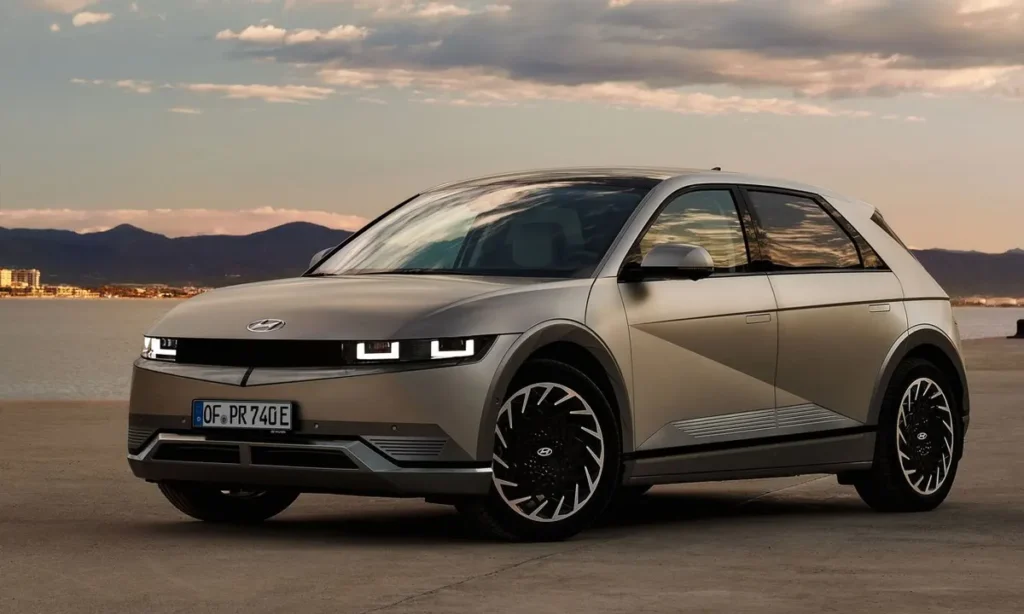
The most consequential development in mainstream EV fast-charging technology over the past three years has not come from the luxury segment or from a manufacturer whose vehicles cost six figures. It has come from Hyundai Motor Group’s E-GMP platform — the 800-volt electrical architecture that underpins the Hyundai Ioniq 5, Hyundai Ioniq 6, Kia EV6, Kia EV9 and Genesis GV60, and that delivers fast-charging performance at attainable price points whose combination of speed and accessibility has permanently shifted buyer expectations for what a mainstream electric vehicle should be capable of at a highway charging stop.
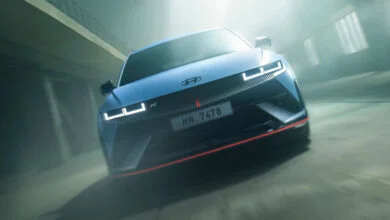
The Hyundai Ioniq 6 is the platform’s fast-charging showcase. Its aerodynamically optimised body, with a drag coefficient that extracts more driving range from every kilowatt than almost any rival in its segment, combines with the E-GMP’s 800-volt architecture to deliver a 10% to 80% fast-charging time of approximately 18 minutes under ideal conditions — a figure that places it among the fastest-charging production sedans available to American buyers at any price. The platform’s peak charging acceptance of approximately 235 kW, while lower than the headline figures of some luxury rivals, is sustained across a broader portion of the charging session, making real-world charging stops consistently quicker than the raw peak number might suggest. Independent testing confirms the Ioniq 6 adds 100 miles of range in approximately 7 minutes and 26 seconds — a real-world benchmark that rivals charging performance from vehicles costing twice as much.
The Hyundai Ioniq 5 shares the same platform and the same 18-minute 10% to 80% benchmark, packaged in a crossover body that adds a further dimension of practicality to the fast-charging credentials. Hyundai’s own specification notes the Ioniq 5 can recover 69 miles of range in five minutes from a compatible 350 kW station — not a figure achievable on every charging stop, but one that illustrates the headroom in the platform’s engineering when conditions align. The Kia EV6, sharing E-GMP architecture and offering a 10% to 80% charge in 18 minutes with its 84 kWh battery pack, adds sports-car-influenced dynamics to the charging credentials of the platform. The Kia EV9, the group’s three-row family SUV, completes the 10% to 80% cycle in under 25 minutes despite its substantially larger 99.8 kWh battery — a consequence of the platform’s architecture that allows the larger pack to accept charging power at rates that compensate partially for the additional energy it must receive. The Genesis GV60, the premium expression of the same platform, adds battery preconditioning that allows it to reach optimal charging temperatures before arriving at a station, reducing the warm-up penalty that cold or untreated batteries impose.
Lucid Air: The Fastest-Charging EV Available in America
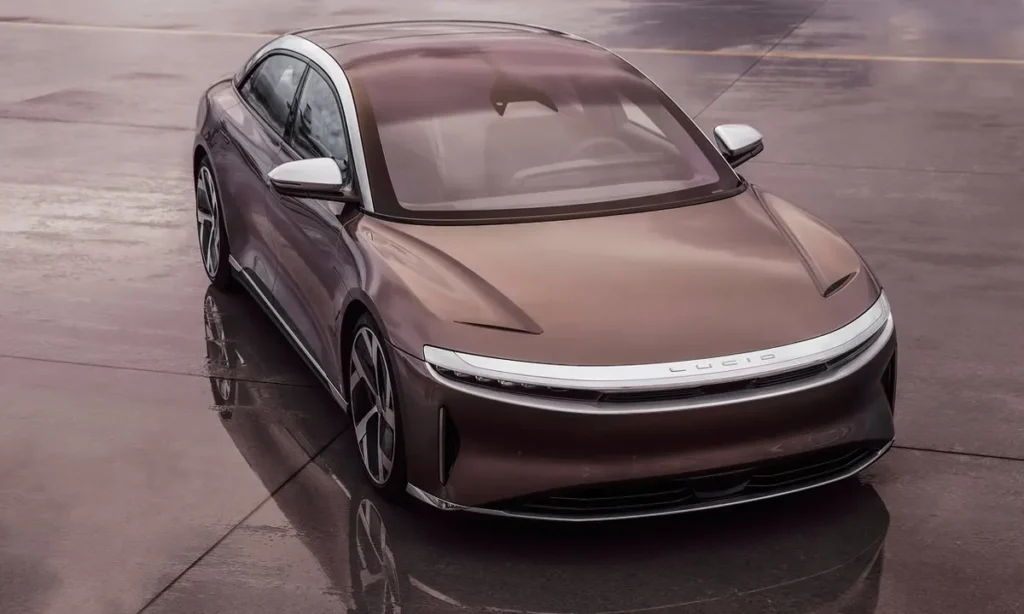
The Lucid Air occupies a category of its own in the American fast-charging landscape — not because it is the most practical vehicle for most buyers, but because its 900-volt electrical architecture delivers fast-charging performance that no other production electric vehicle sold in the United States in 2026 can match. The Air’s proprietary Wunderbox charging technology enables it to accept over 300 kW of DC charging power, with its Grand Touring and Sapphire variants achieving 10% to 80% in approximately 22 minutes — a figure that, given the Air’s EPA-rated range of up to 516 miles, translates to a miles-recovered-per-minute figure that is the highest of any EV currently available in the American market. The manufacturer states that 12 minutes of DC fast charging recovers 200 miles of range under optimal conditions. Even accounting for real-world variability, the Air’s charging performance per minute of session time remains class-defining.
The Lucid Gravity SUV, introduced as the brand’s family-oriented complement to the Air, brings the same high-voltage architecture into a seven-seat format with an EPA range of approximately 450 miles and charging performance that can recover 200 miles in under 12 minutes, sharing the Air’s fundamental charging engineering in a body configuration that serves a far broader population of American buyers. The tradeoff, in both cases, is price — the Air’s starting point above $71,000 and the Gravity’s positioning above $80,000 place these vehicles beyond the reach of most mainstream buyers while delivering charging performance that functions as the benchmark against which every other EV in the market is measured.
Porsche Taycan and Audi e-tron GT: The European 800-Volt Standard-Setters
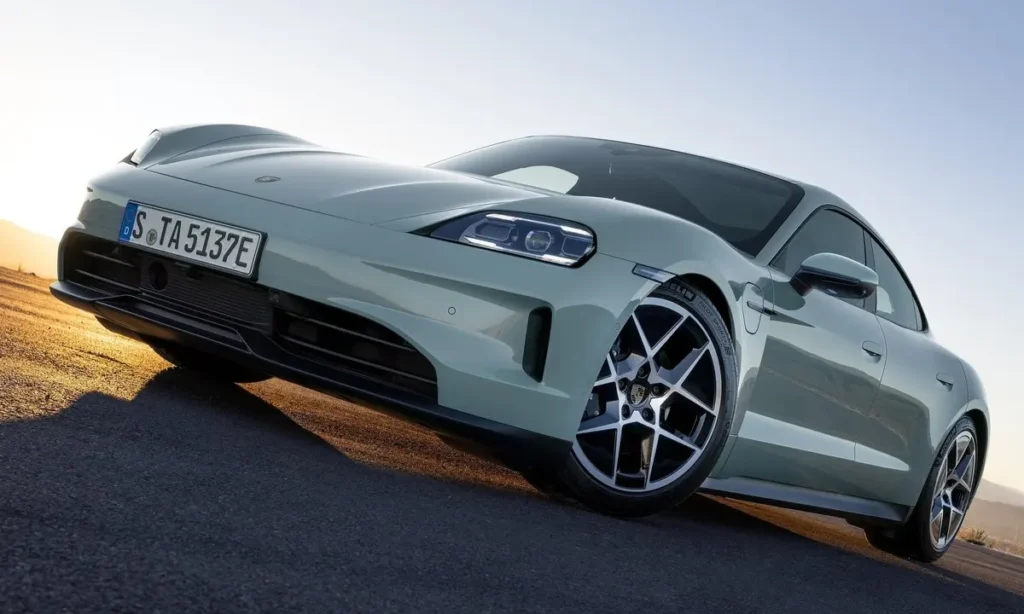
The Porsche Taycan has occupied the upper tier of real-world fast-charging performance rankings since its introduction, and its 2026 specification maintains that position through engineering choices that prioritise not peak power but sustained delivery — the quality that separates a vehicle capable of brief charging spikes from one that maintains high-power input across the entire charging session in a manner that genuinely minimises time at the charger. The Taycan’s 800-volt architecture, with a peak charging acceptance of 320 kW and a 10% to 80% time of approximately 18 minutes, performs particularly well in independent repeat-session testing — a consequence of the exceptional thermal management engineering that allows the Taycan to sustain near-peak power delivery across back-to-back charging stops without the significant derating that affects vehicles whose thermal systems are less comprehensively developed. Porsche notes the Taycan can recover approximately 170 miles of range in 10 minutes at an 800-volt DC fast charger.
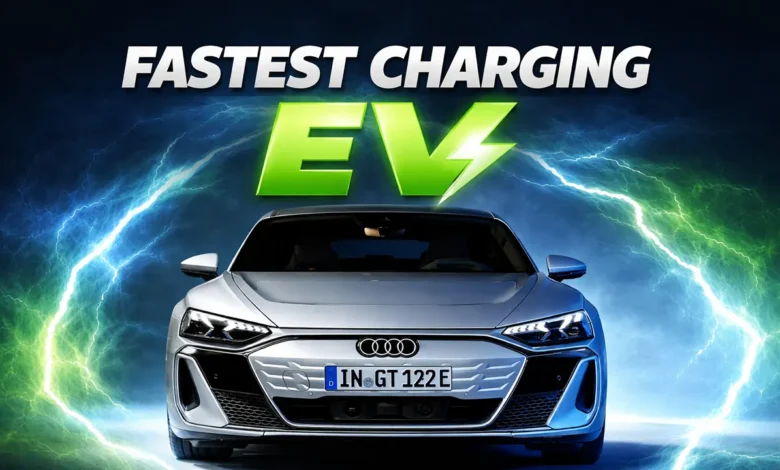
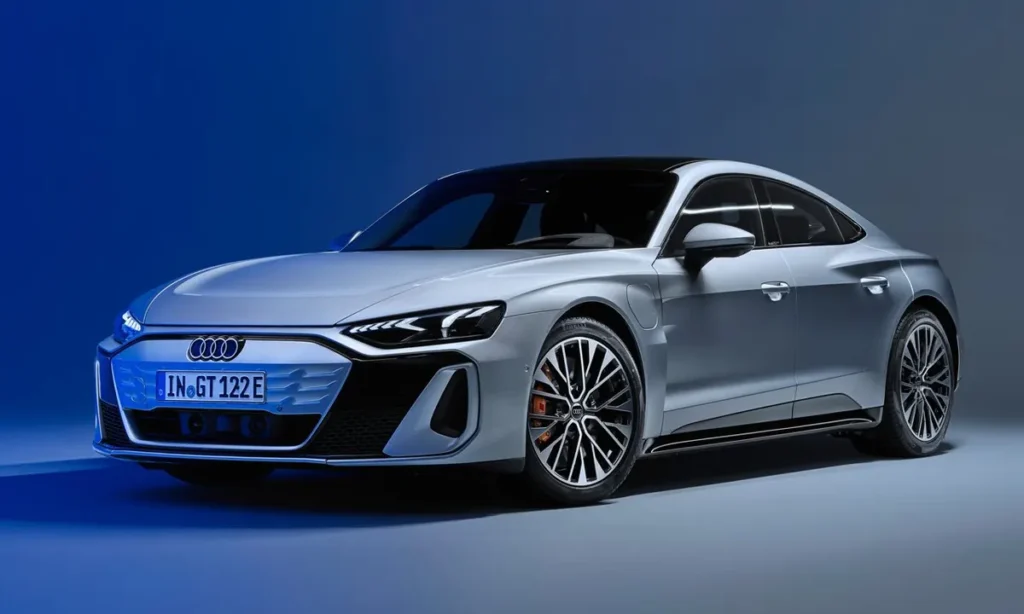
The Audi e-tron GT, sharing the Porsche’s J1 platform and 800-volt architecture, delivers closely comparable real-world charging performance — 10% to 80% in approximately 23 minutes — in a body whose four-door gran turismo proportions prioritise long-distance usability as deliberately as the charging engineering that makes those long distances practical. The Audi Q6 e-tron, built on the newer PPE platform jointly developed with Porsche, pushes peak charging acceptance to 270 kW and achieves the 10% to 80% benchmark in approximately 21 minutes — making it the most accessible entry point into Volkswagen Group’s 800-volt fast-charging ecosystem for buyers whose budgets do not extend to Porsche or Audi GT territory.
Tesla: The Supercharger Network Advantage That Numbers Alone Cannot Capture
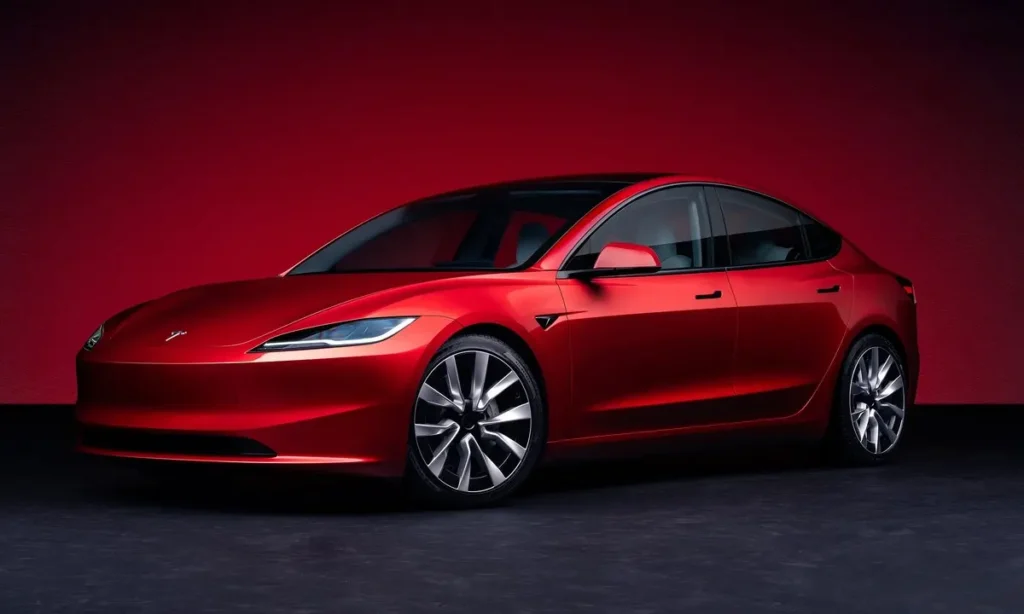
Any honest ranking of the fastest-charging electric vehicles available in America in 2026 must engage with a dimension of Tesla’s charging advantage that kilowatt specifications systematically underrepresent — the Supercharger network itself, whose density, reliability and software integration with Tesla vehicles delivers a fast-charging experience whose real-world consistency exceeds what the hardware specifications of any individual charger or vehicle suggest when considered in isolation. The Tesla Model 3 accepts up to 250 kW of DC charging power and recovers approximately 200 miles of range in 15 minutes under optimal conditions. The Model S, with the same 250 kW peak acceptance and a longer EPA range, can go from 0% to 100% in under 30 minutes at a V3 Supercharger. The Model Y, as the best-selling EV in the United States, achieves approximately 10.8 miles per minute of charging under ideal conditions.
These figures place Tesla’s vehicles in the second tier of raw fast-charging performance relative to the Hyundai Motor Group platform, the Lucid Air and the Porsche Taycan — but the calculation changes materially when charging network reliability and charger availability are weighted alongside vehicle charging acceptance rates. A 350 kW Hyundai Ioniq 6 that arrives at an occupied or malfunctioning third-party charger charges more slowly, in practical terms, than a 250 kW Model 3 that consistently finds available, functioning hardware at one of Tesla’s thousands of Supercharger locations across the American highway network. The 2026 Kia EV9’s new North American Charging Standard port, which now grants access to the Tesla Supercharger network, represents a meaningful expansion of charging reliability for the Korean platform — a development that partially closes the network advantage gap without requiring Tesla’s buyers to sacrifice any of their existing infrastructure access.
Battery Preconditioning: The Feature That Separates Advertised Speed from Achieved Speed
The single most impactful feature separating the fastest-charging EVs from capable-but-slower rivals is one that does not appear on any window sticker specification sheet and that most buyers are entirely unaware of before their first long-distance drive: battery preconditioning. The fastest-charging EVs — the Hyundai and Kia E-GMP vehicles, the Porsche Taycan, the Lucid Air and the Tesla range — all incorporate navigation-integrated battery preconditioning systems that automatically begin warming or cooling the battery pack to its optimal charging temperature when a DC fast charger is entered as a destination. Arriving at a 350 kW station with a battery already at the precise thermal state required for maximum charging acceptance eliminates the slow-ramp warm-up phase that vehicles without preconditioning must complete before their charging curves reach meaningful power levels.
In cold weather particularly, the difference between a preconditioned and an unconditioned battery at the start of a DC fast-charging session can represent ten or more minutes of additional charge time — a penalty that effectively negates much of the speed advantage that an 800-volt architecture delivers over a well-designed 400-volt system. Buyers evaluating EV charging performance for road-trip purposes in Northern states or in climates where winter temperatures regularly fall below freezing should weight the presence and quality of preconditioning systems as heavily as they weight the peak kilowatt specification. The two numbers together — peak acceptance rate and preconditioning capability — define the charging experience that will actually occur at a highway charging station in January far more accurately than either figure alone.
The 2026 Fast-Charging Verdict: Who Wins and Why It Depends on Who Is Asking
The fastest-charging electric car in America in 2026, by the metric of miles recovered per minute of charging session, is the Lucid Air — a vehicle whose 900-volt architecture and real-world performance of 200 miles in 12 minutes has not been surpassed by any production EV currently on sale to American buyers. For the driver whose primary fast-charging criterion is absolute speed per session minute, and whose budget accommodates a luxury purchase, no other vehicle makes a stronger case.
For the driver whose fast-charging requirements are measured against a price point that the mainstream market occupies, the Hyundai Ioniq 6 and Ioniq 5, the Kia EV6 and EV9, and the Genesis GV60 collectively represent the most compelling combination of fast-charging performance, driving range and purchase price available in the American market in 2026. Their 18-minute 10% to 80% capability on appropriate infrastructure, supported by active preconditioning and the platform’s sustained charging curve behaviour, delivers road-trip charging performance that was exclusive to vehicles costing two or three times as much just five years ago.
For the driver whose priority is fast-charging network reliability rather than raw vehicle acceptance rates, Tesla’s Supercharger-integrated lineup — accepting up to 250 kW and consistently connected to the most reliable fast-charging infrastructure in the country — remains the pragmatically superior choice regardless of whether the hardware specification places it at the top of the peak-kilowatt rankings. Charging speed, ultimately, is not the number on the specification sheet. It is the total time from pulling off the highway to pulling back onto it — and that number is determined by vehicle architecture, preconditioning capability, charger availability and network reliability in a combination that no single statistic can capture.
Read: Forget Lamborghini Urus, Ferrari Purosangue Is Here
Fastest Charging Electric Cars in the USA 2026. Quick Reference
| Vehicle | Architecture | Peak Charging | 10–80% Time | Miles Recovered in 10 Min |
| Lucid Air Grand Touring | 900V | 300+ kW | ~22 min | ~200 miles |
| Lucid Gravity | 900V | 300+ kW | ~22 min | ~200 miles |
| Hyundai Ioniq 6 | 800V E-GMP | ~235 kW | ~18 min | ~145 miles |
| Hyundai Ioniq 5 | 800V E-GMP | ~235 kW | ~18 min | ~138 miles |
| Kia EV6 | 800V E-GMP | 240 kW | ~18–20 min | ~130 miles |
| Porsche Taycan | 800V | 320 kW | ~18 min | ~170 miles |
| Audi Q6 e-tron | 800V PPE | 270 kW | ~21 min | ~120 miles |
| Genesis GV60 | 800V E-GMP | ~235 kW | ~18 min | ~125 miles |
| Kia EV9 | 800V E-GMP | 210–235 kW | ~24 min | ~115 miles |
| Tesla Model 3 | 400V | 250 kW | ~18–20 min | ~130 miles |