- The 2026 Ford F-150’s 5.0-liter V8 delivers 400 horsepower and 410 pound-feet of torque with 19 MPG combined.
- The 3.5-liter EcoBoost matches the V8’s 400 horsepower, increases torque to 500 pound-feet and enables up to 13,500 pounds of towing.
- The 2.7-liter EcoBoost balances performance and efficiency with 325 horsepower and 21 MPG combined, while owners remain divided on engine preference and long-term durability.
The Ford F-150 EcoBoost versus V8 debate is the most persistent engine argument in the American truck community — a discussion that has continued since Ford first replaced the V8 as the standard workhorse option with turbocharged V6 engines over a decade ago and that shows no sign of resolution because both sides of the argument are supported by genuine, measurable evidence. The EcoBoost V6 produces equal or greater power than the V8 in torque, achieves better fuel economy and delivers higher maximum towing capability. The V8 produces its power through a simpler, naturally aspirated architecture with no turbocharger, no intercooler and no boost pressure components to maintain or repair — a mechanical simplicity that produces a specific ownership character and a specific long term reliability reputation among experienced truck buyers. This complete review examines both engines across every relevant performance dimension to produce the most honest and most practically useful comparison available.
The Engines: Specification by Specification
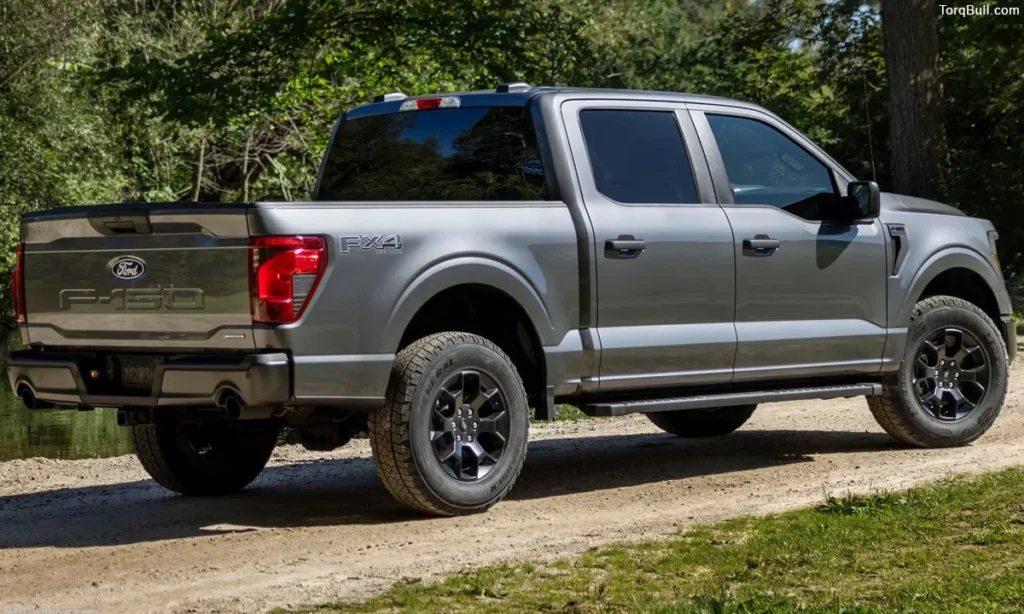
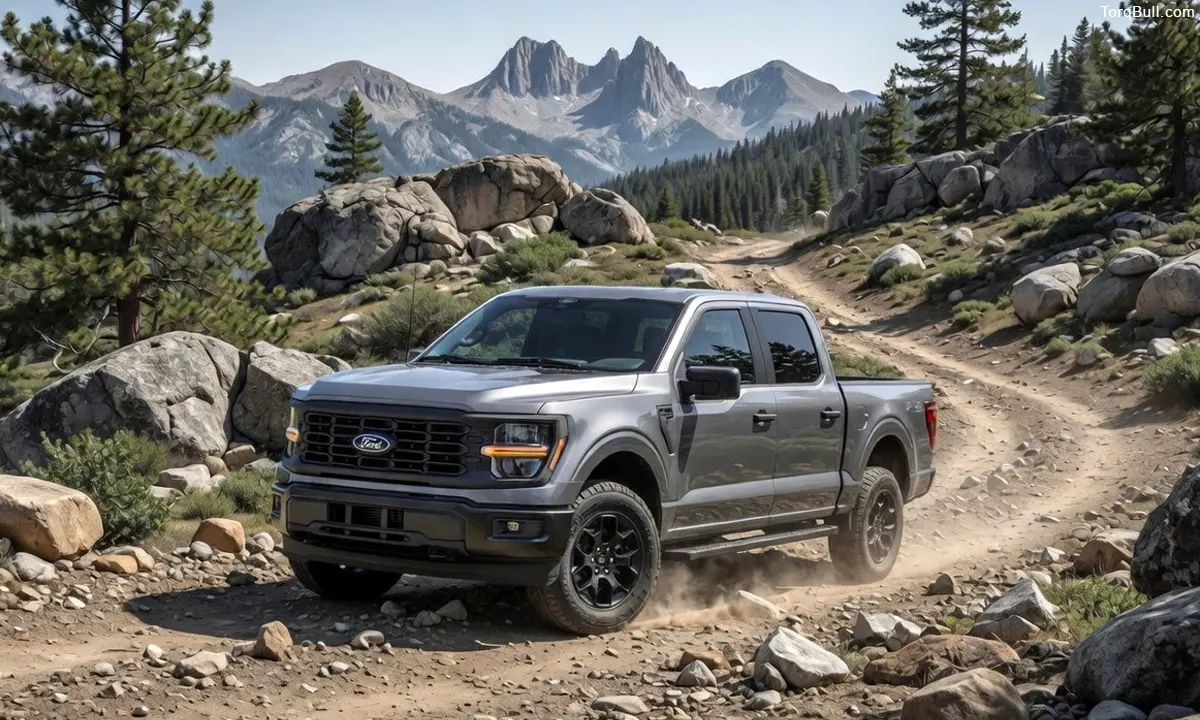
The 2026 Ford F-150 offers two EcoBoost V6 options alongside the 5.0 litre naturally aspirated V8 — each producing a distinct performance character that the specifications begin to capture but do not fully communicate.
The 2.7 litre EcoBoost V6 produces 325 horsepower and 400 pound feet of torque through twin turbochargers. Available on XL, XLT and Lariat trims, it achieves 19 MPG city, 25 MPG highway and 21 MPG combined in rear wheel drive configuration — the most fuel efficient non hybrid option in the F-150 lineup. Maximum towing in properly equipped configuration reaches 9,100 pounds. The 2.7 litre was named one of the ten favourite gas powered engines by major automotive media for its combination of output, efficiency and daily driving character.
The 3.5 litre EcoBoost V6 produces 400 horsepower and 500 pound feet of torque — the same peak horsepower as the V8 but 90 additional pound feet of torque that reflects the twin turbocharger’s ability to build peak torque at lower engine speeds. Available on most F-150 trims, it achieves 17 MPG city, 25 MPG highway and 20 MPG combined in rear wheel drive. Maximum towing reaches 13,500 pounds in the specific configuration required to achieve this class leading figure. This is the engine that provides the F-150’s segment leading capability numbers.
The 5.0 litre Coyote Ti-VCT V8 produces 400 horsepower and 410 pound feet of torque from eight naturally aspirated cylinders. Available across most F-150 trims, it achieves 16 MPG city, 24 MPG highway and 19 MPG combined regardless of drivetrain configuration. The 2026 model includes enhanced cylinder deactivation technology that deactivates cylinders during steady state cruising to reduce fuel consumption when the truck is not under load. Maximum towing capability is lower than the 3.5 litre EcoBoost’s — the V8’s towing rating does not reach the 13,500 pound maximum that the EcoBoost achieves in its most capable configuration.
Read: Which Ford F-150 Trim Is Best for Families? Here Are the Top Picks for Comfort and Value
Torque Delivery: The Most Practically Important Performance Difference
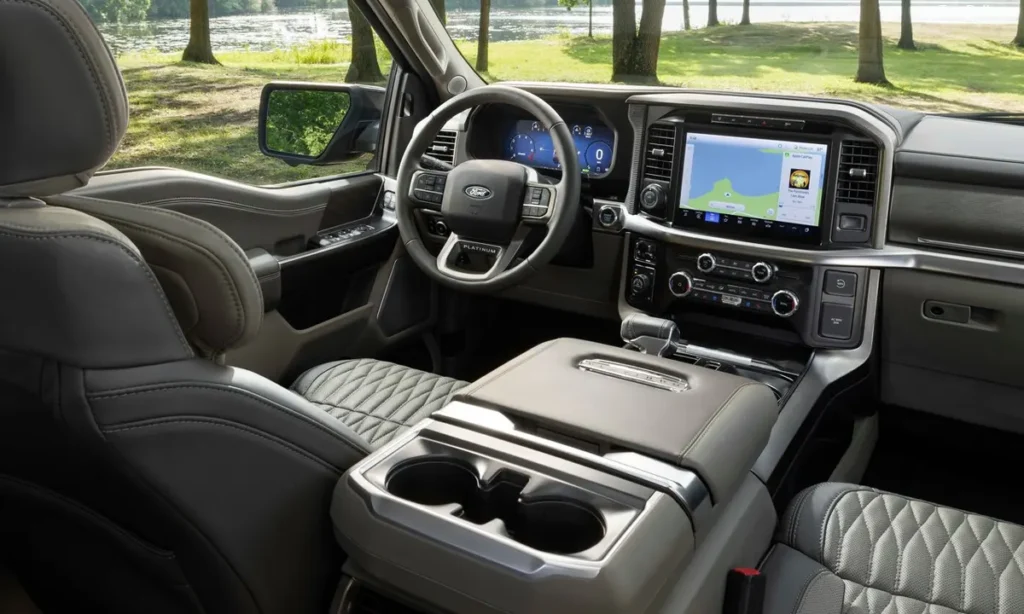
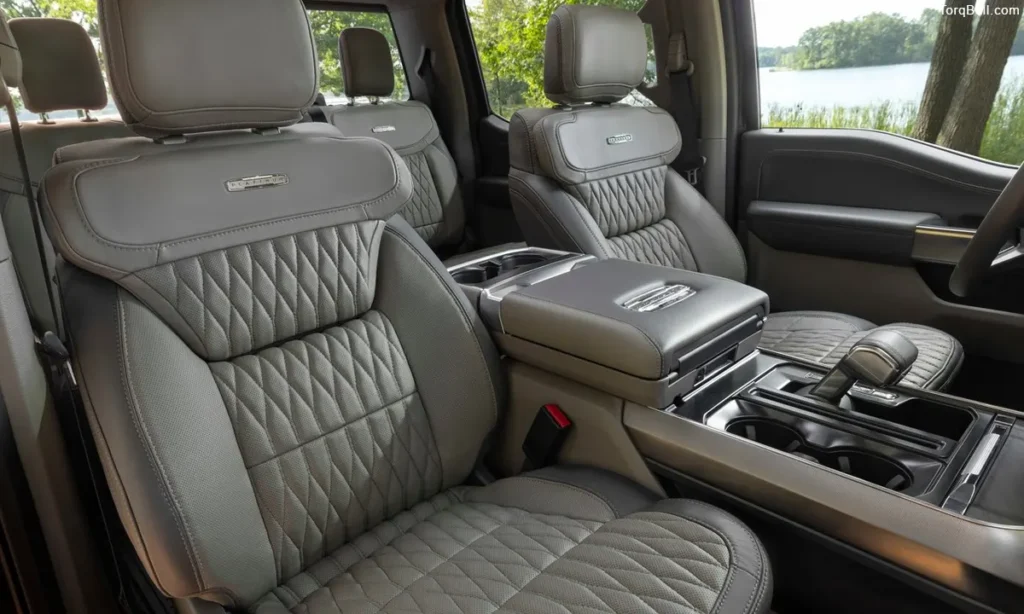
The single most practically important performance difference between the EcoBoost engines and the V8 is not peak horsepower — both the 3.5 litre EcoBoost and the 5.0 litre V8 produce 400 horsepower at peak — but where and how that power arrives in the engine’s operating range.
The EcoBoost V6 engines, by virtue of turbocharging, build peak torque at lower engine speeds than the naturally aspirated V8. The 3.5 litre EcoBoost’s 500 pound feet of torque arrives at approximately 2,500 to 3,500 RPM — the range that daily driving acceleration events, trailer launch from a standstill and uphill grade climbing most frequently engage. This low RPM torque availability produces the immediate, urgent response to throttle input that turbo engines specifically deliver and that makes the EcoBoost feel powerful in the everyday scenarios that truck buyers experience most frequently.
The 5.0 litre V8 produces its 410 pound feet of torque at a higher RPM than the EcoBoost — a characteristic of naturally aspirated engines whose power builds more linearly across the rev range rather than peaking early and sustaining. In practical daily driving terms, this means the V8 requires more throttle input and higher engine revs to access its peak torque compared to the EcoBoost’s boost assisted delivery. Experienced V8 owners describe this as the engine requiring more work to access its capability, while the reward for that engagement is a more mechanical and more sonorous character that the turbo V6 cannot replicate.
Towing and Payload: Where the 3.5 EcoBoost Dominates
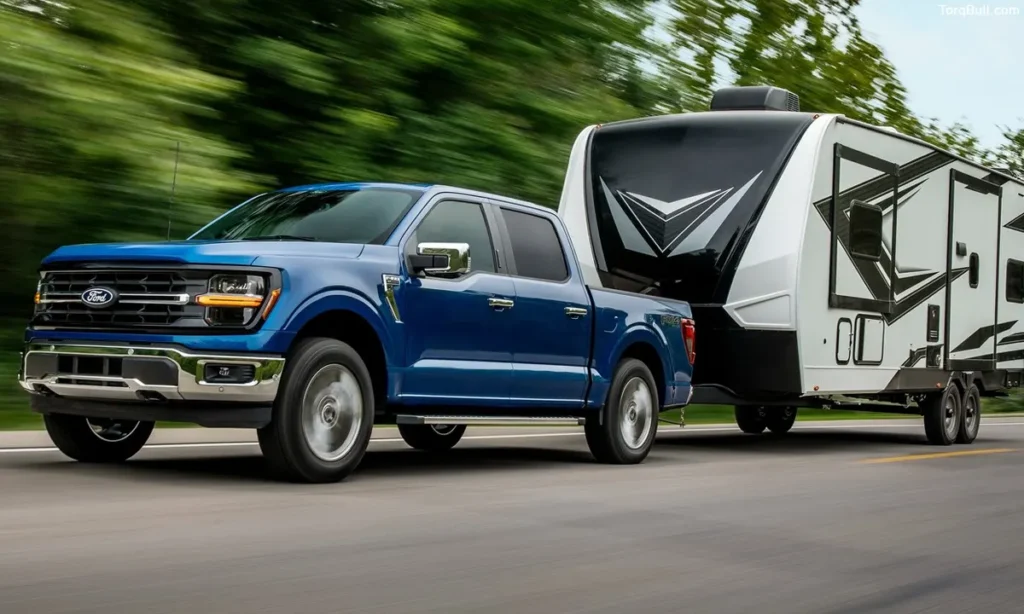
Maximum towing capability is the category where the 3.5 litre EcoBoost’s performance advantage over the V8 is most clearly documented and most practically significant for work truck buyers.
The 3.5 litre EcoBoost achieves a maximum towing rating of 13,500 pounds in the specific SuperCrew 4WD configuration with the 6.5 foot bed — the highest towing rating available in any non heavy duty full size pickup. The 5.0 litre V8’s maximum towing rating is lower than this figure in every configuration — buyers who need to tow trailers approaching or exceeding 11,000 pounds should choose the 3.5 litre EcoBoost rather than the V8, because the V8’s lower towing ceiling becomes a genuine operational limitation at high trailer weights.
The 3.5 litre EcoBoost also achieves the highest payload capacity in the lineup when configured as a Regular Cab rear wheel drive with an 8 foot bed — reaching the 2,440 pound class leading payload figure that the V8 does not achieve in equivalent configuration.
For buyers whose primary truck use involves maximum towing or payload, the 3.5 litre EcoBoost is the clear performance choice. The V8’s lower ratings in both categories are not trivial limitations — they represent real operational differences that determine whether specific trailer weights and job site loads fall within or outside the truck’s safe working parameters.
Fuel Economy: EcoBoost Leads Across Every Comparison
Fuel economy is the performance category where the EcoBoost engines’ advantage over the V8 is most consistently documented and most directly translatable to annual operating cost.
The 2.7 litre EcoBoost achieves 21 MPG combined in rear wheel drive — the best combined fuel economy among all non hybrid F-150 engine options. The 3.5 litre EcoBoost achieves 20 MPG combined in rear wheel drive. The 5.0 litre V8 achieves 19 MPG combined regardless of drivetrain — 1 to 2 MPG combined below the EcoBoost options.
At 15,000 annual miles and $3.08 per gallon, the 1 MPG combined difference between the 3.5 EcoBoost and the 5.0 V8 produces an annual fuel saving of approximately $112. Over five years, this accumulates to approximately $560 — a real but not transformative financial difference that is unlikely to drive the purchase decision independently but contributes to the EcoBoost’s total value case.
The cylinder deactivation technology in the 2026 V8 specifically targets this fuel economy gap by reducing active cylinder count during low demand cruising. The improvement is real in steady state highway conditions but modest in the stop and go driving and variable load conditions that most truck owners experience across mixed daily use.
The Reliability Debate: The Most Contested Question in F-150 Ownership
The reliability comparison between EcoBoost and V8 is the dimension that generates the most passionate owner community discussion — because it draws on direct personal experience and produces genuinely divided owner testimony across verified review platforms.
The V8 community’s core reliability argument is mechanical: a naturally aspirated V8 has no turbochargers to fail, no intercooler system to develop leaks and no boost pressure components to maintain. The 5.0 litre Coyote’s architecture has been produced since 2011 and has accumulated extensive long term production history. Owner accounts of V8 F-150s reaching 200,000 miles with no major powertrain failures are numerous and well documented. One Ford mechanic’s recommendation to a customer — specifically advising the 5.0 Coyote over the 3.5 EcoBoost for long term ownership confidence — is cited repeatedly in owner community discussions as a specific professional endorsement of the V8’s durability advantage.
The EcoBoost community’s response is equally specific: timing chain concerns and cam phaser issues documented on earlier 3.5 EcoBoost production years have been consistently addressed through Ford service bulletins, updated hardware and revised calibrations across newer production years. Multiple owners report three F-150 EcoBoost trucks with no issues whatsoever across high mileage ownership. The turbocharger hardware on modern production EcoBoost engines has proven more durable in extended ownership than early adopters’ experiences suggested.
The honest assessment is that both powertrains have strong long term durability records in their most recent production iterations, that the V8’s mechanical simplicity provides a specific insurance policy against the turbocharged system’s additional component count and that buyers who plan extreme mileage ownership beyond 200,000 miles have valid reasons to consider the V8’s simpler architecture as a specific long term advantage.
Read: Ford F-150 Raptor Full Review 2026. The Complete Performance Truck Assessment
Ford F-150 EcoBoost vs V8 — Complete 2026 Performance Comparison Chart
| Specification | 2.7L EcoBoost V6 | 3.5L EcoBoost V6 | 5.0L Coyote V8 |
| Configuration | Twin turbo V6 | Twin turbo V6 | Naturally aspirated V8 |
| Horsepower | 325 hp | 400 hp | 400 hp |
| Torque | 400 lb ft | 500 lb ft | 410 lb ft |
| EPA Combined (RWD) | 21 MPG | 20 MPG | 19 MPG |
| EPA City (RWD) | 19 MPG | 17 MPG | 16 MPG |
| EPA Highway (RWD) | 25 MPG | 25 MPG | 24 MPG |
| Max Towing (equipped) | 9,100 lbs | 13,500 lbs | Below 3.5L EcoBoost |
| Max Payload (equipped) | Below 3.5L EcoBoost | 2,440 lbs (specific config) | Below 3.5L EcoBoost |
| Torque Delivery | Low RPM turbo surge | Low RPM turbo surge | Linear natural aspiration |
| Mechanical Complexity | Moderate (twin turbos) | Moderate (twin turbos) | Lower (no turbos) |
| Available Trims | XL, XLT, Lariat | Most trims | Most trims |
| Character | Efficient workhorse | Maximum capability | Traditional character |
| Long Term Simplicity | Good | Good | Best |
| Annual Fuel Cost (15K mi) | approximately $1,385 | approximately $1,462 | approximately $1,462 to $1,539 |
The Buyer Profile Verdict
Choose the 3.5 litre EcoBoost when maximum towing capability is a regular operational requirement, when payload capacity at the highest available rating matters for work applications and when the combination of V8 equivalent horsepower with 90 additional pound feet of torque and better fuel economy represents the most complete daily performance package.
Choose the 5.0 litre V8 when mechanical simplicity is a genuine long term ownership priority, when the naturally aspirated V8’s linear power delivery and specific engine sound are valued daily driving qualities rather than specification footnotes and when the truck will accumulate extreme mileage where the absence of turbocharger components provides a specific long term durability argument that experienced truck buyers find genuinely compelling.
Choose the 2.7 litre EcoBoost when fuel economy is the primary selection criterion among non hybrid F-150 options and when towing requirements fall comfortably within the 9,100 pound maximum rather than approaching the segment ceiling.