2026 Hyundai Boulder Concept Signals a Bold Entry into Hardcore Off-Road Territory
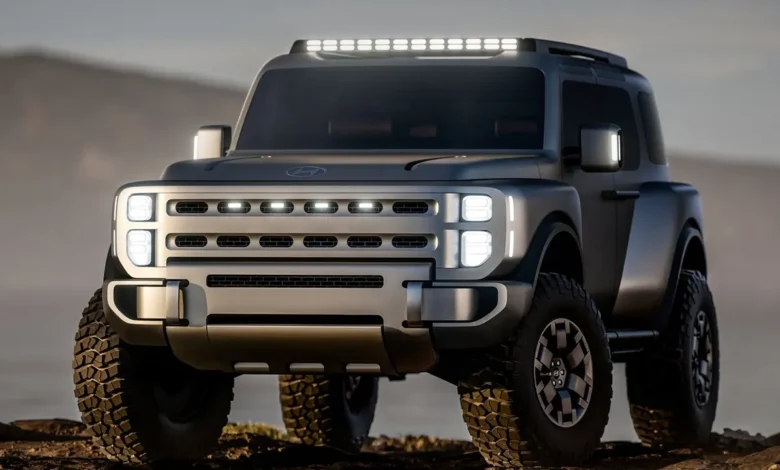
There are automotive debuts whose significance is contained within the vehicle itself — the performance figures, the design language, the technology specification — and there are debuts whose significance extends far beyond the car on the show stand to encompass a manufacturer’s entire strategic identity and the market segment it has chosen, after decades of deliberate absence, to enter with the full weight of its engineering ambition and its commercial determination. The Hyundai Boulder Concept, which made its surprise global debut at the 2026 New York International Auto Show, belongs emphatically to the second category. It is not a speculative design exercise produced to generate press coverage and quietly forgotten before the next model year. It is, as Hyundai’s own President and CEO José Muñoz made clear in the hours following its reveal, a prototype that sits a few designers’ pen strokes away from the production vehicle the company intends to bring to American buyers before the end of the decade — the first expression of a fully-boxed body-on-frame platform that will underpin a family of trucks and SUVs, beginning with a midsize pickup arriving by 2030, designed in America, developed for America and built in America using steel produced by Hyundai’s own domestic manufacturing operations.
Gallery: 2026 Hyundai Boulder Concept
What the Boulder Concept Means for Hyundai’s American Identity
Hyundai entered the American market forty years ago as a manufacturer of affordable, fuel-efficient compact cars whose value proposition was straightforward and whose competitive ambitions were modest relative to the established Japanese and domestic brands it was entering the market to challenge. The forty years since that entry have transformed the company beyond recognition — Hyundai is now the world’s third-largest automotive manufacturer, is pursuing its sixth consecutive year of record American sales in 2026, and has established itself in segments from luxury sedans to electric crossovers to high-performance sports cars that the company’s founders would not have recognised as part of the brand’s conceivable future. The one frontier it had not entered, conspicuously and by deliberate strategic choice, was the body-on-frame truck and SUV segment — the architecture that underpins the Ford F-150, the Toyota Tacoma, the Jeep Wrangler and the Ford Bronco, and that represents the most commercially important and most culturally embedded vehicle category in the American market. The Boulder Concept is Hyundai’s declaration that this omission is ending, and the manner in which it has chosen to make that declaration — with a fully engineered prototype at America’s most commercially significant auto show, confirmed by senior leadership as a near-production preview rather than a speculative concept — communicates the seriousness of its competitive intent more persuasively than any press release could.
The Body-on-Frame Architecture: Why This Platform Is the Real Story
The engineering decision at the heart of the Boulder Concept is the adoption of a fully-boxed body-on-frame ladder chassis — a fundamental departure from the unibody construction that has defined every Hyundai vehicle sold in the American market throughout the brand’s forty-year domestic history. Unibody construction, in which the vehicle’s body and frame are integrated into a single structural unit, dominates the passenger car and crossover segments because it delivers superior on-road refinement, lower weight and better crash energy management for vehicles whose primary use case is road driving rather than serious off-road or heavy-duty work. Body-on-frame construction, in which a separate rigid frame supports the body above it, dominates the truck and serious off-road segments because it delivers the torsional strength, the payload and towing capacity, the off-road articulation capability and the repairability after hard use that unibody construction cannot match at equivalent cost. Hyundai’s decision to develop a new body-on-frame platform from scratch — rather than adapting an existing architecture or sourcing one from another manufacturer — represents a commitment of engineering resources and development capital that confirms the seriousness of its intention to compete in the segment rather than to dip a cautious toe into its margins.
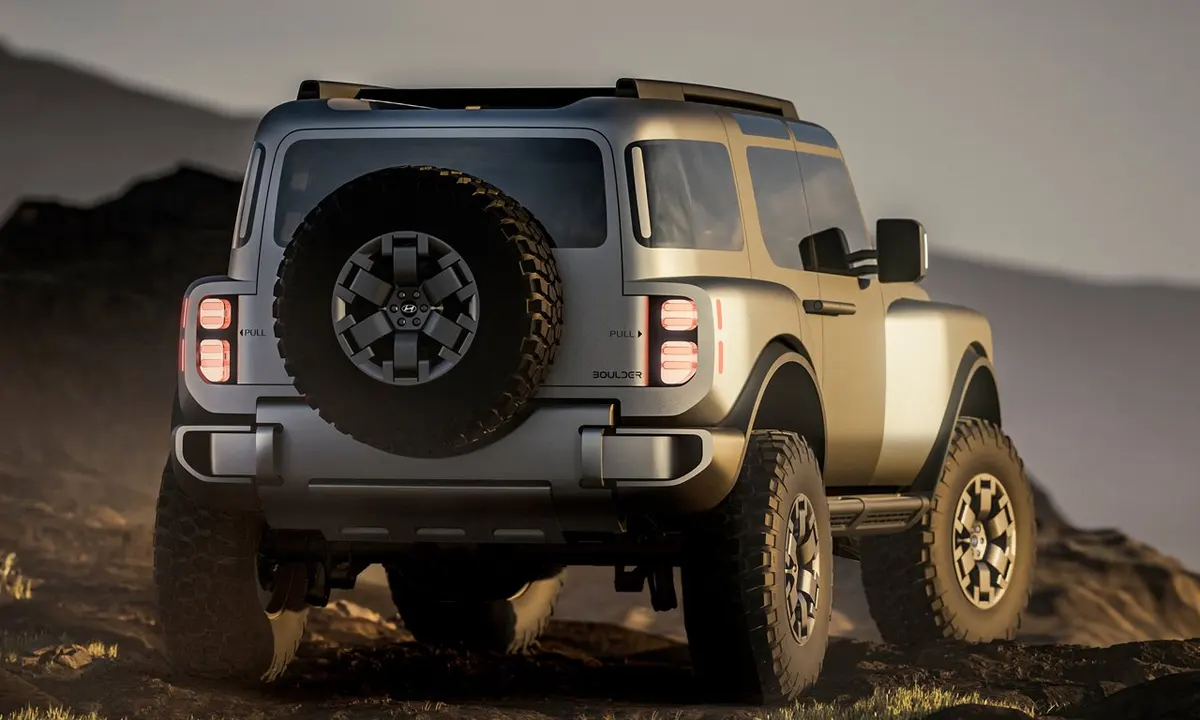
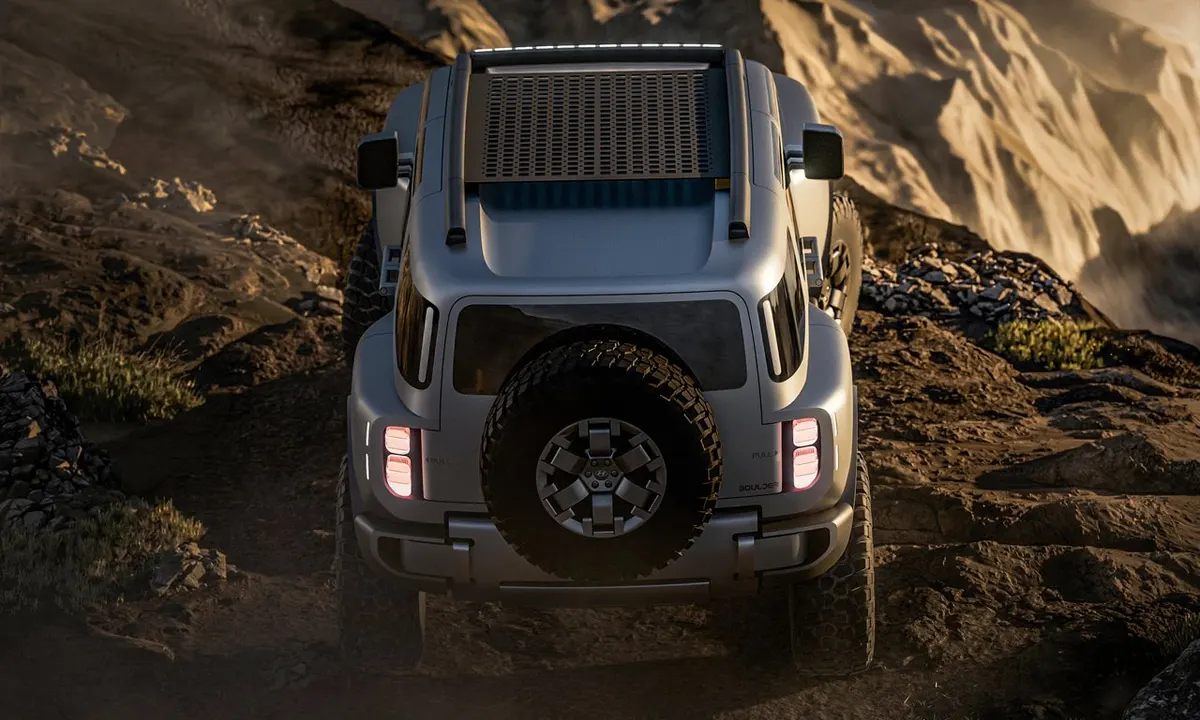
The Boulder Concept’s ladder frame is paired with independent front suspension and a solid rear axle — a configuration that the off-road community will recognise as optimised for the technical trail capability that the concept’s 37-inch mud-terrain tyres and aggressive body cladding suggest as its primary performance aspiration. Generous approach, departure and breakover angles are the direct result of the body’s upright, two-box silhouette and its elevated ride height over those massive tyre stacks, and a confirmed generous fording depth extends the Boulder’s capability into water crossings that would defeat most mainstream crossovers before they reached wheel arch depth. A full-size spare tyre mounted on the tailgate — a detail whose presence signals that the design team expected the Boulder’s tyres to encounter the kind of terrain that punctures them — completes a mechanical package whose off-road credential is earned rather than cosmetic.
Art of Steel Design: The Visual Philosophy of an Off-Road Conviction
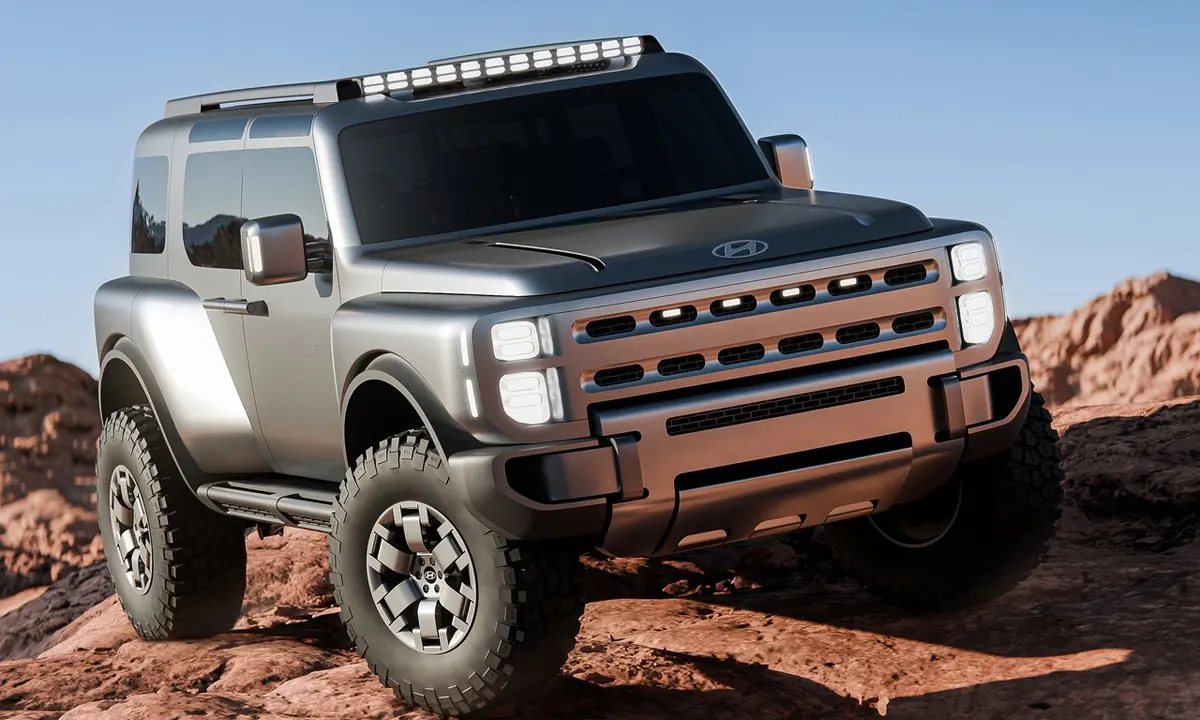
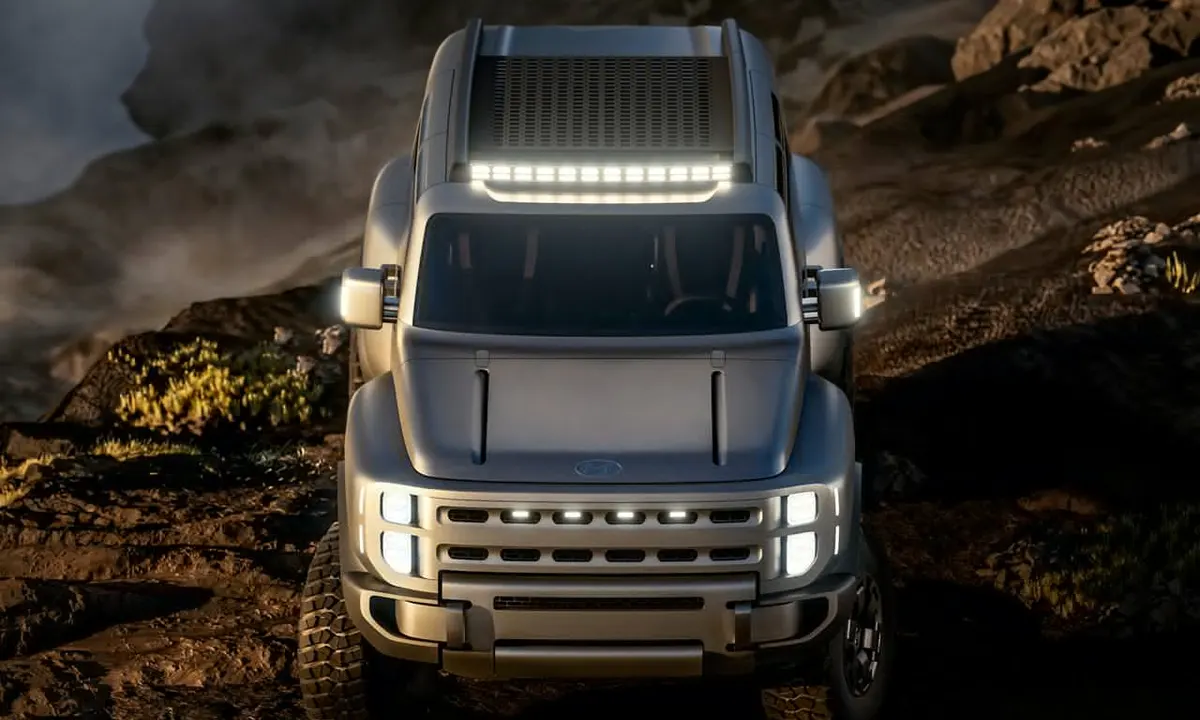
The Boulder Concept’s exterior design language carries the name Art of Steel — a philosophy that Hyundai describes as transforming the strength and natural formability of steel into a sculptural vocabulary that reflects the material’s inherent character rather than concealing it beneath soft organic surfaces. The result is a design whose upright greenhouse, flat bonnet, squared wheel arches and deliberately angular body sides communicate their structural logic visibly rather than disguising the engineering beneath flowing bodywork. The concept is finished in a Liquid Titanium exterior treatment whose metallic depth gives the steel-inspired design language a surface quality that reinforces its material references without resorting to the raw industrial aesthetic that a less resolved interpretation might have produced.
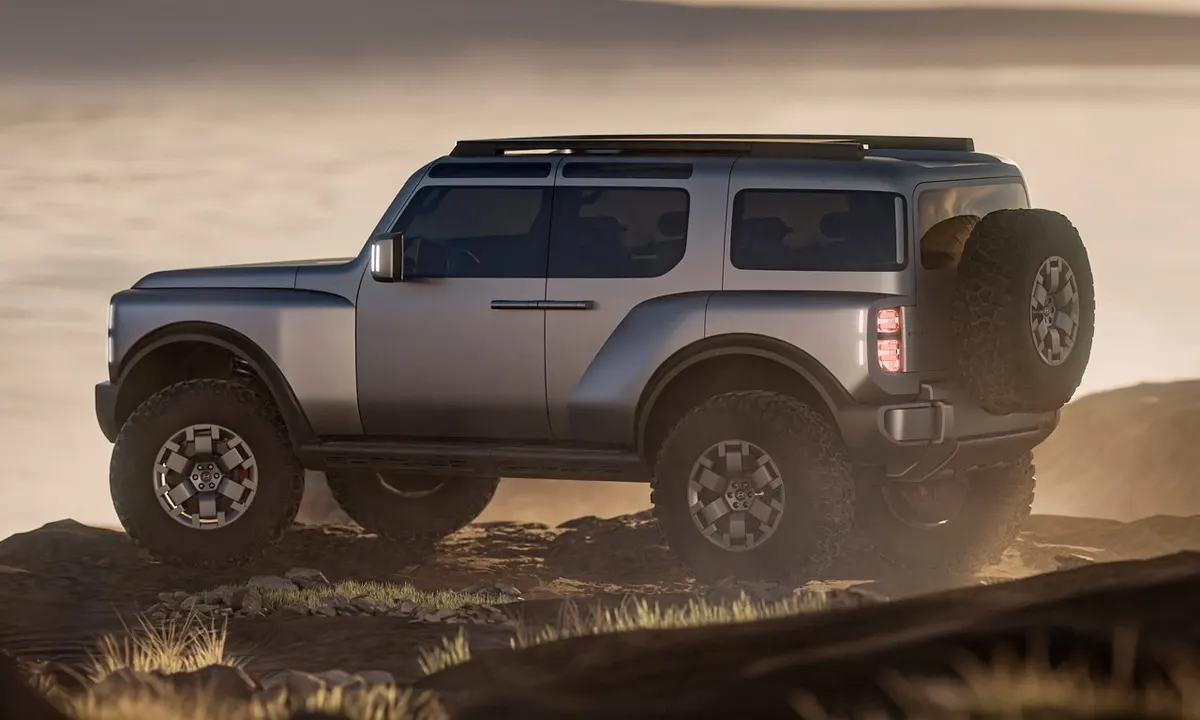
Dual safari-style fixed upper windows flood the cabin with natural light and provide unobstructed views of the terrain surrounding the vehicle — a functional detail whose engineering intent is visibility during low-speed technical off-road navigation and whose visual effect on the exterior profile gives the Boulder a distinctive greenhouse character that differentiates it immediately from both conventional SUVs and established off-road icons. Coach-style doors — hinged at the rear rather than the conventional forward hinge — enhance side-loading access for both passenger rows, a practical design decision whose utility for loading gear, securing children’s safety harnesses and accessing rear storage is immediately apparent to anyone who has attempted the same tasks in a conventionally hinged vehicle. A low-profile roof rack with steel webbing between the rails provides supplementary cargo capacity for the overland travel equipment that the Boulder’s target buyer already owns. Key exterior functional elements including tow hooks and door handles incorporate reflective materials that make the vehicle identifiable after dark in field environments — a detail whose specificity of purpose communicates more about the intended ownership experience than any marketing statement could.
A Retro-Futuristic Interior Built for the Trail
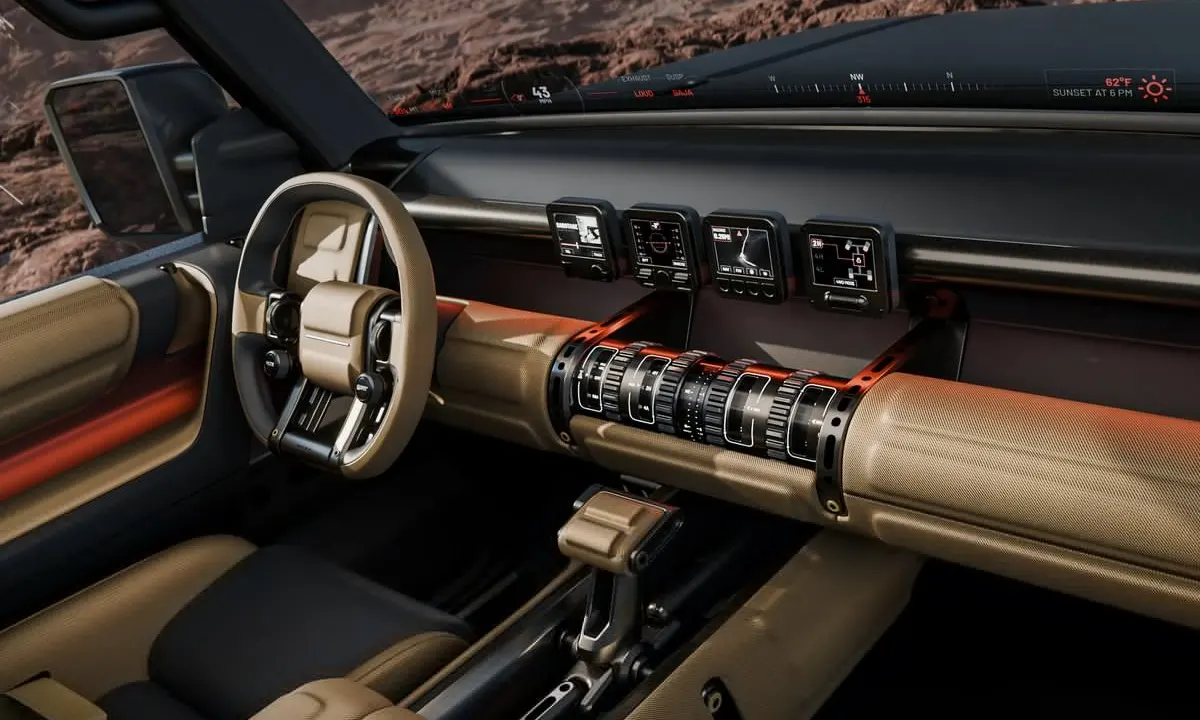
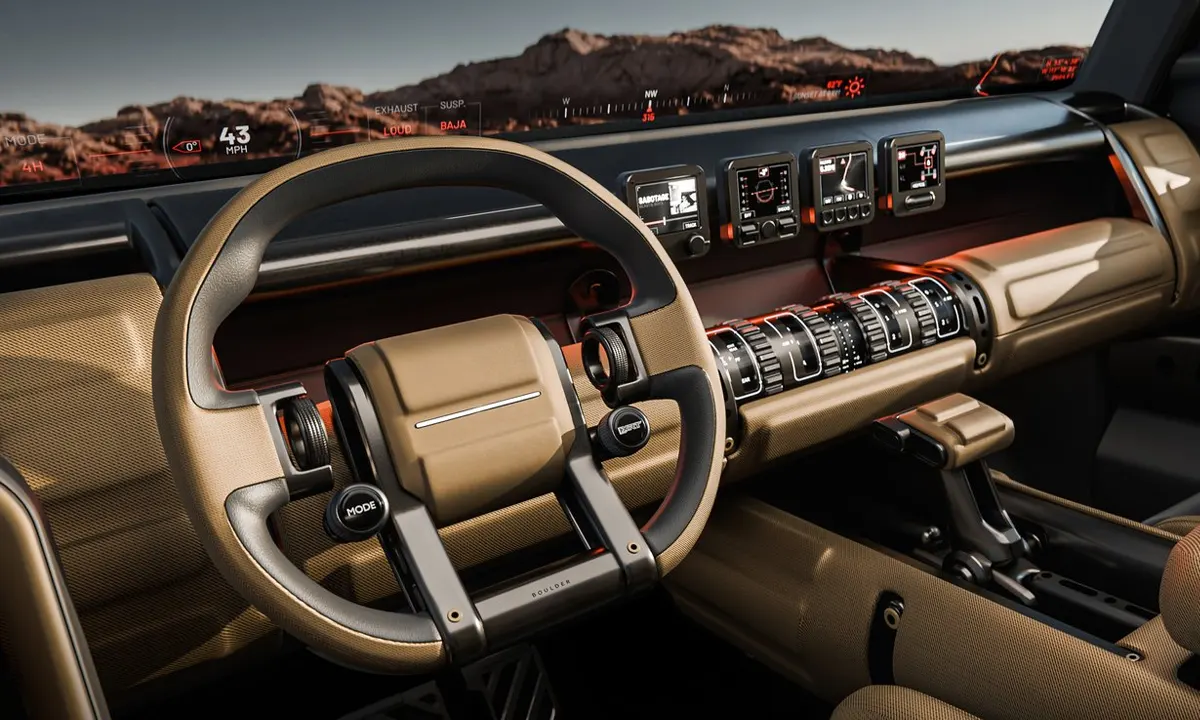
The Boulder Concept’s cabin represents one of the most philosophically coherent interior design statements to emerge from a major manufacturer’s concept programme in recent years, because it makes a deliberate and fully justified argument against the touchscreen-dominant interior philosophy that has spread through the automotive industry with the enthusiasm of a design trend rather than the caution of an engineering decision. The concept’s instrument presentation places vital vehicle information at the base of the windscreen in the form of a full-width head-up display — projecting speed, navigation and vehicle status data where the driver’s eyes naturally rest during forward motion rather than requiring a downward glance to a centre stack display. Four small square individual screens replace the single massive touchscreen that has become the automotive industry’s default infotainment approach, and each screen is accompanied by physical controls whose tactile operation — knobs and buttons that respond to gloved hands, wet hands and hands shaking with the vibration of serious off-road terrain — represents a genuine usability advantage over the capacitive touchscreen controls that require clean, dry fingertips and visual confirmation of correct operation.
The standout technology feature is a real-time off-road guidance system that Hyundai describes as functioning like a digital spotter riding alongside the driver — using sensor data and terrain mapping to help navigate challenging lines, steep approach angles, water crossings and obstacle navigation in situations where an experienced human spotter would traditionally be the only reliable source of guidance. Fold-out tray tables integrated into the cabin provide functional workspace for the field — whether for trail lunch stops, mobile office use or equipment management between sections of a multi-day overland route. Every interior material and control has been selected and positioned with the understanding that the Boulder will be used in the conditions its exterior promises to tackle, and the result is a cabin philosophy that prioritises durability, accessibility and functional intelligence over the visual luxury that defines the premium SUV interior standard.
Powertrain Strategy: Flexibility as a Cornerstone Commitment
Hyundai has not confirmed specific powertrain specifications for the production vehicles that will be derived from the Boulder’s body-on-frame platform, and the concept vehicle itself offers no visible exhaust outlets to declare its energy source definitively. What the company’s leadership has confirmed is a powertrain strategy whose flexibility is described as a cornerstone of the programme rather than an afterthought — one that will draw from the full breadth of Hyundai Motor Group’s existing and in-development powertrain portfolio to offer buyers choices that include internal combustion engines across multiple displacement and cylinder configurations, conventional hybrid systems, plug-in hybrid systems, all-electric drive and the extended-range electric architecture that Hyundai has confirmed is approaching introduction readiness. This multi-powertrain strategy positions the Boulder’s production descendants to address a market segment whose buyers hold strongly diverse preferences and whose geography, from urban environments to remote wilderness, imposes diverse energy infrastructure constraints that no single powertrain can optimally address.
The Platform Family: Beyond the Boulder
The Boulder Concept’s significance extends beyond the specific vehicle it previews to encompass the broader family of body-on-frame products that Hyundai and the wider Hyundai Motor Group intend to build on the new platform. A confirmed midsize pickup truck arriving by 2030 is the first production expression — positioned to compete with the Toyota Tacoma, Ford Ranger and other segment standards whose combined American sales volume makes the midsize truck segment one of the most commercially consequential in the domestic market. An SUV closely related to the Boulder Concept is expected to follow. Senior Hyundai Motor Group insiders have made clear that the new platform’s reach will extend beyond the Hyundai brand to encompass other group members — a development whose implications for the Genesis luxury brand and the Kia commercial lineup could produce some of the segment’s most compelling new entrants by the decade’s end.
Read: 2027 Kia EV3 Comes to America. Everything You Need to Know About Kia’s Most Accessible Electric SUV
Hyundai Boulder Concept: Key Details at a Glance
| Detail | Specification |
| Debut | 2026 New York International Auto Show |
| Architecture | Fully-boxed body-on-frame ladder frame |
| Suspension | Independent front / solid rear axle |
| Tyres | 37-inch mud-terrain (37×12.50R18 LT) |
| Spare | Full-size tailgate-mounted |
| Design Philosophy | Art of Steel — Liquid Titanium finish |
| Interior Displays | Four small screens + full-width HUD |
| Powertrain (Concept) | Unconfirmed — multiple options planned |
| Production Timeline | Midsize pickup by 2030 |
| Manufacturing | Designed, developed and built in America |
| Steel Source | Hyundai-produced U.S. steel |
A Forty-Year Journey That Ends at the Start of Something New
The Hyundai Boulder Concept’s appearance at the 2026 New York International Auto Show is best understood as the conclusion of one chapter in the brand’s American story and the unmistakable opening line of the next. The forty years that began with a modest compact car and produced the world’s third-largest automaker have created the engineering capability, the manufacturing infrastructure, the brand credibility and the commercial ambition to enter the body-on-frame segment not as a challenger grateful for a foothold but as a manufacturer with the resources and the conviction to compete for segment leadership on its own terms. The Boulder Concept communicates that ambition with the clarity of a vehicle that was designed to make a permanent impression rather than fill a news cycle — and the confirmation that a production midsize pickup based on its platform will reach American buyers by 2030 ensures that the Boulder’s debut at the Javits Center in April 2026 will be remembered as the moment Hyundai became something it had never previously been: a genuine player in the most American of all automotive categories.