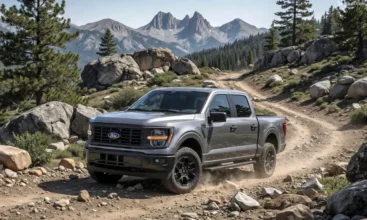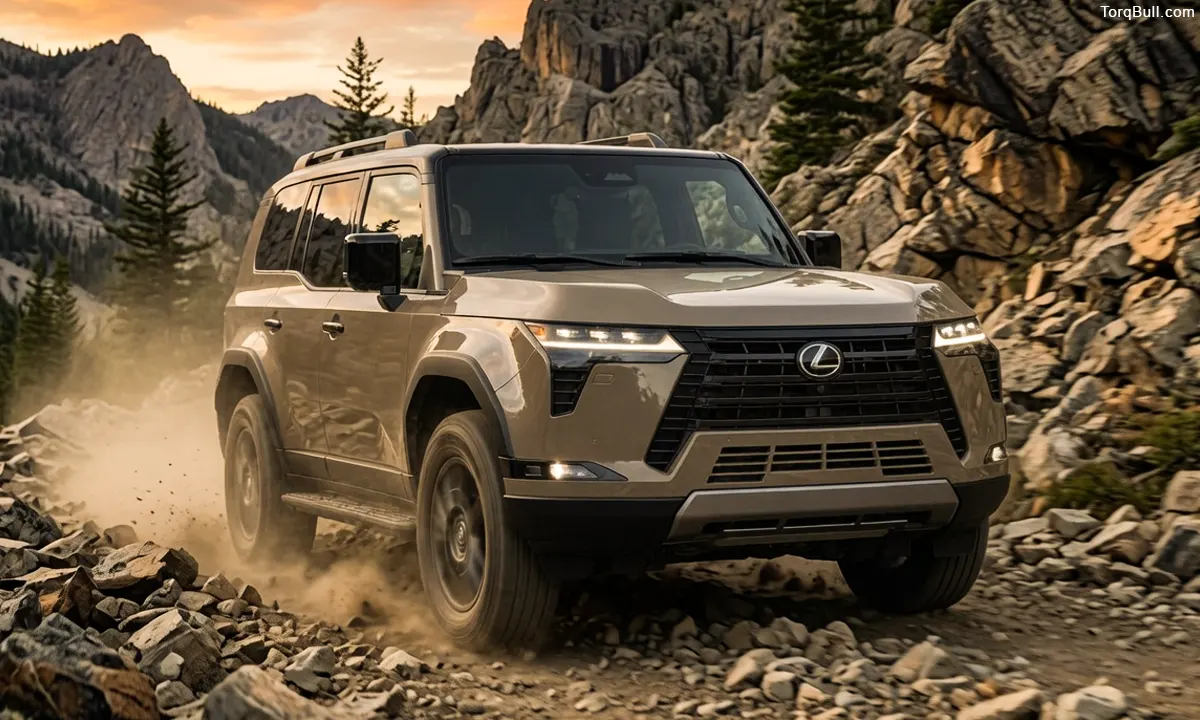
- The 2026 Lexus GX Overtrail demonstrates impressive capability in deep snow and challenging off-road terrain.
- Despite its rugged focus, the GX still accelerates from 0–60 MPH in approximately 6.5 seconds on pavement.
- Features such as 9.84 inches of ground clearance, E-KDSS suspension and a locking rear differential make the Overtrail the most off-road-focused GX variant.
The 2026 Lexus GX’s third-generation redesign — introduced for 2024 and refined through 2026 — represents the most significant reorientation of the GX’s character in the nameplate’s production history. The previous generation GX earned its reputation as an urban luxury SUV that happened to retain body-on-frame capability largely unused by most buyers. The current generation tilts its focus decisively away from on-road luxury and more toward the dirt road less travelled — a deliberate design priority that professional off-road evaluation confirms as genuine capability rather than marketing positioning. This complete off-road assessment examines every relevant capability dimension from the drivetrain hardware through the electronic assistance systems to the real-world testing results that quantify what the GX can actually accomplish on challenging terrain.
The Foundation: Body-on-Frame Architecture and What It Enables
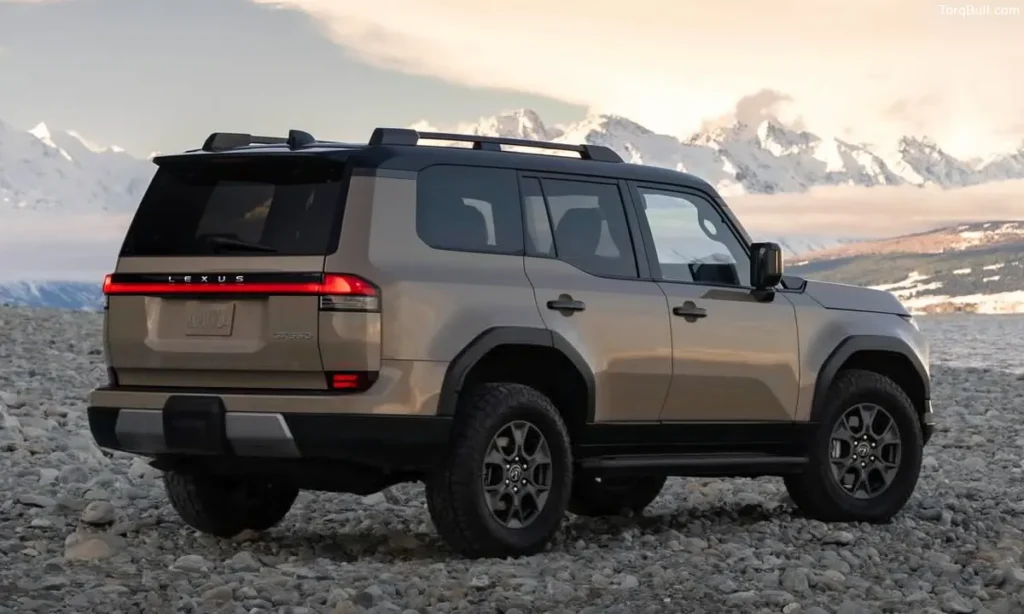
The GX’s most fundamental off-road credential is its body-on-frame construction — the ladder-frame architecture that separates it from every competing luxury crossover SUV whose unibody construction optimises on-road refinement at the cost of the torsional flexibility, suspension articulation and structural separation that genuine off-road capability requires.
Body-on-frame construction provides specific off-road advantages that unibody alternatives cannot replicate regardless of electronic assistance system sophistication. The separation between the rigid frame and the body allows the frame and suspension to flex over uneven terrain independently of the passenger compartment — maintaining wheel contact with uneven surfaces while the cabin remains relatively stable. Unibody construction transfers surface variation from the wheels to the entire body structure simultaneously, limiting the articulation available before suspension travel is exhausted and a wheel lifts from the surface.
The GX’s TNGA-F body-on-frame platform — shared globally with the Toyota Land Cruiser Prado — provides the structural foundation that every off-road system mounted to it requires to function effectively. The electronic locking rear differential, the Crawl Control system and the Multi-Terrain Select modes all perform their functions more effectively on a platform whose fundamental architecture allows wheel articulation rather than constraining it.
Read: Lexus GX Overtrail Review 2026. Rugged Capability Meets Premium Luxury
The Overtrail’s Hardware: What Changes from the Standard GX
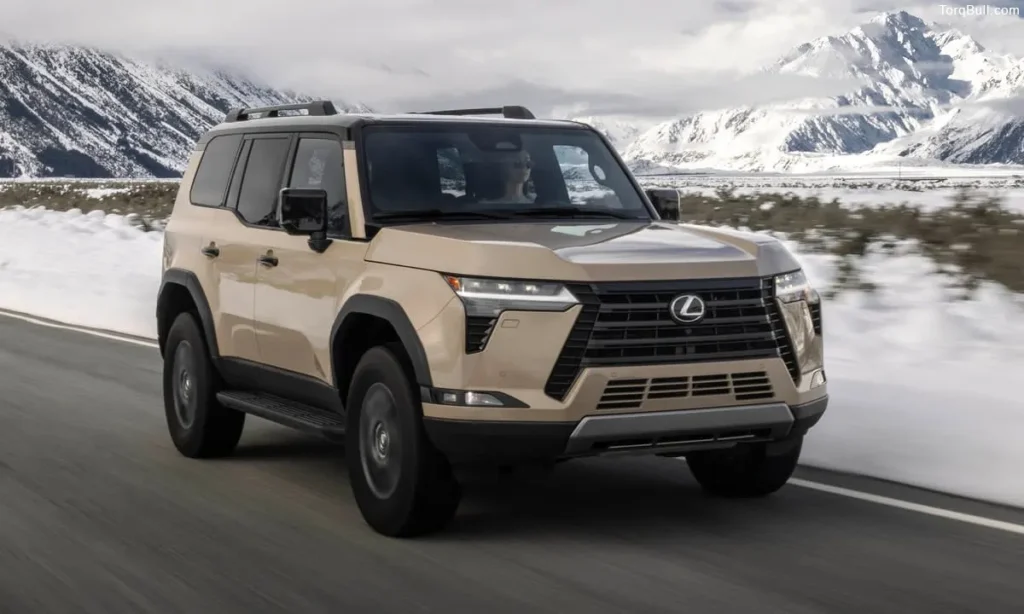
The Overtrail and Overtrail Plus trims represent the GX configuration where Lexus specifically optimised the platform for off-road performance — adding hardware that the Premium and Luxury trims do not carry and that directly enables more challenging trail capability.
The most mechanically significant Overtrail addition is the Electronic Kinetic Dynamic Suspension System — the e-KDSS that electronically disconnects the front and rear stabiliser bars during off-road operation. Stabiliser bars are essential for highway driving — they prevent body roll during cornering and provide the flat, confident handling that highway travel requires. But those same stabiliser bars actively resist the independent wheel movement that off-road terrain demands — preventing one wheel from articulating downward into a rut or upward over an obstacle without affecting the opposite wheel. The e-KDSS resolves this conflict by disconnecting the bars during trail use and reconnecting them automatically for highway operation — providing maximum articulation when terrain demands it without compromising the highway dynamics that the majority of GX miles involve.
The 2025 update specifically increased Overtrail ground clearance to 9.84 inches — an improvement of one full inch over the 2024 Overtrail’s 8.84 inches. This ground clearance improvement was directly responsive to professional evaluation feedback that the original Overtrail’s ground clearance was insufficient for its positioning as a serious off-road configuration — the 9.84 inch figure now exceeds the Subaru Crosstrek’s figure and approaches the capability envelope of dedicated off-road alternatives.
The Overtrail’s electronically controlled locking rear differential is the mechanical traction tool that the standard GX’s locking centre differential does not fully replicate. The centre differential distributes torque between the front and rear axles — ensuring both axles receive power even when one loses traction. But within the rear axle, an unlocked differential allows the wheel with less traction to receive all the available torque — exactly the wrong response when one rear wheel is in contact with the surface and one is lifted. The rear differential lock forces equal torque to both rear wheels regardless of individual wheel traction — the last-resort traction tool that prevents getting stuck in conditions where the open differential would allow wheel spin on the low-traction wheel while the high-traction wheel receives nothing.
Deep Snow and Rugged Trail Performance: The Test Results
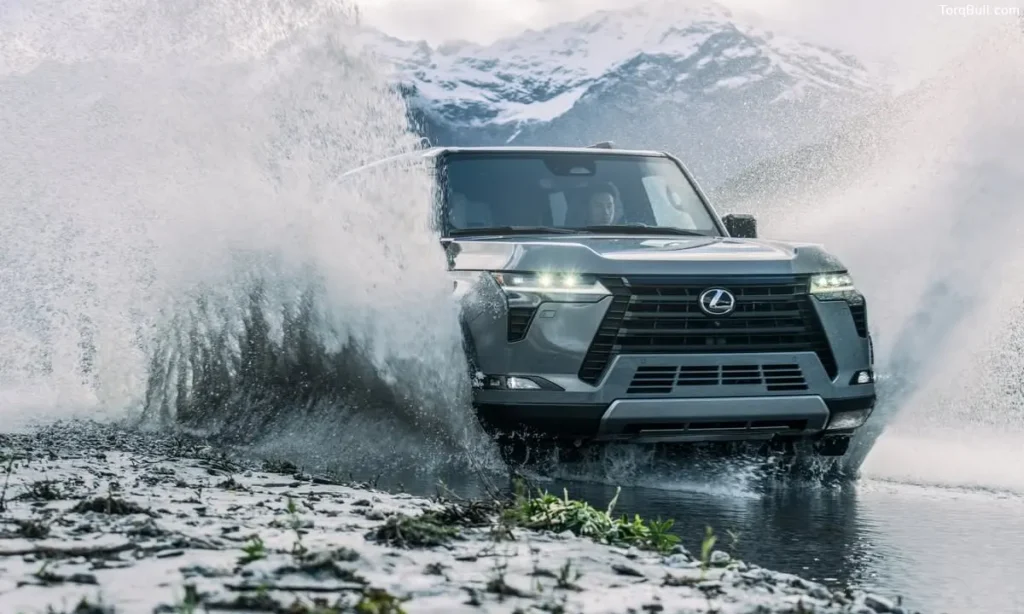
Professional winter testing of the GX 550 Overtrail Plus in southeast Michigan during sustained cold and snowy conditions produced the most comprehensive single-environment off-road assessment available in recent GX evaluation — a test that combined deep snow obstacle crossing with rugged unpaved trail navigation in conditions that authentically replicate what northern state winter driving regularly demands.
The ability to deal with deep snow and rugged trails was described as impressive — a characterisation that confirms the Overtrail’s hardware package delivers genuine trail performance rather than the superficial trail aesthetic that some luxury off-road configurations provide. Deep snow is specifically demanding for SUV capability evaluation because it requires sustained traction management across a surface whose resistance profile changes continuously — compact snow at the top, loose powder at depth, ice underneath — in a way that tests the traction management electronics as thoroughly as fixed surface obstacles test the mechanical suspension components.
The GX’s Multi-Terrain Select system provides specific calibrations for Deep Snow, Mud, Sand and Dirt alongside an Auto mode — with the Deep Snow mode specifically relevant to the Michigan winter evaluation. Deep Snow mode reduces traction control intervention to allow the wheel motion that builds momentum through deep powder, while maintaining the throttle management that prevents wheel spin from digging the vehicle into a stuck position. Professional evaluators who tested this mode in actual deep snow conditions confirmed the system’s specific suitability for the surface it was designed to address.
Crawl Control maintained steady, controlled descent speed during steep grade portions of the trail evaluation — managing brake application automatically without requiring manual throttle and brake coordination from the driver. This system is specifically valuable for trail portions where the descent angle and surface traction combine to produce the situation where driver-managed braking would most likely produce wheel lock and loss of directional control.
Read: Lexus GX Maintenance Cost 2026. Full Ownership Cost Breakdown
On-Road Character: The Honest Trade-Off
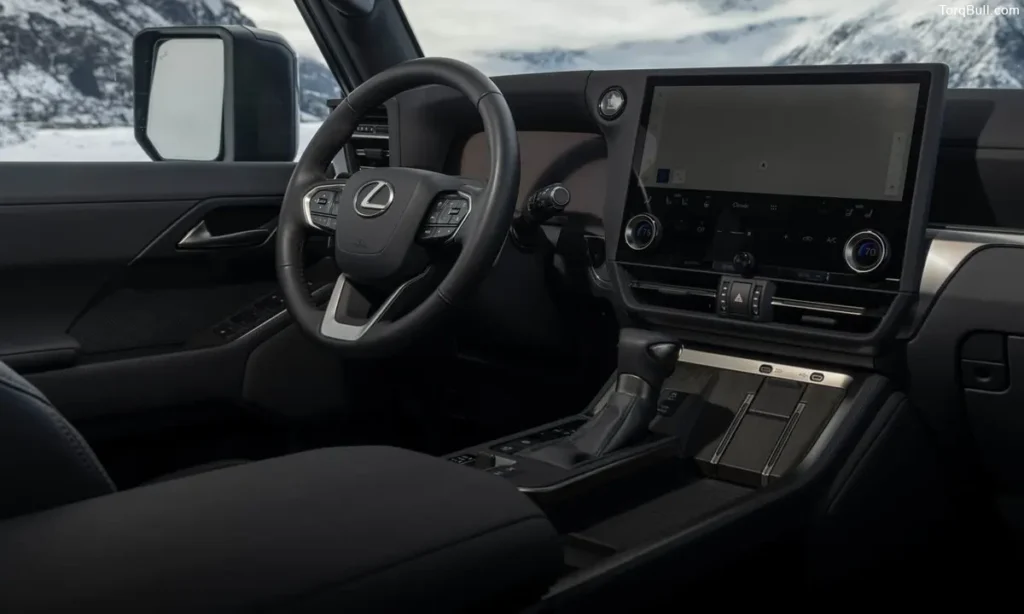
The GX’s off-road capability comes with the specific on-road trade-off that body-on-frame architecture consistently produces in any vehicle that prioritises trail performance over highway refinement.
The GX’s ride did not deliver the plush, quiet experience of other Lexus SUVs in the winter evaluation — a direct and honest characterisation that reflects the suspension calibration trade-off that the Overtrail’s off-road tuning requires. A suspension system optimised for maximum wheel articulation and consistent trail surface contact necessarily sacrifices some of the isolation from road surface variations that a comfort-tuned luxury crossover provides as its primary mission. The GX Overtrail’s suspension is not uncomfortable by absolute standards — it is calibrated for a different priority than the GX Luxury trim’s more comfort-oriented setup.
One owner who traded a Range Rover Sport for the GX 550 Luxury Plus describes the ride quality as nice — acknowledging that the body-on-frame character is different from the air-suspended Range Rover without characterising it as inferior. This owner’s comparison is useful because both vehicles are premium body-on-frame alternatives at similar price points, and the GX’s ride quality relative to Range Rover alternatives represents the most relevant competitive comparison for buyers considering the GX at its price tier.
2026 Lexus GX Off-Road Capability Assessment — Complete Chart
| Off-Road Category | Standard GX (Premium, Luxury) | GX Overtrail | Notes |
| Ground Clearance | 8.6 inches | 9.84 inches | Overtrail gained 1 inch for 2025 |
| Stabiliser Bar System | Fixed (conventional) | e-KDSS electronically disconnectable | Most significant articulation advantage |
| Rear Differential | Locking centre differential only | Electronically locking rear differential | Critical for single-wheel traction loss |
| Tyres | All-season on 20-inch wheels | 33-inch all-terrain on 18-inch wheels | Overtrail tyre compound for trail grip |
| Skid Plates | Front only | Front, mid and rear (aluminium) | Full drivetrain underside protection |
| Multi-Terrain Select | Standard (5 modes) | Standard (5 modes) | Identical electronic assistance |
| Crawl Control | Standard | Standard | Identical automatic slow-speed control |
| Trail Camera Views | Standard | Overtrail-specific enhanced coverage | Additional camera angles for trail use |
| Seating Capacity | 7 passengers (three rows) | 5 passengers (two rows only) | Overtrail removes third row |
| Deep Snow Performance | Good | Excellent (test confirmed) | e-KDSS and rear locker decisive |
| Rugged Trail Performance | Good | Impressive (test confirmed) | Hardware advantage validated |
| On-Road Ride Quality | Better (comfort-tuned) | Firm (off-road-tuned) | The characteristic trade-off |
| Maximum Towing | 8,000 to 9,096 lbs | 9,096 lbs | Overtrail with trailer brake controller |
Read: Lexus GX Ownership Cost 2026. Is This Luxury SUV Worth The Money?
The Competitive Comparison: Where the GX Stands
The GX’s off-road capability positions it specifically between the most capable luxury off-roaders — the Mercedes-Benz G-Class and Land Rover Defender — and the standard luxury crossovers whose unibody platforms limit their genuine trail capability regardless of marketing positioning.
The Mercedes-Benz G-Class provides three locking differentials — front, centre and rear — versus the GX’s centre differential and Overtrail-exclusive rear locker. The G-Class’s greater mechanical traction advantage enables more technically demanding terrain than the GX can access. The trade-off is a significantly higher purchase price, documented lower reliability from the GX’s Toyota-Lexus platform comparison and a less practical interior for daily family transportation.
The Land Rover Defender provides air suspension with adjustable ride height and comparable off-road electronic assistance — but at a significantly lower documented long-term reliability rating than the GX’s Toyota-Lexus platform produces. For buyers specifically prioritising off-road capability alongside long-term ownership confidence, the GX’s capability-to-reliability ratio is specifically compelling relative to the Defender.
The GX is capable of handling just about any terrain without needing a slew of aftermarket upgrades — the assessment from the most comprehensive GX capability evaluation conducted across the platform’s production life — a characterisation that defines the GX’s specific competitive position as a serious off-road tool within the luxury SUV segment.