The Nissan Z NISMO Is the Most Complete and Compelling Japanese Sports Car You Can Buy Right Now
A Twin-Turbocharged V6 Tuned to 420 Horsepower, GT-R-Derived Technology, Aerodynamic Precision, Recaro Bucket Seats and NISMO's Comprehensive Chassis Transformation Deliver the Sharpest, Most Track-Focused Nissan Z Ever Produced in the Model's Five-Decade History
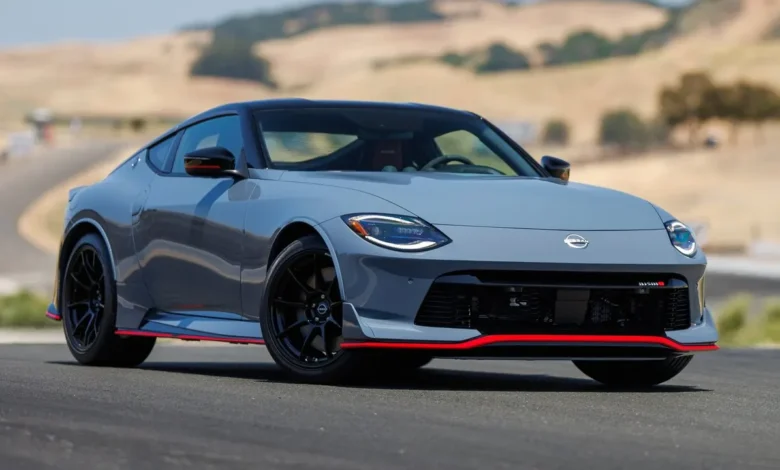
The Nissan Z NISMO is many things simultaneously — a tribute to one of the most enduring and beloved sports car lineages in automotive history, a technically accomplished track-focused performance machine, a statement of Japanese engineering pride, and perhaps the clearest proof that Nissan’s performance division understands exactly what enthusiasts need from a rear-wheel-drive sports coupe in the modern era. Born from a partnership between Nissan’s mainstream engineering team and NISMO — the Nissan Motorsports division that has campaigned Nissan performance vehicles at the highest levels of international motorsport for decades — the Z NISMO takes everything that makes the seventh-generation Z a compelling and characterful grand touring coupe and transforms it into something sharper, faster, more communicative and more emotionally rewarding in every dimension that matters to a driver who truly loves the act of driving.
Gallery: Nissan Z NISMO
The Z nameplate carries more than fifty years of continuous heritage — a lineage that stretches from the original Datsun 240Z of 1969, which redefined what an affordable two-seat sports car from Japan could offer the world, through the successive generations that maintained that spirit of accessible, rear-wheel-drive performance through changing eras of automotive taste and regulation. The seventh-generation Z, launched for the 2023 model year with retro-inspired styling that cleverly referenced the proportions and design cues of both the 240Z and the beloved 300ZX, was warmly received as a stylish and comfortable grand touring coupe. The Z NISMO, arriving for 2024 and carrying forward for 2025 with additional colour options and refinements, addresses every area where enthusiasts felt the standard Z left performance ambitions unfulfilled — and does so with such comprehensive conviction that it creates what many observers regard as the version of the seventh-generation Z that should have existed from the very beginning.
Exterior Design and Aerodynamics: NISMO’s Aggressive Visual Identity
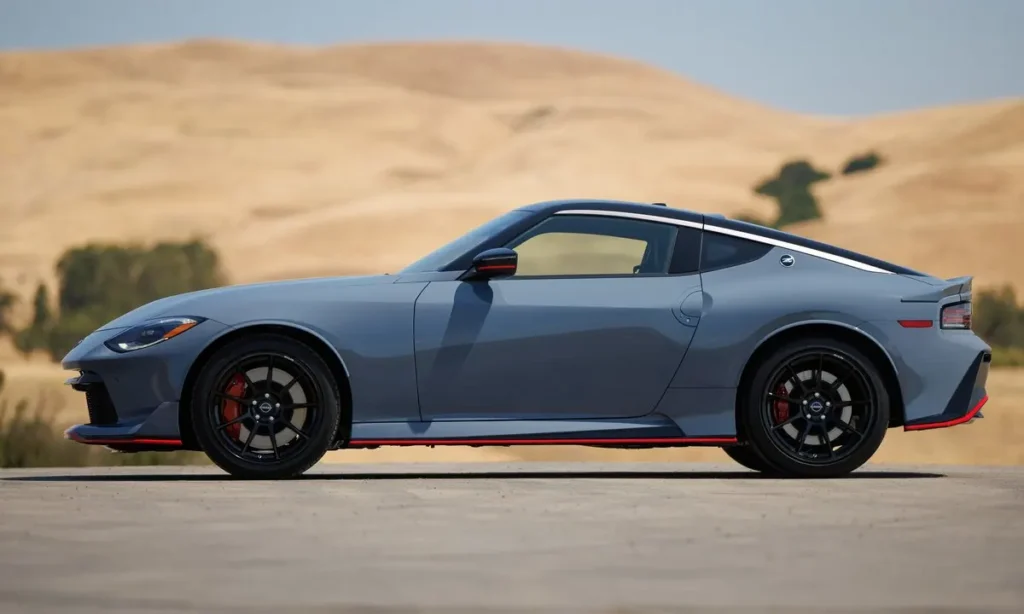
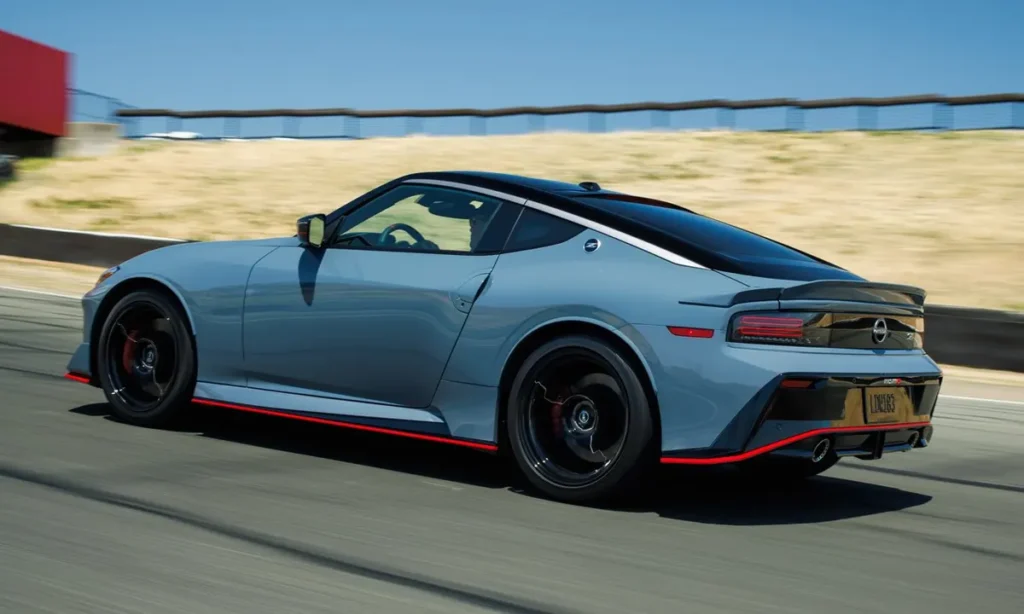
The visual transformation that NISMO applies to the standard Nissan Z is comprehensive, immediately apparent and deeply purposeful — creating an exterior identity that communicates the car’s performance intentions at every angle without resorting to gratuitous visual excess. Where the standard Z is already a handsome and well-proportioned sports coupe, the NISMO variant adds layers of aerodynamic intent and visual aggression that transform it into something that draws genuinely prolonged attention at car meets, on public roads and at track environments alike.
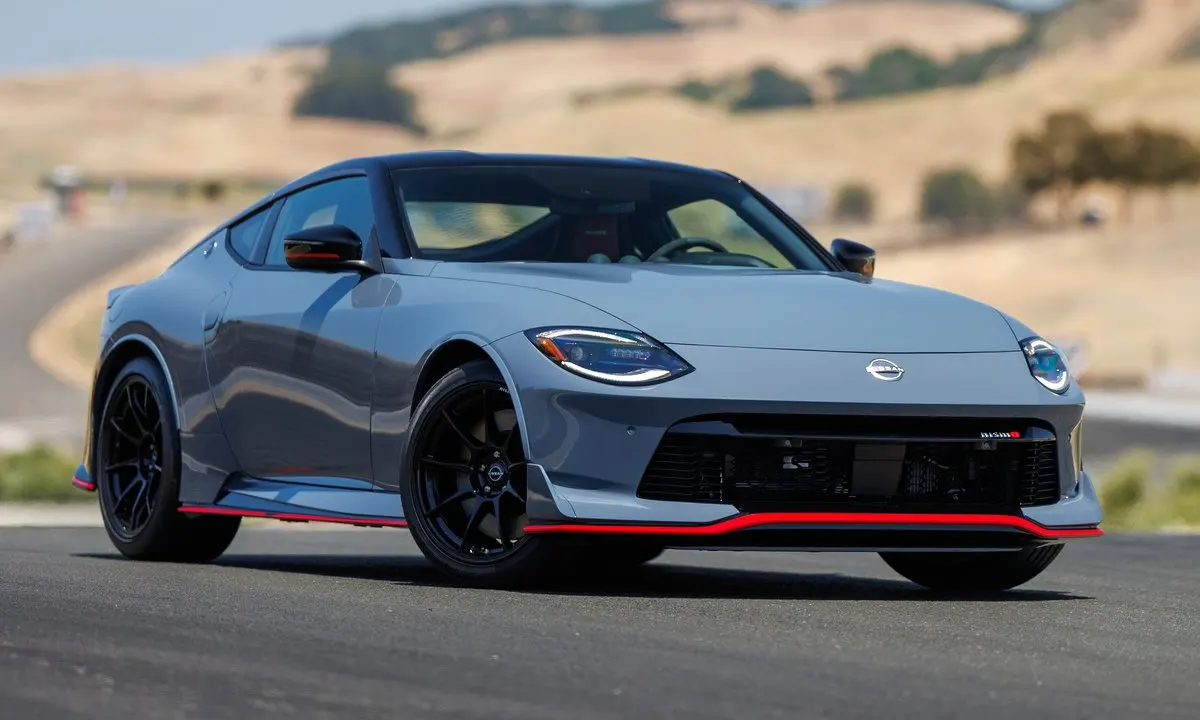
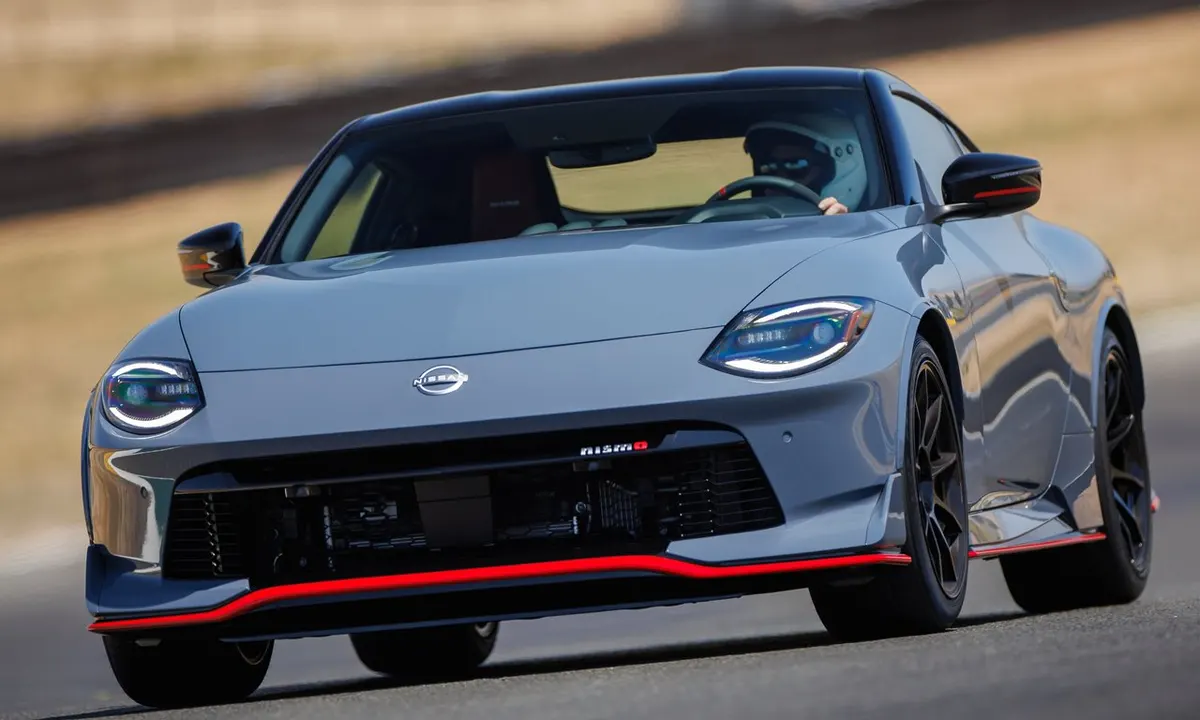
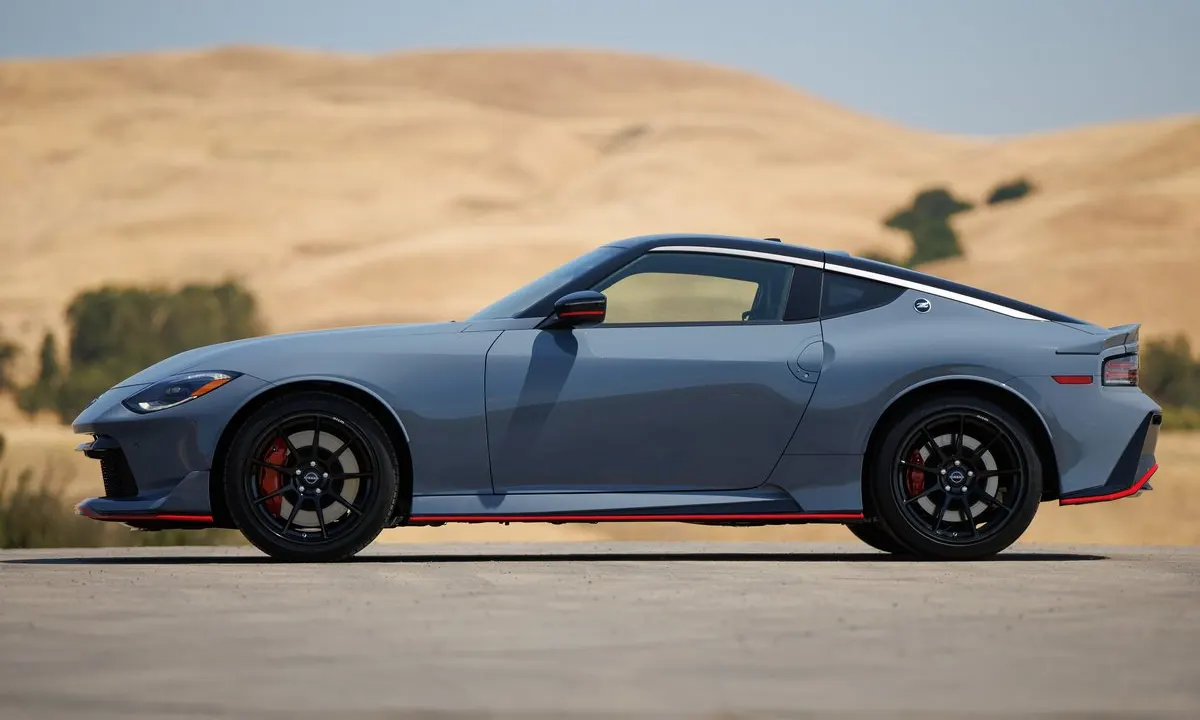
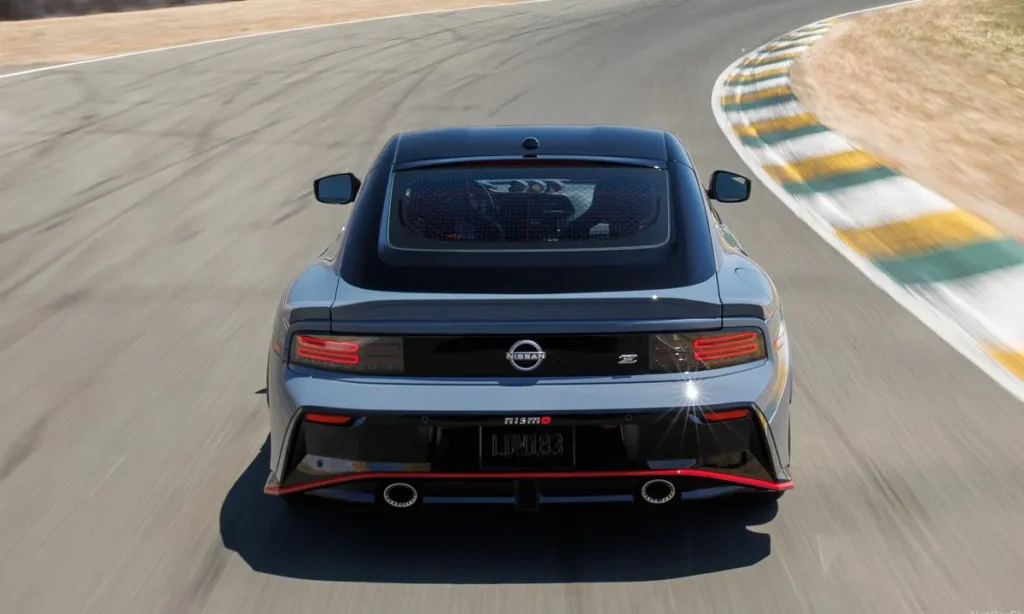
The front fascia, which NISMO designates the Grand Nose, is perhaps the single most visually transformative element of the NISMO exterior package. Redesigned from its standard Z counterpart with a more focused and aggressive lower line, the Grand Nose incorporates functional canards — small aerodynamic fins at the front corners of the bumper — that manage airflow separation at the front axle and contribute to aerodynamic stability at elevated speeds. A prominent front splitter sits below the bumper, generating front-axle downforce and contributing to the aerodynamic balance that NISMO’s engineers have carefully calibrated across the full range of the car’s performance envelope. The overall effect is a front end that looks more focused, more purposeful and considerably more track-ready than the standard Z’s already attractive nose.
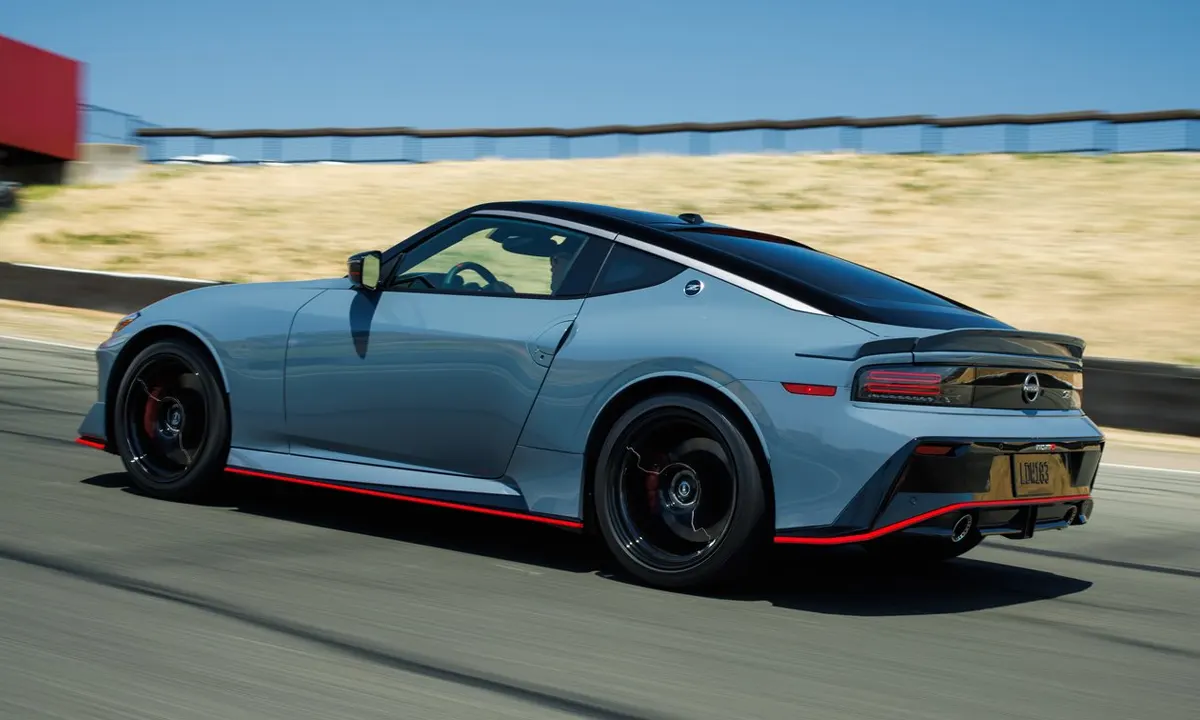
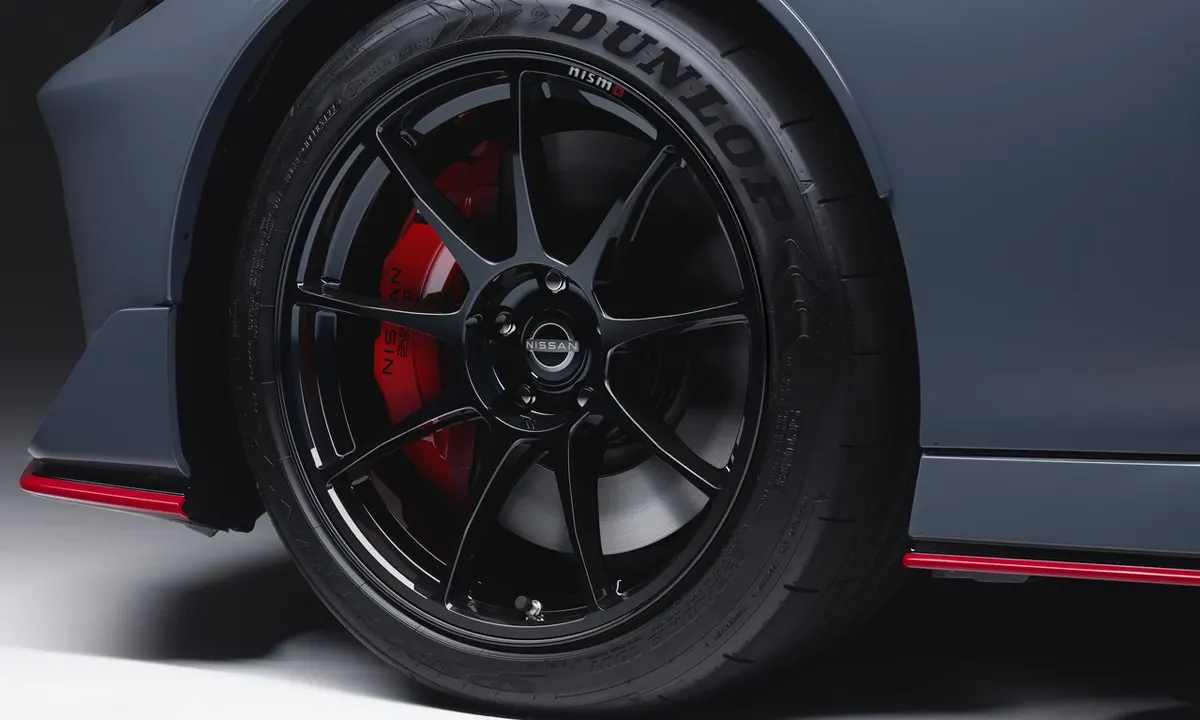
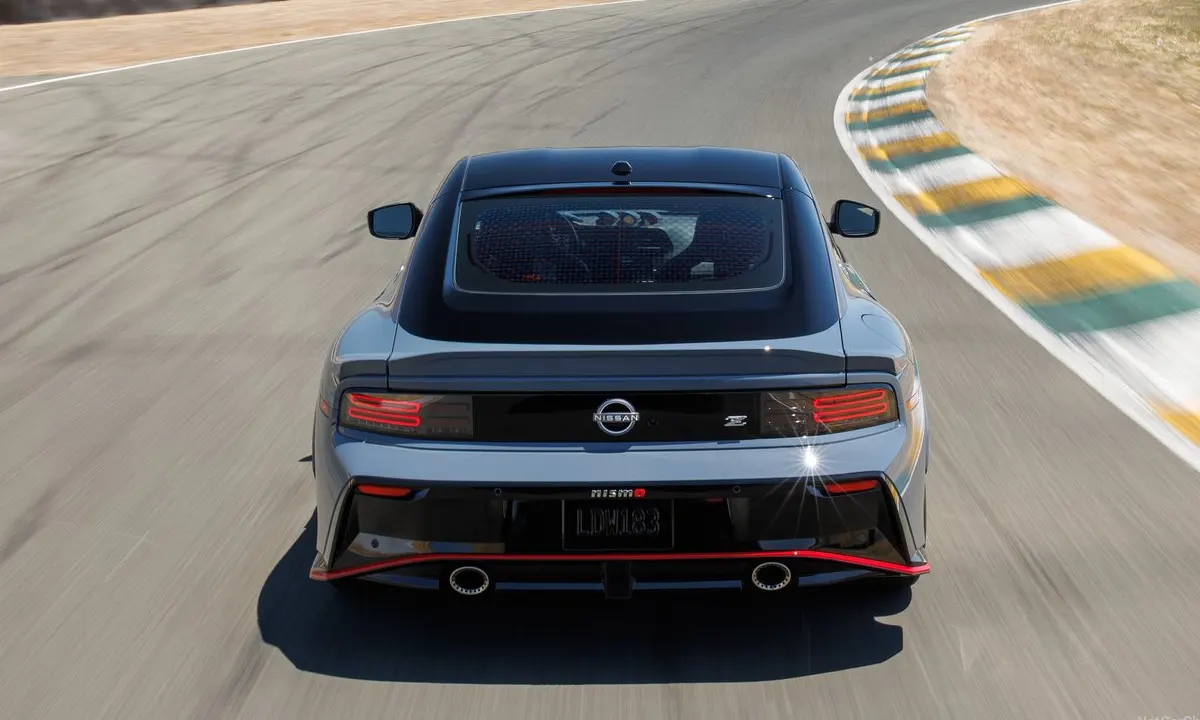
Along the sides, reshaped side skirts reduce aerodynamic lift along the body’s lower surfaces, working in conjunction with the front and rear aerodynamic elements to manage airflow coherently from nose to tail. Flush-fitting door handles maintain the body surface’s aerodynamic cleanliness, while the NISMO’s signature continuous red accent stripe — a thin line of vivid red that runs around the entire body perimeter, framing the lower sections of the bumpers and side skirts — creates a visual signature as distinctive and immediately recognisable as any detail in the performance car world. This red stripe, along with red brake caliper accents visible through the spokes of the 19-inch Rays forged aluminium wheels, creates a visual connection to NISMO’s motorsport identity that requires no badging to communicate.
The 19-inch Rays forged wheels deserve particular attention as one of the Z NISMO’s most admired details. Rays, the legendary Japanese wheel manufacturer responsible for supplying many of the world’s most respected motorsport programmes with their wheel technology, produces these nine-spoke units specifically for the Z NISMO in a design that balances visual drama with lightweight construction. Their fitment with wider rear tyres — Dunlop SP Sport Maxx GT600 performance rubber measuring 285/35 ZR19 at the rear, the same compound used on the Nissan GT-R — provides a visual breadth at the rear axle that emphasises the car’s planted, rear-biased character. At the rear, a taller, wider spoiler extending outward onto the rear fenders generates meaningful downforce while reinforcing the NISMO’s visual width and aerodynamic commitment. The reshaped rear diffuser completes the aerodynamic package, reducing drag while managing the exit velocity of air flowing beneath the car’s floor.
Twin-Turbo V6 Performance: GT-R Technology in a Sports Coupe Body
The mechanical heart of the Nissan Z NISMO is its VR30DDTT twin-turbocharged 3.0-litre V6 engine — a unit that, in NISMO-specification tune, produces 420 horsepower and 384 lb-ft of torque, representing a 20-horsepower and 34 lb-ft improvement over the standard Z’s already capable baseline figures. These improvements, while modest in absolute terms, are the product of deeply considered and technically sophisticated engineering changes that alter the engine’s character and delivery in ways that numbers alone cannot adequately describe.
The combustion chambers have been optimised using technology derived directly from the Nissan GT-R’s VR38DETT engine — one of the most highly regarded turbocharged V6 architectures in the history of Japanese performance engineering. Revised valve timing profiles improve the efficiency of gas exchange at higher engine speeds, contributing to the NISMO engine’s ability to deliver its peak power more usefully and more consistently across a broader rpm range. Enhanced intercooler capacity — the system that cools the compressed intake air before it enters the cylinders — reduces charge temperatures more effectively than the standard Z’s system, providing a meaningful benefit for sustained track use where heat saturation of the intercooler can cause power output to taper as lap times accumulate.
The twin turbochargers themselves, while physically identical to those on the standard Z, are calibrated to spin faster and generate higher boost pressure, extracting additional airflow from the same compressor wheels through revised electronic management parameters. Individual cylinder ignition timing — adjusted by the engine management system for each of the six cylinders independently rather than applying a single common map — allows optimal combustion timing to be maintained even as cylinder-to-cylinder variations in temperature and pressure emerge during sustained high-performance running. Together, these changes create an engine that delivers its power with greater immediacy, greater linearity and greater sustained consistency than the standard Z’s unit, particularly in the conditions of repeated hard acceleration that track driving naturally demands.
Power is transmitted exclusively through a nine-speed automatic transmission — a decision that has attracted the most consistent criticism of the NISMO package from the enthusiast community, which widely and vocally mourns the absence of a manual gearbox option. NISMO’s position is clear and commercially grounded: faster lap times are the primary objective for track-focused drivers, and the nine-speed automatic’s ability to execute gear changes with mechanical precision and consistent optimal timing outperforms what a human driver can achieve consistently through a manual clutch and gearbox. The transmission itself has been comprehensively recalibrated for the NISMO application, with performance-optimised shift software, uprated internal clutch packs and a Sport Plus mode exclusive to the NISMO that delivers shift speeds and throttle responses unavailable in any other Z variant. The result is a transmission that manages its responsibilities with impressive capability on both road and track, even if it denies the driver the physical involvement that a well-chosen manual would provide.
Chassis Dynamics: A Comprehensively Engineered Track Transformation
The most significant and most thoroughly considered aspect of the Nissan Z NISMO’s development is the comprehensive transformation of its chassis dynamics — an engineering programme that goes far beyond the simple spring and damper stiffening that defines many performance variants within a model range. NISMO’s engineers have instead approached the Z’s chassis as a holistic system, reinforcing the structure itself, recalibrating every dynamic component and optimising the interaction between suspension, steering, tyres and aerodynamics for the specific demands of track and performance road driving.
Structural reinforcement takes the form of additional bracing at the front core support and rear floor sections — additions that increase the torsional rigidity of the body structure and reduce the flex that can compromise chassis geometry consistency during the demanding lateral and longitudinal loads of track driving. Stiffer engine mounts reduce the movement of the powertrain within the engine bay under hard acceleration and braking, improving the precision of throttle response and reducing the variation in drivetrain geometry that softer mounts inevitably introduce. Together, these structural changes create a more rigid and dimensionally stable foundation for all of the suspension and dynamic calibration work that sits above them.
The front double-wishbone and rear multi-link suspension systems, while fundamentally shared with the standard Z in their geometry design, are equipped with unique NISMO-specification spring rates, damper valving and stabiliser bar configurations that transform their character entirely. Spring rates are substantially higher than those of the Z Performance, reducing body roll in corners and improving the precision with which suspension geometry changes are managed through directional changes. Damper valving has been calibrated to provide a controlled and progressive response — firm enough to maintain aerodynamic ride height consistency and minimise chassis movement under load, yet not so rigid as to cause the tyre contact patch to skip and bounce on imperfect road surfaces in the manner of a truly uncompromising racing setup. The result is a chassis balance that experienced reviewers consistently describe as among the finest of any rear-wheel-drive coupe in the Z NISMO’s price category — communicative, progressive and deeply rewarding for drivers who invest the time to understand and exploit its capabilities.
Front brake rotors have been enlarged by one inch compared to the Z Performance specification, now measuring 15 inches in diameter, and are gripped by four-piston front calipers finished in the NISMO signature red. This braking system delivers stopping distances of approximately 94 feet from 60 mph — a figure that reflects the combined benefit of larger swept rotor area, optimised pad compounds and the grip contribution of the Dunlop SP Sport Maxx GT600 performance tyre specification. Track testing consistently confirms that the braking system maintains composure and consistent pedal feel through repeated heavy braking events of the kind that circuit driving demands, with no evidence of thermal fade that might compromise safety or driver confidence after multiple laps.
Interior: The Purpose-Built Driver Environment
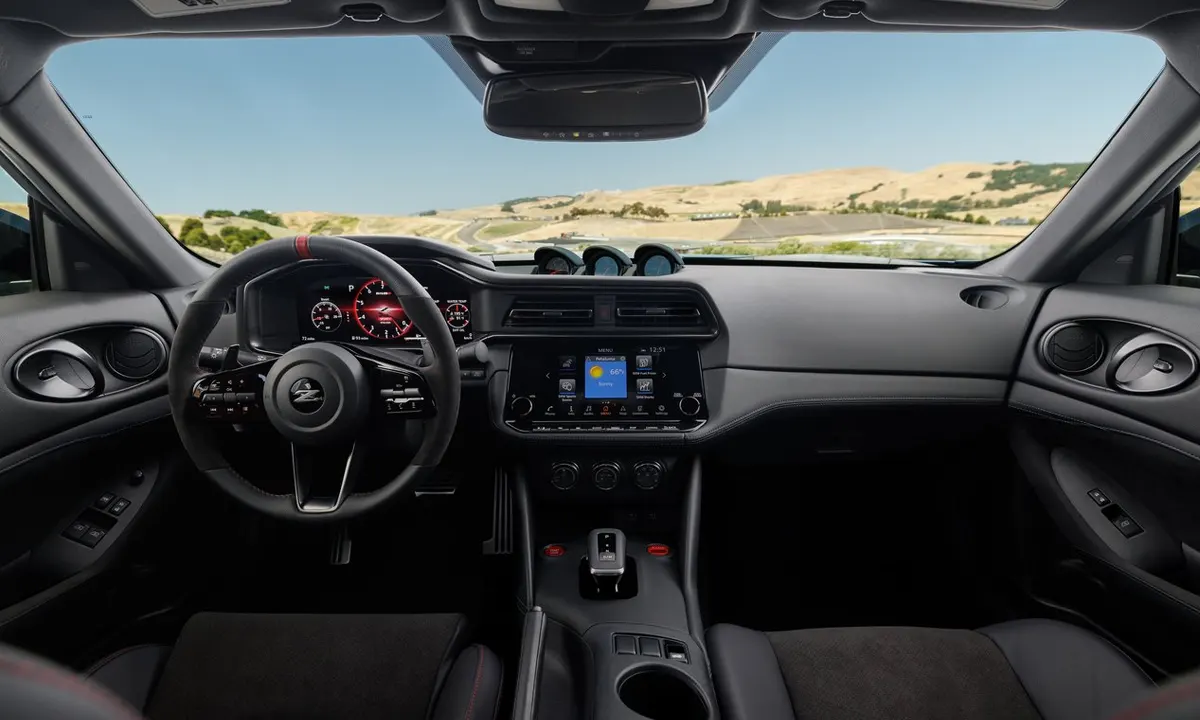
Inside the Nissan Z NISMO, the interior philosophy is one of deliberate minimalism combined with targeted luxury — a combination that creates an environment that feels purposeful and focused without descending into the spartan discomfort of a dedicated competition vehicle. The cabin remains true to the Z’s two-seat, driver-focused architecture, with every significant visual and tactile detail either unchanged from the standard Z in the interest of proven usability or specifically upgraded for the NISMO application in the interest of driving precision and engagement.
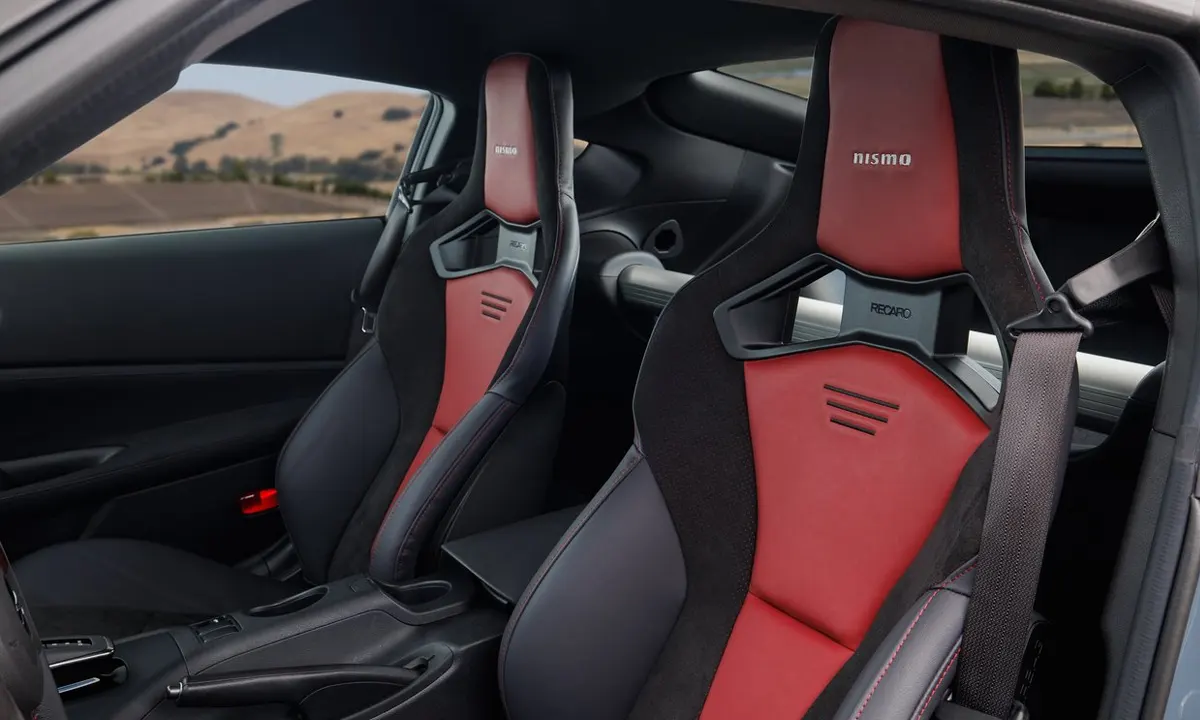
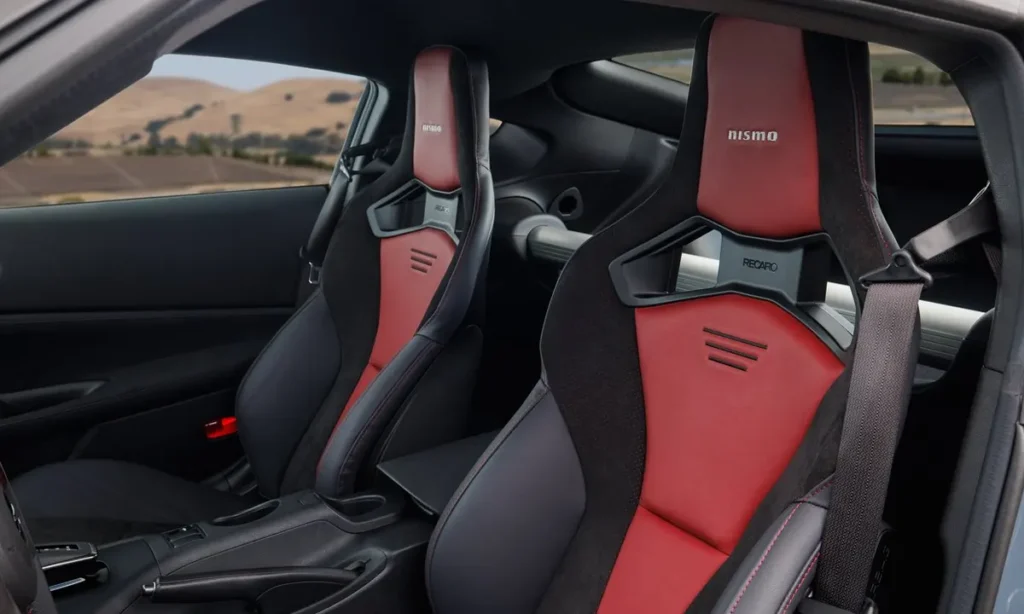
The most immediately impactful interior upgrade is the fitment of NISMO-specific Recaro bucket seats, upholstered in black Alcantara with contrasting red upper section inserts and NISMO embroidery in the headrests. These seats provide the lateral support and secure occupant positioning that high-cornering-load track driving demands, holding the driver firmly in place through the Z NISMO’s most aggressive directional changes without the discomfort that more extreme carbon-backed racing seats typically impose. They sacrifice the heating, cooling and power adjustment functions of the Z Performance’s leather chairs, but for drivers whose priority is performance driving, the Recaro’s character and support capability more than justifies that trade. The manual adjustment system, comprising three rotary knobs that control seat position and backrest angle, provides sufficient range to accommodate most driver dimensions once the initial setup has been established.
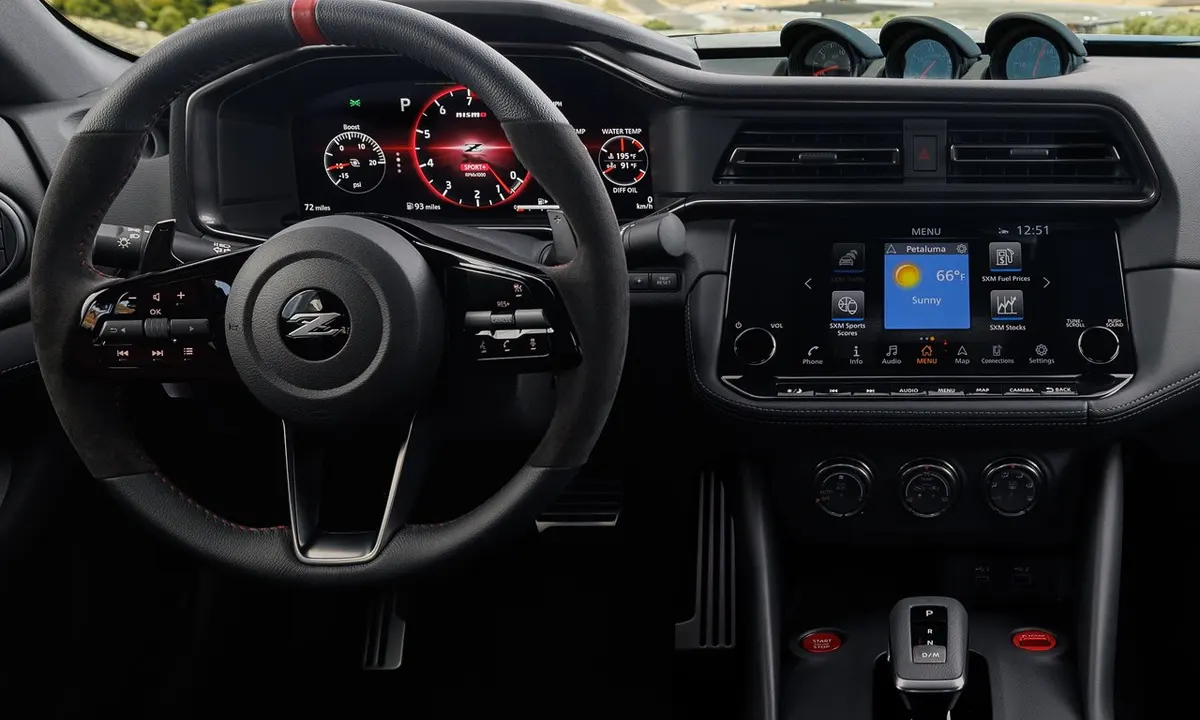
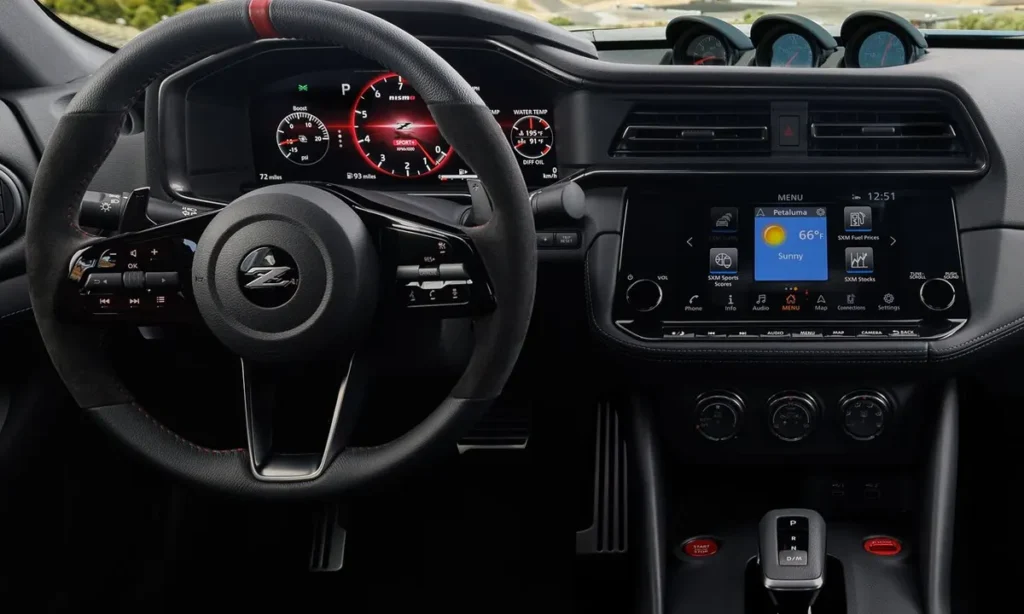
The Alcantara-wrapped flat-bottom steering wheel carries a distinctive red centre stripe at the twelve-o’clock position — a traditional motorsport reference that provides a tactile and visual centre reference during dynamic driving. GT-R-sourced paddle shifters behind the wheel provide the interface for manual gear selection, and their feel and responsiveness consistently receive praise from drivers who find them among the most satisfying of any gearchange mechanism in the class. A fully digital 12.3-inch customisable instrument cluster provides the driver with multiple display configurations encompassing speed, engine data, navigation information and a multi-function centre display that can be tailored to the driver’s preferred information priorities. A nine-inch upper infotainment touchscreen manages audio, connectivity and vehicle settings, with wireless Apple CarPlay and Android Auto integration providing modern smartphone connectivity.
Drive mode selection — Standard, Sport and the NISMO-exclusive Sport Plus — is managed through clearly labelled buttons on the centre console finished in the NISMO signature red, alongside the equally distinctive red engine start button. Sport Plus mode, reserved explicitly for track use in Nissan’s own recommendations, transforms the transmission shift speed, throttle mapping and overall drivetrain character to their most aggressive and focused settings, creating a driving experience that is meaningfully different from anything available in the standard Z’s mode range. Storage is understandably limited within a two-seat sports coupe architecture, with shelf space behind each seat accommodating helmets for track day use and modest personal items for road use — a packaging reality that owners accept as an entirely reasonable characteristic of a vehicle whose design priorities lie firmly elsewhere.
Read: Bentley Bentayga Speed Redefines the pinnacle of Ultra-Luxury SUV Performance
Nissan Z NISMO – Full Specifications and Performance Chart
| Category | Specification |
| Vehicle Type | Rear-Wheel Drive Two-Seat Sports Coupe |
| Engine | 3.0-Litre Twin-Turbocharged V6 (VR30DDTT) |
| Power Output | 420 hp |
| Torque | 384 lb-ft (521 Nm) |
| Power Over Standard Z | +20 hp / +34 lb-ft |
| Transmission | 9-Speed Automatic (NISMO-Retuned) |
| Drivetrain | Rear-Wheel Drive |
| Drive Modes | Standard, Sport, Sport Plus (NISMO-Exclusive) |
| 0–60 mph | Approx. 4.5 seconds (with Launch Control) |
| Top Speed | 155 mph (electronically limited) |
| Braking (60–0 mph) | Approx. 94 feet |
| Front Suspension | Double-Wishbone (NISMO Sport Tuned) |
| Rear Suspension | Multi-Link (NISMO Sport Tuned) |
| Front Brakes | 15-inch Discs, 4-Piston Calipers (Red) |
| Rear Brakes | Uprated Ventilated Discs |
| Front Wheels | 19-inch Rays Forged Aluminium |
| Rear Wheels | 19-inch Rays Forged Aluminium (Wider) |
| Front Tyres | 255/40 ZR19 Dunlop SP Sport Maxx GT600 |
| Rear Tyres | 285/35 ZR19 Dunlop SP Sport Maxx GT600 |
| Aerodynamics | Grand Nose, Canards, Side Skirts, Rear Spoiler, Diffuser |
| Chassis Reinforcement | Front Core Support, Rear Floor Bracing |
| Engine Mounts | Stiffened NISMO Specification |
| Seats | NISMO Recaro Alcantara with Red Inserts |
| Steering Wheel | Alcantara Flat-Bottom with Red Stripe |
| Instrument Cluster | 12.3-inch Fully Digital |
| Infotainment Screen | 9-inch Touchscreen |
| Connectivity | Wireless Apple CarPlay, Android Auto |
| Audio | Bose 8-Speaker System |
| Safety Systems | Nissan Safety Shield (Blind Spot, Lane Departure, Emergency Braking) |
| Kerb Weight | Approx. 3,704 lbs (1,680 kg) |
| Fuel Economy | 17 City / 24 Highway / 19 Combined mpg |
| Fuel Tank | 16.4 gallons |
| Exterior Exclusives | Stealth Grey, Bayside Blue, Red/Black Roof (2025) |
| Warranty | 3-Year/36,000-Mile Bumper-to-Bumper; 5-Year/60,000-Mile Powertrain |
| US Starting MSRP | From USD $65,750 |
The Z NISMO in Competition Context: Where It Stands Among Rivals
The Nissan Z NISMO occupies a fascinating and keenly contested position in the global performance coupe landscape. At its price point of approximately $65,750 to $69,000 depending on specification and destination charges, it competes directly with vehicles of considerable reputation and capability — the Toyota GR Supra 3.0, the BMW M2, the Ford Mustang Dark Horse and, from further afield, several European performance coupes that bring their own combination of heritage, engineering sophistication and driving character to the comparison.
Against each of these rivals, the Z NISMO presents a compelling but nuanced case. Its 420-horsepower twin-turbo V6 provides competitive outright power, and its Dunlop GT600 tyre combination — the same compound used on the GT-R — gives it a level of lateral grip that belies its grand touring origins. Its aerodynamic package is more comprehensively developed than that of most direct competitors, and its structural reinforcement programme gives it a chassis rigidity that rivals costing considerably more cannot always match. The Rays-forged wheel and tyre combination, in particular, receives universal praise for the quality of road contact and steering feedback it provides — a quality that transforms the driving experience from the steering wheel backward in a manner that a purely numerical comparison of specifications fails to capture.
The absence of a manual transmission option remains the most discussed and most debated aspect of the Z NISMO’s specification, and it is difficult to dismiss as inconsequential in a segment where the GR Supra’s manual option has proved transformative for that car’s enthusiast reception. NISMO’s counter-argument — that lap times are faster and more consistent with the nine-speed automatic — is logically sound but emotionally unsatisfying for a significant portion of the buyer community that values the physical engagement of a manual gearchange as an intrinsic part of the sports car experience. It is the Z NISMO’s most meaningful limitation, and one that Nissan has not indicated any intention to address within the current generation’s lifespan.
Why the Nissan Z NISMO Matters More Than the Numbers Suggest
The Nissan Z NISMO is ultimately a vehicle whose significance transcends the sum of its specification sheet. It is the latest chapter in a fifty-five-year story of an affordable, rear-wheel-drive, naturally characterful sports car that has refused to surrender to the forces of homogenisation and practicality that have eliminated so many of its contemporaries from the market entirely. At a time when the global sports car segment is contracting year by year — as manufacturers retreat toward crossovers, electrification and the risk-averse products of spreadsheet-driven product planning — the Nissan Z NISMO’s existence is itself a statement of conviction that rear-wheel-drive, petrol-engined, two-seat sports coupes deserve to remain available, deserving and exciting.
NISMO’s transformation of the standard Z into the NISMO variant is as comprehensive and as technically committed as any performance division upgrade programme currently available in the mainstream sports car market. The chassis reinforcement programme, the GT-R-derived engine enhancements, the Rays-forged wheel specification, the Dunlop GT600 tyre fitment, the aerodynamic package and the Recaro interior transformation together create a vehicle that genuinely earns its significant price premium over the standard Z — not through badge value or marketing positioning, but through measurably and experientially superior driving dynamics that experienced drivers recognise and appreciate immediately behind the wheel.
For anyone who loves the history of the Z car, appreciates the craft of NISMO’s motorsport-derived engineering, values the sensory involvement of a rear-wheel-drive sports coupe on a great road or a racing circuit, and recognises the increasingly rare opportunity to purchase a new vehicle of this character at this price point, the Nissan Z NISMO represents one of the most compelling and most emotionally rewarding purchases currently available in the global performance car market. It is not perfect. But in its imperfection — its stubborn analogue character, its focused and purposeful driving dynamics and its unashamed celebration of a fifty-five-year sporting heritage — lies much of its considerable and enduring appeal.