Pagani Huayra 70 Trionfo: A Hypercar Born From a Founder’s Legacy and an Atelier’s Refusal to Accept Finality
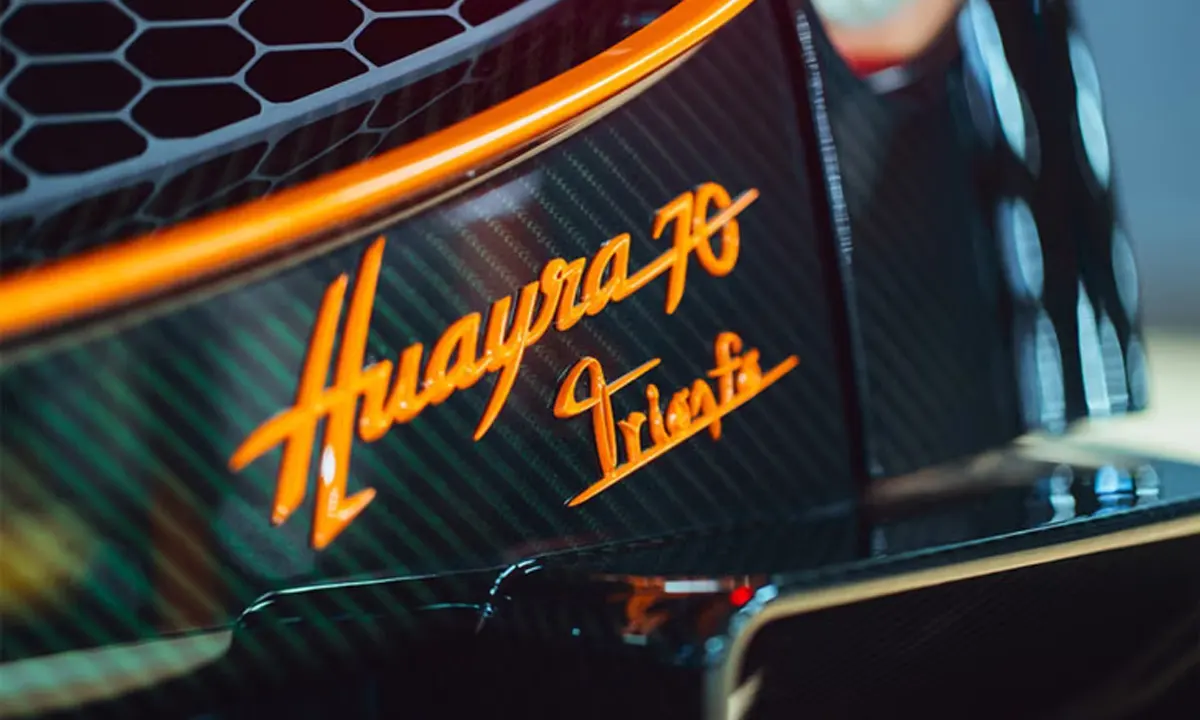
Pagani Huayra 70 Trionfo: There is a category of automobile that exists entirely outside the commercial logic that governs the mainstream automotive industry — a category defined not by market research, competitive positioning or volume targets but by the singular conviction of a founding mind that the act of building a car is, at its most essential, an act of artistic expression that admits no compromise and brooks no expiration date. The Pagani Huayra belongs to this category with a completeness that no other car in production can genuinely claim, and the Huayra 70 Trionfo — revealed in January 2026 as the first of three ultra-exclusive examples commissioned to mark Horacio Pagani’s seventieth birthday — demonstrates with characteristic and almost irrational clarity that the Atelier in San Cesario sul Panaro does not consider any of its creations truly finished as long as its founder has something new to say through them. The Huayra was officially retired to make room for the Utopia. The retirement, as the Trionfo confirms with 834 horsepower and a gated manual shifter, was provisional at best.
Gallery: Pagani Huayra 70 Trionfo
The Birthday Commission and the Precedent It Follows
To understand the Huayra 70 Trionfo’s significance, it is necessary to situate it within a tradition of birthday tributes that Pagani has established across two decades of producing the world’s most obsessively crafted automobiles. When Horacio Pagani turned sixty, the occasion was marked with the Zonda HP Barchetta — a three-car limited series that demonstrated the Italian manufacturer’s willingness to return to a nameplate long considered retired and invest it with fresh engineering ambition as a personal tribute to its creator. That car, like the Trionfo, was produced in three examples. The parallel is deliberate and the philosophy consistent: a milestone in the founder’s life is not an occasion for a commemorative plaque or a special edition badge applied to a standard production model, but for a commission of such engineering and aesthetic ambition that it represents a genuine new chapter in the model’s story rather than a footnote to it.
The Huayra 70 programme extends to three vehicles total, with the Trionfo being the first to be revealed and delivered — its owner, based in Cincinnati, having shared photographs and powertrain confirmation through social media channels before any official Pagani press release formalised the car’s existence. The remaining two Huayra 70 examples are understood to be in various stages of production at the time of writing, with their individual names, specifications and design languages expected to diverge from the Trionfo in ways that reflect Pagani’s commitment to treating each commissioned car as an individual creative work rather than a numbered copy of a template.
A Body That Shares Almost Nothing With the Car It Celebrates
The most immediately striking fact about the Huayra 70 Trionfo’s construction is the radical extent of its visual departure from the standard Huayra platform on which it is based. Only two components carry over from the production car without modification: the door structures and the window frames. Every other body element — every surface, every aerodynamic appendage, every lighting unit, every piece of carbon fibre that defines the car’s silhouette — is entirely new, purpose-designed and purpose-fabricated for this three-car commission by Pagani’s Grandi Complicazioni division, the internal atelier team responsible for the marque’s most ambitious bespoke and limited-series projects.
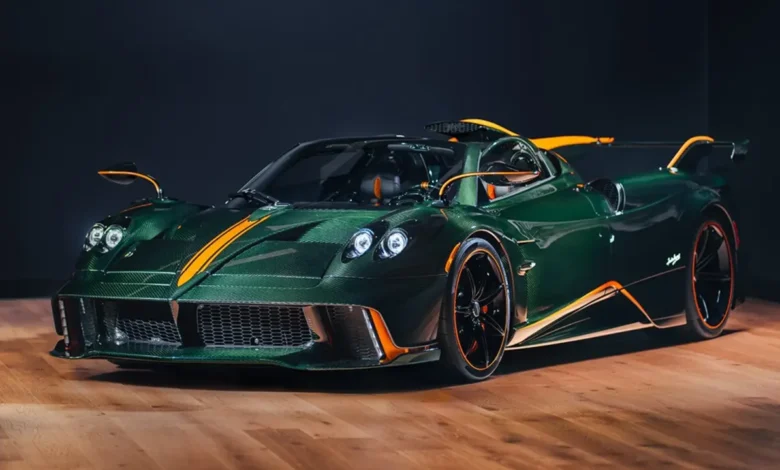
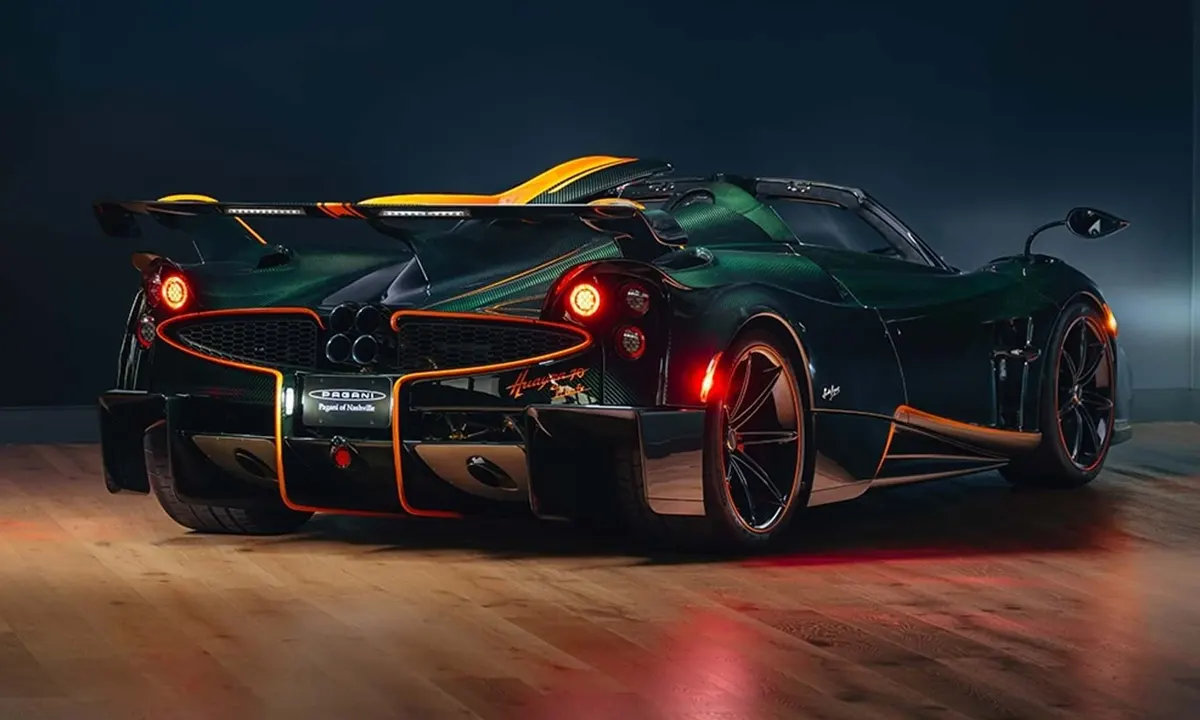
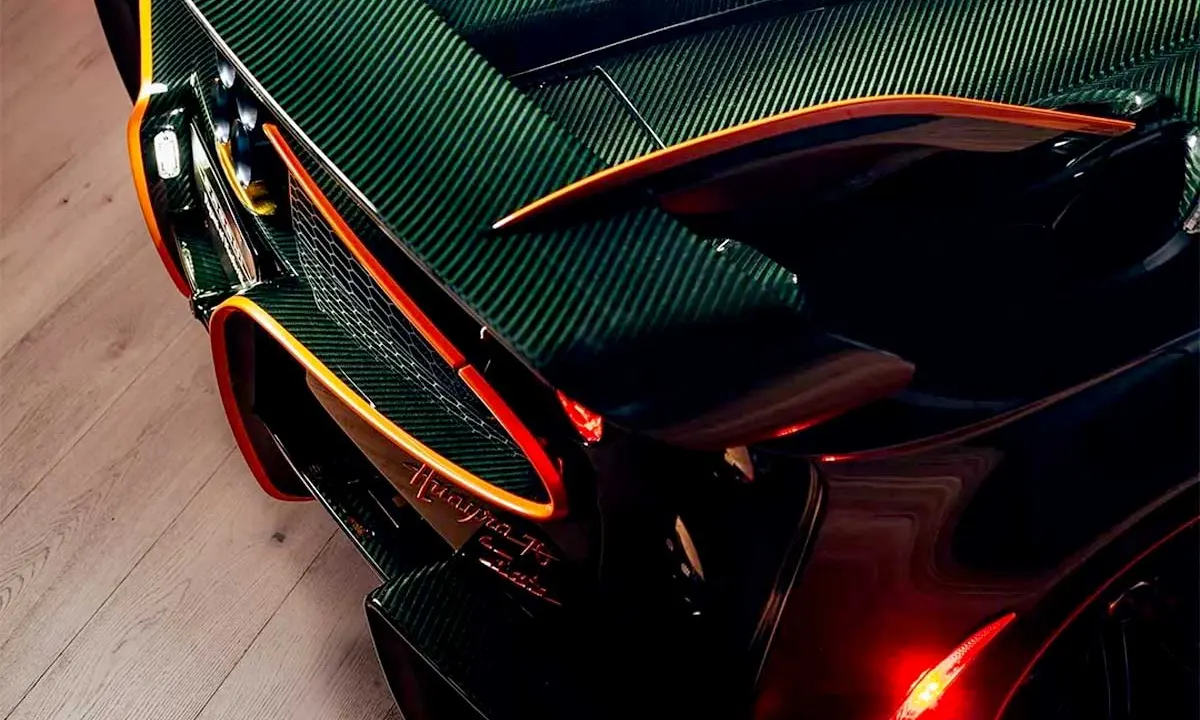
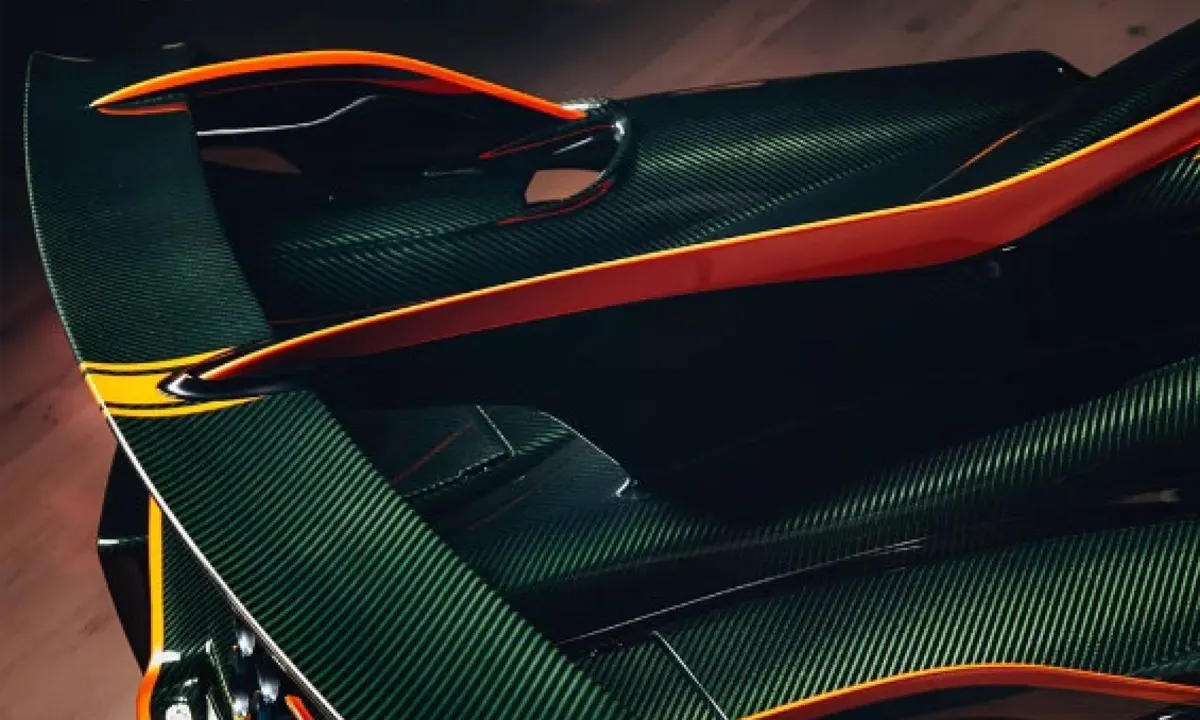
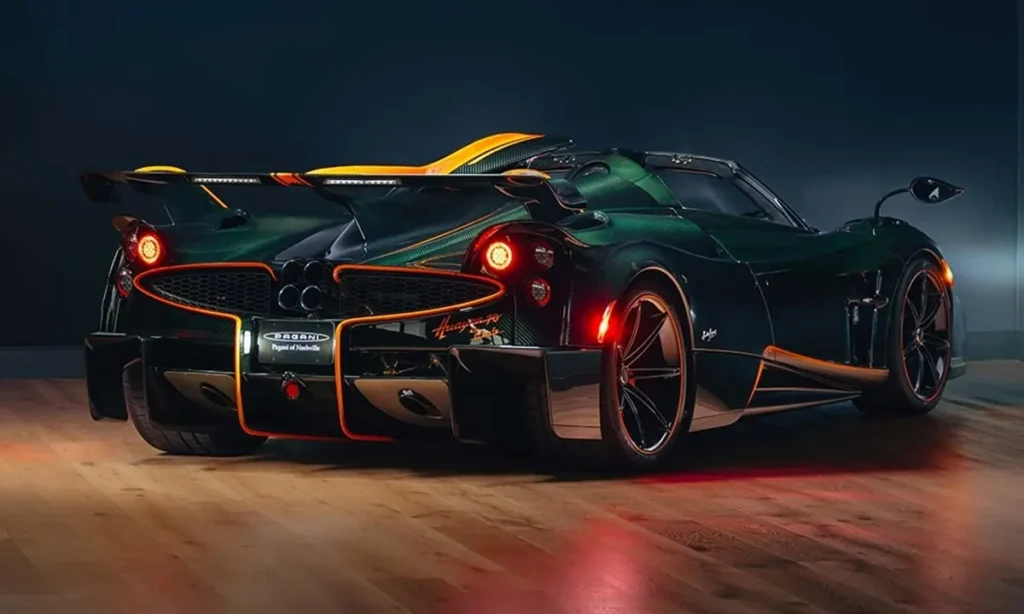
The front end abandons the Huayra’s characteristic quad-headlight arrangement in favour of a dual-point lighting signature whose design language draws a clear visual reference to the Huayra Codalunga longtail special edition, one of the most celebrated and visually distinctive interpretations of the Huayra platform to have preceded it. Vertical daytime running lights flank a simplified front bumper whose aerodynamic intent is evident in its sculpting without resorting to the visual complexity that characterises some earlier Huayra derivatives. The swan-neck rear wing — a design choice whose engineering logic involves mounting the wing to the upper body structure rather than the boot lid, preserving downforce consistency across the wing’s full span — carries custom endplates finished in the car’s signature orange accent colour, tying the aerodynamic hardware to the broader colour strategy in the manner of a couture house ensuring that every accessory speaks the same design language as the principal garment.
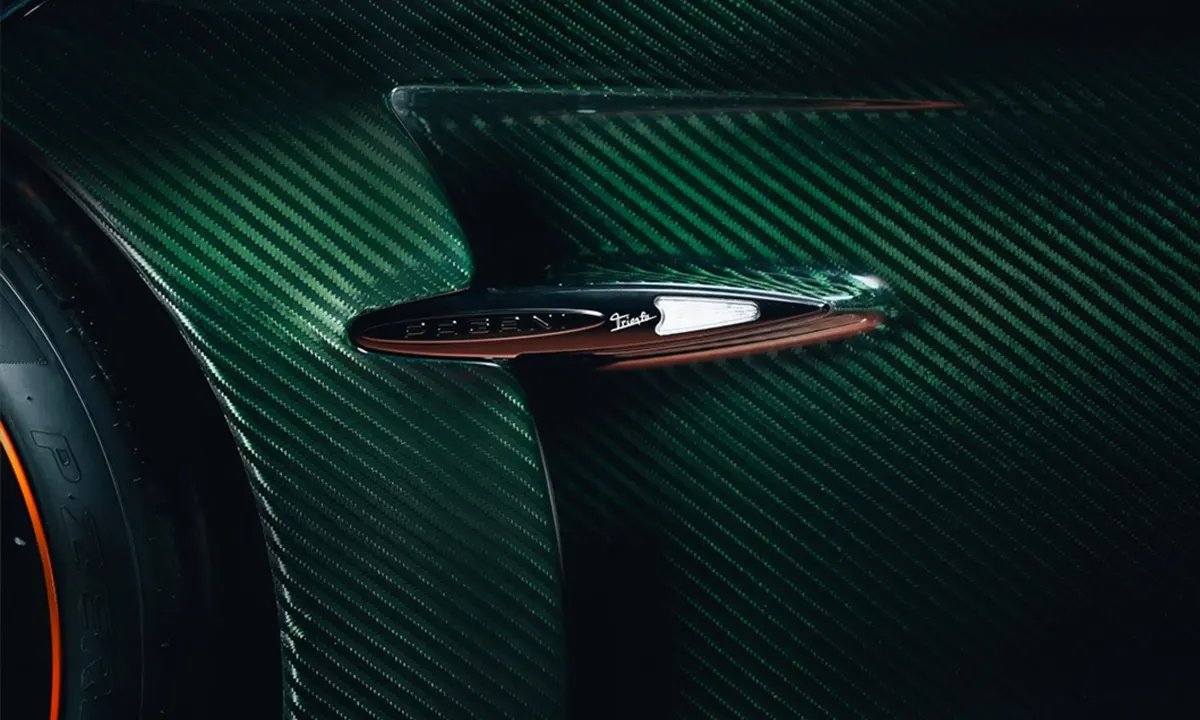
That colour strategy is itself a statement of confident restraint in a world where hypercar liveries frequently pursue complexity over coherence. The Trionfo’s body is finished in green-tinted carbon fibre — a material choice that simultaneously references Pagani’s long tradition of exposed carbon construction and adds a chromatic depth to the weave that plain black carbon cannot achieve. Against this foundation, orange accents are applied with the deliberateness of a painter who understands that the accent colour’s power derives from the discipline of its application rather than its quantity. The hood receives orange treatment, as do the front intakes, side skirts, side sills, roof scoop and rear fascia — a distribution that traces the car’s aerodynamic airflow path with the accent colour, creating a visual map of the car’s engineering priorities that is as functionally logical as it is aesthetically satisfying.
834 Horsepower and a Manual Transmission: The Engineering Case for Continuing the Huayra
The powertrain specification of the Huayra 70 Trionfo makes an argument about the car’s engineering ambition that its visual drama only partially prepares the observer to receive. The heart of the Trionfo is the Mercedes-AMG twin-turbocharged 6.0-litre V12 — a unit whose presence in the engine bay of every road-going Huayra has been among the constants of the platform’s long production history — in a state of tune that produces 834 horsepower. This figure represents a meaningful step beyond the 791 horsepower extracted from the same fundamental architecture in the Huayra Roadster BC, itself a car that represented the upper limit of the platform’s development at the time of its production, and situates the Trionfo at the performance level of the most extreme road-legal Huayra variants yet produced.
The transmission paired to this output is, by any reasonable measure, the most significant engineering decision in the Trionfo’s specification — because the Huayra’s long production history had been defined entirely by automated-manual gearboxes whose paddle-shifted convenience was appropriate for the car’s original design intent but whose existence denied the driver the most direct and most emotionally unmediated form of mechanical communion that the powertrain’s character deserved. The seven-speed manual transmission installed in the Trionfo — the same unit that Pagani developed and debuted in the one-off Huayra Epitome approximately eighteen months prior, making that car the first Huayra ever to receive manual shift capability — transforms the driving experience from one mediated by electronics into one governed entirely by the driver’s physical skill, timing and mechanical sympathy. In a hypercar world increasingly dominated by dual-clutch automatics whose shift speeds are measured in milliseconds, the decision to install a proper manual in a car producing 834 horsepower is a philosophical statement as much as an engineering one — the statement being that the measure of a driving experience is not the speed of its gear changes but the depth of its engagement.
The Grandi Complicazioni Atelier and the Craft Behind the Commission
The Trionfo was produced by Pagani’s Grandi Complicazioni division — an internal designation that translates from Italian as, approximately, the great complications, and which describes both the complexity of the work undertaken and the philosophy that animates it. This team is responsible for Pagani’s most ambitious client commissions, where the specification brief is not constrained by production feasibility or volume economics but only by the limits of what the Atelier’s craftsmen and engineers can achieve in the time allocated to a project of this scale. The interior of the Trionfo, which Pagani has described as immersing the driver in a composition of the finest leathers and textures available to the marque’s interior specialists, reflects the same commitment to material quality and craft execution that has distinguished every Pagani interior since the original Zonda established the benchmark for what a hand-built Italian hypercar’s cockpit could achieve.
The first completed Trionfo was delivered to its owner in Cincinnati — a detail that places one of the three most exclusive automobiles produced in 2026 in an American city rather than the European luxury capital or Middle Eastern collector context that might be the expected backdrop for a car of this rarity and price. Standard Huayra models have historically commanded prices between three million and seven million dollars depending on specification and customisation level, and the Trionfo’s combination of bespoke bodywork, elevated powertrain specification and manual transmission development investment places it comfortably within or above that range, though Pagani has, characteristically, released no official pricing for a car whose allocation was effectively spoken for before its public existence was confirmed.
Read: Forget Lamborghini Urus, Ferrari Purosangue Is Here
Pagani Huayra 70 Trionfo Specification Summary
| Specification | Detail |
| Engine | 6.0-litre Twin-Turbocharged V12 (Mercedes-AMG) |
| Power Output | 834 horsepower |
| Transmission | 7-speed manual |
| Drive Configuration | Rear-wheel drive |
| Production Number | 3 units (Trionfo is the first) |
| Base Platform | Huayra Roadster BC |
| Carry-Over Components | Doors and window frames only |
| Livery | Green carbon fibre with orange accents |
| Delivered | First unit — Cincinnati, USA |
| Estimated Price Range | $3 million – $7 million+ |
The Huayra That Will Not Rest
The Huayra 70 Trionfo is, in one framing, a birthday present — three extraordinarily exclusive automobiles commissioned to mark a milestone in the life of the man whose name appears on the building where they were created. In a more accurate framing, it is a demonstration that the most compelling automotive nameplates are those whose creators refuse to treat their retirement as a creative conclusion. The Zonda refused to die for more than two decades, each new iteration revealing something about the car’s fundamental architecture that previous versions had not fully expressed. The Huayra has been retired, returned, retired again and returned again across a production history that stretches from 2011 to the present, each new chapter adding to rather than diminishing the nameplate’s cumulative significance. The Trionfo, with its rebuilt body, its elevated powertrain output and its belated but entirely correct adoption of manual shift control, is the most concentrated expression of what the Huayra represents — not a model in a manufacturer’s lineup but an ongoing creative act whose completion is always provisional, always subject to revision, and always dependent on whether the man who conceived it has something new worth saying.