V8 Cars Still Available In USA in 2026. A Celebration of The Engines That Refuse To Die
V8 Cars Still Available In USA: There is a moment approaching in the automotive landscape — not a hypothetical, not a distant theoretical, but a measurable, model-year-by-model-year reality — when the V8 engine will no longer be available in any new production car sold in the United States market. That moment has not arrived yet. In 2026, a genuinely remarkable number of new vehicles — sports cars, luxury coupes, performance sedans, full-size trucks and muscle-infused SUVs — still offer the eight-cylinder experience in forms ranging from the elegantly restrained to the operatically absurd. But the list is demonstrably shorter than it was five years ago. The affordable V8 sedan has effectively ceased to exist as a new-car proposition. The V8 pickup truck is retreating toward the premium end of the market. And the naturally aspirated V8 sports car, outside of a handful of extraordinary survivors, has largely given way to turbocharged six-cylinders and electrified powertrains that deliver comparable or superior performance figures without the acoustic and mechanical character that V8 devotees consider non-negotiable. This is a guide to the V8 cars still available in the USA in 2026 — the survivors, the holdouts and the machines whose eight-cylinder commitment represents both a technical statement and a cultural one.
Why the V8 Is Disappearing and Why It Has Not Disappeared Yet?
Understanding the current state of V8 availability requires a brief accounting of the forces working against it, because they are real and they are accelerating. Emissions regulations — both the federal Corporate Average Fuel Economy standards and the state-level requirements that California’s framework extends to a substantial portion of the American car market — make every naturally aspirated large-displacement engine progressively more expensive to keep in production. Turbocharged four-cylinder and six-cylinder engines now deliver power outputs that would have required a V8 a decade ago, doing so at meaningfully lower fuel consumption figures and with correspondingly lower fleet average emissions penalties for the manufacturers that offer them. Electric powertrains deliver instant torque and sub-three-second acceleration times that no V8 can match at equivalent price points in the new-car market. Against these forces, the V8 persists in 2026 for reasons that are simultaneously commercial and emotional — because a specific, loyal and financially committed segment of American car buyers continues to demand it, and because several of the cars that offer it remain, by any objective assessment, the best versions of what they are.
Chevrolet Corvette: America’s V8 Flagship in Every Form
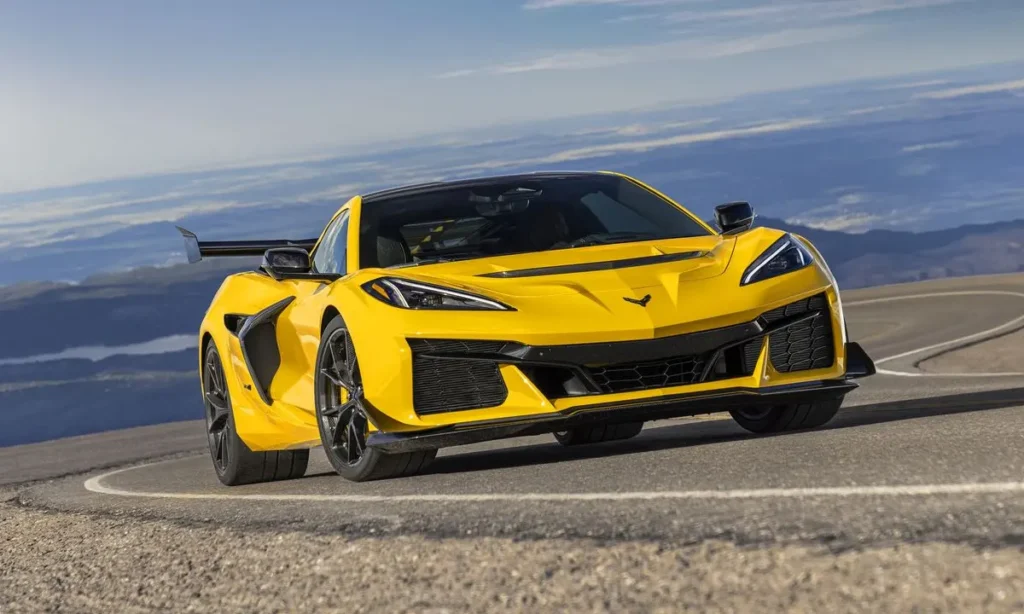
V8 Variants: Stingray (490 hp) | Z06 (670 hp) | ZR1 (1,064 hp combined)
The 2026 Chevrolet Corvette lineup represents the most comprehensive and most technologically advanced expression of American V8 engineering currently available in any production car at any price point, offered across three distinct powertrain architectures that collectively demonstrate how far the naturally aspirated and turbocharged V8 formats can be developed when the engineering resources and institutional commitment are serious. The base Stingray’s 6.2-litre naturally aspirated V8 produces 490 horsepower and drives the rear wheels through an eight-speed dual-clutch automatic transmission in a mid-engine chassis layout that delivers handling balance and cornering capability far beyond what the car’s $72,495 starting price would conventionally imply. The Z06 escalates to a 5.5-litre flat-plane-crank V8 — the highest-revving unit in Corvette history, spinning to 8,600 rpm and producing 670 horsepower with a mechanical intensity and acoustic character that consistently draws comparisons to European supercar engines costing three to five times as much. At the apex, the ZR1’s twin-turbocharged 5.5-litre V8 produces 1,064 horsepower from the combustion side of its powertrain alone, with additional electric assistance from the front axle contributing to a combined output that makes the 2026 ZR1 the most powerful production Corvette in history. The Corvette’s continued, uncompromising commitment to V8 power across its entire lineup — across three separate engine architectures, from naturally aspirated to twin-turbocharged — stands as the single most defiant and most convincing argument that the American V8 sports car is not merely surviving but actively evolving.
Ford Mustang GT and Dark Horse: The Last V8 Pony Car Standing
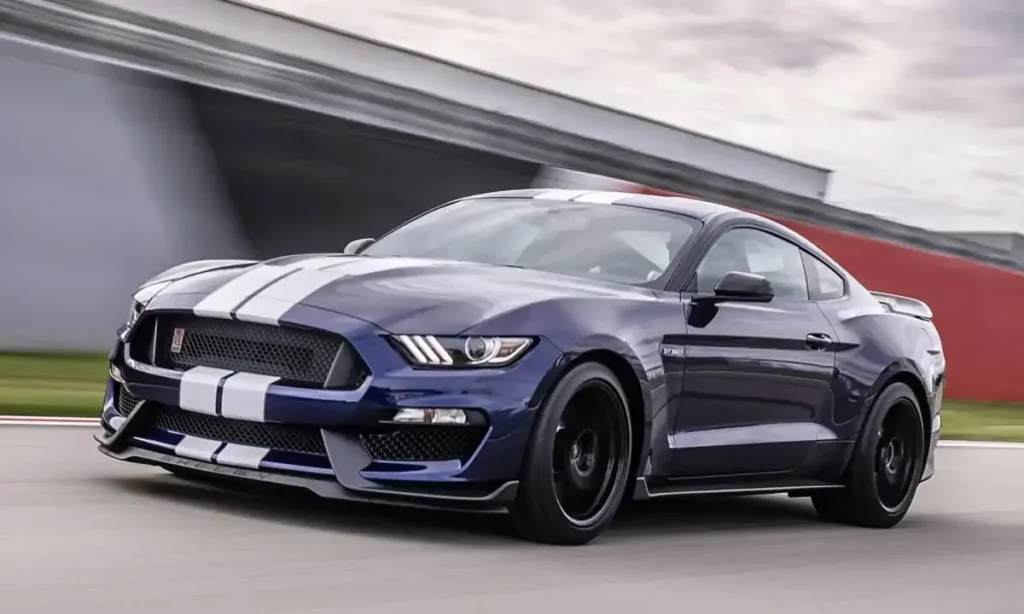
V8 Power: 480 hp (GT) | 500 hp (Dark Horse) | Starting Price: From approximately $43,000
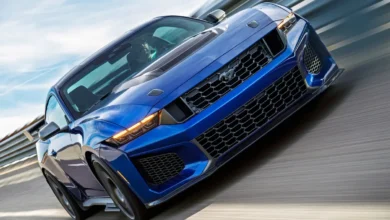
The Ford Mustang holds a distinction in 2026 that its history of sixty-plus years of production has never previously required it to claim: it is the only mass-produced, rear-wheel-drive sports coupe with a naturally aspirated V8 engine available at a mainstream price point anywhere in the American new-car market. Dodge’s departure from V8 muscle cars with the electrification of the Charger name has left the Mustang without a direct domestic rival for the first time in decades, and Ford’s response has been to lean into rather than soften the Mustang’s V8 identity. The 5.0-litre Coyote V8 produces 480 horsepower in GT trim and 500 horsepower in the track-focused Dark Horse variant, in both cases mated to the buyer’s choice of a ten-speed automatic or a six-speed manual transmission — one of the few new-car combinations of V8 and manual gearbox remaining in the American market. The naturally aspirated character of the Coyote — its linear power delivery, its willingness to rev, its acoustic presence at full throttle — provides the driving experience that the EcoBoost four-cylinder alternative, however capable, cannot replicate. For the buyer who intends to understand the Mustang’s character at its most fundamental and most historically authentic, the V8 is not an option — it is the point.
Cadillac CT5-V Blackwing: America’s Last V8 Performance Sedan
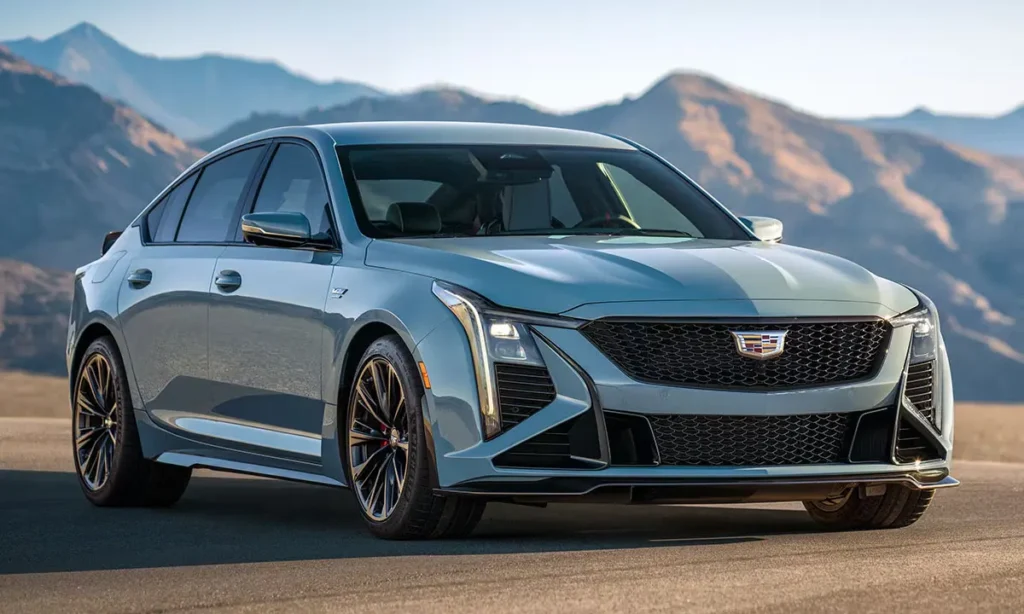
V8 Power: 668 hp (Supercharged 6.2L) | Transmission: 6-Speed Manual or 10-Speed Auto | Starting Price: From $91,095
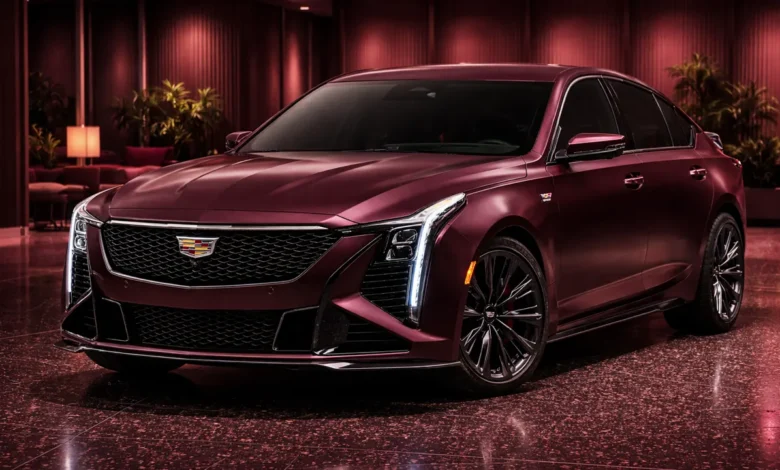
The Cadillac CT5-V Blackwing occupies a position in the 2026 American performance sedan market that is simultaneously unique and, in the context of the broader industry’s trajectory toward electrification, almost poignant — the last hand-built, supercharged V8 sports sedan available in the United States new-car market, and by several assessments the best performance sedan that Cadillac has ever produced. The 6.2-litre supercharged V8, producing 668 horsepower and 659 pound-feet of torque, is assembled by hand — a manufacturing distinction that Cadillac engineers and enthusiasts emphasise with genuine pride and that results in a power unit whose refinement and consistency exceed what automated production processes typically achieve at this output level. The six-speed manual transmission option places the Blackwing in an even rarer category — a high-performance luxury sedan with both a supercharged V8 and the option to row through its own gears, a combination that the global automotive market of 2026 simply does not offer elsewhere. Updated recently with a more aggressive front fascia and a 33-inch curved display integrating infotainment and instrumentation, the CT5-V Blackwing confirms that Cadillac has not allowed the Blackwing’s performance credentials to age while its technology provision fell behind. It will reach 200 miles per hour, accommodate four adults in considerable leather-trimmed comfort, and provide the kind of daily usability that makes its extremity feel accessible rather than demanding — a combination that no electrified rival currently approaches on emotional terms.
Dodge Durango: The V8 Family SUV That Refuses Compromise
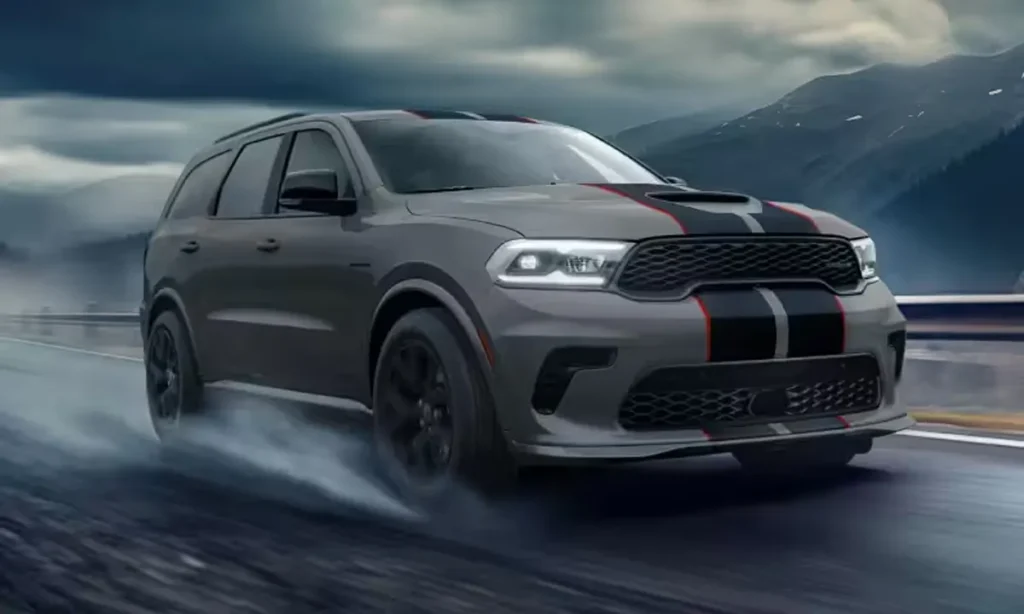
V8 Variants: 5.7L HEMI (360 hp) | 6.4L 392 HEMI (475 hp) | SRT Hellcat 6.2L (710 hp)
The 2026 Dodge Durango is the only three-row family SUV in the American market that is available exclusively with V8 power — Dodge having eliminated the V6 option entirely from the 2026 lineup in a move that positions the Durango as an unambiguous, unapologetic V8 proposition for the buyer who regards eight cylinders as non-negotiable even when the vehicle’s primary purpose is school runs and family road trips. The entry-level 5.7-litre HEMI produces 360 horsepower and 390 pound-feet of torque; the R/T advances to the 6.4-litre 392 HEMI with 475 horsepower and 470 pound-feet; and at the apex of the range, the SRT Hellcat variant carries the supercharged 6.2-litre HEMI producing 710 horsepower — making it, by a considerable margin, the most powerful three-row SUV currently available for sale anywhere in the world. The combination of standard all-wheel drive, an eight-speed automatic transmission and up to 8,700 pounds of towing capacity confirms that the Durango’s V8 power serves genuinely practical purposes as well as the emotional ones — towing a boat, hauling a trailer and accommodating seven occupants in genuine comfort are all within the Durango’s competence, and the HEMI soundtrack that accompanies those activities is available as standard equipment at every trim level.
Lexus LC 500: The Naturally Aspirated V8 Grand Tourer’s Final Act
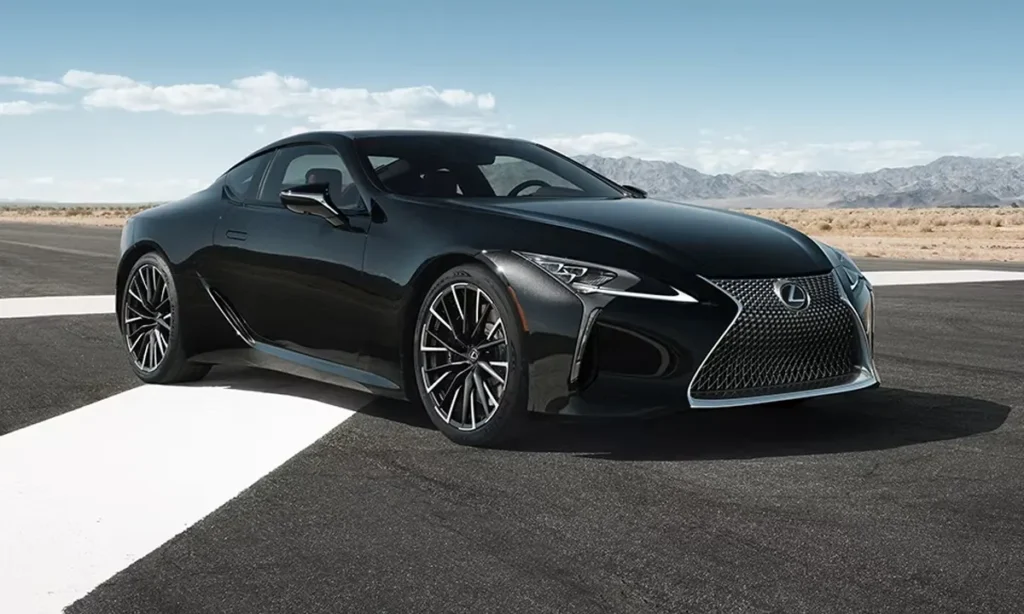
V8 Power: 471 hp (5.0L NA V8) | 0–60 mph: 4.4 Seconds | Starting Price: From $101,700
The Lexus LC 500 is, in 2026, carrying the additional significance of a confirmed final model year — Lexus having announced that this generation of the LC concludes production with the 2026 model, a designation that places the naturally aspirated 5.0-litre V8 at the centre of one of the most emotionally resonant final chapters in recent luxury car history. The 2UR-GSE V8 engine — shared with the RC F sports coupe and previously installed in the GS F and IS F — produces 471 horsepower and 398 pound-feet of torque from its naturally aspirated architecture, revving freely to its 7,100 rpm redline with a mechanical character and an exhaust note that no turbocharged or electrified alternative can authentically replicate. The 2026 Inspiration Series — limited to 200 units for the North American market and featuring Smoke Matte Gray exterior paint, carbon fibre roof, Active Rear Steering and a Mark Levinson audio system — underlines the cultural significance of this final year. For the buyer who considers the naturally aspirated high-revving V8 an irreplaceable sensory experience rather than merely a performance specification, the LC 500’s 2026 model year represents the last opportunity to acquire that experience in a new Lexus of this character, at any price.
Read: 5 Reasons Why the Porsche 911 Is Still Better Than Most Supercars
V8 Cars Still Available in the USA 2026 — Quick Reference
| Model | V8 Engine | Power | Starting Price |
| Chevrolet Corvette Stingray | 6.2L NA V8 | 490 hp | From $72,495 |
| Chevrolet Corvette Z06 | 5.5L Flat-Plane NA V8 | 670 hp | From $119,695 |
| Chevrolet Corvette ZR1 | 5.5L Twin-Turbo V8 | 1,064 hp | From $182,395 |
| Ford Mustang GT | 5.0L NA V8 (Coyote) | 480 hp | From ~$43,000 |
| Ford Mustang Dark Horse | 5.0L NA V8 (Coyote) | 500 hp | From ~$60,000 |
| Cadillac CT5-V Blackwing | 6.2L Supercharged V8 | 668 hp | From $91,095 |
| Dodge Durango SRT Hellcat | 6.2L Supercharged V8 | 710 hp | From ~$90,000 |
| Dodge Durango R/T | 6.4L 392 HEMI V8 | 475 hp | From ~$55,000 |
| Lexus LC 500 | 5.0L NA V8 | 471 hp | From $101,700 |
Buy One While You Still Can
The V8 cars available in the United States in 2026 share a characteristic that is easy to overlook when reviewing their power figures and their price points individually: they are all, without exception, the last of something. The Corvette is the last American mid-engine V8 sports car offered at its price point. The Mustang GT is the last affordable, naturally aspirated V8 rear-wheel-drive sports coupe in mass production. The CT5-V Blackwing is the last hand-built V8 performance sedan available in the American market. The Durango is the last V8-only three-row family SUV. The LC 500 is the last naturally aspirated V8 Lexus grand tourer — and the 2026 model year is confirmed as its final chapter entirely.
The case for buying any of them is not based on nostalgia alone — though nostalgia is a legitimate and well-documented factor in the purchase decisions that the V8’s remaining devotees make. It is based on the recognition that the acoustic character, the linear power delivery and the mechanical personality of the naturally aspirated and supercharged V8 are not engineering deficiencies awaiting correction but experiences with their own irreplaceable value — experiences that the automotive industry’s direction strongly suggests will not be available as new-car propositions much longer. In 2026, the window is still open. The question is how long it will remain so.