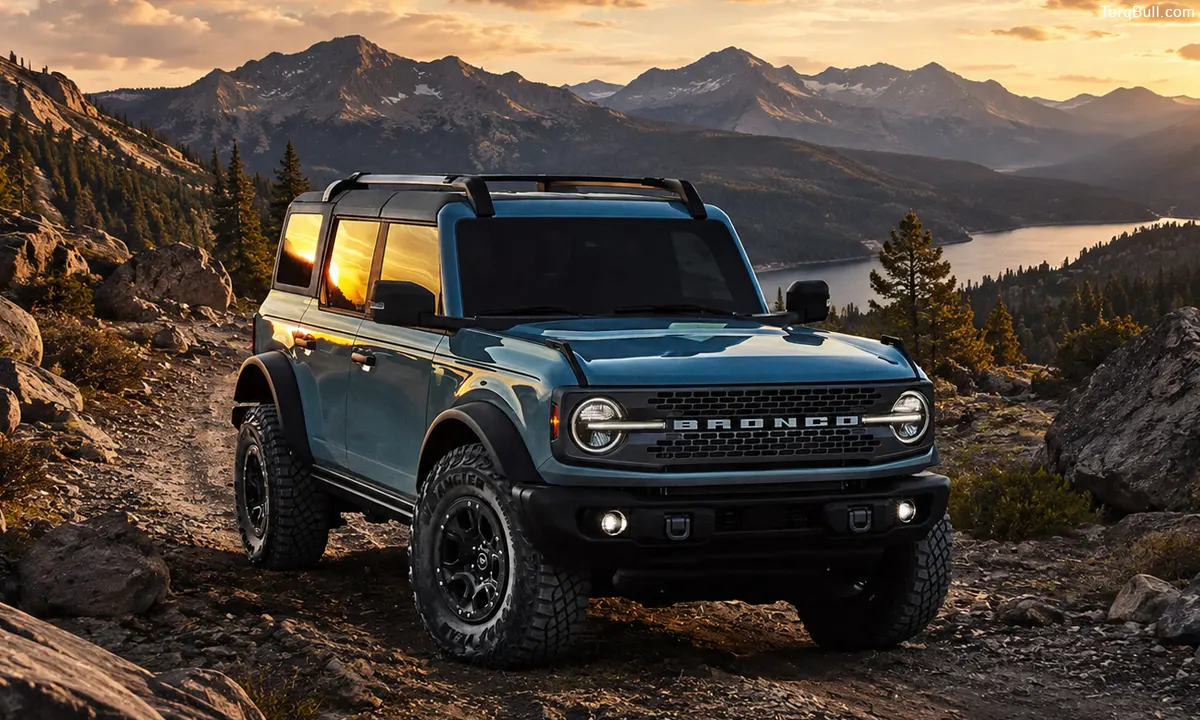
- Even the road-focused Bronco Outer Banks successfully handled difficult rock-crawling tests in independent evaluations.
- The Bronco Badlands adds Bilstein dampers, locking front and rear differentials and stabilizer bar disconnect technology.
- The Bronco Raptor features advanced FOX Live Valve semi-active shocks with real-time electronic adjustment for maximum off-road performance.
The Ford Bronco’s return to the American market in 2021 was premised on a specific and verifiable claim: that it could deliver genuine off road capability across its entire trim lineup rather than reserving meaningful trail performance for only the highest specification variants. Five years of real world trail experience, professional evaluations and owner community data in 2026 confirm that this premise has been delivered. Independent testing found that even the Outer Banks trim, which sits toward the more road oriented end of the Bronco lineup, handily scaled a challenging rock hill thanks to generous suspension travel, ground clearance, short overhangs and a locking rear differential. The Bronco is described by professional evaluators as an immensely capable off roader that genuinely competes with the Jeep Wrangler in the terrain it was designed to conquer. This detailed review examines every off road system, every suspension tier and the specific capability that each Bronco configuration delivers across the terrain types most buyers encounter.
The Foundation: Ground Clearance, Approach Angles and Water Fording

The geometric capability of any off road vehicle is defined by four specific measurements that determine what obstacles the vehicle can approach, traverse and exit without structural damage — and the 2026 Bronco’s base figures across these measurements establish it as genuinely capable before any optional equipment is considered.
Standard configuration ground clearance of 11.6 inches allows the Bronco to clear rock steps, embedded logs and trail obstacles that would ground most conventional crossover SUVs at 7 to 8 inches of clearance. The approach angle — the steepest incline the front bumper can climb without striking the ground — and departure angle — the equivalent measurement for the rear — benefit specifically from the Bronco’s short front and rear overhangs, which extend minimally beyond the front and rear axles. This short overhang design allows the vehicle to tip into steep descents and climb out of deep ditches without the front or rear bumper striking the terrain that longer overhangs would catch on.
Water fording capability of 33.5 inches allows the 2026 Bronco to cross streams and flooded trail sections that would disable vehicles with lower fording capability — where water intrusion into the engine intake, transmission or electrical systems causes immediate failure. The Bronco’s elevated air intake, sealed electrical connections and raised body positioning enable this water crossing capability that the vast majority of crossover competitors cannot safely attempt.
The available Sasquatch package transforms these already capable base specifications into a more extreme off road geometry. Sasquatch includes 35 inch all terrain tyres, beadlock capable wheels, an enhanced suspension system providing additional ground clearance and front and rear locking differentials as standard. The 35 inch tyre fitment specifically changes the effective ground clearance and approach geometry relative to the standard tyre specification, allowing the Sasquatch equipped Bronco to address obstacles that the standard tyres’ diameter would ground on.
Read: Ford Bronco Pros and Cons. Everything Buyers Need to Know
The HOSS Suspension System: Four Distinct Capability Tiers
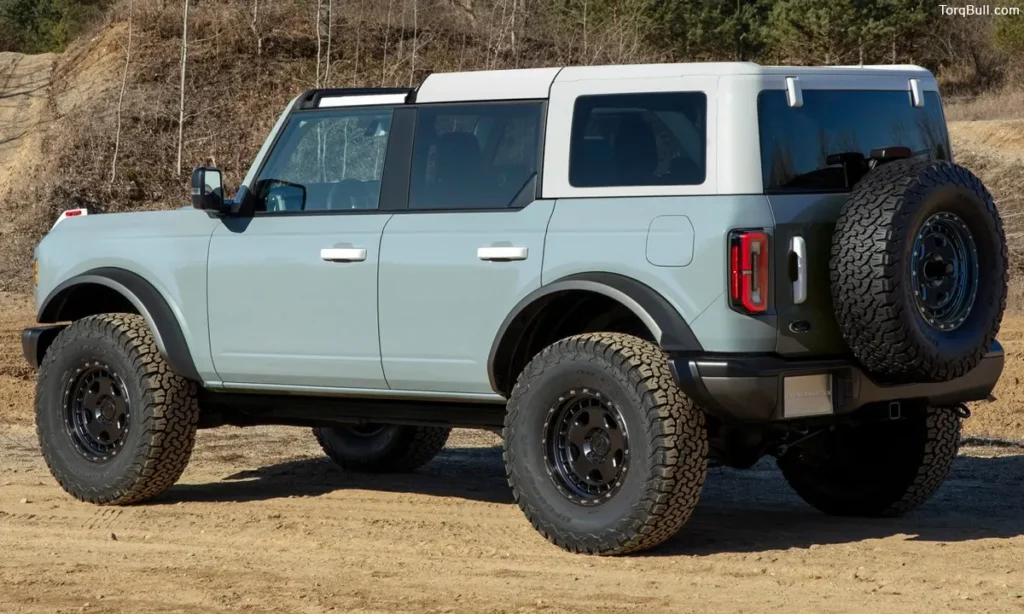
The 2026 Bronco suspension system is organised into four progressive tiers under the HOSS naming designation — an acronym for High Performance Off Road Stability Suspension. These tiers represent meaningfully different hardware specifications rather than simply different tuning calibrations of identical components. Understanding the differences between tiers is essential for matching the right Bronco configuration to specific off road use cases.
HOSS 1.0 is the standard suspension on base and lower mid trims. The dampers are specifically tuned for the Bronco’s weight and geometry, providing genuine off road articulation that exceeds what conventional SUV suspension designs deliver. HOSS 1.0 capability is fully adequate for gravel roads, light trails, snow and the moderate off road terrain that most buyers describe as their primary off road use — it does not require upgrading for this use profile.
HOSS 2.0 adds Bilstein position sensitive dampers at the rear as standard on the Badlands trim. Position sensitive damping is a meaningful engineering distinction: the damping rate changes based on where the shock is within its travel range rather than providing a fixed resistance regardless of position. The result is more compliance over small surface inputs — where the shock operates in the middle of its travel — and more control and resistance near the extremes of travel where the risk of bottoming impact is highest. This progressive response produces a trail experience that is simultaneously more comfortable over moderate terrain and more controlled over the obstacles that approach the suspension’s limits.
HOSS 3.0, new for 2026, is available on Badlands as a standalone option when combined with the Sasquatch package or as part of the Wildtrak Package. This tier adds further suspension refinement beyond HOSS 2.0 for buyers who specifically trail run regularly on dedicated off road parks, ATV trails or similar demanding terrain where the incremental capability improvement is fully exercised.
HOSS 4.0 on the Bronco Raptor is a different category entirely from the trail focused tiers below it. The Raptor’s FOX Live Valve dampers are semi active — the damping rate changes electronically based on real time inputs from terrain sensors, throttle position, brake inputs, steering angle and wheel position. The system adjusts suspension character multiple times per second, stiffening for high speed stability and softening for obstacle absorption faster than any passive system can respond. Combined with Ford Performance control arms allowing 13 inches of front and 14 inches of rear wheel travel, the Raptor suspension transforms the Bronco from a capable trail truck into a high speed desert running vehicle capable of sustained rough terrain travel at speeds that would destroy standard suspension hardware.
The G.O.A.T. Mode System: Seven Terrain Calibrations
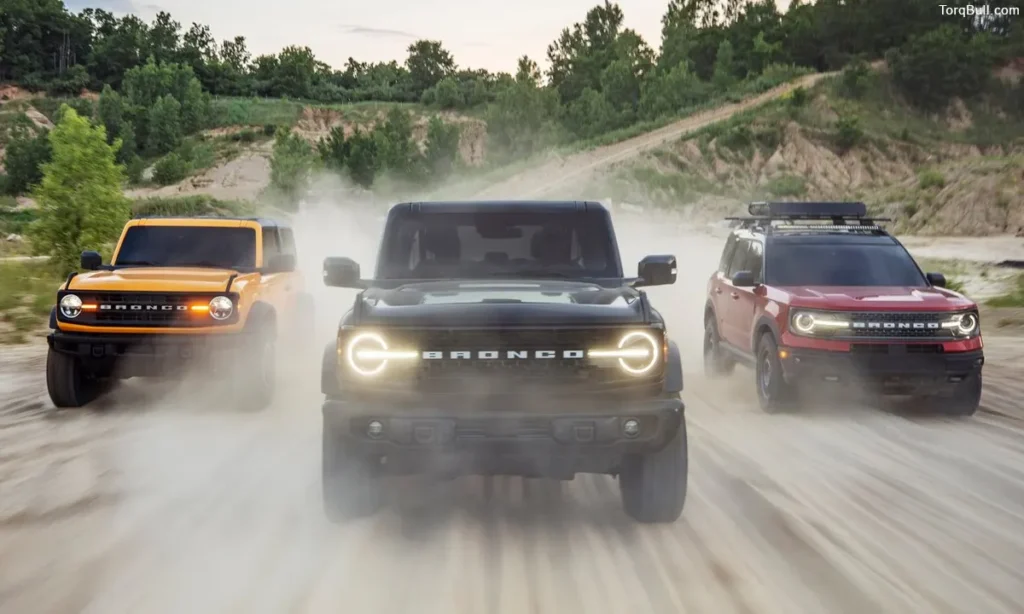
The G.O.A.T. mode system — Goes Over Any Type of Terrain — is the Bronco’s electronic terrain management framework, providing up to seven distinct terrain calibrations that adjust throttle response, transmission behaviour, stability control threshold and differential engagement for specific surface conditions.
The seven available modes on Badlands and Raptor configurations include Normal, Eco, Sport, Slippery, Sand, Rock Crawl and Baja. Each mode simultaneously adjusts multiple vehicle systems rather than changing only a single parameter. In Rock Crawl mode, throttle response is reduced to its most linear and most moderate setting, the transmission holds lower gears for maximum engine braking during descents, stability control thresholds are relaxed to allow controlled wheel articulation on uneven rock surfaces and the locking differentials engage. In Baja mode, the opposite calibration applies — throttle response is sharpened for immediate power availability, the transmission allows higher revs before upshifting to maintain momentum and the suspension’s active management is optimised for sustained high speed rough terrain travel.
Trail Control, available on Badlands and higher configurations, functions as an off road cruise control — managing throttle and brake application automatically to maintain the driver’s selected pace over trail obstacles from 1 to 20 MPH. This allows the driver to concentrate entirely on steering inputs without simultaneously managing acceleration and braking, reducing the cognitive load of technical trail navigation significantly. The Trail Turn Assist feature — unique to the Bronco in the off road SUV segment — applies the inside rear brake during tight trail turns to reduce the turning radius, enabling the Bronco to navigate turns that its physical dimensions would otherwise prevent it from completing without reversing.
Read: Ford Bronco vs Jeep Wrangler: Which Is Better For You in 2026?
Locking Differentials: Front, Rear and Combined
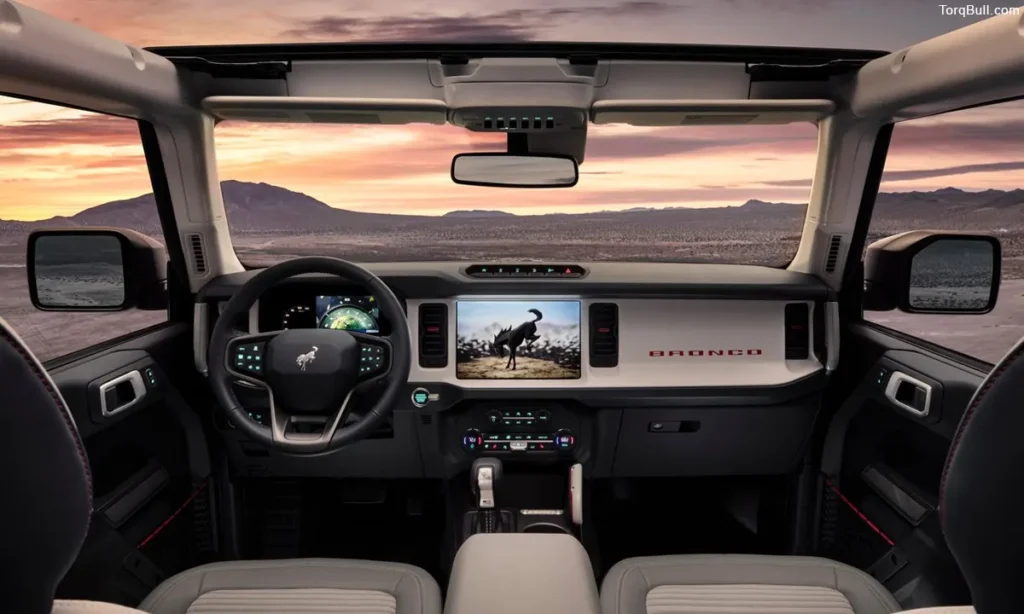
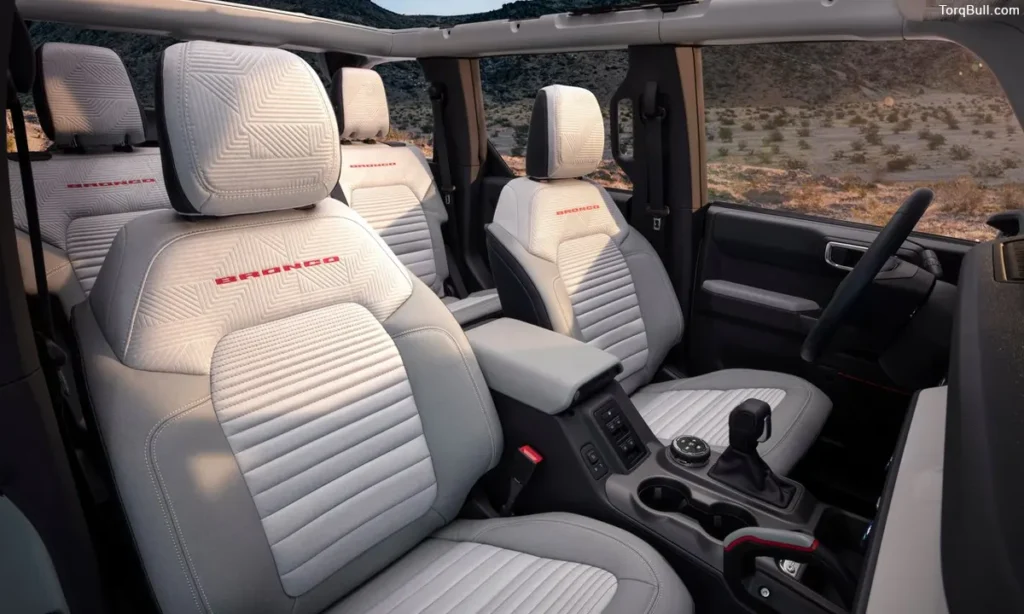
The 2026 Bronco’s differential locking system is one of its most capable and most specifically described off road hardware advantages. The standard rear locking differential is available on Outer Banks and higher configurations, while the Sasquatch package and Badlands trim add front differential locking capability for simultaneous front and rear locking.
When both front and rear differentials are locked, all four wheels receive equal torque regardless of the traction condition at any individual wheel. A single wheel with grip in an otherwise zero traction environment can theoretically move the vehicle forward because the locked differentials prevent power from routing exclusively to the spinning wheels that have lost traction. This maximum mechanical traction state is the hardware of last resort before a recovery strap becomes necessary, and it provides the capability that distinguishes serious off road vehicles from trail appearance packages on crossover bodies.
The electronic locking system engages quickly from a button on the dash, providing locking confirmation through the instrument cluster display and allowing the driver to lock and unlock differentials as terrain conditions change without stopping the vehicle. This accessibility encourages proactive differential management — locking before the traction event rather than after — which produces cleaner terrain navigation than reactive engagement allows.
Ford Bronco 2026 Off Road Capability by Trim — Complete Chart
| Trim | Suspension | Locking Differentials | Trail Control | GOAT Modes | Ground Clearance | Best Off Road Use |
| Base / Big Bend | HOSS 1.0 | Rear only (standard) | Not standard | 4 modes | 11.6 inches | Light trails, gravel, snow |
| Outer Banks | HOSS 1.0 | Rear locking | Not standard | 4 modes | 11.6 inches | Moderate trails, rock hills |
| Badlands | HOSS 2.0 (Bilstein rear) | Front and rear locking | Standard | 7 modes | 11.6 inches standard | Technical trails, rock crawl |
| Badlands with Sasquatch | HOSS 2.0 or 3.0 | Front and rear locking | Standard | 7 modes | More with 35 inch tyres | Rock crawling, serious trails |
| Wildtrak | HOSS 3.0 available | Front and rear locking | Standard | 7 modes | Enhanced with Sasquatch | High speed trails, varied terrain |
| Raptor | HOSS 4.0 FOX Live Valve | Front and rear locking | Standard | 7 modes | 13.1 inches | High speed desert, extreme terrain |
Read: Ford Bronco Engine Performance Real Test. The Complete 2026 Analysis
Where the Bronco Excels and Where It Has Honest Limitations
The Bronco’s most genuinely distinctive off road advantage over the Jeep Wrangler is its independent front suspension — the engineering decision that allows each front wheel to articulate independently rather than moving together as a solid front axle does. Independent front suspension produces better on road handling, more stable highway behaviour and steering that relays confidence at freeway speeds in a way the Wrangler’s solid front axle cannot match. The trade is that independent front suspension provides marginally less maximum wheel articulation at the extreme end of rock crawling compared to the Wrangler’s solid front axle design — though this difference is relevant primarily at the most technical competitive rock racing level rather than in the recreational off road use that the vast majority of Bronco owners engage in.
The front trail camera — displaying a live feed from a forward facing camera that shows the terrain immediately ahead of the front tyres — makes placing the wheels precisely on trail lines significantly easier than seat of the pants judgment allows. The trail map integration within the SYNC 4 system provides digital trail information for popular off road parks and trail systems, allowing navigation by trail name rather than requiring GPS coordinates.
The Bronco’s off road performance in 2026 is comprehensively delivered: a genuine trail machine across its entire lineup that improves progressively with each hardware tier from HOSS 1.0 through the Raptor’s semi active FOX system, supported by locking differentials, Trail Control and the most complete terrain management mode system in the off road SUV segment.