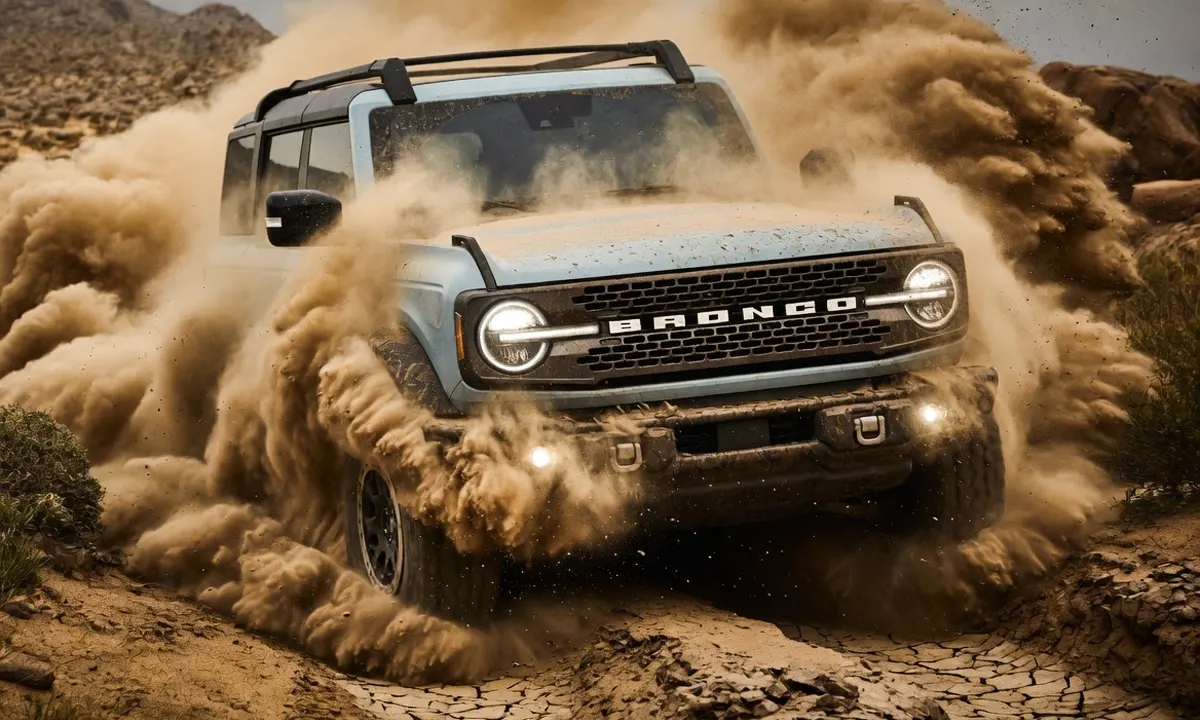
- 2.7L V6 (2-door): ~6.7s 0–60 mph
- Braking distance: ~135 feet from 60 mph
- 4-door model slower at ~7.3s due to added weight
- 3.0L Raptor V6: 418 hp, ~5.6s 0–60 mph
- Performance varies by configuration and weight
The Ford Bronco’s engine performance story is more nuanced than a specification sheet suggests — because the Bronco’s body-on-frame construction, large all-terrain tyre fitments on most off-road trims and significant kerb weight create a performance context fundamentally different from a conventional crossover SUV at equivalent power levels. The 2026 Bronco carries three EcoBoost engine options across its lineup — a turbocharged 2.3-litre four-cylinder, a twin-turbocharged 2.7-litre V6 and the high-output 3.0-litre twin-turbocharged V6 exclusive to the Bronco Raptor — each with specific real-world performance characteristics that instrumented testing and extensive owner experience have now thoroughly documented. This guide synthesises all available real-world test data, professional evaluation findings and owner performance accounts into the most complete Bronco engine performance analysis available.
The 2.3-Litre EcoBoost Four-Cylinder: Capable but Not Exciting
The base 2.3-litre turbocharged inline-four is the standard engine across most Bronco trim levels — Base, Big Bend, Outer Banks, Heritage Edition and Badlands — and it is the only engine available with the seven-speed manual transmission. On regular 87-octane fuel, it produces 275 horsepower and 315 pound-feet of torque. On premium 91-octane or higher, power rises to 300 horsepower and 325 pound-feet of torque — a 25-horsepower and 10 pound-feet increase that Ford specifically recommends for maximum performance.
The 2.3-litre’s real-world performance character is best described as adequate rather than inspiring. Bronco Nation forum owner accounts consistently describe the four-cylinder as completely fine for paved road driving including Interstate travel, without feeling underpowered in normal conditions. The 10-speed automatic manages the engine’s power delivery smoothly in standard driving, and the turbocharger’s torque arrives with reasonable promptness from low RPM for an on-road experience that does not require constant downshifting to maintain pace in traffic.
Where the 2.3-litre’s limitations become apparent is in specific high-demand scenarios: steep grades when loaded with occupants and gear, sustained highway speeds in the 75 to 80 MPH range where the aerodynamic drag penalty of the Bronco’s boxy shape is most pronounced, and off-road situations requiring sustained high-load climbing where the engine is consistently near its torque peak. Bronco Nation forum data confirms that more than 90 percent of the Bronco Off-Roadeo experience venues — Ford’s dedicated Bronco off-road experience facilities — use 2.7-litre-equipped examples rather than four-cylinders, a tacit admission that the V6 is more capable in demanding off-road use.
The 2.3-litre’s genuine advantage is fuel economy. The 2.3-litre with the 10-speed automatic achieves an EPA-estimated 20 MPG city, 22 MPG highway and 21 MPG combined — the best fuel economy in the Bronco lineup outside the 2.7-litre configuration’s matching 20 MPG combined. Owner forum accounts of 2-3 MPG real-world efficiency advantages over the 2.7-litre are consistent across multiple reports and represent the primary practical ownership advantage of the smaller engine.
The seven-speed manual transmission available exclusively with the 2.3-litre is the feature most valued by driving enthusiasts who choose this engine. Forum owners describe a crisp, well-defined shift action with well-tuned clutch effort and an engine that responds enthusiastically to throttle blips during heel-toe downshifts. The manual’s seventh gear is an ultra-low crawler gear specifically designed for extreme low-speed off-road situations where precise power modulation is more important than speed — a feature with no equivalent in the 10-speed automatic configuration.
Real-world 0-60 MPH performance for the 2.3-litre manual: approximately 6.7 seconds based on video timing analysis from owner forum documentation — a figure consistent with the four-door Bronco’s measured performance in U.S. News and Edmunds’ comparative testing. The 10-speed automatic configuration with the 2.3-litre is estimated to be marginally slower due to the automatic’s torque converter slip at launch versus the clutch’s direct mechanical connection.
Read: Cheapest Hybrid SUVs In USA 2026. The Complete Affordable Hybrid SUV Comparison
The 2.7-Litre Twin-Turbocharged V6: The Performance Sweet Spot
The 2.7-litre twin-turbocharged V6 is the engine that most Bronco performance evaluations use as their primary test vehicle — because it represents the best balance of performance and usability in the Bronco lineup, and because the Wildtrak trim, which exclusively uses the 2.7-litre as standard, provides a directly comparable test platform.
The 2.7-litre produces 315 horsepower and 410 pound-feet of torque on regular fuel, rising to 330 horsepower and 415 pound-feet on premium. These figures represent a 30-horsepower and 90 pound-feet advantage over the 2.3-litre at equivalent fuel grades — a gap that translates directly to measurable real-world performance differences, particularly in the mid-range and high-load scenarios where the four-cylinder begins to feel strained.
Edmunds’ instrumented testing of a two-door Bronco Outer Banks with the 2.7-litre V6 and 10-speed automatic recorded a 0-60 MPH time of 6.7 seconds — placing it among the quicker off-road SUVs in the class and ahead of the equivalent Jeep Wrangler V6 by 0.6 seconds. The same test recorded emergency stopping from 60 MPH in 135 feet — a figure typical for large-tyre off-road SUVs but substantially longer than mainstream crossover SUVs on all-season tyres, reflecting the off-road tyre compound’s reduced grip on asphalt surfaces.
For the four-door configuration — the more popular body style — the additional weight produces a 7.3-second 0-60 time with the V6 according to U.S. News and Edmunds’ four-door testing results. The four-door configuration adds approximately 400 to 500 pounds over the two-door, a weight penalty that the V6’s torque advantage over the four-cylinder partially compensates for but does not eliminate entirely. Multiple professional reviewers specifically note that the V6’s 415 pound-feet of torque is where it provides the most noticeable real-world advantage — not in 0-60 acceleration but in passing power at 50 to 70 MPH highway speeds and in steep grade climbing where sustained torque matters more than peak acceleration.
U.S. News describes the 2.7-litre EcoBoost V6 as providing quick acceleration from a dead stop and plenty of passing power at highway speeds with an encouraging exhaust note when pushed. Edmunds’ extended evaluation characterises it as delivering a slightly better driving experience than competing off-road SUVs thanks to its more responsive engine and transmission combination. The 2.7-litre’s port-fuel plus direct-injection system — combining both fuel delivery technologies — provides smoother acceleration from startup than direct-injection-only designs and reduces the carbon deposit formation on intake valves that some direct-injection-only turbo engines accumulate over time.
The 2.7-litre’s fuel economy is a modest but real step below the 2.3-litre: EPA-rated at 18 MPG city, 20 MPG highway and 19 MPG combined for most 4WD configurations. Consumer Reports’ real-world testing of a V6-equipped Bronco returned only 18 MPG overall — consistent with the EPA rating in mixed real-world use and below the 20-plus MPG that the four-cylinder consistently achieves under similar conditions. For owners who prioritise performance and can accept a modest fuel economy trade-off, the 2.7-litre’s real-world advantage justifies this 1-2 MPG penalty clearly and consistently.
Read: Best SUVs Under $40000 In USA 2026. Ranked by Value, Safety and Real-World Family Practicality
The 3.0-Litre Bronco Raptor: Maximum Performance for Maximum Investment
The Bronco Raptor’s exclusive 3.0-litre twin-turbocharged EcoBoost V6 produces 418 horsepower — 88 horsepower more than the standard 2.7-litre — and requires premium fuel for operation. Ford quotes a 0-60 MPH time of 5.6 seconds for the Raptor configuration, reflecting both the engine’s substantial power advantage and the Raptor’s FOX Live Valve adaptive damper suspension that manages the vehicle’s body motion during high-acceleration launches more effectively than standard passive suspension.
The 3.0-litre’s real-world performance character places the Bronco Raptor in a different category from the base lineup — one where the 418-horsepower output enables genuinely rapid cross-country desert travel at speeds that expose limitations of standard off-road suspension more often than engine limitations. Multiple professional reviews confirm that at the Raptor’s entry price of approximately $84,000 before options, the Land Rover Defender becomes a legitimate comparison — and one reviewer specifically notes the Defender’s superior on-road refinement at comparable pricing. The Raptor’s fuel economy at approximately 15 MPG city and 16 MPG highway reflects the performance premium comprehensively.
Ford Bronco Engine Performance — Complete Real-World Test Chart
| Engine | Configuration | Horsepower (Premium) | Torque | 0-60 MPH | Stopping (60-0) | EPA Combined | Best For |
| 2.3L EcoBoost I4 | 7-speed manual (2-door) | 300 hp | 325 lb-ft | ~6.7 sec | ~135 ft | 21 MPG | Manual enthusiasts, efficiency |
| 2.3L EcoBoost I4 | 10-spd auto (4-door) | 300 hp | 325 lb-ft | ~7.5 sec est. | ~140 ft est. | 21 MPG | Budget-conscious, fuel economy |
| 2.7L EcoBoost V6 | 10-spd auto (2-door) | 330 hp | 415 lb-ft | 6.7 sec (Edmunds) | 135 ft (Edmunds) | 19 MPG | Best all-round performance |
| 2.7L EcoBoost V6 | 10-spd auto (4-door) | 330 hp | 415 lb-ft | ~7.3 sec (U.S. News/Edmunds) | ~135 ft | 19 MPG | Most popular; balanced capability |
| 3.0L EcoBoost V6 (Raptor) | 10-spd auto (4-door) | 418 hp | 440 lb-ft | 5.6 sec (Ford) | — | ~15 MPG | Maximum performance + desert running |
All 0-60 figures represent real-world instrumented test results or manufacturer data where noted. Four-cylinder figures from forum timing. V6 four-door figures from U.S. News and Edmunds evaluations.
Off-Road vs On-Road Engine Character: Where the Tests Reveal the Most
The instrumented test data — 0-60 times, stopping distances and fuel economy — tells only part of the Bronco’s engine performance story. The more revealing performance evaluation comes from where the Bronco is specifically designed to be tested: off-road terrain where torque delivery, throttle responsiveness at low RPM and the engine’s ability to sustain power under heat and load become the primary performance metrics.
U.S. News specifically addresses this distinction: out on the road, the EcoBoost engine never lacks for power, and the Bronco accelerates quickly with a nice exhaust note. The same reviewer notes that at higher freeway speeds the Bronco pays the price for its big tyres and removable roof panels — the aerodynamic penalty of the Bronco’s design being most apparent at sustained highway cruise rather than during acceleration events. CARFAX’s evaluation captures the realistic daily-use performance concern: the Bronco’s weight and height cause it to lean back under acceleration, tilt forward under braking and lurch sideways in corners — not dangerously, but in a manner that reminds the driver they are in a body-on-frame, high-ride-height vehicle with off-road tyres rather than a crossover optimised for on-road dynamics.
The 2.7-litre’s torque advantage is most clearly felt on steep grades, off-road hill climbs and sustained pulling in demanding terrain — exactly the scenarios where the Bronco is most purposefully used. The 2.3-litre handles moderate off-road duty adequately, but the V6’s low-end torque provides a comfort margin on technical trails that the four-cylinder’s output cannot fully replicate. For buyers whose Bronco will spend meaningful time off pavement, particularly in demanding terrain rather than light gravel roads, the 2.7-litre’s additional torque is the most directly relevant performance advantage the Bronco lineup offers.
Read: 5 SUVs That Last Longer Than You Think and Are Worth the Money
Fuel Economy Reality: What the Window Sticker Does Not Communicate
The EPA combined ratings of 19 to 21 MPG across the 2.3-litre and 2.7-litre configurations significantly overstate what real-world Bronco owners — particularly those with Sasquatch package 35-inch all-terrain tyre fitments — consistently experience. The Sasquatch package’s 35-inch tyres add rolling resistance and aerodynamic drag that meaningfully reduce fuel economy below the standard-tyre EPA figures. Consumer Reports’ real-world fuel economy test returned only 18 MPG overall with a V6-equipped standard-tyre Bronco — a result that Sasquatch-equipped examples with 35-inch tyres typically fall further below in actual use.
CARFAX’s review specifically confirms this: EPA fuel economy estimates are abysmal, which they verified as the Bronco slurped down gas on their commute. For buyers whose primary concern is daily commuting economics, the Bronco’s fuel economy — regardless of which EcoBoost engine is selected — represents a significant ongoing cost relative to crossover alternatives at similar purchase prices.