- Professional reviewers recommend the Toyota Corolla Cross Hybrid as the better overall choice thanks to its stronger performance and efficiency.
- The Hybrid delivers 42 MPG combined and includes standard AWD, compared with 32 MPG combined for the gas model.
- The gas-powered Corolla Cross starts about $3,000 cheaper, making it the lower-cost entry point to the lineup.
The 2026 Toyota Corolla Cross comparison between hybrid and gas-only powertrains produces one of the clearest and most directly stated professional recommendations in the compact crossover segment — the hybrid is the more efficient, more powerful and more pleasant version, and the gas model exists primarily for buyers who specifically cannot accept the hybrid’s price premium. The 2026 refresh introduced updated styling for both versions, a new front face design, a revised centre console, a new multimedia system and slightly improved fuel economy numbers across the lineup. Beyond the visual update, the fundamental powertrain and capability differences between the gas and hybrid Corolla Cross remain as significant as they have been since the Hybrid’s introduction. This complete guide examines every meaningful difference across every relevant category to produce the most practically useful comparison available for buyers deciding between these two configurations.
The Professional Verdict: Hybrid Is Better in Every Performance Dimension
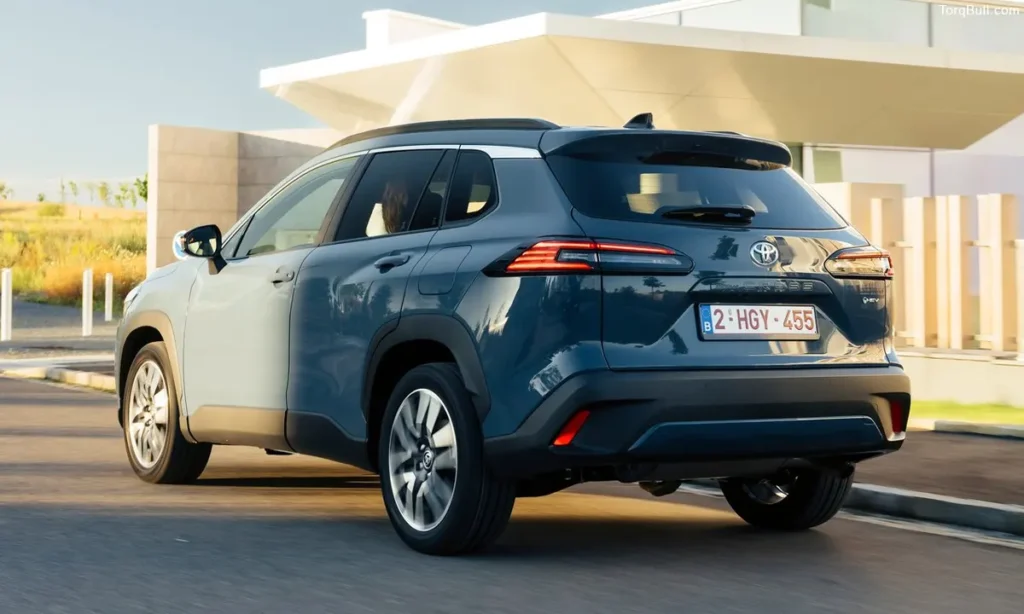
The unambiguous professional assessment of the hybrid versus gas Corolla Cross comparison is that the hybrid is better — not marginally or in some specific scenarios, but across every driving-related metric that daily ownership involves. More efficient means lower annual fuel cost across every mileage level. More powerful means 196 combined horsepower against the gas model’s 169 horsepower — a 27 horsepower advantage that produces a 0-60 MPH time of approximately 8 seconds for the hybrid against 9-plus seconds for the gas model. More pleasant means the hybrid’s electric motor delivers instant torque at low speeds, producing a livelier and more responsive character in city traffic where both vehicles spend the majority of their operating time.
The single category where the gas model retains an advantage is starting price — approximately $3,000 less at comparable configurations and the FWD option that the hybrid does not offer. For buyers who specifically need the lowest possible purchase price and who will cover low annual mileage where the fuel saving does not accumulate quickly, the gas model’s price advantage is a legitimate reason to choose it. For buyers whose ownership profile involves any meaningful annual mileage, the hybrid’s advantages compound across every year of ownership.
Read: Toyota Corolla Cross Reliability Review 2026. What Makes This SUV a Smart Buy?
Powertrain: Two Fundamentally Different Approaches
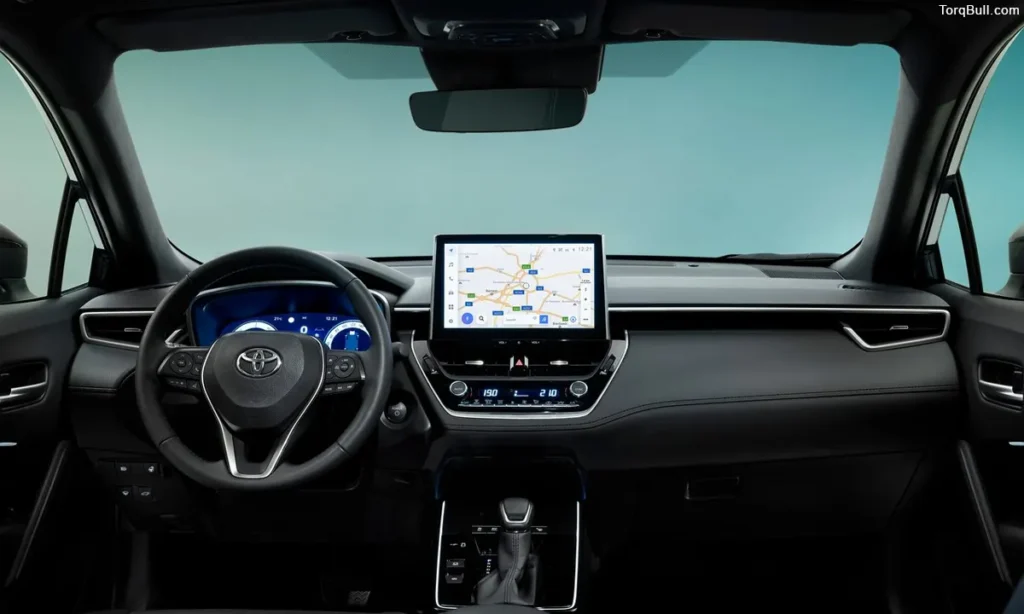
The gas-powered 2026 Corolla Cross uses a 2.0-litre four-cylinder engine producing 169 horsepower and 151 pound-feet of torque through a continuously variable automatic transmission. Front-wheel drive is standard with all-wheel drive available as a paid option on all gas trims except the base L. The naturally aspirated engine’s power delivery is linear and predictable — adequate for daily commuting but not particularly responsive at low speeds where most urban driving occurs.
The 2026 Corolla Cross Hybrid uses Toyota’s fifth-generation hybrid electric vehicle system combining a 2.0-litre four-cylinder engine with three electric motors — two at the front axle and one at the rear — for 196 combined horsepower. This three-motor configuration produces standard electronic all-wheel drive on every hybrid trim without requiring additional payment. The three-motor AWD system uses the rear electric motor to drive the rear wheels independently rather than through a mechanical connection to the front axle, providing all-weather traction without the weight and mechanical complexity of a conventional AWD drivetrain.
The electric motor’s specific contribution to daily driving character is the most immediately felt difference between these powertrains. Electric motors deliver their maximum torque at zero RPM — meaning the instant the driver requests acceleration, full electric torque is available without waiting for engine RPM to build. In stop-and-go city traffic, this instant response makes the hybrid feel noticeably livelier and more confident than the gas model’s naturally aspirated engine whose torque builds progressively through the rev range. The hybrid system allows quieter operation at low speeds where the electric motor operates independently of the gasoline engine, contributing to a more refined cabin experience in urban traffic.
Fuel Economy: The Hybrid’s Most Financially Significant Advantage
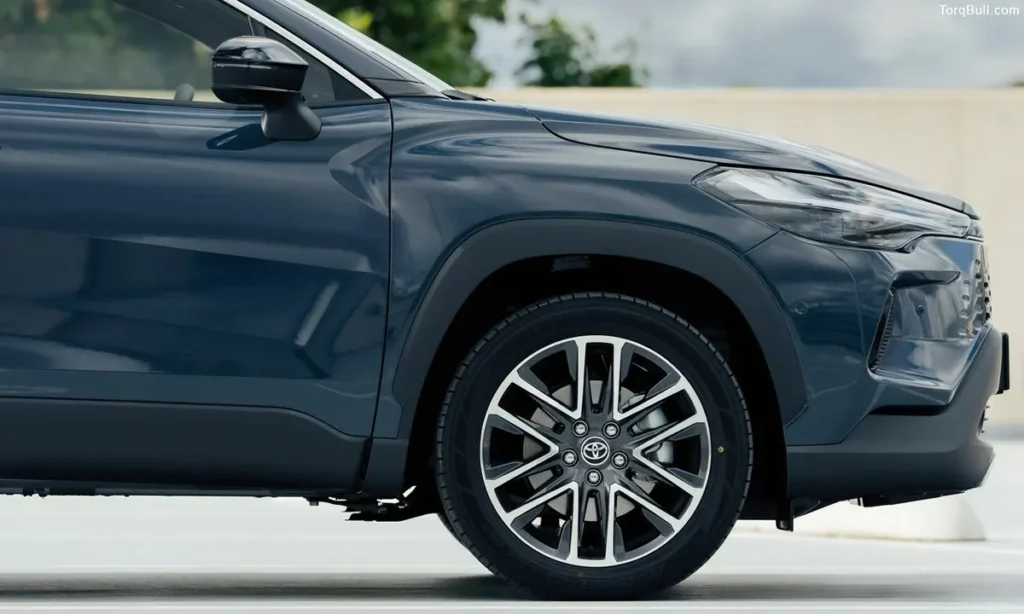
The fuel economy gap between the gas and hybrid Corolla Cross is one of the widest within any single compact crossover nameplate — 10 MPG combined separating two powertrains in vehicles that are otherwise substantially similar in body, dimensions and feature content.
The gas 2026 Corolla Cross achieves 32 MPG combined in FWD configuration — a competitive non-hybrid result that positions it well against similarly sized naturally aspirated competitors. With AWD added, this drops to 29 MPG combined.
The 2026 Corolla Cross Hybrid achieves 42 MPG combined — one of the highest combined fuel economy figures available in any compact crossover regardless of powertrain type. This 42 MPG figure represents the AWD-equipped hybrid configuration that is the only drivetrain option for the hybrid — confirming that the Hybrid achieves its peak efficiency while simultaneously providing all-wheel drive traction that the equivalent gas AWD configuration cannot match in fuel economy.
At 15,000 annual miles and $3.08 per gallon, the gas FWD Corolla Cross costs approximately $1,444 per year in fuel. The Hybrid at 42 MPG combined costs approximately $1,100 per year — an annual saving of approximately $344. Over five years, the hybrid saves approximately $1,720 in fuel costs. This five-year fuel saving is not sufficient on its own to recover the approximate $3,000 hybrid price premium — reaching fuel-cost-only break even at approximately 8.7 years of average mileage ownership. Buyers who cover significantly above-average annual mileage of 20,000 or more miles reach break even considerably faster.
The fuel economy saving is most relevant in its annual cost context: $344 less per year, every year, as long as the vehicle is owned. For buyers planning ten-year ownership, the cumulative $3,440 in fuel savings fully recovers the hybrid premium and provides additional ongoing benefit thereafter.
Read: Toyota Corolla Maintenance Cost Per Year 2026. Full Ownership Breakdown
Drivetrain: AWD Standard vs AWD Optional
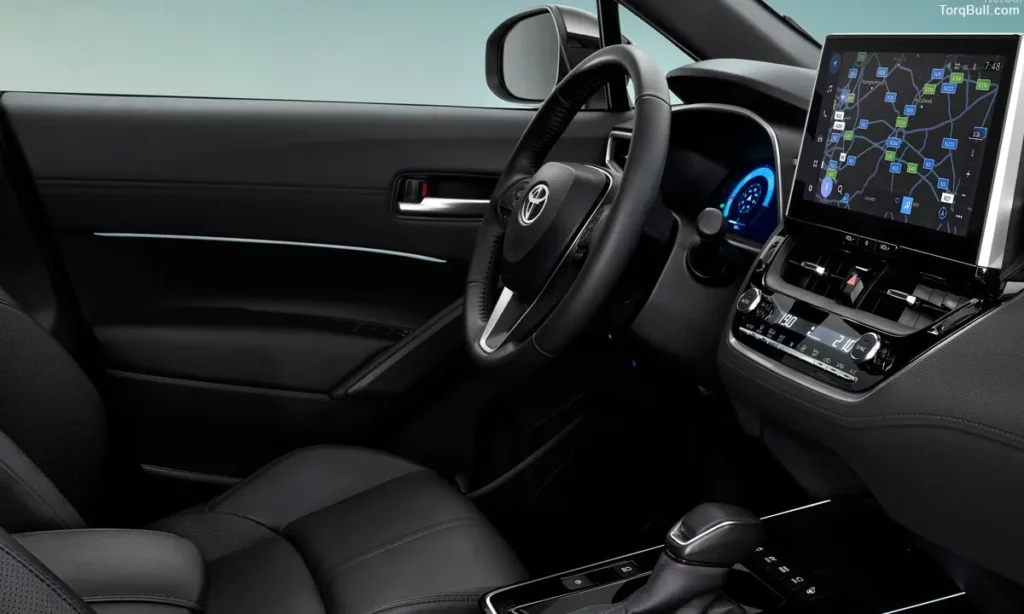
The drivetrain comparison between these powertrains produces the hybrid’s most unambiguous competitive advantage for specific buyer categories — specifically buyers in winter-climate states where all-wheel drive is a genuine daily necessity rather than an occasional benefit.
The gas Corolla Cross offers FWD as standard and AWD as a paid upgrade across most trims. The AWD upgrade costs approximately $1,450 — a meaningful addition that closes approximately half of the $3,000 hybrid price premium when equivalent AWD capability is the comparison basis. A gas AWD Corolla Cross and a Hybrid Corolla Cross are approximately $1,550 apart in effective purchase price when the AWD cost is incorporated into the gas model’s comparison price.
The hybrid’s standard AWD is specifically relevant for buyers in northern states, mountain regions and the Pacific Northwest where winter precipitation, ice and snow make all-wheel drive a daily safety requirement. For these buyers, the hybrid’s combination of AWD standard and 42 MPG efficiency produces two specific ownership advantages over the gas model simultaneously — making the hybrid the clearly superior purchase even before the fuel saving calculation is considered.
For buyers in mild-climate states where AWD is not a genuine daily need, the gas FWD model maintains a larger effective price advantage and the fuel saving argument is the primary remaining hybrid consideration.
2026 Toyota Corolla Cross Hybrid vs Gas — Complete Comparison Chart
| Category | Gas Model | Hybrid Model | Winner |
| Starting Price | approximately $25,000 (L trim) | approximately $28,000 (S trim) | Gas (approximately $3,000 less) |
| Engine Power | 169 hp, 151 lb ft | 196 hp combined, instant electric torque | Hybrid |
| 0-60 MPH | 9-plus seconds | approximately 8 seconds | Hybrid |
| EPA Combined MPG (FWD available) | 32 MPG | Not available FWD | Gas (FWD option only) |
| EPA Combined MPG (AWD) | 29 MPG | 42 MPG | Hybrid |
| AWD Standard | No (optional, approximately $1,450) | Yes (all trims) | Hybrid |
| Annual Fuel Cost (15,000 miles) | approximately $1,444 (FWD) | approximately $1,100 (AWD) | Hybrid |
| 5-Year Fuel Saving | Baseline | approximately $1,720 vs gas FWD | Hybrid |
| Driving Character | Adequate, linear | Livelier, instant torque | Hybrid |
| Urban Low-Speed Feel | Standard | Electric-motor responsiveness | Hybrid |
| Reliability Rating | Below average (2025 gas model) | Above average (2025 hybrid) | Hybrid |
| Toyota Safety Sense 3.0 | Standard | Standard | Tie |
| FWD Option | Available | Not available | Gas |
| Hybrid Price Premium Recovery | N/A | Approximately 8.7 years at average mileage | Context dependent |
Reliability: The Hybrid’s Additional Advantage
The reliability comparison between these powertrains extends the hybrid’s advantage into the ownership confidence category — providing a specific and practically significant additional reason to choose the hybrid beyond performance and efficiency.
The 2025 gas-only Corolla Cross is rated less reliable than other cars from the same model year in independent owner survey data — with documented electronics trouble spots including Apple CarPlay connection drops during navigation and GPS mapping failures. The 2025 Corolla Cross Hybrid is rated more reliable than other cars from the same model year in the same survey — carrying the above-average reliability designation that the gas model does not achieve.
For buyers who prioritise long-term ownership confidence, this reliability differential adds meaningful weight to the hybrid’s case beyond the performance and efficiency advantages that the powertrain specification alone establishes. The combination of better reliability rating, higher performance, better fuel economy and standard AWD at a modest price premium represents the most comprehensive case for a hybrid option over a gas alternative within any single nameplate available in the compact crossover segment.
Read: Should I Buy Honda Civic or Toyota Corolla? Ultimate Comparison for 2026
Who Should Still Choose the Gas Model
The gas Corolla Cross is the correct choice for a specific and honest buyer profile — buyers for whom the approximately $3,000 lower starting price is a genuine financial constraint, who cover low annual mileage where the fuel saving accumulates slowly, who live in mild-climate states where AWD adds no genuine daily value, and who specifically want the FWD option that the hybrid does not offer.
For buyers who are first-time new car purchasers for whom the lowest possible monthly payment is the primary constraint — the gas model’s lower starting price may be the determining factor regardless of the hybrid’s long-term advantages. For buyers whose annual mileage is 8,000 to 10,000 miles, the annual fuel saving of approximately $230 to $290 makes the break-even point more distant and the hybrid’s financial case weaker. For buyers in Florida, Texas and other consistently warm states where AWD adds virtually no daily traction benefit, the FWD gas model’s combination of lower price and adequate fuel economy for their specific use profile is a defensible choice.
For every other buyer — higher mileage, winter-climate states, AWD-needed driveways and anyone who will appreciate the more responsive daily driving character — the hybrid is the better vehicle by every measurable criterion the professional evaluation community has assessed.