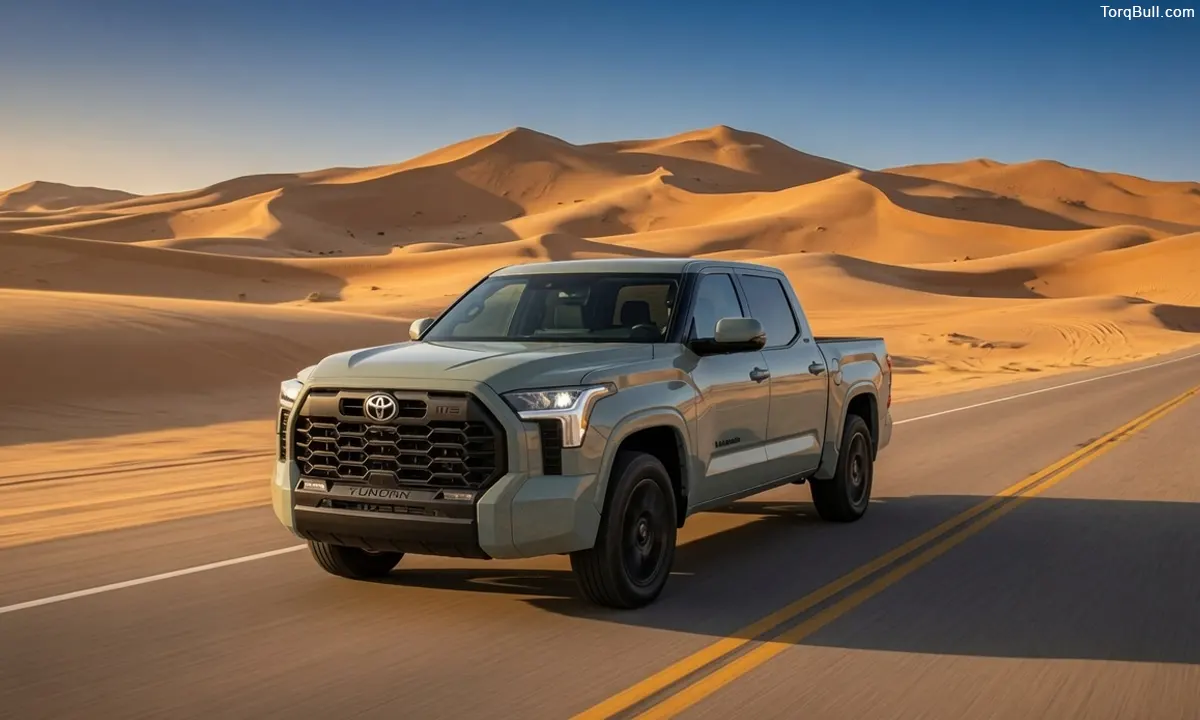
- The 2026 Toyota Tundra i-Force MAX produces 437 horsepower and 583 pound-feet of torque from its hybrid twin-turbo V6 powertrain.
- Fuel economy ranges from 19 to 22 MPG combined, depending on configuration, with towing capacity reaching 11,450 pounds.
- Owners praise its strong acceleration, smooth ride quality and effortless highway performance.
The Toyota Tundra i-Force MAX is Toyota’s answer to the full-size truck buyer who refuses to choose between power and efficiency — a hybrid powertrain that produces more torque than any previous Tundra engine while simultaneously improving the fuel economy that determines the truck’s weekly operating cost. In a segment where the Ford F-150 PowerBoost, Ram 1500 eTorque and Chevrolet Silverado offer competing electrified alternatives, the i-Force MAX distinguishes itself through the specific character that electric motor integration into the transmission housing produces: instant, linear torque delivery at the moment of throttle application rather than after a turbocharger spool period, and a smoothness under load that owners who have transitioned from non-hybrid trucks specifically and repeatedly document as the most transformative daily difference. This complete review examines every dimension of the i-Force MAX — its powertrain architecture, performance credentials, fuel economy in real conditions, towing capability and what owners who live with it daily actually report.
The Powertrain Architecture: How the i-Force MAX Actually Works
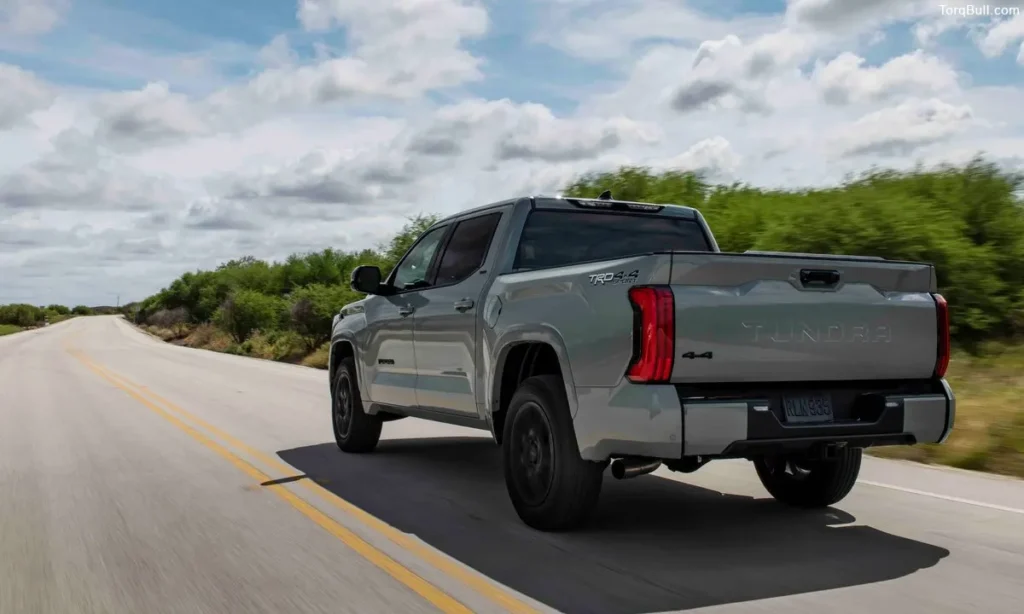
The i-Force MAX is not a conventional hybrid where a separate electric motor assists the gasoline engine through a belt or external coupling. It is a specifically engineered hybrid integration where the electric motor is housed within the 10-speed automatic transmission itself — a placement that fundamentally changes how the hybrid system delivers its torque contribution relative to the driver’s experience.
The gasoline component is the same 3.4-litre twin-turbocharged V6 that powers the standard non-hybrid Tundra — a proven engine architecture producing 389 horsepower in non-hybrid application. The i-Force MAX adds a 48-horsepower electric motor integrated into the transmission casing, producing 437 combined system horsepower and 583 combined pound feet of torque. This torque figure — 583 pound feet — exceeds the non-hybrid Tundra’s 479 pound feet by 104 additional pound feet and is delivered in a fundamentally different character.
Electric motors produce their maximum torque output at zero RPM — the moment the motor begins to rotate from a stationary position. This physics principle produces the specific driving experience that i-Force MAX owners most consistently document: the instant the driver requests acceleration from any speed, maximum torque is available immediately without waiting for the turbochargers to build boost pressure or for the engine to climb through its rev range. Under highway acceleration — where non-hybrid turbocharged trucks may produce a brief half-second delay between throttle input and full power delivery — the i-Force MAX responds with what multiple owner accounts describe as effortless, immediate thrust that makes passing slower traffic feel genuinely confident rather than managed.
The system operates as an enhanced version of Toyota’s Lexus Hybrid Drive technology scaled for full-size truck application — drawing from the same engineering foundation that has produced documented long-term reliability across hundreds of thousands of hybrid vehicles in Toyota’s and Lexus’s combined production history.
Read: Toyota Tundra Payload Capacity Test 2026. Is It Built for Serious Work?
Performance: What 437 Horsepower and 583 Pound Feet Deliver Daily
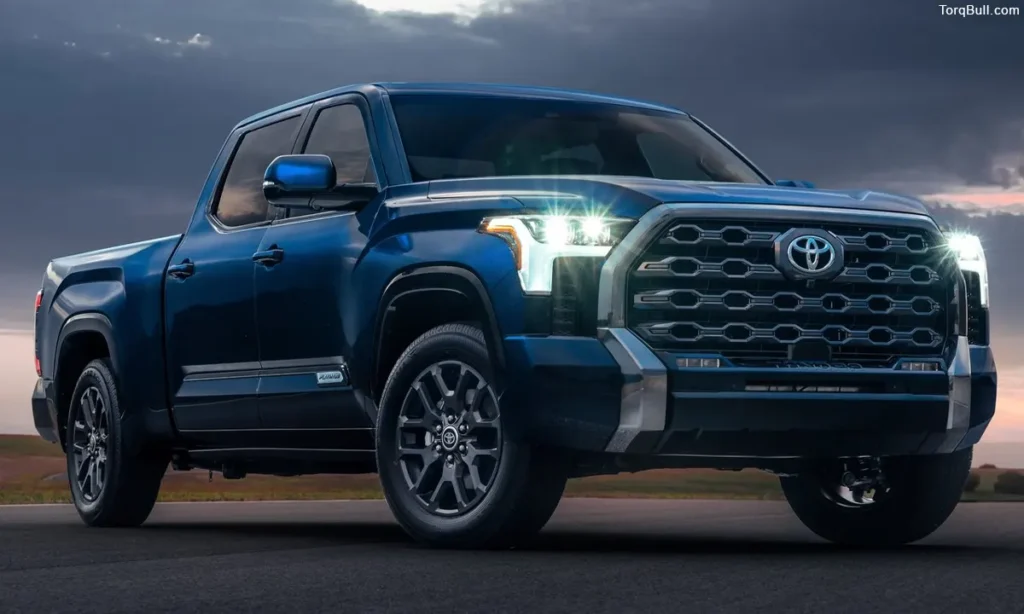
The i-Force MAX’s performance credentials go beyond the specification numbers to produce a daily driving character that owners describe in more consistently enthusiastic terms than any other Tundra powertrain option.
One 2026 Tundra 1794 Edition i-Force MAX owner who drives and works with the truck daily describes the powertrain as strong and responsive whether accelerating onto highways or towing, with passing slower traffic never feeling slow but rather effortless. A separate owner describes the 2026 Tundra as capable enough for hard work, comfortable enough for long trips and refined enough that people notice it is not just another pickup.
The 10-speed automatic transmission’s calibration specifically for the hybrid powertrain produces seamless ratio management that complements the electric motor’s instant torque fill — the system selecting the appropriate gear without the hunting behaviour that some turbocharged trucks exhibit when their torque curves and transmission programming are less precisely matched. Four drive modes — Eco, Normal, Sport and Tow and Haul — adjust the powertrain’s response character for specific use scenarios, with Tow and Haul specifically calibrating the engine braking and shift logic for sustained heavy trailer operation.
The ride quality that owners document alongside the powertrain praise is a specific and consistent finding across 2025 and 2026 i-Force MAX accounts: the ride is smooth even over imperfect roads, with a refinement that the truck’s 5,710 to 6,185 pound curb weight would not suggest to those who have not experienced the truck. This ride smoothness reflects the Tundra’s hydraulic cab mounts — a specific isolation system between the cab structure and the ladder frame that absorbs road surface harshness before it reaches the passenger compartment — alongside suspension calibration that manages the truck’s significant mass without producing the jarring character that less sophisticated large truck suspensions allow.
Fuel Economy: The Hybrid Advantage Over the Standard Tundra
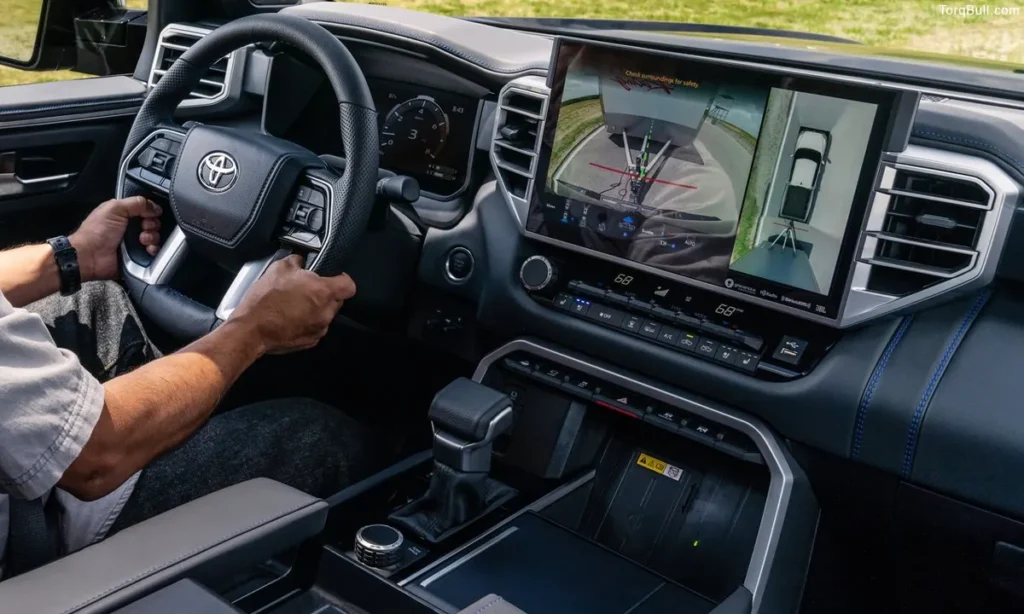
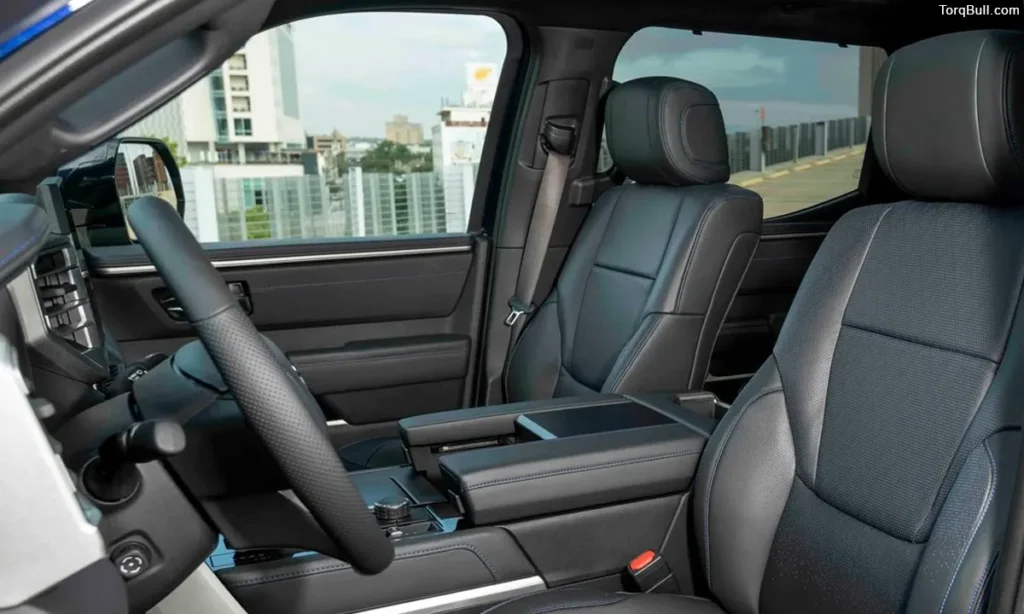
The fuel economy comparison between the i-Force MAX hybrid and the standard non-hybrid Tundra engine is where the hybrid premium most clearly justifies itself in financial terms.
The non-hybrid 3.4-litre Tundra achieves approximately 17 MPG city and 23 MPG highway in standard 2WD configurations. The i-Force MAX in 2WD achieves 20 MPG city and 24 MPG highway — 3 MPG better in the city and 1 MPG better on the highway. In 4WD configurations where most Tundra buyers operate, the i-Force MAX achieves approximately 19 MPG city and 22 MPG highway combined — still meaningfully better than the non-hybrid’s 4WD city figures.
At 15,000 annual miles and $3.08 per gallon, the city fuel economy improvement from 17 to 20 MPG — for an owner whose driving is predominantly urban — produces annual fuel savings of approximately $300 to $400 per year. Highway-dominant drivers whose annual mileage is primarily at sustained cruise speeds capture a smaller efficiency advantage, as the hybrid’s electric motor contributes most meaningfully to city stop-and-go efficiency through regenerative braking energy recovery rather than sustained highway operation where the gasoline engine operates near its most efficient load point.
The combined EPA estimate of 19 to 22 MPG depending on configuration compares favourably against the Ford F-150 PowerBoost Hybrid’s 22 to 23 MPG combined — the two most directly competitive hybrid full-size truck powertrains producing broadly comparable real-world efficiency results, with the F-150 PowerBoost maintaining a modest combined efficiency advantage and the Tundra i-Force MAX competing closely through its towing-specific torque advantage.
Towing: 11,450 Pounds With a Specific Advantage Over the Non-Hybrid
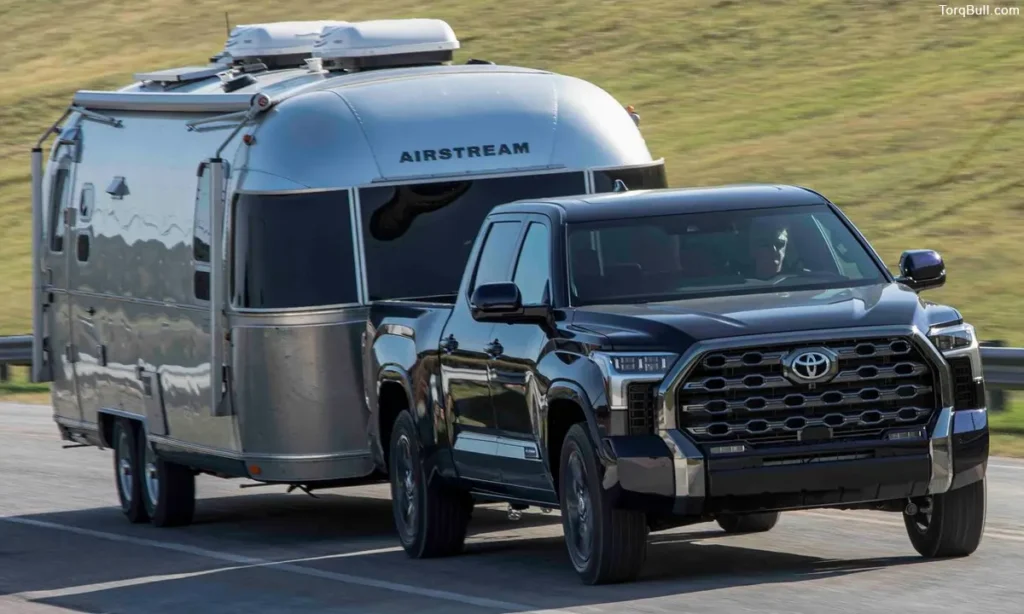
The i-Force MAX’s maximum towing capacity of 11,450 pounds when properly equipped is slightly lower than the non-hybrid Tundra’s 12,000-pound maximum — a consequence of the hybrid battery system’s additional weight reducing the Gross Combined Weight Rating available for trailer tongue load.
This 550-pound towing capacity reduction is a real specification difference that buyers who specifically need maximum towing capability should acknowledge — the non-hybrid Tundra is the correct choice when extracting every pound of rated tow capacity is the primary purchase criterion.
For buyers whose regular towing falls within the 11,450-pound ceiling — which includes virtually every recreational trailer, standard boat trailer, personal watercraft transport and utility trailer application that the majority of Tundra owners actually use — the i-Force MAX’s hybrid advantage is experienced in towing character rather than towing capacity. The electric motor’s instant torque delivery from a standstill makes trailer launches — the moment of highest stress between tow vehicle and trailer — the smoothest and most confident of any Tundra powertrain. The Tow and Haul mode’s specific calibration for sustained trailer operation manages the powertrain’s thermal state and transmission programming for extended load carrying in a way that non-hybrid alternatives cannot replicate through purely mechanical means.
One extended owner account of sustained towing with the i-Force MAX specifically identifies the smoothness under sustained load as the daily operational advantage that justifies the powertrain premium — the truck maintaining confident, composed behaviour throughout extended towing sessions where non-hybrid alternatives can feel more mechanically strained.
2026 Toyota Tundra i-Force MAX — Complete Specification Chart
| Specification | i-Force MAX | Standard i-Force (non-hybrid) | Notes |
| Engine | 3.4L Twin Turbo V6 + 48 HP electric motor | 3.4L Twin Turbo V6 | Same base engine |
| Combined Horsepower | 437 hp | 348 or 389 hp (by tune) | Hybrid adds 48 HP motor |
| Combined Torque | 583 lb ft | 405 or 479 lb ft (by tune) | 104 to 178 lb ft torque advantage |
| Transmission | 10-speed automatic | 10-speed automatic | Motor integrated into transmission housing |
| EPA City MPG (2WD) | 20 MPG | 17 MPG | 3 MPG city advantage |
| EPA Highway MPG (2WD) | 24 MPG | 23 MPG | 1 MPG highway advantage |
| EPA Combined (2WD) | 22 MPG | 20 MPG | 2 MPG combined advantage |
| EPA Combined (4WD) | 19 to 20 MPG | 17 to 18 MPG | 4WD reduces all configurations |
| Maximum Towing | 11,450 lbs (properly equipped) | 12,000 lbs (properly equipped) | Non-hybrid tows 550 more pounds |
| Drive Modes | Eco, Normal, Sport, Tow and Haul | Eco, Normal, Sport, Tow and Haul | Identical mode availability |
| Curb Weight | 5,710 to 6,185 lbs | Lower | Battery system adds weight |
| Available Trims | Limited, Platinum, 1794 Edition, TRD Pro, Capstone | Most Tundra trims | SR and SR5 are non-hybrid only |
| Starting Price Range | $59,950 to $77,000 | Lower by approximately $3,000 to $5,000 | Hybrid commands premium |
| Annual Fuel Saving vs Non-Hybrid | approximately $250 to $450 | Baseline | Varies by driving mix |
Read: 5 Toyota Cars That Last Forever! Myth or Reality?
Owner Verdict: The i-Force MAX Ownership Reality
Owner accounts across verified review platforms for the 2025 and 2026 Tundra i-Force MAX consistently describe the same core ownership reality: a truck that performs more confidently, more smoothly and more responsively than the non-hybrid alternative, at a fuel economy improvement that is meaningful without being transformative, at a towing capacity that meets all but the most maximum-rated commercial applications and at a ride quality that surprises buyers who expected a truck with 583 pound feet of torque to feel larger and less composed than it does.
The verdict from owners who use the i-Force MAX as both a daily commuter and a weekend work truck is the most revealing — the electric motor’s contribution to daily driving character is consistently described as the more noticeable daily benefit than the fuel economy improvement itself. The effortless highway acceleration, the smooth trailer launch from a stop and the linear response to throttle inputs in stop-and-go traffic collectively produce a daily quality upgrade that non-hybrid Tundra owners who have not driven the i-Force MAX consistently underestimate when evaluating whether the hybrid premium is worth paying.