Longest Range Electric Cars Under $50,000 in the USA
From a Compact Sedan That Delivers 363 Miles on a Single Charge for Under $43,000 to a Crossover That Covers 319 Miles and Starts Below $35,000 — Here Is the Definitive, Data-Driven Guide to the Electric Vehicles That Go the Furthest Without Breaking a $50,000 Budget in 2026
Longest Range Electric Cars: There is a question that every electric vehicle buyer in the United States eventually asks — not at the beginning of the research process, when the attraction of lower running costs and zero tailpipe emissions tends to dominate the conversation, but at the moment a purchase decision becomes real and the practical mathematics of range, price and charging access have to be confronted simultaneously. That question is this: how far can a genuinely affordable electric vehicle actually travel on a full charge before requiring a stop? In 2026, the answer to that question has become meaningfully better than at any previous point in the history of the American EV market. Several electric vehicles now available at dealerships across the country for under $50,000 — a price point that represents the upper boundary of what most financial analysts classify as the mainstream new-car market — deliver more than 300 miles of EPA-rated range from a single charge. One of them delivers 363 miles. Another manages 321 miles at a price that undercuts most of its direct competitors by thousands of dollars. A third covers 319 miles in a practical crossover body from a base price of $34,995. These are not marginal improvements over previous model years. They represent the point at which the fundamental objection to electric vehicle ownership — the concern that the car will run out of charge at an inconvenient moment — has been rendered statistically irrelevant for the overwhelming majority of American driving scenarios.
Why Range Matters More at $50,000 Than at $100,000
The relationship between vehicle price and the tolerance for range limitation is not symmetrical across the new-car market. A buyer spending $80,000 or more on a luxury electric vehicle typically has access to a second vehicle, a more flexible schedule and a more comprehensive home charging setup that reduces the practical importance of maximum EPA-rated range. A buyer at the $35,000 to $50,000 price point — the segment that represents the largest share of American new-car purchases — is far more likely to be making an either-or commitment to a single vehicle that must serve every driving need from the weekday commute to the annual road trip, and that must do so reliably across varying weather conditions, seasonal temperature swings and the occasional unplanned detour. For this buyer, range is not a luxury specification to be compared against leather upholstery and ambient lighting choices. It is the single most consequential practical attribute of the vehicle, because it determines the set of situations in which that vehicle can be trusted to perform without the intervention of a carefully pre-planned charging stop.
The 300-mile threshold — now widely accepted as the point at which range anxiety effectively ceases to be a structuring concern for daily driving — has, until very recently, been almost exclusively the domain of vehicles priced well above $50,000. The engineering advances of the past three model years, combining more energy-dense battery chemistry with dramatically improved drivetrain efficiency, more aerodynamically optimised body forms and more sophisticated thermal management systems, have pulled that threshold down into the mainstream price bracket for the first time. The vehicles that follow are the four strongest arguments that the affordable long-range EV has arrived — not as a promise, but as a product.
Tesla Model 3 Standard: 321 Miles for $38,630 — The Benchmark That Refuses to Be Surpassed
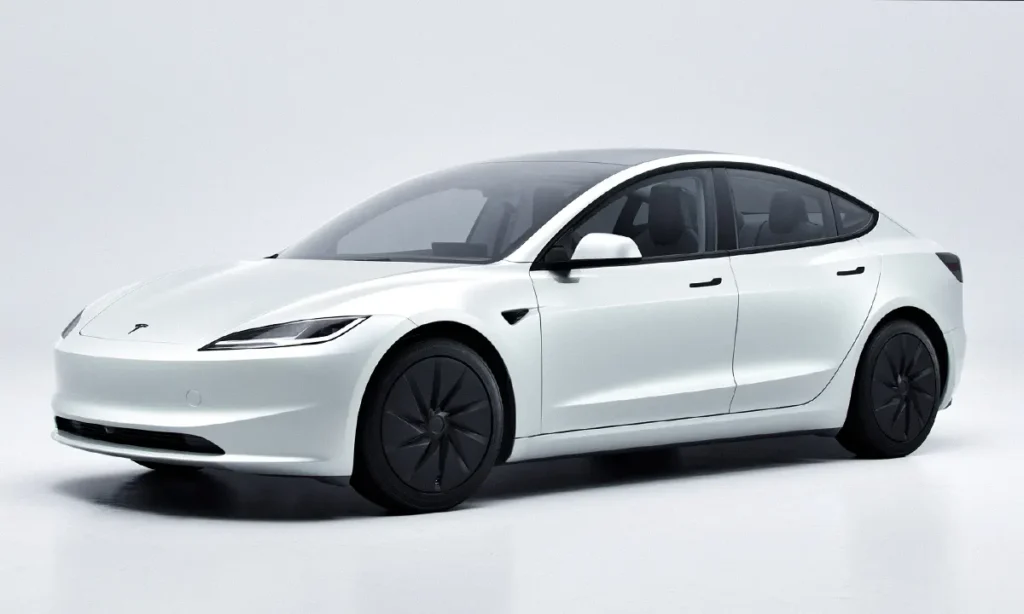
The Tesla Model 3 has occupied a unique position in the American EV market since its introduction: the vehicle that most buyers researching electric cars compare everything else against, regardless of whether they intend to buy one. The 2026 Model 3 Standard — the newest, most accessible trim in the updated lineup — justifies that benchmark status more convincingly than any of its predecessors, delivering 321 miles of EPA-rated range at a starting price of $38,630 including all destination and order fees. In independent real-world range testing conducted under consistent conditions, the Model 3 Standard covered 339 miles on a full charge — exceeding its official EPA figure by nearly 6 percent and confirming that the vehicle’s efficiency credentials are not confined to laboratory test cycles.
The efficiency architecture that makes the Model 3’s range figures possible at this price point is the product of nearly a decade of continuous powertrain refinement. The rear-wheel-drive single-motor configuration of the Standard trim consumes approximately 23 kilowatt-hours of energy per 100 miles in real-world driving — a figure that represents exceptional energy efficiency for a vehicle of this size and performance level, and that explains why the Model 3 Standard’s real-world range routinely exceeds its EPA estimate rather than falling below it as many EV owners experience. DC fast charging at up to 225 kilowatts means that a meaningful range replenishment — sufficient to add more than 150 miles of range — takes approximately 15 minutes at a compatible Supercharger station, and the Model 3’s native access to Tesla’s Supercharger network, now comprising more than 7,600 stations and 48,000 individual charge points across the United States, gives it a practical charging infrastructure advantage that no competitor at this price point has yet fully replicated.
The 2026 model returns traditional turn-signal stalks across all trim levels — a change that addresses the most widely cited ergonomic criticism of the refreshed Model 3 and that improves the day-to-day usability of a vehicle whose minimalist interior design remains polarising for buyers accustomed to conventional dashboard layouts. The 15.4-inch central touchscreen continues to serve as the control interface for virtually all vehicle functions, supported by a fully revised instrument display. Standard equipment across all Model 3 variants includes heated front seats, a heated steering wheel, adaptive cruise control, automatic emergency braking, blind-spot warning and a hands-free power trunk — a feature set that competes directly with vehicles positioned several thousand dollars above the Model 3’s asking price.
For buyers whose requirements extend beyond the 321-mile capability of the Standard trim, the Model 3 Premium rear-wheel-drive variant delivers 363 miles of EPA-rated range at a price of $44,130 including fees — a range figure that, for a vehicle under $45,000, was simply unavailable in the American market two model years ago. The Premium AWD configuration adds dual-motor traction for $47,630 and returns 346 miles of EPA-rated range, an acceleration time of 4.2 seconds from zero to 60 miles per hour, and the substantially elevated driving confidence that all-wheel drive provides in wet or winter conditions.
Chevrolet Equinox EV: 319 Miles in a Practical Crossover, Starting at $34,995
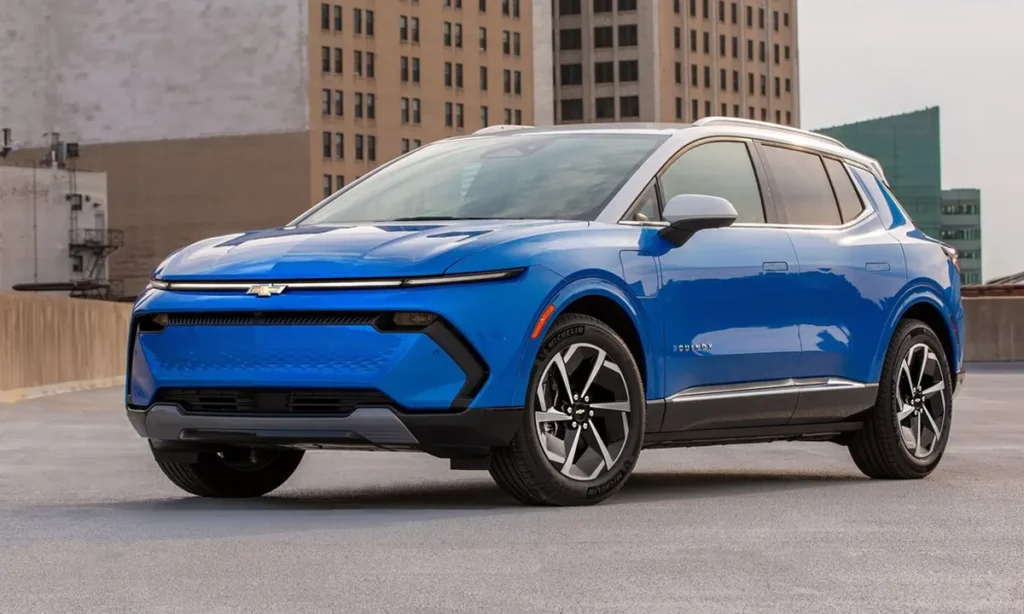
If the Tesla Model 3 makes the strongest case for long-range capability in the sub-$50,000 sedan segment, the 2026 Chevrolet Equinox EV makes an equally compelling argument for the crossover body style that the overwhelming majority of American buyers actually prefer — and it makes it at a starting price that is, before any applicable incentives, the lowest available on any long-range electric vehicle at any American dealership in this model year. The Equinox EV’s front-wheel-drive configuration achieves 319 miles of EPA-rated range, recovering approximately 70 miles of charge in just 10 minutes at a compatible DC fast-charging station — a replenishment rate that meaningfully reduces the practical inconvenience of longer highway journeys.
The Equinox EV’s most significant feature statement is its 17.7-inch central touchscreen — the largest standard infotainment display fitted to any vehicle in its competitive class — which incorporates Google built-in navigation, wireless Apple CarPlay and Android Auto integration, and a comprehensive suite of connected vehicle services. More than 20 driver assistance systems are included as standard across the lineup, covering automatic emergency braking, lane-keeping assist, rear cross-traffic alert, pedestrian detection and a rear camera system, along with the more advanced Super Cruise hands-free highway driving assistance available on higher trim levels. Optional bidirectional charging capability — which allows the Equinox EV to supply energy back to a home during a power outage — adds a dimension of practical utility that few vehicles at this price point offer and that is increasingly relevant for American buyers in regions with aging electrical grid infrastructure.
The all-wheel-drive Equinox EV delivers 307 miles of EPA-rated range at a price that remains well within the $50,000 boundary, providing buyers in colder climates or those who simply prefer the added traction security of dual-motor propulsion with a long-range option that does not require a significant compromise on driving distance. With 57.2 cubic feet of maximum cargo volume and comfortable accommodation for five occupants, the Equinox EV occupies the practical centre of the American crossover market while delivering a range figure and feature set that, two years ago, would have been considered aspirational rather than accessible.
Hyundai Ioniq 6: Aerodynamic Precision Delivers 361 Miles Under $50,000
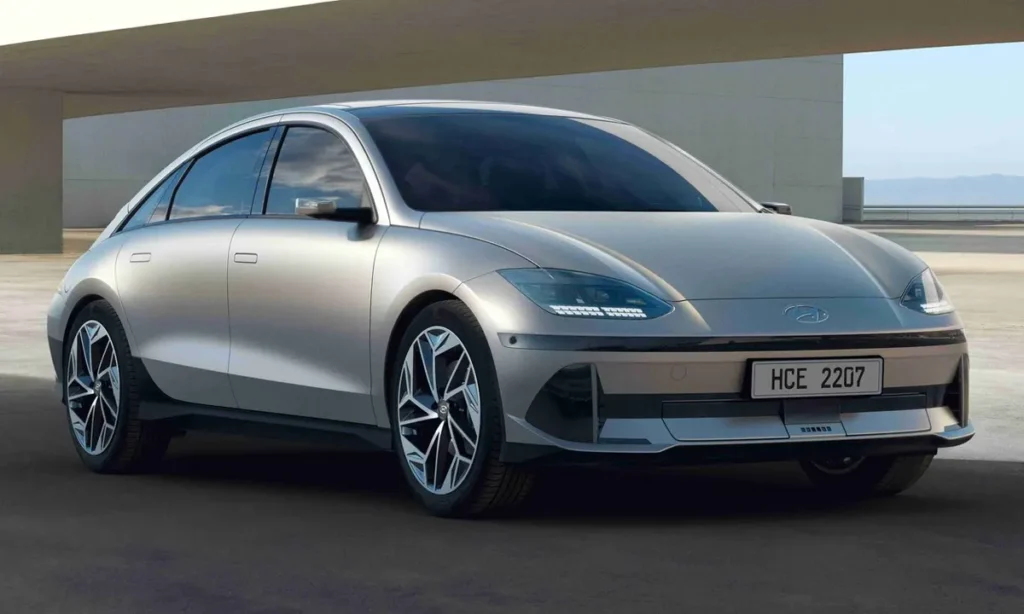
The Hyundai Ioniq 6 approaches the long-range EV problem from a fundamentally different engineering direction than its crossover-bodied competitors. Where the Equinox EV achieves its 319-mile range figure through a combination of large battery capacity and efficient drivetrain engineering, the Ioniq 6’s 361-mile maximum EPA-rated range in its rear-wheel-drive long-range configuration is a direct product of the vehicle’s extraordinary aerodynamic efficiency — a drag coefficient that places it among the most slippery production vehicles ever offered at mainstream prices. That aerodynamic advantage, combined with Hyundai’s 800-volt electrical architecture, produces a vehicle that covers more distance per kilowatt-hour of stored energy than virtually any competitor in its class, and that charges faster on ultra-high-power DC fast-charging infrastructure than the 400-volt systems fitted to the majority of its rivals can approach.
The Ioniq 6 SE RWD long-range trim, starting below $45,000, delivers that 361-mile EPA range alongside an 18-minute charge time from 10 percent to 80 percent state of charge on a compatible 350-kilowatt fast charger — a charging speed that transforms long-distance travel from a logistical exercise into a routine event. Standard equipment includes a dual 12.3-inch curved display spanning the driver and centre console positions, heated front and rear seats, wireless smartphone integration and Hyundai’s SmartSense active safety package. Independent real-world testing has repeatedly confirmed that the Ioniq 6’s actual range under highway driving conditions meets or exceeds its EPA estimates — an outcome that reflects the genuine efficiency of the underlying platform rather than the optimistic laboratory conditions that inflate some manufacturers’ official figures.
The Verdict: Three Different Vehicles, One Undeniable Conclusion
The 2026 sub-$50,000 long-range EV market does not present a single dominant answer — it presents three vehicles optimised for three distinct buyer profiles, each of which is compelling on its own terms and none of which requires meaningful compromise on the range capability that makes genuine electric mobility practical for American drivers. The Tesla Model 3 Standard remains the definitive choice for buyers who prioritise maximum efficiency, charging network access and the proven reliability of the most refined EV platform in the mainstream market, with the Premium RWD variant extending that case to a 363-mile range figure that no competitor at comparable pricing has matched. The Chevrolet Equinox EV is the strongest argument for buyers who need crossover practicality, entry-level affordability and a feature set that does not penalise the decision to choose the lowest price point in the lineup. And the Hyundai Ioniq 6 is the choice for buyers who want the most aerodynamically efficient, fastest-charging, longest-range EV available under $50,000 — a vehicle whose engineering ambition is matched by its real-world performance in ways that continue to surprise buyers and reviewers alike.
What all three confirm, together, is that the question the American EV market has been working toward answering for fifteen years — the question of whether a genuinely useful, genuinely affordable, genuinely long-range electric vehicle is possible — has been answered. In 2026, the answer is yes. And it comes in three body styles, at three price points, from three manufacturers who arrived at the same conclusion through entirely different paths.
Read: From Aston Martin to Denza Z9 GT, Could 007 Switch to Electric?
Longest Range Electric Cars Under $50,000 — 2026 USA Comparison
| Category | Tesla Model 3 Standard | Tesla Model 3 Premium RWD | Chevrolet Equinox EV FWD | Hyundai Ioniq 6 SE RWD LR |
| Base Price (MSRP + Fees) | $38,630 | $44,130 | $34,995 | ~$44,500 |
| EPA-Rated Range | 321 miles | 363 miles | 319 miles | 361 miles |
| Real-World Range (Independent Test) | 339 miles | ~345 miles | ~310 miles | Meets/Exceeds EPA |
| Motor Configuration | Single Motor RWD | Single Motor RWD | Single Motor FWD | Single Motor RWD |
| Battery Architecture | ~60 kWh / 400V | ~79 kWh / 400V | ~82 kWh / 400V | 77.4 kWh / 800V |
| Peak DC Fast Charge Speed | 225 kW | 250 kW | Up to 150 kW | Up to 350 kW |
| 10–80% Charge Time | ~25 minutes | ~25 minutes | ~26 minutes | ~18 minutes |
| Charging Port Standard | NACS (Native) | NACS (Native) | NACS (Native) | NACS (Native) |
| Supercharger Network Access | Yes — Native | Yes — Native | Yes — Native | Yes — Native |
| 0–60 mph | 5.8 seconds | 4.9 seconds | ~6.5 seconds | ~7.4 seconds |
| Infotainment Screen | 15.4-inch | 15.4-inch | 17.7-inch | Dual 12.3-inch |
| Wireless CarPlay / Android Auto | No (Built-in Google) | No (Built-in Google) | Yes | Yes |
| Heated Front Seats | Yes | Yes | Available | Yes |
| Active Safety Suite | Standard | Standard | 20+ Systems Standard | SmartSense Standard |
| Cargo Volume | 23 cu ft (combined) | 23 cu ft (combined) | 57.2 cu ft (max) | 26.3 cu ft |
| Drivetrain Options | RWD / AWD | RWD / AWD | FWD / AWD | RWD / AWD |
| AWD Range (if applicable) | 346 miles (Premium AWD) | — | 307 miles | 266 miles |
| AWD Price | $47,630 | — | Under $50,000 | Under $50,000 |
| Bidirectional Charging | No | No | Available | No |
| Federal Tax Credit Eligibility | Check income limits | Check income limits | Yes | Check income limits |
| Vehicle Type | Sedan | Sedan | Compact Crossover | Sedan |
| Best For | Efficiency + Network | Maximum Range | Practicality + Value | Fastest Charging |