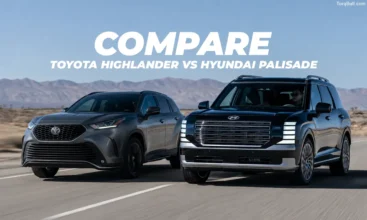
- The Honda Pilot delivers up to 22 MPG combined, while the gas-powered Toyota Highlander reaches 24–25 MPG combined.
- The Toyota Highlander Hybrid achieves 35–36 MPG combined, matching the new Kia Telluride Hybrid at 35 MPG combined.
- Expert says the Pilot falls more than 10 MPG behind the Toyota Grand Highlander Hybrid in overall fuel efficiency.
The Honda Pilot’s fuel efficiency story in 2026 is the most important competitive weakness the vehicle carries — and the one that Cars.com, Autoblog, U.S. News and Edmunds all specifically and consistently identify as the Pilot’s primary disadvantage in a segment that has collectively moved toward hybrid technology while Honda has not followed. The Pilot remains the only major three-row midsize SUV without a hybrid powertrain in a segment where Toyota, Hyundai, Kia and Mazda all offer electrified options. At 22 MPG combined maximum with front-wheel drive, the Pilot produces adequate efficiency from its naturally aspirated 3.5-litre V6 — but it is meaningfully less efficient than competing gasoline alternatives and dramatically less efficient than the hybrid-equipped competitors that are now available at comparable prices. This guide examines the complete fuel efficiency picture, the annual fuel cost implications for real families and the specific scenarios where the Pilot’s efficiency profile is most and least competitive.
The 2026 Honda Pilot’s EPA Fuel Economy: Every Configuration
The 2026 Honda Pilot uses the same naturally aspirated 3.5-litre V6 engine producing 285 horsepower across its entire trim lineup — from the base Sport through the Black Edition. No powertrain variation exists between trims, and therefore fuel economy differences between configurations reflect only the drivetrain choice between front-wheel drive and all-wheel drive.
Front-wheel drive configurations — Sport, EX-L and Touring trims — achieve the highest available Pilot fuel economy at 19 MPG city, 27 MPG highway and 22 MPG combined according to EPA estimates. Autoblog confirms the 2026 FWD model is 1 MPG more efficient in city driving relative to the 2025 FWD model, while the combined figure of 22 MPG remains unchanged from 2025. The all-wheel drive configurations — available on EX-L, Touring, Elite and Black Edition trims — produce 18 MPG city, 25 MPG highway and 21 MPG combined. The TrailSport — the off-road oriented trim equipped with all-terrain tyres — produces the lineup’s lowest figures at 18 MPG city and 23 MPG highway due to increased rolling resistance from the off-road rubber.
Real-world fuel economy from independent highway testing confirms the EPA estimates are achievable in normal conditions. Cars Frenzy’s independent highway test of the Elite trim recorded 27 MPG at 75 MPH — matching the EPA highway figure for AWD models. The TrailSport managed 22 MPG under the same conditions, confirming the off-road tyre penalty is real and consistent. Fuelly user-submitted data from actual Pilot owners produces real-world averages of 19.9 to 22.4 MPG in mixed driving conditions — closely aligned with EPA combined estimates and confirming the Pilot meets but does not exceed its official ratings in typical family use.
The Pilot’s 18.5-gallon fuel tank — larger than many competitors’ tanks — does provide one meaningful practical advantage: at 22 MPG combined, a full tank delivers an estimated 400 to 500 miles of driving range, reducing fill stop frequency on longer road trips compared to vehicles with smaller tanks at similar or lower fuel economy.
Read: Which Honda Pilot Variant Offers the Best Value? The Complete 2026 Trim-by-Trim Breakdown
The Competitive Problem: No Hybrid in a Hybrid Segment
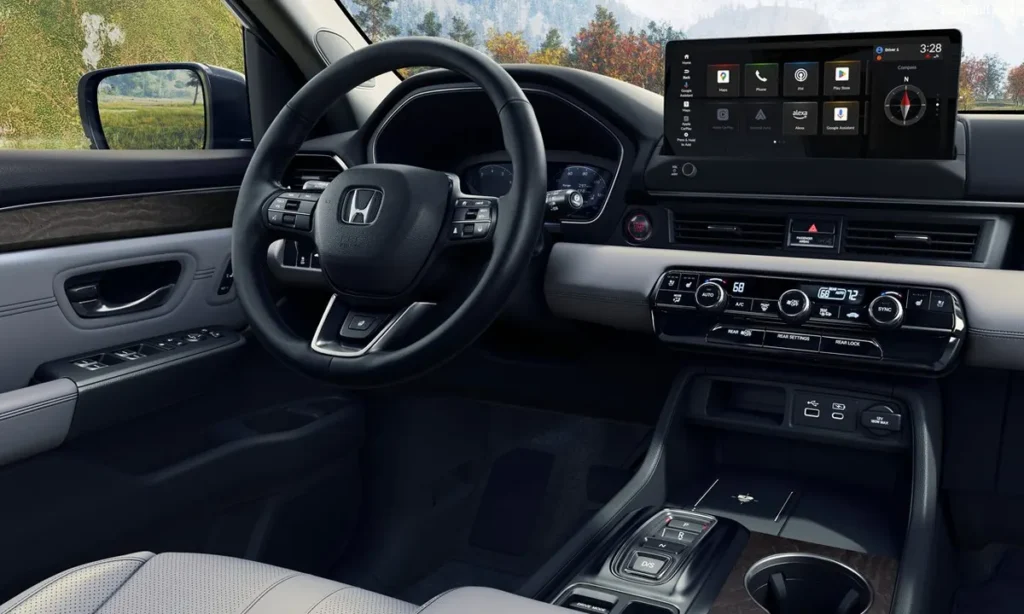

The Honda Pilot’s fundamental fuel efficiency challenge in 2026 is not that its naturally aspirated V6 is particularly inefficient — it is that the segment has moved around the Pilot while Honda has stood still on powertrain strategy.
Cars.com identifies the Pilot as one of only two vehicles in its class still powered by a naturally aspirated V6 — the Nissan Pathfinder being the other. Neither can match the efficiency of competitors that have adopted turbocharged four-cylinders or, in many cases, hybrid assistance. Autoblog is direct in its assessment: the Pilot’s lack of a hybrid powertrain continues to hold it back — rivals from Toyota, Hyundai, Kia and Mazda all have more efficient hybrid options.
The practical consequence of this competitive positioning is stark when expressed in annual fuel costs. The EPA calculates that the average driver saves approximately $300 per year by choosing the Toyota Highlander gas model over the base Honda Pilot — and the hybrid-equipped alternatives produce savings that dwarf this figure. At 15,000 annual miles and $3.08 per gallon, the 22 MPG Pilot costs approximately $2,100 per year in fuel. The Toyota Highlander Hybrid at 35 MPG combined costs approximately $1,323 per year — an annual saving of approximately $777. Over five years, this hybrid advantage accumulates to $3,885 in fuel cost savings that the Pilot cannot offer, because no Honda Pilot Hybrid exists.
The 2027 Kia Telluride Hybrid — the most directly competitive redesigned alternative — further compounds this disadvantage. The Telluride Hybrid achieves 34 MPG city and 36 MPG highway in FWD configuration. Compared to the Pilot’s 19 MPG city and 27 MPG highway, the Telluride Hybrid is 15 MPG more efficient in the city and 9 MPG more efficient on the highway. These are not marginal differences — they represent fundamentally different fuel cost profiles across ownership periods that will increasingly define the segment’s purchase conversation.
Read: Is the Honda Pilot Good for First-Time SUV Buyers? The Complete 2026 Guide
Where the Pilot Is Most Competitive: Gas-Only Peer Group
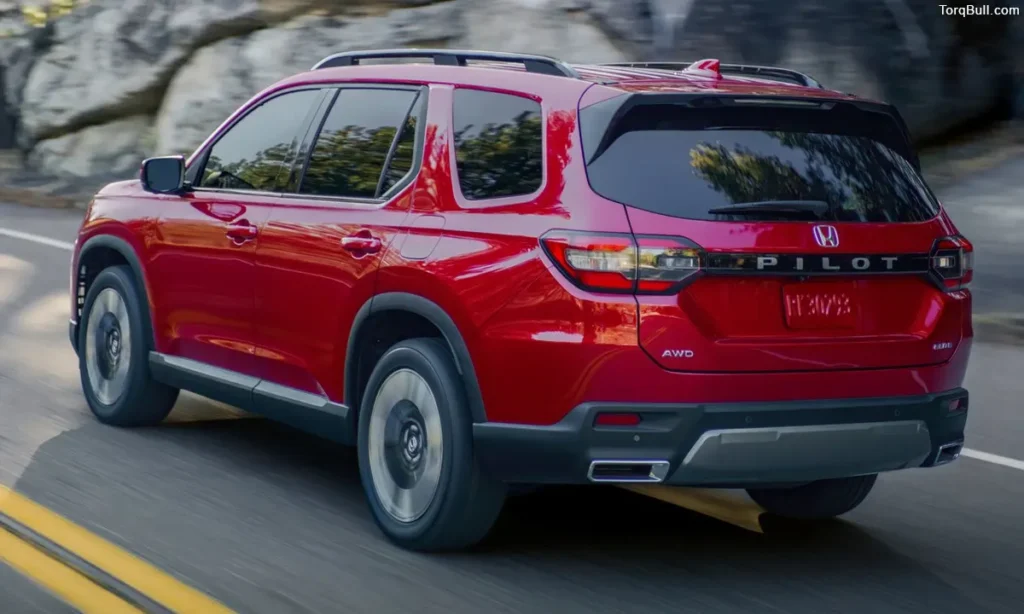
Within the gas-only three-row SUV peer group — excluding hybrid alternatives — the Honda Pilot’s 22 MPG combined maximum is competitive with the Kia Telluride and modestly below the Toyota Highlander’s gas model.
The non-hybrid Toyota Highlander achieves 21 to 22 MPG combined in AWD configuration and 24 to 25 MPG combined with front-wheel drive — outperforming the Pilot by 2 to 3 MPG in equivalent drivetrain comparisons. Edmunds’ real-world evaluation route returned 26.6 MPG for the gas Highlander — meaningfully above the Pilot’s 22 MPG combined EPA figure and substantially better in real-world conditions as well as on the specification sheet. U.S. News confirms the EPA average driver fuel cost savings of $300 per year from choosing the Highlander over the Pilot at equivalent configurations.
The Kia Telluride in its non-hybrid gas configuration achieves 20 MPG city, 26 MPG highway and 23 MPG combined with front-wheel drive — closely matched to the Pilot’s 22 MPG combined, with the Pilot modestly competitive in highway fuel economy particularly. Cars Frenzy’s real-world highway test confirms the Pilot achieving 27 MPG versus the Telluride’s 26 MPG on the highway — the Pilot’s single genuine fuel economy win in a direct competitor comparison. The Ford Explorer achieves 21 MPG city, 28 MPG highway and 24 MPG combined — also slightly above the Pilot on most metrics.
In this non-hybrid comparison context, the Honda Pilot is a competitive but trailing participant — not dramatically less efficient than the Highlander or Explorer but consistently behind them, and approaching the lower-efficiency Telluride more closely on highway numbers. For buyers who specifically cannot or will not consider a hybrid powertrain, the Pilot’s gas efficiency is adequate rather than competitive.
Honda Pilot Fuel Efficiency vs Competitors — Complete 2026 Comparison Chart
| Vehicle | Powertrain | EPA City | EPA Highway | EPA Combined | Annual Fuel Cost* | vs Pilot Saving |
| Honda Pilot FWD | 3.5L V6 NA | 19 MPG | 27 MPG | 22 MPG | ~$2,100 | Baseline |
| Honda Pilot AWD | 3.5L V6 NA | 18 MPG | 25 MPG | 21 MPG | ~$2,200 | −$100 vs Pilot FWD |
| Honda Pilot TrailSport AWD | 3.5L V6 NA (AT tyres) | 18 MPG | 23 MPG | 20 MPG | ~$2,310 | Worse |
| Toyota Highlander Gas FWD | 2.4L Turbo 4-cyl | 22 MPG | 29 MPG | 25 MPG | ~$1,848 | +$252/yr |
| Toyota Highlander Gas AWD | 2.4L Turbo 4-cyl | 21 MPG | 28 MPG | 24 MPG | ~$1,925 | +$175/yr |
| Toyota Highlander Hybrid AWD | 2.5L NA 4-cyl + electric | 36 MPG | 35 MPG | 35 MPG | ~$1,323 | +$777/yr |
| Kia Telluride Gas FWD | 3.8L V6 NA | 20 MPG | 26 MPG | 23 MPG | ~$2,009 | +$91/yr |
| Kia Telluride Hybrid FWD | 2.5L Turbo + electric | 34 MPG | 36 MPG | 35 MPG | ~$1,320 | +$780/yr |
| Hyundai Palisade Hybrid | Hybrid powertrain | 33 MPG | 35 MPG | 34 MPG | ~$1,364 | +$736/yr |
| Ford Explorer FWD | 2.3L EcoBoost 4-cyl | 21 MPG | 28 MPG | 24 MPG | ~$1,925 | +$175/yr |
| Toyota Grand Highlander Hybrid | 2.4L Turbo + electric | 36 MPG (FWD est.) | 34 MPG | 35 MPG | ~$1,323 | +$777/yr |
Annual fuel cost calculated at $3.08/gallon, 15,000 miles per year using EPA combined figures. Savings versus Honda Pilot FWD baseline.
The Practical Ownership Implication: When Pilot Efficiency Is Good Enough

The Honda Pilot’s fuel efficiency disadvantage is most material in specific owner profiles — and genuinely less consequential in others. Understanding which profile matches any specific buyer determines whether the efficiency gap is a decisive limitation or an acceptable trade-off.
The efficiency gap is most consequential for buyers who cover high annual mileage — 15,000 or more miles per year — because the annual fuel saving from a hybrid competitor accumulates proportionally with mileage. An owner covering 20,000 annual miles saves approximately $1,036 per year by choosing the Highlander Hybrid over the Pilot — a five-year total of $5,180 that significantly narrows the Highlander Hybrid’s purchase price premium. For a high-mileage buyer, the Pilot’s lack of a hybrid option is a meaningful financial disadvantage that compounds across the ownership period.
The efficiency gap is least consequential for buyers who specifically need the Pilot’s specific strengths — particularly its genuinely adult-accessible third row, its removable second-row centre seat for eight-passenger flexibility, its competitive pricing relative to fully equipped alternatives and its strong reliability reputation. For a family whose annual mileage is modest, whose third-row accommodation requirements specifically match the Pilot’s superior packaging and who values Honda’s ownership experience, the $91 to $777 annual fuel cost premium versus gas competitors is a manageable and justifiable trade-off.
Autoblog’s conclusion represents the most balanced available assessment: the Pilot is a good vehicle whose fuel efficiency limitations are real but contextual — buyers who specifically need the Pilot’s interior advantages and Honda’s reliability track record can accept the efficiency gap, while buyers who prioritise fuel economy above interior packaging should seriously evaluate the hybrid-equipped alternatives.