Charge Smarter, Not Longer. EV Charging Time vs Battery Size Explained
Why a Larger Battery Does Not Always Mean a Longer Charge, How Kilowatt Ratings Determine Real Charging Speed, the C-Rate Relationship That Battery Engineers Use to Predict Charging Behaviour and the Simple Framework Every EV Owner Needs to Understand Before Plugging In
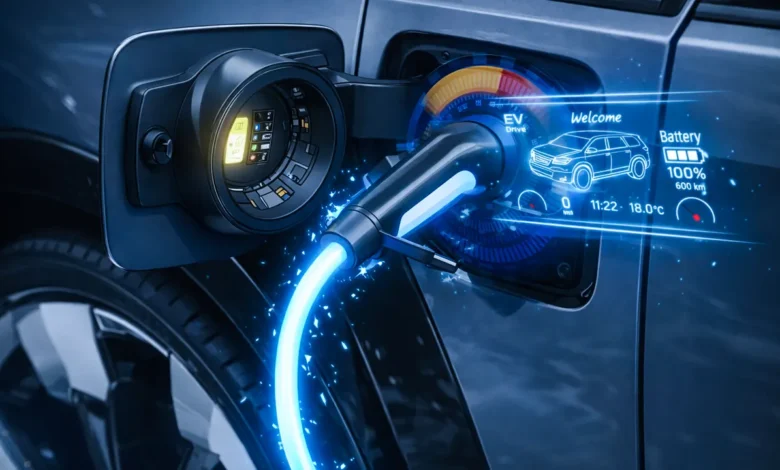
EV Charging Time vs Battery Size: The relationship between an electric vehicle’s battery size and its charging time is one of the most commonly misunderstood aspects of EV ownership — a connection that most buyers assume is simple and linear but whose actual behaviour involves charging power, battery chemistry, thermal management and the C-rate relationship that determines how quickly any specific battery can safely accept energy. Understanding this relationship transforms the EV ownership experience from a passive wait at a charging station into an informed process whose management the driver can optimise through charger selection, charging timing and the battery pre-conditioning that modern EVs make available as a standard capability.
The Basic Relationship: Battery Size and Charging Time
The most fundamental principle governing EV charging time is the relationship between battery capacity — measured in kilowatt-hours — and charging power — measured in kilowatts. The basic calculation is straightforward: charging time equals battery capacity divided by charging power. A 77-kilowatt-hour battery charged at 77 kilowatts would theoretically charge from empty to full in one hour.
The word theoretically is critical — because real-world charging behaviour deviates from this simple calculation through several factors whose understanding is essential to predicting actual charging stops accurately.
The first deviation is charging efficiency — whose 85 to 95 percent range means that more energy is drawn from the charger than is stored in the battery, extending the actual charging time beyond the theoretical calculation by approximately 5 to 15 percent. The second is the charging curve’s non-linear behaviour — whose tapering above 80 percent state of charge slows the charging rate to protect battery chemistry, meaning the final 20 percent of capacity takes disproportionately longer than the initial 80 percent.
Why Charging Power Matters More Than Battery Size
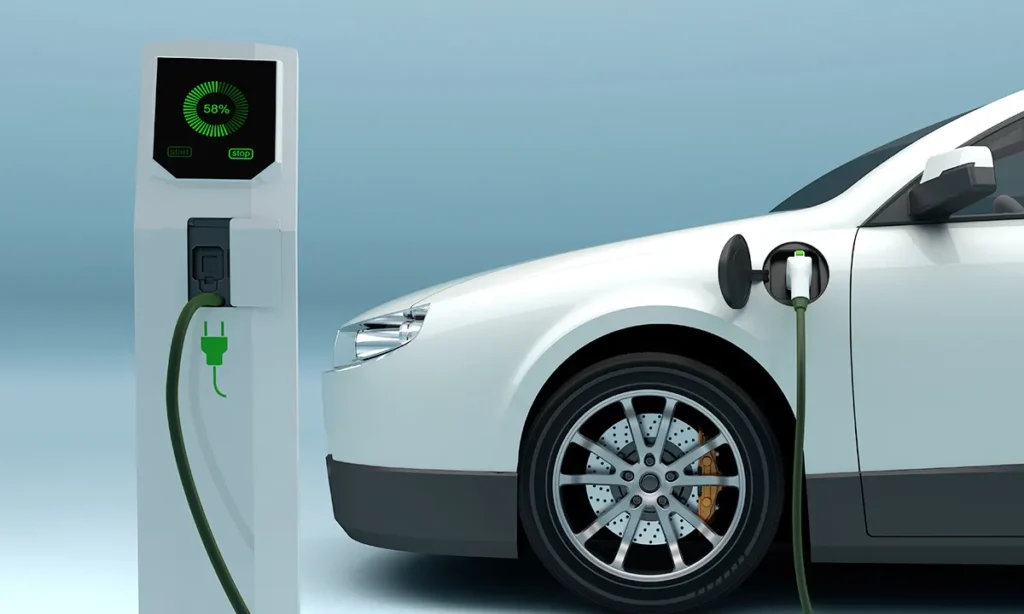
The charging power that the EV’s onboard charger accepts — rather than the battery’s capacity — is the primary determinant of charging speed. A larger battery charged at lower power charges more slowly than a smaller battery charged at higher power, despite containing more total energy.
The Hyundai Ioniq 6’s 77.4-kilowatt-hour battery accepts DC fast charging at 350 kilowatts — producing a 10-to-80 percent charge time of approximately 18 minutes. The Ford F-150 Lightning’s 131-kilowatt-hour Extended Range battery accepts a maximum of 150 kilowatts — producing a 10-to-80 percent charge time of approximately 41 minutes despite the battery containing nearly twice the total energy. The Lightning’s larger battery takes more than twice as long to charge to 80 percent because its maximum charging rate is less than half the Ioniq 6’s acceptance capability.
This relationship demonstrates that battery size and charging speed are independent variables — one measures energy storage capacity while the other measures energy transfer rate. Confusing the two produces incorrect charging time expectations that create unnecessary range anxiety and poor charging stop planning.
The C-Rate: The Engineering Relationship Behind Charging Speed
Battery engineers use a measurement called the C-rate to express charging speed relative to battery capacity — a normalised figure that allows direct comparison between batteries of different sizes. A 1C rate charges the battery at a current equal to its capacity in one hour. A 2C rate charges at twice that current, completing the charge in 30 minutes. A 0.5C rate takes two hours.
The practical significance of the C-rate for EV owners is the understanding it provides for why different battery sizes respond differently to the same charger. A 100-kilowatt-hour battery accepting 100 kilowatts is charging at 1C. A 50-kilowatt-hour battery accepting the same 100 kilowatts is charging at 2C — twice the rate relative to its capacity, charging twice as fast proportionally.
Modern high-performance EV batteries are engineered to accept charging rates between 2C and 5C under optimal thermal conditions — with the 800-volt architecture’s ability to deliver high power at lower current enabling the higher C-rates that faster charging demands without the heat generation that high-current charging at lower voltage produces.
Read: EV Charging Cost Per Month in the USA. A Complete Comparison
Temperature’s Effect on Charging Time
Battery temperature is the variable that most significantly affects real-world charging time beyond the theoretical calculation — because lithium-ion chemistry’s electrochemical processes slow at low temperatures and accelerate at optimal temperatures whose range of approximately 20 to 35 degrees Celsius produces maximum charging rate acceptance.
A cold battery — below 10 degrees Celsius — may accept only 20 to 50 percent of its maximum charging rate until thermal management systems raise the cell temperature to the optimal range. This temperature limitation explains why winter charging stops take longer than summer equivalents at identical chargers — not because the charger is performing differently but because the battery’s chemistry requires temperature as a prerequisite for maximum rate acceptance.
Battery pre-conditioning — whose activation through the navigation system’s charging stop routing raises battery temperature before arrival at a fast charger — addresses this limitation by using the driving time to prepare the battery for maximum rate acceptance. EV owners who regularly pre-condition their batteries before DC fast charging consistently report charging times 20 to 40 percent shorter than equivalent cold-battery stops.
Read: Real Cost of Owning an Electric Car for 5 Years
EV Charging Time vs Battery Size — Quick Reference Chart
| Vehicle | Battery Size | Max DC Charge Rate | 10–80% Time | Charging Architecture |
| Hyundai Ioniq 6 LR | 77.4 kWh | 350 kW | ~18 min | 800-Volt |
| Kia EV6 LR AWD | 77.4 kWh | 350 kW | ~18 min | 800-Volt |
| Tesla Model 3 LR | 82 kWh | 250 kW | ~25 min | 400-Volt |
| Chevrolet Equinox EV | 85 kWh | 150 kW | ~35 min | 400-Volt |
| Ford F-150 Lightning ER | 131 kWh | 150 kW | ~41 min | 400-Volt |
| Mercedes EQS 450+ | 107.8 kWh | 200 kW | ~31 min | 400-Volt |