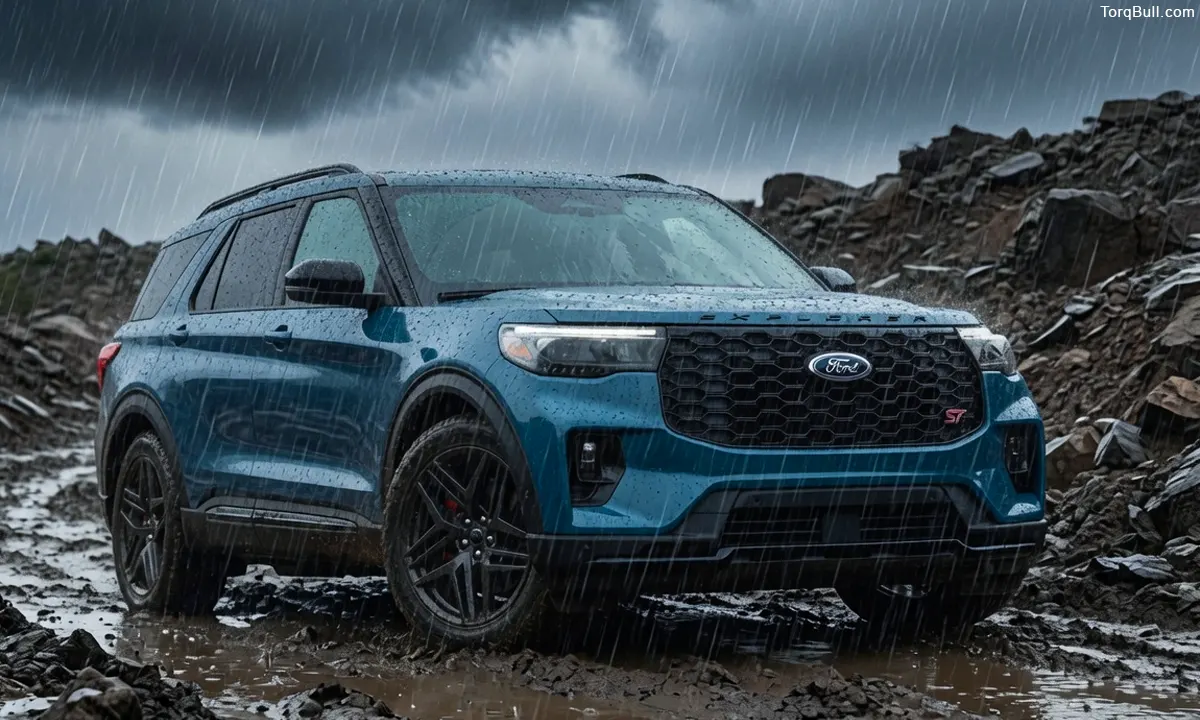
- The 2026 Ford Explorer’s Intelligent AWD system continuously adjusts torque distribution to improve traction, stability and confidence in changing road conditions.
- Adding AWD costs about $2,000 on four-cylinder models and results in a modest fuel-economy penalty of roughly 1–2 MPG combined.
- Thanks to its rear-wheel-drive-based platform, the Explorer retains a rear-biased driving feel, while the new Tremor trim enhances capability further with a Torsen limited-slip rear differential, all-terrain tires and increased ground clearance.
The Ford Explorer occupies an unusual position in the midsize three-row SUV segment — it is one of very few vehicles in this class that uses a rear-wheel-drive-based platform rather than the front-wheel-drive-based unibody construction that the Honda Pilot, Toyota Highlander, Kia Telluride and most competing alternatives use. This rear-wheel-drive-based architecture shapes every dimension of the Explorer’s AWD experience, producing a driving character that is noticeably sportier and more driver-focused than front-drive-biased alternatives even when the optional AWD system is engaged. Professional evaluation confirms that even when equipped with all-wheel drive, the rear bias is noticeable and welcome — a rare character trait in a family SUV segment that typically prioritises stability-oriented front-drive handling over the engaged rear-drive feel that the Explorer specifically delivers. This complete review examines every dimension of the Explorer’s AWD system, from its technical architecture through real-world traction performance, fuel economy impact and the Tremor’s specific off-road hardware that extends the AWD system’s capability further than any previous Explorer configuration.
The AWD Architecture: Rear-Biased and Intelligent
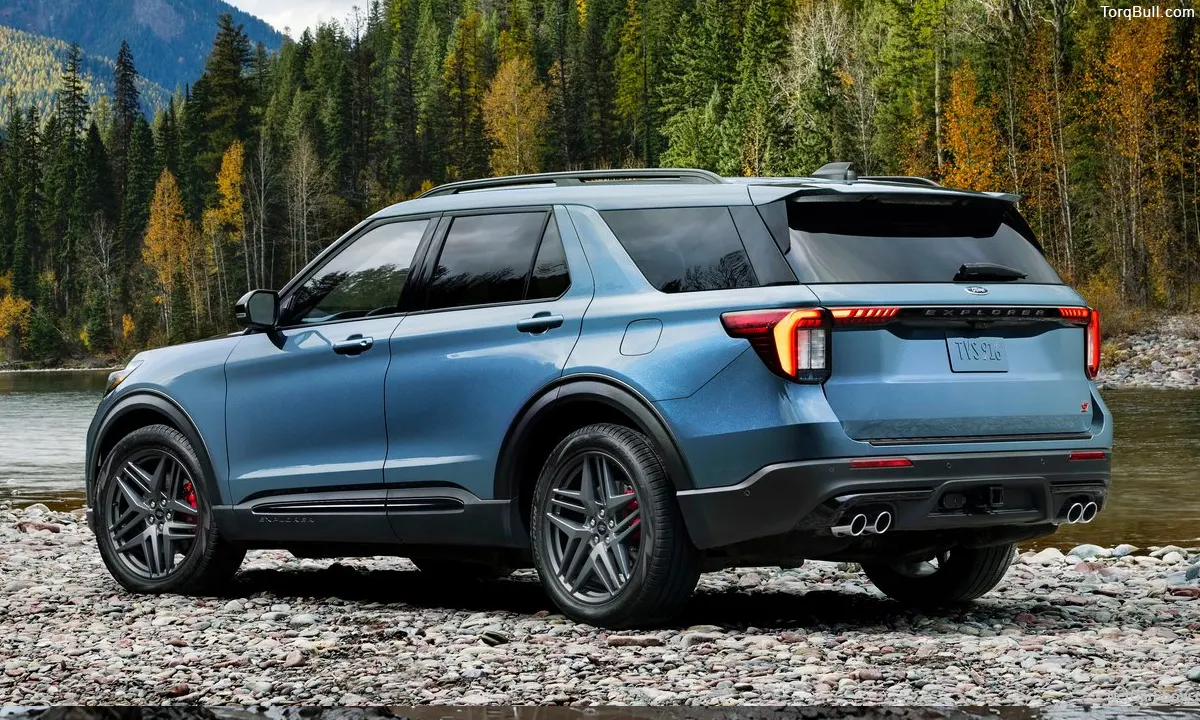
The 2026 Ford Explorer’s intelligent all-wheel-drive system operates as an on-demand system with a rear-wheel-drive default — meaning the vehicle operates in rear-wheel drive during normal dry-pavement conditions and transfers torque forward to the front wheels when the system’s electronic management detects wheel slip, traction loss or driving conditions that benefit from four-wheel engagement.
This rear-drive-default architecture is specifically uncommon in the midsize three-row segment where most competitors use front-drive-default systems that send most power to the front wheels during normal operation. The Explorer’s rear-default approach produces the rear-biased feel that professional evaluation characterises as noticeable and welcome — a more balanced and more driver-engaged handling character than front-heavy alternatives provide even when the full AWD system is engaged.
The intelligent AWD system automatically transfers torque between axles and individual wheels through a coupling mechanism that responds to wheel speed differences and throttle inputs within milliseconds. During normal driving, the transition from rear-wheel drive to AWD is imperceptible to occupants. During aggressive acceleration on low-traction surfaces or during sudden traction loss events, the front wheel engagement is immediate enough to prevent the extended wheel spin that AWD systems with slower response times allow before engagement.
The terrain management system optimises vehicle behaviour across different surface conditions by adjusting throttle mapping, transmission shift strategy and AWD torque distribution simultaneously. Multiple terrain modes tailor these adjustments for different environments, from normal dry pavement through wet roads and light snow to the off-road conditions where the Tremor’s enhanced hardware extends the system’s effective range.
Read: Ford Explorer Road Trip Review 2026. Can It Keep Families Comfortable for Hours?
The Fuel Economy Trade: What AWD Actually Costs
The AWD option carries a $2,000 purchase price premium on the 2026 Ford Explorer, added to any trim level across the lineup. The fuel economy cost of this option is modest: adding AWD reduces fuel economy by approximately 1 to 2 MPG across both powertrains, reflecting the additional mechanical losses from the front driveshaft and front differential that AWD adds to the drivetrain.
The four-cylinder Explorer achieves 20 MPG city and 29 MPG highway in rear-wheel drive, for a 24 MPG combined rating — the best non-hybrid fuel economy in the segment. Adding AWD produces 20 MPG city and 27 MPG highway, for a 23 MPG combined rating, a 1 MPG combined reduction from the minimal AWD penalty. At 15,000 annual miles and $3.08 per gallon, this 1 MPG combined reduction costs approximately $63 per year in additional fuel — a modest ongoing cost for the year-round traction confidence that AWD provides.
The V6-equipped Explorer ST and Platinum achieve 18 MPG city and 25 MPG highway in rear-wheel drive, or 18 MPG city and 25 MPG highway combined with AWD. The V6’s fuel economy is modest by segment standards at 20 MPG combined in AWD configuration, reflecting the performance engine’s priority over efficiency.
The Tremor: AWD With Purpose-Built Off-Road Hardware
The 2026 Ford Explorer Tremor is the new trim that most specifically expands what the Explorer’s AWD system can accomplish — pairing the intelligent AWD architecture with hardware additions that extend the system’s traction capability onto surfaces that the standard Explorer AWD addresses less confidently.
The Tremor’s standard Torsen limited-slip rear differential is the most mechanically significant addition — distributing power more effectively than an open differential when one rear wheel loses traction, maintaining forward momentum in situations where a standard open differential would allow the low-traction wheel to spin without contributing to vehicle progress. The Torsen unit’s mechanical bias action is faster and more predictable than electronically controlled alternatives, providing immediate traction response that off-road driving specifically benefits from.
The Bridgestone Dueler all-terrain tyres mounted on 18-inch wheels provide the traction compound and aggressive shoulder block geometry that loose dirt, gravel and light mud surfaces require for grip — the tyre characteristic that electronic AWD management cannot compensate for when standard highway tyres are the contact point between the drivetrain and the surface. Standard AWD without all-terrain tyres reaches the limits of its effective traction range significantly sooner on unpaved surfaces than the same AWD system with properly compounded tyres.
The extra inch of ride height compared to standard Explorer configurations, improved approach and departure angles and underbody steel deflector plates protecting critical components from rock strikes collectively extend the terrain that the Tremor can navigate without contact damage. Professional evaluation of the Tremor during its Death Valley development testing described Ford as doing an admirable job of making occupants forget that the Tremor is fitted with chunky all-terrain tyres and an off-road suspension, specifically because engineers revised dampers, springs and sway bars to produce a plusher ride than the previous Timberline trim delivered.
Read: Ford Explorer ST Review 2026. Here’s What Makes It So Exciting to Drive
2026 Ford Explorer AWD System and Fuel Economy — Complete Reference Chart
| Configuration | Drive System | City MPG | Highway MPG | Combined MPG | 0 to 60 MPH | Annual Fuel Cost (15K miles) |
| Four-cylinder 300 HP | Rear-wheel drive | 20 MPG | 29 MPG | 24 MPG | 6.1 seconds | approximately $1,925 |
| Four-cylinder 300 HP | Intelligent AWD | 20 MPG | 27 MPG | 23 MPG | 6.8 seconds | approximately $2,009 |
| V6 400 HP (ST, Platinum) | Rear-wheel drive | 18 MPG | 25 MPG | 21 MPG | 5.0 to 5.1 seconds | approximately $2,200 |
| V6 400 HP (ST, Platinum) | Intelligent AWD | 18 MPG | 25 MPG | 20 MPG | 5.1 to 5.5 seconds | approximately $2,310 |
| Tremor 400 HP (V6) | Full-time AWD, Torsen rear diff | 17 MPG | 22 MPG | 19 MPG | 6.0 seconds estimated | approximately $2,432 |
| AWD option purchase premium | $2,000 added to any trim | |||||
| AWD annual fuel cost premium | approximately $63 to $120 additional | |||||
| Towing capacity (all AWD) | 5,000 lbs with Class III hitch |
Real-World AWD Performance: What the Testing Confirms
The Explorer’s AWD system specifically impressed in wet-weather conditions during professional extended testing, where the rear-biased character and intelligent torque distribution produced a notably more controlled and more engaged driving experience than competing front-drive-default alternatives. The absence of the push-through-understeer character that front-heavy crossovers exhibit in hard cornering on wet surfaces is the most consistent professional characterisation of the Explorer AWD’s cornering advantage over segment alternatives.
In the Explorer ST’s AWD configuration, the 400-horsepower V6’s torque delivery on wet surfaces is managed by the AWD system with sufficient precision that professional evaluation describes the ST as able to effortlessly slice through traffic — a traction management description that confirms the system’s effectiveness at managing the high-torque V6’s power delivery across varied surface conditions.
The Tremor’s off-road AWD performance was evaluated on Death Valley trails during Ford’s development testing period, confirming that the Torsen rear differential and all-terrain tyres extend the Explorer’s effective off-road range significantly beyond standard AWD configurations. The system tackled trails throughout the park without the difficulty that a standard Explorer AWD would have encountered on the more demanding sections — the combination of the mechanical LSD, the terrain-appropriate tyres and the enhanced ground clearance producing a genuinely more capable off-road machine within the Explorer’s fundamentally road-biased unibody platform.
Read: Ford Explorer Insurance Cost 2026. The Hidden Expense Every Buyer Should Consider
Who Should Choose AWD: The Practical Recommendation
AWD is the correct choice for Explorer buyers in northern states and mountain regions where winter precipitation, ice and seasonal snow are regular features of the driving environment. The $2,000 purchase premium is recovered in daily confidence across months of winter weather, and the $63 annual fuel cost at four-cylinder efficiency is among the most modest AWD efficiency penalties in the segment.
AWD is also the correct choice for the Explorer Tremor, where it is standard rather than optional — the all-terrain tyre and Torsen differential package specifically requires AWD to realise its full traction benefit, and the Tremor’s positioning as an adventure-capable family SUV assumes AWD as the foundational capability.
Rear-wheel drive remains appropriate for buyers in consistently mild-climate markets where winter precipitation is genuinely rare, and for driving enthusiasts who specifically want the purest rear-drive character that the Explorer’s platform most naturally delivers.