- The 2026 Honda CR-V gas model returns up to 30 MPG combined, with annual fuel costs estimated at roughly $1,444–$1,700.
- The CR-V Hybrid improves efficiency to 40 MPG combined, delivering significant fuel savings in everyday driving.
- Choosing the Hybrid can save approximately $400 per year and about $2,000 over five years compared with the gas-powered CR-V.
The Honda CR-V’s fuel cost story in 2026 is a tale of two powertrains that serves fundamentally different buyer financial profiles — a gas-only 1.5-litre turbocharged four-cylinder that achieves competitive non-hybrid fuel economy and a hybrid system that improves on the gas model’s already capable efficiency by 10 MPG combined while simultaneously accelerating from 0-60 MPH approximately one second faster. Understanding exactly what each powertrain costs per year, per fill, per mile and across the five-year ownership horizon gives every CR-V buyer the financial clarity to make the right configuration decision for their specific annual mileage, driving environment and ownership timeline. This complete guide provides every fuel cost figure across every configuration and every mileage scenario.
The Gas CR-V Fuel Economy: Competitive Without Electrification
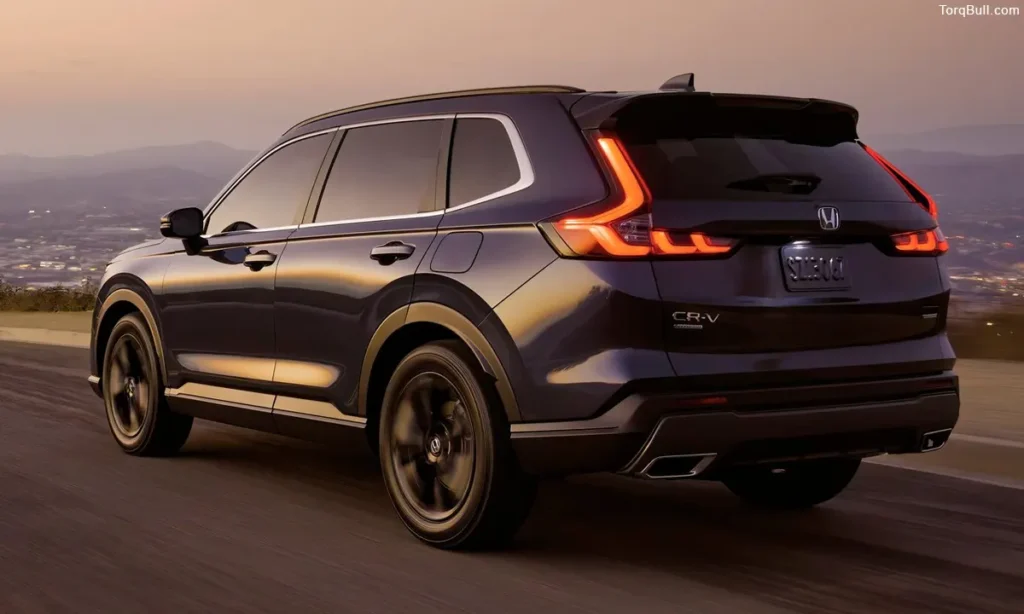
The 2026 Honda CR-V with the standard 1.5-litre turbocharged four-cylinder engine producing 190 horsepower achieves fuel economy ratings that are competitive within the non-hybrid compact crossover segment — achieving higher combined efficiency than many competing V6-powered alternatives while delivering the performance and towing capability that the turbocharged application provides.
The front-wheel drive gas CR-V achieves 28 MPG city, 34 MPG highway and 30 MPG combined — a strong non-hybrid result that EPA comparison data shows would save the average driver roughly $750 per year compared to the average new vehicle’s fuel cost. The all-wheel drive gas CR-V achieves 27 MPG city, 31 MPG highway and 29 MPG combined — a modest 1 MPG combined reduction from the FWD configuration that reflects the additional drivetrain components’ mechanical load rather than any fundamental efficiency compromise.
The industry average compiled across real-world CR-V ownership confirms approximately 32 MPG across mixed driving conditions — slightly above the EPA 30 MPG combined estimate, indicating that real-world CR-V gas driving produces results that match or slightly exceed the standardised test cycle figures for many owners.
Read: Is the Honda CR-V Worth Buying in 2026? A Complete Buyer’s Guide
The Hybrid CR-V Fuel Economy: The Efficiency Step Change

The 2026 Honda CR-V Hybrid uses a naturally aspirated 2.0-litre four-cylinder engine combined with two electric motors — producing 204 combined horsepower through an electric motor drive system without a conventional transmission — and achieves fuel economy that represents a meaningful step change from the gas model rather than a marginal improvement.
The FWD CR-V Hybrid achieves 43 MPG city, 36 MPG highway and 40 MPG combined — 10 MPG combined better than the gas FWD model. The AWD CR-V Hybrid achieves 40 MPG city, 34 MPG highway and 37 MPG combined — still significantly above the gas AWD model’s 29 MPG combined.
The hybrid’s 43 MPG city figure is the most practically significant individual fuel economy specification for buyers who commute in urban and suburban stop-and-go conditions — where regenerative braking recovery is most active and the electric motor operates most independently of the gasoline engine. At 43 MPG city, the CR-V Hybrid is more fuel-efficient in city driving than many vehicles marketed specifically as city commuter alternatives.
The hybrid accelerates from 0 to 60 MPH approximately one second quicker than the gas CR-V — confirming that the hybrid system’s efficiency advantage does not come at the cost of performance compromise but alongside meaningful performance improvement from the electric motor’s instant torque contribution at low speeds.
Annual Fuel Cost: Every Configuration at Every Mileage Level

Converting the 2026 CR-V’s EPA fuel economy figures into annual fuel costs at national average regular unleaded pricing of $3.08 per gallon produces the practical planning numbers that every CR-V buyer needs for accurate ownership budgeting.
Gas CR-V FWD at 30 MPG combined:
At 10,000 annual miles: approximately $1,027 per year At 15,000 annual miles: approximately $1,540 per year At 20,000 annual miles: approximately $2,053 per year
Gas CR-V AWD at 29 MPG combined:
At 10,000 annual miles: approximately $1,062 per year At 15,000 annual miles: approximately $1,593 per year At 20,000 annual miles: approximately $2,124 per year
CR-V Hybrid FWD at 40 MPG combined:
At 10,000 annual miles: approximately $770 per year At 15,000 annual miles: approximately $1,155 per year At 20,000 annual miles: approximately $1,540 per year
CR-V Hybrid AWD at 37 MPG combined:
At 10,000 annual miles: approximately $832 per year At 15,000 annual miles: approximately $1,249 per year At 20,000 annual miles: approximately $1,665 per year
The annual fuel saving of the Hybrid FWD over the Gas FWD at 15,000 miles is approximately $385 — consistent with the EPA’s own comparison placing the hybrid at approximately $400 less per year than the gas model at standard fuel pricing and average mileage. Over five years, this saving accumulates to approximately $1,925 to $2,000 — a meaningful offset against the hybrid’s higher purchase price.
Read: Honda CR-V Hybrid Battery Life. What Owners Can Expect After Years of Use
The Five Year Fuel Cost: Gas vs Hybrid Financial Comparison

Five-year ownership cost tracking confirms approximately $7,700 in fuel costs over five years for the gas CR-V — averaging approximately $1,540 annually — based on real-world ownership data from a broad sample of CR-V owners covering typical mixed driving conditions.
The CR-V Hybrid at 40 MPG combined covering the same 15,000 annual miles produces approximately $5,775 in five-year fuel costs — a five-year saving of approximately $1,925 to $2,000 over the gas model. The hybrid’s five-year fuel saving of $2,000 specifically offsets a meaningful portion of the approximately $3,000 to $4,000 hybrid purchase premium — producing break-even on the combined fuel and purchase cost analysis at approximately seven to eight years of average mileage ownership.
For buyers planning ownership beyond seven years — which the CR-V’s documented reliability strongly supports — every additional year of hybrid ownership produces approximately $400 in additional net benefit after the break-even point is reached. A 10-year CR-V Hybrid owner at average mileage saves approximately $4,000 in fuel over the equivalent gas model — a cumulative benefit that substantially exceeds the initial hybrid premium.
Honda CR-V Fuel Cost Per Year — Complete Configuration Chart
| Configuration | EPA City | EPA Highway | EPA Combined | Annual Fuel Cost (10K miles) | Annual Fuel Cost (15K miles) | Annual Fuel Cost (20K miles) | 5-Year Fuel Total |
| Gas FWD (LX, EX, EX-L) | 28 MPG | 34 MPG | 30 MPG | approximately $1,027 | approximately $1,540 | approximately $2,053 | approximately $7,700 |
| Gas AWD | 27 MPG | 31 MPG | 29 MPG | approximately $1,062 | approximately $1,593 | approximately $2,124 | approximately $7,965 |
| Hybrid FWD (Sport, Sport-L, Sport Touring) | 43 MPG | 36 MPG | 40 MPG | approximately $770 | approximately $1,155 | approximately $1,540 | approximately $5,775 |
| Hybrid AWD | 40 MPG | 34 MPG | 37 MPG | approximately $832 | approximately $1,249 | approximately $1,665 | approximately $6,245 |
| Hybrid vs Gas FWD annual saving | 10 MPG | approximately $257 | approximately $385 | approximately $513 | approximately $1,925 | ||
| Toyota RAV4 Hybrid (comparison) | 41 MPG | 38 MPG | 39 MPG | approximately $790 | approximately $1,185 | approximately $1,580 | approximately $5,923 |
| Nissan Rogue FWD non-hybrid (comparison) | 29 MPG | 36 MPG | 32 MPG | approximately $963 | approximately $1,444 | approximately $1,925 | approximately $7,219 |
All fuel cost calculations at $3.08 per gallon regular unleaded. Actual costs vary with local fuel pricing and individual driving patterns.
Read: Honda CR-V EX vs EX-L: Is the Higher Trim Worth the Extra Cost?
City vs Highway Driving: Where the Hybrid Advantage Is Largest
The CR-V Hybrid’s fuel economy advantage over the gas model is not uniformly distributed across driving environments — and understanding where the hybrid’s advantage is largest helps buyers whose specific commute pattern heavily favours one environment calibrate their annual fuel saving expectations more accurately.
In city driving — stop-and-go traffic, urban commuting, suburban school runs — the hybrid’s 43 MPG city versus the gas model’s 28 MPG city produces a 15 MPG gap that is the largest in the comparison. At this city-driving fuel economy gap, a buyer covering 15,000 annual miles entirely in city conditions saves approximately $720 per year on fuel — nearly double the average-mileage-mix saving. City-dominant CR-V Hybrid buyers receive the hybrid’s maximum financial benefit and reach the purchase premium break-even point significantly faster than mixed-driving buyers.
On the highway — where the hybrid’s regenerative braking opportunity is reduced and the gasoline engine operates at sustained cruise loads — the advantage narrows to 36 MPG Hybrid versus 34 MPG Gas FWD — only 2 MPG. Highway-dominant drivers benefit most modestly from the hybrid’s efficiency in this specific driving environment, though the hybrid still maintains a 5 to 8 MPG advantage over AWD gas configurations even in highway-dominant driving.