Kia Just Confirmed Its Cheapest Ever Electric Car. Baby Kia EV1 That Could Change Everything
- Confirmed by Kia CEO at April 2026 Investor Day
- EV1 positioned as Kia’s most affordable electric car
- B-segment hatchback on 400V E-GMP platform
- Dual battery options with Level 2+ highway autonomy
- Software-defined architecture starting just over £20,000
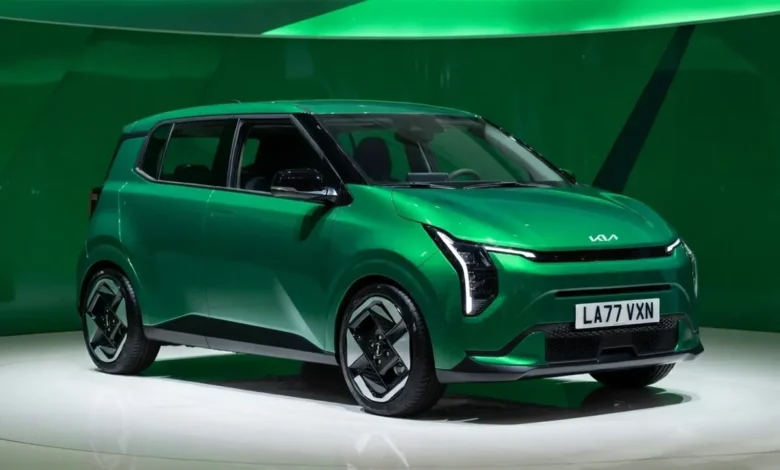
2027 Kia EV1: The most consequential electric car Kia has ever committed to building may not be its most powerful, its most technologically spectacular or its most visually striking. It will be its smallest and its cheapest — a compact city hatchback whose strategic importance rests not on performance credentials but on its ability to bring genuinely affordable electric mobility to the largest possible number of ordinary buyers. Officially confirmed by Kia CEO Ho Sung Song at the brand’s Investor Day in Seoul on April 9, 2026, the Kia EV1 is targeted for a 2027 launch as a B-segment electric hatchback positioned as a direct electric successor to the long-running Kia Picanto. It will compete against the Renault 5, the Peugeot e-208, the Vauxhall Corsa Electric and the forthcoming Volkswagen ID. Lupo — and it will do something that no vehicle in this price category has ever previously attempted: arrive as the world’s first software-defined vehicle in the city car segment.
That combination — accessible pricing, credible range, the full depth of Hyundai Motor Group’s SDV technology and Level 2+ highway autonomous driving — positions the EV1 as one of the most significant product announcements in Kia’s history.
Why the EV1 Is Kia’s Most Important Launch in a Generation
Understanding the EV1’s strategic weight requires understanding the structural challenge that every mainstream EV manufacturer currently faces in the small car category. Margins in this segment are razor-thin, engineering compromises are structurally forced and the commercial case for building a genuinely premium-quality product at sub-£25,000 pricing is harder to construct than in any other part of the market. Kia’s CEO acknowledged this reality directly at the Investor Day, describing the global EV market as entering a “chasm phase” in which growth has slowed from its early-adopter peak and where expanding the customer base now requires meaningfully improving affordability rather than simply adding technology to existing premium products.
The EV1 is the brand’s direct answer to that challenge. Kia has declared its intention to grow EV sales to one million units annually by 2030, targeting a global market share of 3.8 percent — a goal that requires winning buyers in every segment, not merely the profitable upper end of the market where the brand has already established strong EV credentials. The EV1 makes that ambition real in the segment where the most untapped buyers currently exist.
Kia design director Jochen Paesen has confirmed that the city car segment is one the brand intends to enter in a way that reflects Kia’s values rather than simply filling a gap — meaning the EV1 will need to bring the design confidence, quality standard and technological ambition that Kia’s larger models have established, compressed into a package that a first-time EV buyer can afford and a city dweller can live with daily.
Platform, Powertrain and Range: What to Expect Under the Skin
The EV1’s engineering foundation is the same 400-volt E-GMP platform that underpins the EV2 — a proven architecture whose reuse across multiple models generates the manufacturing economies that make genuinely affordable pricing achievable without compromising build quality. Two battery configurations are expected. The entry-level variant is anticipated to carry a 42.2kWh pack delivering approximately 200 miles of range — sufficient for the weekly commuting and urban mobility patterns of the overwhelming majority of city car buyers, whose average daily mileage rarely exceeds 30 miles. Higher trim levels are expected to step up to a 61kWh battery pushing range toward 300 miles — a figure that eliminates meaningful range anxiety for any usage pattern that a city car buyer is realistically likely to encounter.
Power output is expected to mirror the EV2’s specification, meaning approximately 145 horsepower from a front-mounted electric motor. This is not a performance figure — nor is it intended to be. The EV1 is being engineered for urban agility, efficient energy management and the smoothness of power delivery that electric motors provide naturally, rather than for sprint times that city car buyers neither need nor prioritise. The 400-volt charging architecture will support DC fast charging speeds comparable to the 90kW capability associated with the smaller battery and up to 130kW for the larger pack — delivering real-world top-up times that comfortably meet the practical requirements of everyday ownership.
The SDV Breakthrough: Technology That Has Never Existed at This Price
The single most technically ambitious and most commercially significant element of the EV1’s confirmed specification is its status as Kia’s first software-defined vehicle in the B-segment — and the first SDV of any kind ever offered in the city car class. A software-defined vehicle departs fundamentally from the architecture of every current affordable car, which typically runs dozens of separate electronic control units each managing a specific system in relative isolation. An SDV consolidates all core vehicle functions into a centralised, deeply integrated software architecture that allows every system to be updated, upgraded and recalibrated over the air — exactly as a smartphone receives its operating system updates, without requiring a dealer visit or physical hardware change.
For the EV1, this means deploying Hyundai Motor Group’s CODA electronic and electrical architecture alongside the Pleos Connect infotainment platform — a system built on Android Automotive OS that delivers a smartphone-comparable user interface with split-view and multi-window functionality, full third-party app support and integration with Gleo AI, the group’s AI voice assistant that allows natural conversational control of vehicle functions, navigation, real-time traffic management and personal scheduling. A single Pleos ID profile follows the driver across every Pleos-equipped vehicle, maintaining personalised settings, preferences and connected services.
Beyond the infotainment layer, the EV1 is confirmed to include Level 2+ highway autonomous driving capability — a system that deploys cameras and radar with AI deep-learning decision structures to manage lane centring, speed management and safe following distance on highway sections without continuous manual input. An expanded Level 2++ version capable of operating in urban environments is planned for deployment in early 2029, meaning the EV1’s hardware will be capable of receiving this capability as an over-the-air software update rather than requiring a new vehicle. For a car expected to start at just over £20,000, the presence of this technology tier represents a genuine step change in what the affordable segment can deliver.
Read: 2027 Kia EV3 Comes to America. Everything You Need to Know About Kia’s Most Accessible Electric SUV
Design: Urban Character Without SUV References
Kia’s head of advanced design has confirmed that the EV1 will be shaped as a purpose-built urban car rather than a scaled-down SUV — a deliberate differentiation from the crossover-influenced EV2 that sits above it in the range. The expected silhouette leans toward a monobox profile with compact proportions designed for city manoeuvrability, featuring vertically oriented LED lighting elements, a distinctive Kia design identity applied at a smaller scale and the use of black plastic detailing on the bumpers and sills to convey urban robustness rather than off-road ambition. The brand’s design leadership has also indicated that the EV1 will reflect a new, more aspirational direction for Kia’s smaller vehicles — drawing inspiration from Muji’s philosophy of reducing design to its functional essence while retaining strong visual desirability and meaningful scope for personalisation.
Read: The Dawn of a New Seltos! The 2027 Kia Seltos Fully Explained
2027 Kia EV1 — Everything Confirmed and Expected at a Glance
| Category | Detail |
| Official Confirmation | Kia Investor Day, Seoul — April 9, 2026 |
| Body Style | B-Segment Electric Hatchback |
| Target Launch | 2027 |
| Platform | 400V E-GMP (Shared with EV2) |
| Battery Option 1 | 42.2kWh — ~200 miles estimated range |
| Battery Option 2 | 61kWh — ~300 miles estimated range |
| Expected Power Output | ~145 hp (mirroring EV2 base specification) |
| Drivetrain | Front-Wheel Drive |
| SDV Architecture | Hyundai Motor Group CODA — First in Segment |
| Infotainment | Pleos Connect (Android Automotive OS) |
| AI Assistant | Gleo AI — Conversational, Agentic Control |
| Autonomous Driving | Level 2+ Highway (at launch) |
| Autonomous Upgrade | Level 2++ Urban — OTA update from early 2029 |
| Over-the-Air Updates | Yes — Full Software and Feature Updatability |
| Primary Markets | Europe-Focused — Slovakia Plant Likely |
| Design Style | Urban Monobox — No SUV References |
| Closest ICE Equivalent | Kia Picanto (Electric Successor) |
| Key Rivals | Renault 5, Peugeot e-208, Corsa Electric, VW ID. Lupo |
| Expected Starting Price | From just over £20,000 / ~€23,000 |
| Part of Kia EV Plan | 14 EVs globally by 2030 / 1 million annual EV sales |
The Bigger Picture: Kia’s Route to One Million EVs
The EV1 does not exist in isolation. It arrives as part of a comprehensive EV expansion strategy in which Kia has committed to offering 14 electric vehicles globally by 2030, growing annual EV sales from 250,000 units in 2025 to one million — capturing 3.8 percent of the world’s new car market in the process. In Europe specifically, where Kia has set a target of 66 percent EV sales mix by 2030, the EV1 plays the critical role of making Kia electric ownership accessible to buyers for whom the EV3, EV4 and EV5 remain out of financial reach. Every successful EV1 sale in 2027 is not merely a transaction — it is the beginning of a customer relationship with Kia’s electric ecosystem that the brand expects to develop across future upgrade purchases, software subscription services and the expanding connected mobility platform that Pleos represents.
For buyers watching the affordable EV market closely, the 2027 Kia EV1 is already among the most anticipated entries the segment has ever seen.