Timing Belt vs Timing Chain Differences: Why One Can Destroy Your Engine Without Any Warning
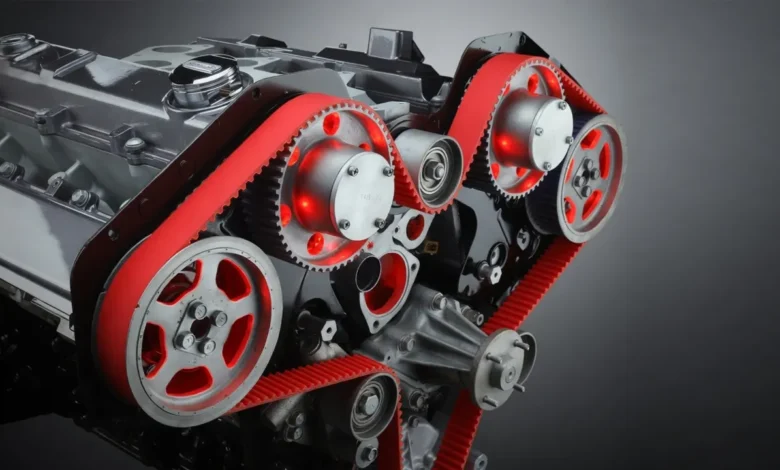
- Timing belt requires replacement at 60,000–100,000 miles
- Failure can cause severe engine damage
- Timing chain is metal and typically lifetime durable
- Chains require less maintenance but can still wear
- Key factor in long-term ownership and maintenance costs
Timing Belt vs Timing Chain Differences: Every internal combustion engine depends on precise synchronisation between two fundamental mechanical systems: the crankshaft, which converts the up-and-down motion of the pistons into rotational power, and the camshaft, which opens and closes the intake and exhaust valves in the exact sequence and timing that allows combustion to occur. Maintain that synchronisation and the engine runs. Lose it — even by a fraction of a degree at high RPM — and the results range from rough running and lost power at the mild end to bent valves, destroyed pistons and catastrophic engine failure at the severe end. The component responsible for maintaining that synchronisation is either a timing belt or a timing chain, and the choice between these two systems affects everything from a vehicle’s maintenance schedule and long-term reliability to its purchase price, service cost and the risk profile of buying it used. This guide explains every meaningful difference between timing belts and timing chains in plain, precise language — and tells you exactly what to do with that information as a car buyer, owner and driver.
What a Timing Belt Is and How It Works
A timing belt is a reinforced rubber belt with precisely moulded teeth on its inner surface that mesh with matching sprocket teeth on the crankshaft and camshaft. As the crankshaft rotates, the belt drives the camshaft sprocket in exact proportion — typically at half the crankshaft’s rotational speed in a four-stroke engine — maintaining the precise valve timing relationship that the engine requires. The belt runs under tension maintained by a spring-loaded tensioner, and may also drive accessory components including the water pump in some engine designs.
The rubber compound used in timing belts is reinforced with fibreglass or Kevlar cords to provide tensile strength, but it remains a polymer material subject to the degradation mechanisms that affect all rubber: heat cycling, oil contamination, ozone exposure and the cumulative fatigue of millions of flexion cycles. These mechanisms make timing belt replacement not optional but mandatory at the intervals specified by the manufacturer — because unlike most automotive components that fail gradually and provide warning signs before complete failure, timing belts frequently fail suddenly and without any preceding symptoms.
The engineering motivation for using a belt rather than a chain is straightforward. Rubber belts run quietly — the elastic damping properties of the polymer absorb the small variations in load and tension that would generate noise in a metal chain system. They run dry without requiring the oil lubrication that a chain needs, simplifying engine design. They are lighter than chain systems. And their manufacturing cost is lower. These advantages explain why timing belts were widely adopted by European manufacturers in the 1970s and 1980s and remain in service on certain engines today.
What a Timing Chain Is and How It Works
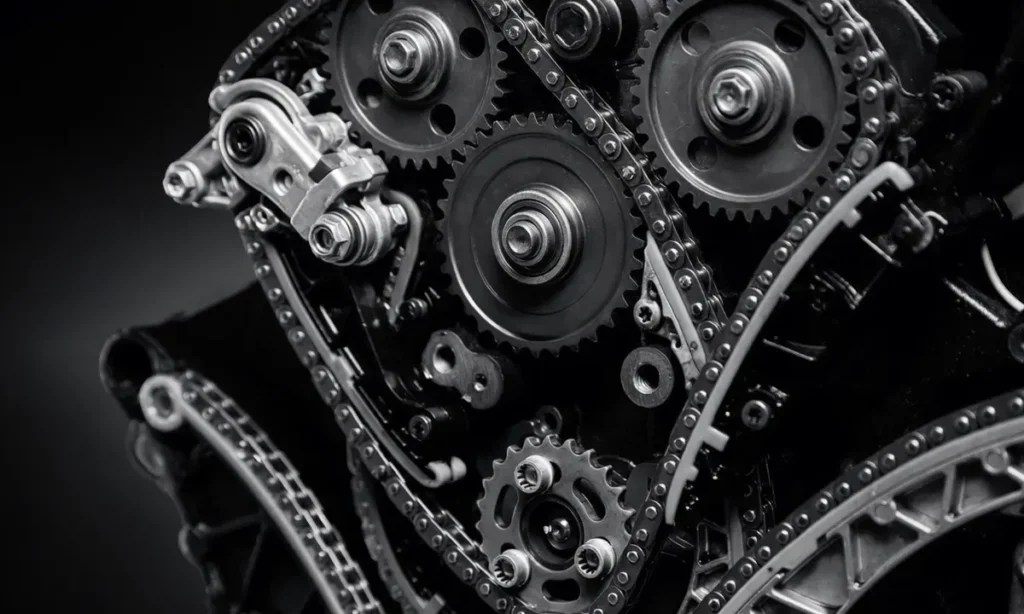
A timing chain is a precision metal roller chain, broadly similar in construction to a bicycle chain but manufactured to much tighter tolerances and made from higher-grade steel. Like the timing belt, it connects the crankshaft sprocket to the camshaft sprocket or sprockets, maintaining the valve timing relationship. Unlike the belt, the chain runs within the engine’s oil supply — it is lubricated continuously by the pressurised oil that circulates through the engine, and hydraulic chain tensioners maintain correct tension automatically as the chain elongates minimally through normal wear.
Modern engines increasingly use timing chains rather than belts, driven by consumer demand for lower maintenance requirements and manufacturer desire to reduce the warranty liability associated with catastrophic belt failure. Double overhead cam (DOHC) engines with multiple camshafts often use multiple chains in a staged configuration — a primary chain from the crankshaft to an intermediate shaft, with secondary chains driving the camshafts — adding complexity but maintaining the fundamental durability advantage of metal over rubber.
The timing chain’s most significant advantage over a belt is its service life. A properly designed and adequately lubricated timing chain in an engine that receives regular oil changes should last the full life of the vehicle — typically 200,000 miles or more — without requiring planned replacement. This is not a universal guarantee, and certain engines have developed documented timing chain wear or stretching problems that manufacturers have addressed through design updates. But the principle that a metal chain significantly outlasts a rubber belt in normal service is supported by decades of engineering data and real-world owner experience.
Timing Belt: Specific Characteristics, Advantages and Limitations
The timing belt’s most important characteristic for the car owner is its mandatory replacement interval. Most manufacturers specify timing belt replacement between 60,000 and 100,000 miles, with some newer high-quality belt compounds allowing intervals approaching 120,000 miles. These intervals are not conservative suggestions — they represent the manufacturer’s engineering assessment of the belt’s reliable service life, and operating beyond these intervals significantly increases the probability of sudden belt failure.
When a timing belt breaks, the consequences in an interference engine are immediate and catastrophic. An interference engine is one designed with valve and piston paths that overlap — the valves extend into the cylinder bore space that the piston occupies, which is permissible because their movements are precisely timed to never coincide. When the timing belt breaks, that timing is lost instantly. Pistons hit open valves. Multiple valves are bent in the first revolution following belt failure. In severe cases, piston crowns are damaged, connecting rods are bent and cylinder head surfaces are warped from impact. The repair cost for an interference engine that suffers a timing belt failure is typically between $3,000 and $8,000 depending on the extent of damage, the vehicle and the labour market.
Not all engines are interference designs. Non-interference engines — also called free-wheeling engines — have sufficient clearance between valve and piston paths that a timing belt failure, while disabling to the engine, does not cause immediate mechanical destruction. The engine simply stops when the belt breaks. Both types are in widespread use, and determining which type your engine is before making a purchase decision is valuable information.
The timing belt’s advantages — quiet operation, no lubrication requirement, lower manufacturing cost and reduced engine complexity — are real and relevant to manufacturers. For the vehicle owner, however, the mandatory periodic replacement at significant expense is the most important operational consideration. A timing belt replacement on a typical four-cylinder engine costs between $400 and $1,000 in parts and labour. On a V6 or inline-six with complex access requirements, that cost may reach $1,500 to $2,500. Engines where the timing belt also drives the water pump — common in transversely mounted engines — warrant replacing the water pump, tensioner and idler pulleys simultaneously, adding cost but preventing a secondary failure that would require reopening the same engine.
Read: Engine Overheating Causes and Solutions. Here Is Exactly What Is Wrong and How to Fix It
Timing Chain: Specific Characteristics, Advantages and Limitations
The timing chain’s defining operational advantage is its absence from the planned maintenance schedule. In a properly maintained engine with regular oil changes, a timing chain requires no periodic replacement — it is an engine component rather than a wear item, expected to last as long as the engine itself. This characteristic makes timing chain engines less costly to maintain over a long ownership period and eliminates the catastrophic failure risk associated with neglected belt replacement.
The timing chain’s primary cost is carried at the manufacturing stage: chains, sprockets, hydraulic tensioners and the pressurised oil system that lubricates them are more complex and more expensive to produce than belt systems. This cost is reflected in the vehicle’s purchase price, though spread across the ownership period it is typically smaller than the accumulated cost of timing belt replacements.
The critical caveat in the timing chain’s durability story is the word “properly” in “properly maintained engine.” Timing chains elongate minimally with wear — all metal components wear against each other in service. Hydraulic tensioners automatically compensate for this elongation within their design range. However, engines that receive infrequent oil changes, that run on degraded oil or that suffer oil pressure problems accelerate chain wear beyond the tensioner’s compensation range. The symptomatic result is a rattling sound on cold start — the chain slapping against its guide before the hydraulic tensioner pressurises fully — which indicates accelerated wear and warrants inspection.
Several specific engines have developed documented timing chain problems that contradict the general principle of chain durability: certain BMW inline-six engines from the 2000s and 2010s experienced timing chain stretch at relatively low mileage. Several Chevrolet V8 engines used in General Motors trucks experienced timing chain wear with insufficient oil changes. These examples illustrate that chain durability is a function of design quality and maintenance history together, not of chain construction alone. For used vehicle buyers, a timing chain engine with well-documented oil change history provides confidence that the chain is performing as intended. A timing chain engine with an unknown or irregular service history warrants professional inspection before purchase.
Read: Brake Pad Replacement Cost In USA. Complete 2026 Price Guide
Timing Belt vs Timing Chain — Complete Comparison Chart
| Characteristic | Timing Belt | Timing Chain |
| Material | Reinforced rubber | Precision steel roller |
| Replacement Required | Yes — every 60,000–100,000 miles | No — lasts life of engine (with proper maintenance) |
| Replacement Cost | $400–$2,500 depending on engine | Not applicable (failure-based repair: $1,000–$3,000+) |
| Failure Mode | Sudden, no warning | Gradual stretch — typically shows symptoms first |
| Consequence of Failure | Engine destruction in interference engines | Engine stops; no immediate destruction |
| Operating Noise | Very quiet | Slight mechanical noise (normal) |
| Lubrication Required | No — runs dry | Yes — requires engine oil |
| Engine Design Complexity | Lower | Higher |
| Cold-Start Behaviour | Unaffected | Chain rattle on cold start if worn |
| Long-Term Ownership Cost | Higher (repeated replacement) | Lower (no planned replacement) |
| Common in | Many European, Japanese, Korean engines | Most American, German (recent), modern engines |
| Best Practice for Used Car Buying | Verify service history; replace if unknown | Check for cold-start rattle; verify oil change history |
How to Identify Which System Your Car Has — and What to Do About It
Determining whether your vehicle uses a timing belt or timing chain is information every owner should have, and it is easily obtained by checking the owner’s manual under the maintenance schedule section. If timing belt replacement appears at a specific mileage interval, the engine uses a belt. If no such interval appears, a chain is almost certainly the system in use. The manufacturer’s website, a dealership service department or a quick search combining your vehicle’s make, model, engine code and “timing belt or chain” will confirm the answer definitively.
For timing belt engines, the action is clear: know the replacement interval, track the mileage and budget for replacement before the interval is reached rather than after a failure makes the decision for you. If you are buying a used vehicle with a timing belt engine, request service records that document the belt’s replacement history. If the history is unavailable and the mileage is within the replacement window, negotiate the replacement cost into the purchase price or budget for it immediately after purchase. The cost of a timing belt replacement is always less than the cost of the engine damage that follows a belt failure — by a factor of three to five.
For timing chain engines, the action is to maintain consistent, high-quality oil changes at the manufacturer’s recommended intervals and to investigate any cold-start rattling sounds immediately rather than ignoring them. A timing chain that rattles on cold start and then quiets as oil pressure builds is a chain that is approaching the outer boundary of its tensioner’s compensation range — a warning that deserves professional attention rather than dismissal.
The most important single piece of advice is this: in any vehicle purchase decision where the engine type is unknown, identifying the timing system and its service status should be among the first questions asked. A timing chain engine with a clean oil change history and no cold-start noise is an engine whose most critical synchronisation component is in sound condition. A timing belt engine whose records show the belt was replaced at the manufacturer’s specified interval is equally reassuring. A timing belt engine with no service records and high mileage is a liability whose resolution cost may significantly exceed the apparent purchase price saving.