How Evidence Like Dashcam Footage, Photos and Medical Reports Win Car Accident Cases

- Car accident claims often hinge on disputes about fault, speed and the sequence of events leading to the crash.
- Video footage, medical records and detailed scene photographs provide powerful evidence that can support a claim.
- Preserving evidence immediately after an accident is one of the most important steps for protecting legal and insurance rights.
A car accident claim is fundamentally an evidence competition — a process where two conflicting accounts of the same event are evaluated against the available documentation, and where the quality, completeness and timeliness of that documentation determines which account prevails. Insurance adjusters are trained to identify and exploit evidence gaps. Personal injury attorneys are trained to close those gaps with documentation that makes the injured party’s account the most credible and most compelling version of events. Understanding exactly how each category of evidence works — what dashcam footage proves, what scene photographs establish, what medical records connect and what expert reports reconstruct — is the knowledge that transforms accident victims from passive participants in the claims process into active advocates for their own recovery.
Dashcam Footage: The Most Powerful Evidence Available in 2026
Dashcam footage has become the most consequential single evidence category in modern car accident claims — and its importance continues to grow in 2026 as dashcams have become common on roads from individual commuters to commercial fleets to rideshare vehicles. When dashcam footage exists and is preserved promptly, it replaces the conflicting human accounts that make most disputed liability cases genuinely difficult to resolve with objective, contemporaneous visual documentation that neither party can effectively contradict.
The specific capability that makes dashcam footage uniquely valuable is its temporal scope. Dashcams record not just the moment of impact but the events leading up to the collision — the lane changes, speed changes, signal activations, red-light violations and distracted driving behaviour that establish the pattern of negligence rather than just its consequence. A dashcam that captures a driver’s phone distraction in the seconds before impact documents not just what happened but why it happened — establishing the negligence that is required for a personal injury claim alongside the liability itself.
Insurance companies respond differently when dashcam footage exists. Adjusters who might otherwise dispute liability or negotiate aggressively based on the expectation that conflicting accounts will produce a contested outcome are specifically more willing to settle claims fairly when clear video evidence shows unambiguous fault. This willingness translates to faster claim resolution and higher settlement offers than the same injury claim would produce without video documentation.
The preservation requirement is the dashcam footage category’s most critical practical consideration. Most dashcam systems use loop recording — overwriting older footage automatically when the storage card fills — meaning that footage that exists in the hours immediately after an accident can be permanently lost within days if not actively preserved. The steps required to preserve dashcam footage are specific: remove the storage card, copy the footage to a computer or cloud storage immediately, and do not allow the dashcam to continue recording onto the card that contains the accident footage. An attorney can additionally issue a legal preservation letter to any third party — a business whose security camera captured the accident, a traffic authority whose intersection cameras may have recorded it — requiring that footage be retained rather than overwritten.
The admissibility standard for dashcam footage in legal proceedings requires that the footage be authentic, relevant to the case and not tampered with. Courts also consider whether the footage provides a fair and accurate representation of events — which matters when footage captures only part of an incident or when context not visible in the frame is required to correctly interpret what the footage shows. This admissibility consideration is why dashcam footage is most effective when used alongside other supporting evidence rather than as the sole basis for a liability claim.
Read: Insurance Claim vs Lawsuit: Which One Is Right for Your Car Accident Case?
Scene Photographs: The Evidence Window That Closes Within Hours
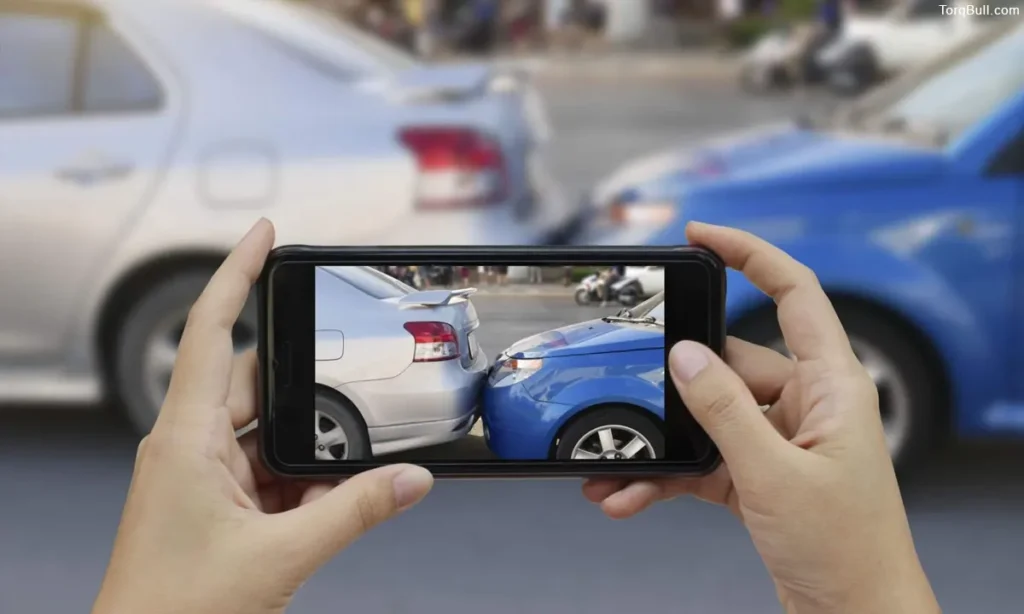
Systematic scene photography is the evidence category most frequently described by personal injury attorneys as the single most impactful action an accident victim can take in the immediate aftermath of a collision — because the scene evidence it captures exists only at the moment of impact and disappears permanently as road crews clear the scene, vehicles are moved and the physical record of the collision is lost.
The specific evidence that scene photographs preserve falls into categories whose individual importance for the claims process is distinct. Vehicle damage photographs from all four sides of every involved vehicle document the physical force and direction of impact — information that accident reconstruction experts use to determine speed, angle of contact and sequence of events. Position-of-vehicle photographs taken before any vehicle is moved document where each vehicle came to rest after impact — the information that establishes the collision’s geometry and that is permanently lost the moment vehicles are moved for traffic clearance.
Road surface photographs capture tyre marks, debris fields, fluid spill patterns and impact scarring — the physical evidence that reconstruction experts and police investigators use to determine pre-impact speeds and trajectories. Signal position photographs document the state of traffic signals at the intersection where the collision occurred — directly relevant when signal state is disputed between the parties. Weather condition, road surface condition and visibility condition photographs document the environmental factors that may have contributed to the collision or that may affect comparative fault assessment.
Injury photographs taken at the scene document the immediate post-impact appearance of injuries — before adrenaline-masked pain resolves to reveal the full injury extent and before medical treatment changes the visible presentation. These immediately post-impact injury photographs establish the connection between the collision event and the injury that subsequent medical records document — a chronological link that defendants frequently attempt to break by arguing that injuries documented days after a collision may have other causes.
The complete scene photography process takes approximately fifteen to twenty minutes using a smartphone camera and should cover every element before any authority requests vehicle movement or before the parties agree to clear the scene for traffic.
Read: How Long Does a Car Accident Case Take? Timeline From Claim to Settlement
Medical Records: The Chain of Evidence That Connects the Collision to the Injury
Medical records are the evidence category that most directly determines the financial value of a car accident claim — because economic damages are calculated from the medical records that document what treatment was required, and non-economic damages are multiplied from the economic total.
The specific characteristic of medical records that makes them most persuasive is chronological continuity — the unbroken chain of treatment documentation from the initial evaluation at an emergency room or urgent care facility through the final treatment event that precedes claim settlement. An emergency room record dated the same day as the accident establishes that the injury existed immediately after the collision. A specialist referral dated one week later establishes that the initial evaluation identified conditions requiring further investigation. A physical therapy discharge note dated four months after the accident establishes the duration of active treatment. Together, these records construct the narrative of the injury’s development and resolution that the settlement demand document presents as the basis for economic damage calculation.
The gap in medical records is the specific vulnerability that opposing insurance adjusters most consistently exploit. A victim who sought emergency evaluation on the day of the accident, was discharged with instructions to follow up with a primary physician, and then waited two weeks before scheduling that follow-up has created a two-week gap in the medical record during which, from the insurer’s perspective, the injury may have substantially resolved. The counter-argument requires demonstrating that the gap was caused by scheduling constraints, financial barriers to care or other documented reasons — rather than by the absence of ongoing symptoms.
The most effective medical record documentation for claims purposes includes contemporaneous written records of symptoms — dated entries in a phone notes application or written journal documenting what symptoms were present each day, what activities were limited by those symptoms and what the subjective pain experience consisted of. These daily contemporaneous records corroborate the medical record’s objective findings with the patient’s subjective experience in a way that reconstructed accounts produced months later cannot replicate.
Evidence Categories and Their Specific Claims Value — Complete Reference Chart
| Evidence Type | What It Proves | Preservation Window | Claims Impact | Limitation |
| Dashcam footage | Sequence of events, fault, behaviour before impact | Hours to days before loop overwrites | Highest — replaces conflicting accounts with objective record | May capture only partial view; context may be needed |
| Scene photographs | Position, damage, road conditions, injuries, signals | First 30 minutes before scene is cleared | High — establishes physical collision record | Requires systematic approach; missing angles reduce value |
| Medical records | Injury existence, treatment duration, future needs | Ongoing throughout treatment | Essential — economic damages calculated from this record | Gaps in treatment undermine continuity and value |
| Police report | Official fault assessment, witness accounts, citations | 24 to 48 hours for report completion | Strong — official independent record carries authority | May contain errors; initial assessment is not final |
| Witness statements | Corroboration of account, independent observation | Hours to days before memories fade | Significant — independent corroboration of account | Witness availability and memory reliability vary |
| Vehicle EDR data | Speed, braking, throttle at moment of impact | Days to weeks before data can be extracted | Very high — objective sensor data for fault and speed | Requires technical extraction; not available from all vehicles |
| Surveillance footage | Traffic cameras, business cameras, doorbell cameras | 24 to 72 hours before automatic overwrite | High — independent third-party recording of collision | Preservation letter required immediately; angle limitations |
| Expert reconstruction | Professional analysis of all physical evidence | Months to years for litigation preparation | Very high in litigation — scientific methodology persuasive | Expensive; most valuable when other evidence is incomplete |
Read: Top Insurance Company Tactics That Hurt Your Car Accident Claim
The New Evidence Category in 2026: Vehicle EDR and Telematics Data
The 2026 evidence landscape for car accident claims has expanded beyond traditional categories to include the electronic data recorded by modern vehicles’ Event Data Recorders and telematics systems — data that provides objective sensor-based records of vehicle speed, braking force, throttle position, steering angle and seatbelt status in the seconds before and during a collision.
This electronic data is stored in the vehicle’s EDR independently of dashcam footage and independently of the police report — and it captures information that neither human witnesses nor camera footage can reliably document. The pre-impact speed of a vehicle traveling at 45 MPH in a 30 MPH zone is established definitively by the EDR without the uncertainty that eyewitness speed estimates carry. The failure to brake in the two seconds before impact — establishing distracted driving or conscious disregard of the collision risk — is documented with sensor precision rather than memory reconstruction.
The preservation risk with EDR data is the vehicle repair timeline. Once a vehicle enters a repair shop and work begins on collision-affected systems, EDR data can be altered or overwritten. Any accident where EDR data may be relevant — particularly serious injury accidents, fatal collisions and cases where speed is disputed — requires a preservation letter to the opposing party’s insurer, the repair shop and any vehicle custodian before repair work begins.