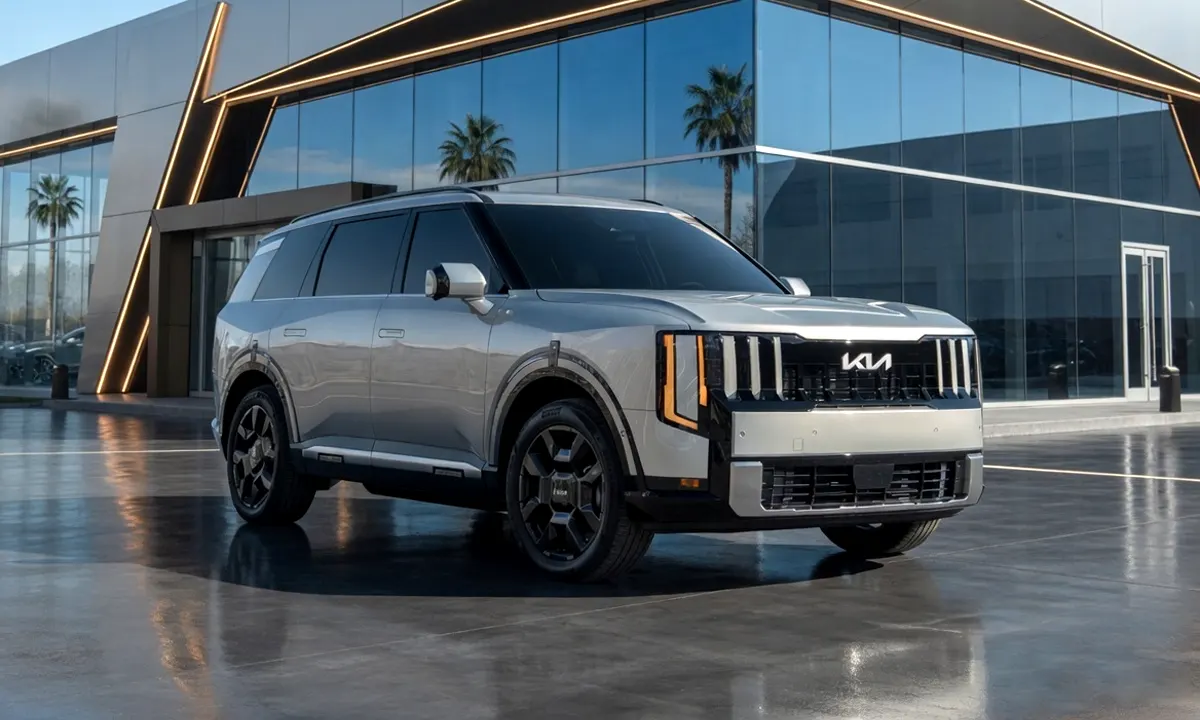
- Enhanced NVH with triple seals and thicker glass
- Rack-mounted steering improves highway stability
- Comfort-tuned suspension for smoother ride
- Highway Driving Assist 2 and smart cruise control
- Relaxation seats and premium Meridian audio system
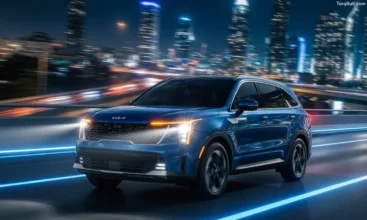
The test of any three-row family SUV is not conducted in a parking lot, on a track or in the measured conditions of a laboratory. It is conducted on a six-hour interstate drive with a full complement of passengers, luggage stacked to the roofline, a mix of smooth and deteriorating road surfaces, sustained highway speeds for hours on end and the specific kind of fatigue that accumulates when a vehicle is less composed, less quiet and less comfortable than its occupants deserve. The 2027 Kia Telluride — a complete redesign of the award-winning original that skipped the 2026 model year entirely — has been rebuilt with that test as a primary design objective. Every significant engineering change introduced for this second generation has a direct bearing on the highway experience, and the result is a vehicle that reviewers have described in terms rarely applied to a mainstream family SUV: composed, hushed, supple and sophisticated in a manner that invites comparison with luxury vehicles costing considerably more.
The NVH Revolution: Engineering Silence Into a Family SUV
The most consequential single change Kia has made to the 2027 Telluride’s highway comfort credentials is not mechanical — it is acoustic. The new comprehensive Noise Vibration and Harshness package represents a fundamental rethinking of how unwanted noise and vibration are managed in the cabin, addressing the three primary pathways through which highway noise reaches passengers: the door seals, the structural panels and the glass.
Enhanced triple door seals replace the previous generation’s double-seal arrangement on all four doors, creating an additional barrier between the interior and the turbulent air pressure that builds against the bodywork at highway speeds. This seemingly modest change has a disproportionate effect on the subjective quietness of the cabin, because door seal integrity is one of the primary determinants of wind noise intrusion at 70 and 80 miles per hour — the speeds at which wind noise typically overtakes tyre and road noise as the dominant acoustic intrusion in a vehicle interior.
Read: 2027 Kia Telluride Redefines the Modern Family SUV with Hybrid Power
Expanded use of sound-absorbing materials throughout the body structure — in the door panels, floor, firewall and roof — addresses structure-borne vibration that travels through the body rather than through the air. Increased door glass thickness on the front and rear windows completes the package by reducing the transmission of external noise frequencies that glass panels — being the thinnest element of any vehicle’s acoustic barrier — pass most readily.
The cumulative result has been consistently praised in first-drive reviews from multiple automotive publications. Motor1 noted that the 2027 Telluride’s main takeaway is how comfortable the overall ride quality is, particularly in combination with the improved NVH — describing it as a vehicle that is very pleasant to drive for long stretches. Independent testing has placed the cabin noise levels of the NVH-equipped Telluride significantly below the previous generation, with the interior environment at 70 miles per hour approaching levels associated with European luxury SUVs rather than mainstream American family haulers.
Suspension Character: Comfort Without Compromise
The 2027 Telluride’s suspension tuning philosophy is unambiguously comfort-oriented — a choice that reflects the vehicle’s primary mission but is executed with sufficient sophistication to prevent the softness from becoming sloppiness. Reviewers have described the suspension character in terms that evoke luxury rather than mere adequacy: supple, controlled, settled and progressive in a manner that absorbs highway surface variations without transmitting them to occupants, while maintaining the body control needed to prevent the floating, bouncing sensation that poorly damped soft setups produce on undulating road surfaces.
On smooth highway tarmac, the Telluride’s ride is genuinely serene. Expansion joints, concrete seam transitions and minor surface irregularities are absorbed smoothly, arriving at the cabin as faint impressions rather than jarring inputs. On degraded pavement — the rough-surfaced highway sections that are increasingly common on America’s aging road network — the suspension demonstrates the depth of its travel and damping calibration, absorbing larger impacts without bottoming out and without the harsh secondary rebound that characterises suspensions tuned primarily for handling rather than comfort. Edmunds confirmed that rough roads do not faze the Telluride, and that the Kia feels stable at freeway speeds — a combination that is less common in the segment than it should be.
Around corners, the Telluride leans in a manner consistent with its comfort-first tuning — reviewers have noted lateral body motion through turns as characteristic of the setup — but the movement is controlled and predictable rather than alarming, and the vehicle never feels unstable or unmanageable. The extended 2.7-inch wheelbase over the previous generation contributes directly to highway stability, providing a longer platform that resists the pitching and yawing tendency that can develop in shorter-wheelbase vehicles at sustained high speeds.
Steering Upgrade: A Fundamental Improvement for Highway Use
One of the most technically significant changes for 2027 is the replacement of the previous generation’s column-mounted motor-driven power steering system with a new Rack-Mounted Motor-Driven Power Steering arrangement. This architectural change moves the power assist mechanism from the steering column to the steering rack itself — a location that provides more direct and accurate communication between the driver’s steering input and the front wheels’ actual response.
The practical consequences for highway driving are measurable. The new system provides more consistent steering weight across the full range of driving speeds, with a heft at highway velocities that gives the driver genuine feedback about road surface conditions and vehicle attitude rather than the light, largely information-free steering feel that column-mounted systems frequently produce. Progressive steering response — where additional steering angle produces a proportionally increasing cornering effect — makes the Telluride feel more predictable and more settled during lane changes at speed, a manoeuvre that exposes the handling limitations of less well-sorted vehicles.
The available memory-enabled power tilt-and-telescoping steering wheel, new for the 2027 model, allows each driver to configure the steering column position precisely and return to that position automatically — a feature with direct long-distance comfort relevance, since optimal driving posture over a multi-hour journey is determined as much by steering wheel position as seat adjustment.
Read: 2026 Kia K4 Debuts With Futuristic Design and Advanced Technology
Highway Driving Assist 2: Making Long Journeys Less Demanding
The availability of Highway Driving Assist 2 on upper Telluride trim levels represents the most significant technology addition for long-distance comfort — a system that addresses the primary source of driver fatigue on extended highway journeys: the cumulative cognitive and physical workload of maintaining speed, following distance, and lane position continuously over hundreds of miles.
HDA2 combines input from a forward-facing camera, radar sensors and navigation data to maintain a driver-set speed and following distance, keep the Telluride centred within detected lane markings on compatible highway sections and provide steering assist for lane changes when the turn signal is activated and the system confirms sufficient space in the adjacent lane. When the system detects that the vehicle ahead has slowed, it decelerates smoothly and automatically to maintain the preset following gap, then reaccelerates when the road clears — without requiring driver brake or throttle input.
Pairing HDA2 with the Navigation-Based Smart Cruise Control with Stop-and-Go function extends this capability further. This secondary system reads navigation map data to detect upcoming curves and adjust speed accordingly before the corner arrives, and adapts the vehicle’s speed automatically when posted speed limits change — reducing the need for constant speed adjustment that otherwise interrupts the otherwise passive driving experience HDA2 creates. The system also maintains function in stop-and-go traffic down to complete stops, resuming automatically when traffic clears.
Reviewers have consistently rated the Telluride’s adaptive cruise control and lane-keeping assist implementation as well-calibrated, with smooth, natural-feeling intervention that does not produce the sudden corrections or uncomfortable braking events that less refined systems generate. For a family completing a ten-hour drive, the difference between a highway assistance system that inspires confidence and one that requires constant monitoring represents the difference between arriving reasonably refreshed and arriving exhausted.
Seating Comfort: Three Rows, Hours of Travel
The 2027 Telluride’s seating system has been comprehensively revised around the specific comfort requirements of long-distance travel. Front-row occupants gain access to the newly available relaxation seats — wider than the previous generation’s chairs, with powered leg rests that elevate the lower legs into a reclined position that reduces lumbar pressure significantly during sustained highway hours. The available Ergo Motion driver’s seat uses internally positioned air pockets to provide both a massage function and continuous micro-adjustments to seat cushioning and lumbar support — a system whose value becomes genuinely apparent after three or more hours of continuous driving.
Second-row passengers benefit from the class-leading 43.0 inches of legroom that the 2027 Telluride’s extended wheelbase provides — a measurement that allows adult rear passengers to sit with knees unconstrained by the front seatbacks, in a position that remains comfortable for the duration of any realistic journey. Available power-operated second-row captain’s chairs with heating and ventilation add a level of rear-seat appointment that most vehicles in this price bracket reserve for the front row only.
Third-row occupants find 32.1 inches of legroom and improved access thanks to the forward-sliding second-row seats — enough for teenagers and smaller adults to travel without the discomfort that has typically characterised third-row use in this vehicle class. Dedicated roof air vents, standard USB-C charging ports and available heating for outboard third-row positions address the three practical comfort requirements that determine whether third-row passengers consider their journey acceptable or unacceptable.
Read: 2027 Kia K4 Sportswagon Combines Style, Space, and Modern Technology
The Meridian Audio System: Turning Every Mile Into an Experience
The available Meridian Premium Audio System with 14 speakers is the highway comfort feature that is easiest to quantify and most consistently appreciated in practice. Meridian’s acoustic engineering has calibrated the system specifically for the Telluride’s cabin dimensions, producing sound that remains detailed and spatially accurate at highway speeds — a performance standard that requires meaningful investment in speaker placement, amplification and acoustic tuning that budget audio systems do not achieve.
Paired with the cabin quietness delivered by the NVH package, the Meridian system creates an in-cabin acoustic environment at 75 miles per hour that allows passengers to hold conversations at normal volume levels, listen to music at comfortable playback levels that would be inaudible in a less well-insulated vehicle and enjoy podcasts and audiobooks without the fatigue-inducing concentration that competing with road noise demands. For families measuring their road trips in hours rather than minutes, this represents a meaningful quality-of-life distinction.
2027 Kia Telluride — Highway Comfort Features At a Glance
| Highway Comfort Feature | Detail | Availability |
| NVH Package | Triple door seals, sound-absorbing materials, thicker glass | Available (SX and above) |
| Suspension Tuning | Comfort-oriented — controlled body motion, absorbed inputs | Standard all trims |
| Steering System | Rack-Mounted MDPS — more direct, progressive highway feel | Standard all trims |
| Wheelbase | Extended 2.7 inches over previous generation | Standard all trims |
| Highway Driving Assist 2 | Lane centering, adaptive cruise, assisted lane change | Available upper trims |
| Nav-Based Smart Cruise | Speed adapts to limits and curves — stop-and-go capable | Available upper trims |
| Relaxation Seats (Front) | Power leg rests — sustained comfort position | Available SX Prestige |
| Ergo Motion Driver Seat | Massage + cushion adjustment via air pockets | Available SX Prestige |
| 2nd-Row Legroom | 43.0 inches — class-leading | Standard all trims |
| 3rd-Row Legroom | 32.1 inches — improved access | Standard all trims |
| Heated / Ventilated Seats | Front + available 2nd row + heated 3rd row outboard | Available from EX+ |
| Heated Steering Wheel | Available from EX trim | Available EX and above |
| Meridian Audio System | 14 speakers — highway-calibrated acoustic performance | Available upper trims |
| Dual Wireless Charging Pads | Two pads — front row | Standard most trims |
| USB-C Ports | Throughout all three rows | Standard all trims |
| Tri-Zone Climate Control | Independent settings — front, 2nd row, 3rd row | Available from S+ |
| 12-inch Head-Up Display | Speed, navigation overlay — reduces eyes-off-road | Available upper trims |
| Combined 29.6-inch Panoramic Display | Dual 12.3-inch screens — infotainment + cluster | Standard from S trim |
| Gas Hybrid Highway MPG | Up to 38 mpg highway (FWD hybrid) | Hybrid trims |
| Standard Gas Highway MPG | Up to 26 mpg highway (FWD) | Gas trims |
| Towing Capacity (Gas) | 5,000 lbs | Gas AWD variants |
| Stay Mode (Hybrid) | Climate + audio without engine for up to 1 hour | Hybrid trims |
The Highway Verdict
The 2027 Kia Telluride has been built for exactly the kind of driving that its core buyers do most — sustained, multi-passenger, long-distance highway travel where the quality of the road hours determines whether a family arrives at its destination having enjoyed the journey or endured it. The combination of the new NVH package’s measurable acoustic improvement, the comfort-oriented suspension’s ability to absorb imperfect highway surfaces without disturbing the cabin, the rack-mounted steering’s more direct and informative highway character, the Highway Driving Assist 2 system’s reduction of driver workload on extended motorway sections and the comprehensive seating comfort available across all three rows creates a highway experience that consistently exceeds what the Telluride’s price point would historically have suggested was achievable.
Motor1’s first-drive summary was direct: the new Telluride is very pleasant to drive for long stretches, with the overall ride quality and improved NVH standing as the main takeaway from extended testing. JD Power’s review described the supple suspension’s body movements as controlled and comparable in character to a Range Rover or top-tier Mercedes — not bad company for a vehicle beginning at $39,190. For families choosing a three-row SUV primarily because they will drive it across states and through seasons, the 2027 Kia Telluride’s highway comfort credentials have moved it decisively ahead of where the already-excellent first generation left the bar.