- Starting price and trim value comparison
- Engine options, performance and hybrid efficiency
- Interior space and third-row comfort
- Cargo capacity and family practicality
- Safety features and driver assistance tech
- Warranty coverage and reliability expectations
- Long-term ownership costs and value proposition
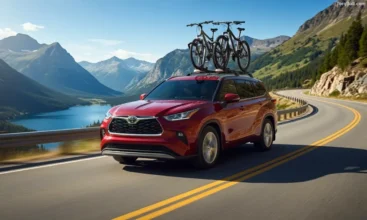
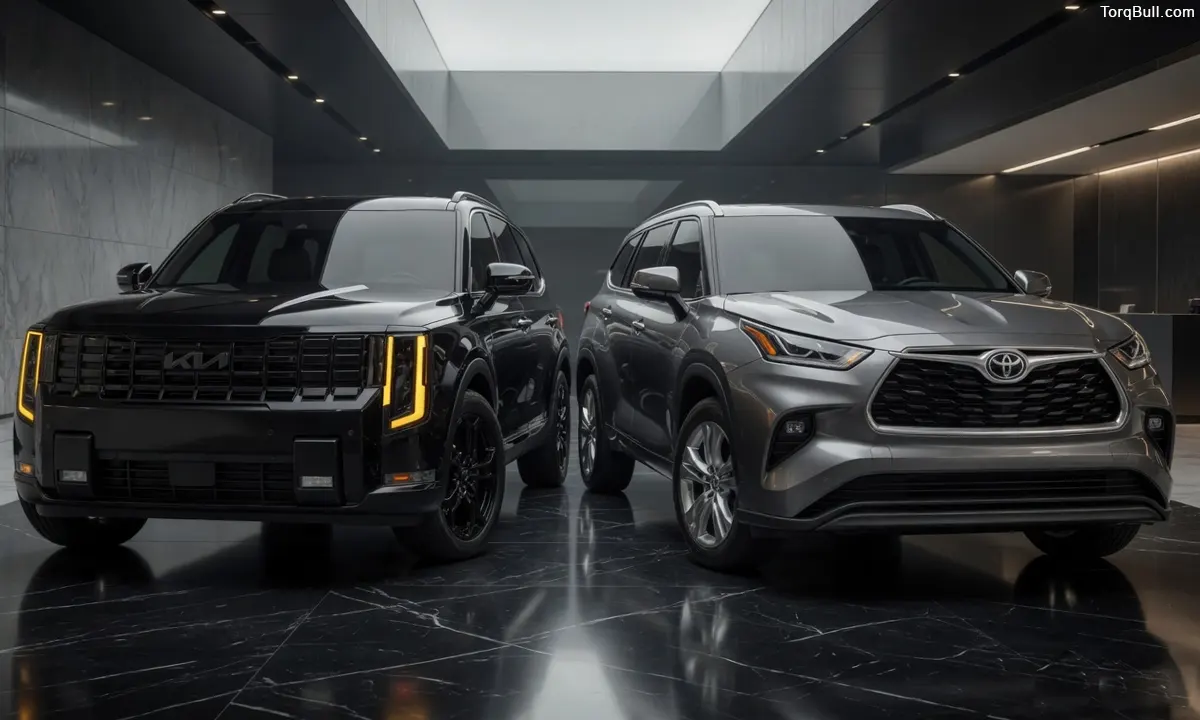
Kia Telluride vs Toyota Highlander: If a single question has dominated the three-row family SUV segment for the past five years, it is this one: does the Kia Telluride deserve its reputation as the segment’s best value, or does the Toyota Highlander’s proven long-term reliability and stronger resale value make it the smarter purchase over a full decade of ownership? Both SUVs seat up to eight passengers, both deliver comfortable long-distance ride quality, both offer comprehensive standard safety technology, and both have earned the kind of consistent critical and consumer acclaim that puts them at the top of virtually every midsize three-row recommendation list published in recent years.
The 2027 Kia Telluride arrives as a complete redesign — the first significant overhaul of the Telluride since its debut — bringing a new turbocharged engine, expanded hybrid option, larger dimensions and updated interior technology. The 2026 Toyota Highlander continues its current generation with its established 2.4-litre turbocharged powertrain, well-documented reliability and the hybrid variant that has long been the segment’s benchmark for combined fuel economy and smooth daily drivability. This comparison covers every dimension that genuinely matters for a family buying a three-row SUV intended to serve as their primary vehicle for the next eight to twelve years.
Price and Value: Telluride Leads Across the Lineup
The 2027 Kia Telluride starts at approximately $40,735 including destination charges for its base LX front-wheel drive configuration. The 2026 Toyota Highlander starts at approximately $39,520 for its base LE trim — making the entry-level Highlander marginally less expensive at the absolute base level. However, the comparison changes meaningfully as buyers move into the mid and upper trim ranges that most purchasers actually select. At equivalent feature content levels, the Telluride consistently undercuts the Highlander by $2,000 to $4,000 across comparable specifications.
The Highlander’s hybrid variant — which most buyers choosing fuel economy as a priority will select — starts at approximately $47,045 in the XLE Hybrid configuration, representing a significant premium over the standard powertrain. The Telluride Hybrid’s pricing has not been officially finalised at time of writing but is expected to enter the market at a competitive figure that positions it meaningfully below equivalent Highlander Hybrid trim levels, continuing the value pattern the Telluride has established throughout its commercial life.
The Toyota Highlander holds a well-documented advantage in resale value retention — losing approximately 41.8 percent of its value over five years compared to the Telluride’s 48.8 percent depreciation over the same period. For buyers who trade or sell within five to six years, this residual advantage partially narrows the Telluride’s initial purchase price advantage. For buyers who retain vehicles beyond seven years, this resale calculation becomes progressively less relevant to their actual ownership cost.
Engine and Performance: Telluride More Powerful, Highlander Hybrid More Efficient
The 2027 Kia Telluride adopts a new 2.5-litre turbocharged four-cylinder engine producing 274 horsepower and 311 lb-ft of torque — a departure from the previous generation’s 3.5-litre V6 that sacrifices a small amount of power in exchange for improved fuel efficiency and reduced weight. Towing capacity in gas form reaches 5,000 pounds. The Telluride Hybrid pairs this turbocharged four-cylinder with an electric motor for a combined system output of 329 horsepower and 339 lb-ft of torque — making it the more powerful of the two SUVs’ hybrid systems — with fuel economy of approximately 35 miles per gallon combined.
The 2026 Toyota Highlander uses a 2.4-litre turbocharged four-cylinder producing 265 horsepower in its standard gas configuration, paired to an eight-speed automatic transmission. The Highlander Hybrid combines a 2.5-litre naturally aspirated four-cylinder with dual electric motors for approximately 243 combined horsepower and class-leading fuel economy of approximately 35 miles per gallon combined — efficiently matching the Telluride Hybrid’s efficiency figure from a less powerful but exceptionally refined powertrain. The Highlander’s standard gas towing capacity reaches 5,000 pounds, dropping to approximately 3,500 pounds for the hybrid variant.
For buyers whose primary interest in a hybrid is fuel cost reduction rather than performance enhancement, the Highlander Hybrid’s smooth, refined operation and Toyota’s extensive hybrid engineering experience represent a genuinely compelling argument. For buyers who want hybrid efficiency without accepting a significant power reduction, the Telluride Hybrid’s 329-horsepower output is the more compelling performance proposition.
Read: Toyota Highlander Hybrid Maintenance Cost Per Year. Complete 2026 Guide
Interior Space: Telluride Wins in Every Row That Matters
The interior space comparison consistently favours the Kia Telluride across the passenger dimensions that family buyers prioritise most. The Telluride provides 43.0 inches of second-row legroom compared to the Highlander’s 38.7 inches — a 4.3-inch advantage that is immediately noticeable when adult passengers occupy the second row on longer journeys. Third-row headroom reaches 37.4 inches in the Telluride compared to 36.1 inches in the Highlander. Third-row legroom is 32.1 inches in the Telluride versus 28.0 inches in the Highlander — a 4.1-inch difference that separates a third row capable of accommodating adults on longer trips from one best suited to children or short-duration use.
The 2027 Telluride’s wheelbase has been extended by 2.7 inches over its predecessor, and overall length has increased by 2.3 inches — changes that contribute further to the improved third-row experience that has been one of the Telluride’s consistent competitive advantages throughout its production life. Cargo volume behind the third row reaches 22.3 cubic feet in the Telluride versus 16.0 cubic feet in the Highlander — a 6.3-cubic-foot advantage that is practically significant when packing for a family trip without folding seats.
The Toyota Highlander counters with marginally more front-row legroom at 42.0 inches compared to the Telluride’s 41.4 inches — a half-inch difference that most drivers will not notice in practice. For buyers whose primary concern is the first row and cargo flexibility behind a folded second row, the Highlander’s maximum cargo volume of 84.3 cubic feet is competitive, though it trails the Telluride’s 89.3 cubic feet in that configuration as well.
Technology and Infotainment: Telluride More Generous at Base
The 2027 Kia Telluride provides a standard dual 12.3-inch display arrangement — combining the driver information cluster and central touchscreen in a wide, integrated panel — across its lineup, paired with wireless Apple CarPlay and Android Auto, five USB-C ports throughout the cabin and Highway Driving Assist 1.5 as standard equipment. The Blind-Spot View Monitor, which displays a live camera feed in the instrument cluster when a turn signal is activated, comes standard on more trim levels than the Highlander’s equivalent offering.
The 2026 Toyota Highlander comes standard with an 8-inch touchscreen on the base LE trim — a specification that represents a notable gap compared to the Telluride’s larger standard display — stepping up to a 12.3-inch screen on higher trim levels. Toyota Safety Sense 3.0 is standard across the entire Highlander lineup, covering pre-collision warning, radar cruise control, lane departure alert with steering assist, automatic high-beam headlights and lane tracing assist. The Highlander’s driver assistance systems have been consistently rated as among the most natural and least intrusive in the segment, with the adaptive cruise control in particular praised for smooth acceleration and braking behaviour that closely replicates what a skilled driver would produce.
Read: Toyota Highlander Hybrid Real World Fuel Economy. Why This SUV Tells A Very Different Story
Safety Ratings: Both Earn Top Honours
The Toyota Highlander and Kia Telluride share identical five-star overall safety ratings from the National Highway Traffic Safety Administration. The Kia Telluride has earned IIHS Top Safety Pick+ status, the highest award the Insurance Institute for Highway Safety awards — a designation the Highlander has also achieved in recent testing cycles. Both SUVs can be considered among the safest choices in the three-row midsize segment, and safety concerns need not be a differentiating factor in this comparison.
Warranty: Telluride Wins Decisively
The Kia Telluride is covered by a 5-year, 60,000-mile bumper-to-bumper warranty and a 10-year, 100,000-mile powertrain warranty — the most generous coverage structure offered by any mainstream three-row SUV manufacturer in the American market. The Toyota Highlander is covered by a 3-year, 36,000-mile basic warranty and a 5-year, 60,000-mile powertrain warranty.
This is not a marginal difference. A Telluride owner whose powertrain develops a fault at 85,000 miles — a point well within what should be middle age for any modern SUV — is protected. A Highlander owner at the same mileage is not. For buyers planning a decade of ownership, the Telluride’s warranty advantage represents meaningful financial risk protection that the Highlander’s stronger resale value does not fully offset.
The Toyota Highlander counters with ToyotaCare — two years or 25,000 miles of complimentary scheduled maintenance included with every new purchase — while the Kia Telluride does not include a standard complimentary maintenance programme.
Reliability: Toyota’s Track Record Remains the Gold Standard
Toyota’s long-term mechanical reliability is the most consistently documented in the automotive industry. The Highlander specifically carries J.D. Power predicted reliability scores in the 81–90 range — categorised as Great — supported by decades of owner data confirming that Highlander powertrains routinely reach 200,000 miles with conventional maintenance. The Kia Telluride scores comparably in predicted reliability at 86 out of 100, reflecting Hyundai Motor Group’s significant improvement in build quality and durability over the past decade — but the depth of long-term ownership data behind the Highlander’s track record exceeds what the Telluride, first sold in 2020, can yet document.
For buyers who weight long-term mechanical dependability above all else and who plan decade-plus ownership, Toyota’s accumulated reliability evidence remains the stronger case. For buyers comfortable with Kia’s improved but shorter documented track record and who value the ten-year warranty protection as a risk mitigant, the Telluride’s case is strong and credible.
Read: Toyota Highlander vs Honda Pilot Reliability. News Scores and the Complete 2026 Verdict
2027 Kia Telluride vs 2026 Toyota Highlander — Complete Comparison Chart
| Category | 2027 Kia Telluride | 2026 Toyota Highlander |
| Starting Price (Gas) | ~$40,735 | ~$39,520 |
| Hybrid Starting Price | TBC — expected competitive | ~$47,045 (XLE Hybrid) |
| Standard Engine | 2.5L Turbo 4-cyl — 274 hp / 311 lb-ft | 2.4L Turbo 4-cyl — 265 hp / 310 lb-ft |
| Hybrid Output | 329 hp / 339 lb-ft | 243 hp (Hybrid) |
| Gas Fuel Economy | ~22 mpg combined | ~24 mpg combined |
| Hybrid Fuel Economy | ~35 mpg combined | ~35 mpg combined |
| Max Towing (Gas) | 5,000 lbs | 5,000 lbs |
| Max Towing (Hybrid) | TBC | ~3,500 lbs |
| 2nd-Row Legroom | 43.0 inches | 38.7 inches |
| 3rd-Row Legroom | 32.1 inches | 28.0 inches |
| 3rd-Row Headroom | 37.4 inches | 36.1 inches |
| Cargo (Behind 3rd Row) | 22.3 cu-ft | 16.0 cu-ft |
| Max Cargo Volume | 89.3 cu-ft | 84.3 cu-ft |
| Standard Touchscreen | 12.3-inch dual display | 8-inch (LE) / 12.3-inch (upper) |
| Standard Wireless CarPlay | Yes | Yes |
| Standard Safety Suite | Kia Drive Wise — all trims | Toyota Safety Sense 3.0 — all trims |
| NHTSA Safety Rating | 5 Stars Overall | 5 Stars Overall |
| IIHS Award | Top Safety Pick+ | Top Safety Pick+ |
| Bumper-to-Bumper Warranty | 5 years / 60,000 miles | 3 years / 36,000 miles |
| Powertrain Warranty | 10 years / 100,000 miles | 5 years / 60,000 miles |
| Complimentary Maintenance | Not included standard | 2 years / 25,000 miles (ToyotaCare) |
| Resale Value (5-Year) | ~48.8% depreciation | ~41.8% depreciation |
| Reliability Track Record | Good — improving | Excellent — decades documented |
| Available Body Style | SUV | SUV |
| Hybrid AWD | Yes | Yes (standard on Hybrid) |
The Verdict: Which Three-Row SUV Should You Buy?
The Kia Telluride is the better choice for the majority of family buyers in 2026 and beyond — and the case for that conclusion rests on a convergence of advantages rather than a single decisive factor. Its interior is genuinely more spacious where it matters most: in the second row and especially the third row, where the 32-inch legroom advantage over the Highlander transforms a row adults endure into a row adults can actually occupy comfortably on a two-hour drive. Its standard technology specification is more generous at entry level. Its turbocharged hybrid system produces more power than the Highlander Hybrid while matching it in fuel economy. And its 10-year, 100,000-mile powertrain warranty provides financial protection that the Highlander’s shorter coverage cannot replicate regardless of how strong Toyota’s reliability record is.
The Toyota Highlander is the better choice for buyers whose highest priorities are long-term proven dependability backed by decades of documented ownership data, stronger resale value retention and the smoothly integrated ToyotaCare maintenance programme that reduces first-year ownership costs. Buyers who have owned multiple Toyotas and whose relationship with the brand and its service network is a factor in their purchase decision have a legitimate and data-supported argument for the Highlander that this comparison does not dismiss.
There is no wrong choice between two SUVs operating at the level both achieve. But for most families buying a three-row SUV as their primary vehicle in 2026, the Telluride’s combination of space, specification, performance and warranty coverage represents the more complete package at every price point in the range.