- U.S. News gives Santa Fe a slight category win
- The Car Connection favors Sorento (6.7 vs 6.5)
- TrueCar buyers rate Santa Fe higher (4.88 vs 4.78)
- Sorento is more affordable with more powertrain options
- Santa Fe offers more cargo space and newer interior
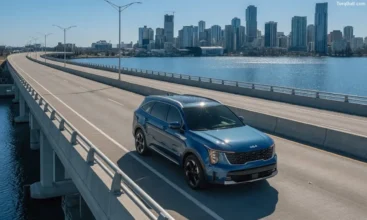
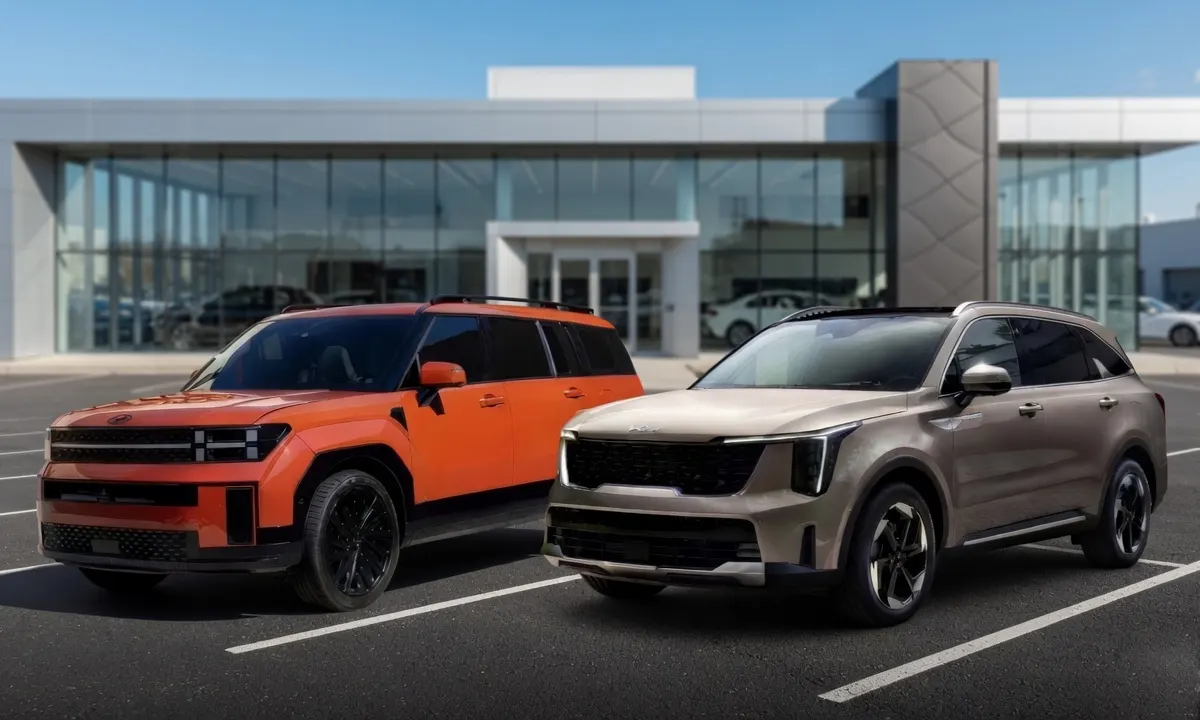
Kia Sorento vs Hyundai Santa Fe: The Kia Sorento and Hyundai Santa Fe are genuinely the most closely matched comparison in the American midsize SUV market — built on shared corporate platforms, powered by related engine families, priced within a few thousand dollars of each other and serving nearly identical buyer demographics. They are, in the most literal automotive sense, fraternal twins who went to different stylists and chose different personalities. The Santa Fe got the fresher, bolder redesign in 2024 with a boxier silhouette and roomier interior. The Sorento brings a broader powertrain menu including a plug-in hybrid, lower entry pricing and stronger crash-test credentials. Multiple independent automotive sources conducted head-to-head comparisons and reached different verdicts — because both vehicles genuinely win different categories, and the better choice depends on which of those categories matters most to any specific buyer.
The Fundamental Context: Same Family, Different Personalities
Before examining specific categories, understanding the corporate relationship between these vehicles provides essential context. Both are built by the Hyundai Motor Group — the Sorento by Kia and the Santa Fe by Hyundai — on the same fundamental vehicle architecture. They share powertrain families, safety technology suppliers and manufacturing quality standards. This means the comparison between them is less about fundamental quality differences and more about design philosophy, feature prioritisation and how each brand has chosen to differentiate within their shared foundation.
The Santa Fe received a comprehensive generational redesign for 2024 — adopting the boxier, function-forward design language that has proven commercially successful across the segment. The Sorento is approaching the end of its current generation, with a fifth-generation redesign expected for 2026. KBB specifically notes that the Santa Fe’s newness is reflected in its higher starting price. The Sorento’s position as a late-generation vehicle means it benefits from years of refinement and competitive pricing but does not carry the freshness premium of its sibling.
Price: Sorento’s Clear Advantage at the Entry Point
The price comparison between these two vehicles requires attention to where in the lineup the comparison is made — because the entry-level gap is meaningful while upper-trim pricing converges.
The 2026 Kia Sorento starts at approximately $31,990 for the base LX with a naturally aspirated engine. TrueCar confirms the similarly equipped Sorento at $33,885 against the Santa Fe’s $36,650 starting MSRP — a $2,765 entry-level advantage for the Sorento. KBB’s comparison specifically notes the Sorento’s lower starting price includes a less powerful non-turbocharged engine, which partially explains the price gap. The Sorento Hybrid starts at approximately $40,000, and the Sorento PHEV at approximately $49,500. The Santa Fe Hybrid SEL starts at approximately $38,000 — narrowing the hybrid price gap between the two.
The Sorento’s entry price advantage is meaningful for budget-conscious buyers, but the comparison requires acknowledging what the lower price delivers. The base Sorento’s non-turbocharged engine is noticeably less powerful than the Santa Fe’s standard turbocharged unit at equivalent pricing, and AWD — which is standard or easily accessible on Santa Fe trims — adds $1,500 to $2,000 to Sorento configurations where it is optional. The effective price comparison for equivalently equipped, similarly capable versions narrows the Sorento’s advantage considerably.
Interior Space and Cargo: Santa Fe’s Most Decisive Advantage
The Santa Fe’s 2024 redesign was specifically engineered to maximise interior volume within the vehicle’s footprint — and the result is a measurable cargo and passenger space advantage over the Sorento that U.S. News identifies as a key Santa Fe win.
The Santa Fe provides a class-leading 79.6 cubic feet of maximum cargo space with all rows folded, 40.5 cubic feet with the second row upright and 14.6 cubic feet behind the third row. The Sorento provides 75.5 cubic feet maximum, 38.5 cubic feet with the third row folded and a notably tighter 12.6 cubic feet behind the third row — the smallest third-row cargo space of the two by a meaningful margin. TrueCar confirms the Santa Fe’s superiority in front-row legroom — 44.4 inches versus the Sorento’s 41.4 inches — and in second-row legroom — 42.3 inches versus 41.7 inches.
The Santa Fe’s boxy design philosophy — taller, broader and longer than its predecessor — directly produces these interior volume advantages. For families who use the third row regularly or who regularly load cargo behind occupied seating, the Santa Fe’s interior space advantage is a genuine daily functional benefit rather than a specification footnote. KBB notes the built-in grab handle on the Santa Fe’s side for easier roof access as another packaging detail that reflects Hyundai’s function-forward approach to the redesign.
Read: 2027 Kia K4 Sportswagon Combines Style, Space, and Modern Technology
Powertrain and Fuel Economy: Sorento’s Broader Menu
Powertrain variety is where the Sorento holds its most substantial advantage over the Santa Fe — not because any individual Sorento powertrain dramatically outperforms the Santa Fe, but because the Sorento offers options that the Santa Fe does not.
The Sorento’s powertrain menu spans from a base naturally aspirated 2.5-litre four-cylinder through a 2.5-litre turbocharged unit producing 281 horsepower, a 1.6-litre turbocharged hybrid at 232 horsepower with 36 MPG combined and — uniquely in this comparison — a plug-in hybrid version that provides 31 miles of electric-only range, approximately 33 MPG combined when the battery is depleted and zero tailpipe emissions for most daily commutes. The Santa Fe offers a 2.5-litre turbocharged unit producing 277 horsepower and a hybrid version at 231 horsepower, but no plug-in hybrid equivalent.
TrueCar data confirms the non-hybrid fuel economy advantage in favour of the Sorento: the Sorento achieves 23 MPG city and 31 MPG highway versus the Santa Fe’s 20 MPG city and 29 MPG highway in equivalent drivetrain configurations. U.S. News identifies fuel economy as a Sorento category win. For buyers who cover significant annual highway mileage, this 2-MPG combined advantage produces meaningful annual fuel cost savings. The Sorento Hybrid’s 36 MPG combined is the highest among non-plug-in Sorento and Santa Fe versions, and the Sorento PHEV’s electric-first capability is unavailable in any Santa Fe configuration.
One important 2026 note: KBB reports that Hyundai replaced the Santa Fe’s troublesome 8-speed dual-clutch automatic transmission with a more traditional torque-converter 8-speed for 2026 — addressing the reliability concern that prompted a transmission recall on earlier Santa Fe models. Kia has not yet made this change to the Sorento’s DCT-equipped trims for 2026, leaving a potential transmission reliability advantage with the Santa Fe’s updated hardware.
Driving Dynamics and Ride: Santa Fe’s Advantage
U.S. News, which gave the Santa Fe a narrow overall win in their head-to-head comparison, identifies acceleration and ride and handling as Santa Fe category wins — findings that reflect the Santa Fe’s standard turbocharged engine’s performance advantage over the Sorento’s base naturally aspirated unit and the Santa Fe’s more refined driving character in equivalent trim configurations.
Consumer Reports’ comparison of these vehicles confirms the Santa Fe’s driving dynamic advantage at equivalent powertrain levels — the 277-horsepower turbocharged Santa Fe provides more confident and responsive highway performance than equivalent non-turbocharged Sorento configurations, and the suspension tuning in the redesigned Santa Fe was specifically calibrated for improved refinement. The Santa Fe’s Panoramic Curved Display — integrating the digital gauge cluster and infotainment screen into one cohesive unit — contributes to an interior quality perception that U.S. News also identifies as a Santa Fe advantage in its category breakdown.
Reliability and Safety: Sorento’s Edge on Track Record
The Car Connection’s overall comparison score of 6.7 for the Sorento versus 6.5 for the Santa Fe reflects in part the Sorento’s reliability and safety advantages — specifically stronger crash-test scores and a longer track record in its current form that provides more owner experience data.
The Sorento earns IIHS Top Safety Pick designation. Both vehicles have received mixed crash-test results from NHTSA and IIHS in specific categories, but the Sorento’s safety score carries more established data given the Santa Fe’s more recent redesign. Kia’s 10-year, 100,000-mile powertrain warranty — shared with the Sorento — and 5-year, 60,000-mile basic warranty provide industry-leading coverage for both brand’s buyers. The DCT transmission recall that affected some Santa Fe models — addressed for 2026 through the torque-converter replacement — represents a reliability concern in the Santa Fe’s recent production history that the Sorento has not experienced in equivalent form, though the Sorento’s DCT trims retain the same transmission architecture.
Read: Kia K4 Hatchback Brings Bold Design and Smart Tech to the Compact Segment
Kia Sorento vs Hyundai Santa Fe 2026 — Complete Comparison Chart
| Category | Kia Sorento | Hyundai Santa Fe | Winner |
| Starting Price | ~$31,990 | ~$36,650 | Sorento |
| Powertrain Options | 4 (incl. PHEV) | 2 (gas + hybrid) | Sorento |
| Fuel Economy (non-hybrid) | 23 city / 31 hwy | 20 city / 29 hwy | Sorento |
| Hybrid MPG (non-PHEV) | 36 MPG combined | 36 MPG combined | Tie |
| PHEV Electric Range | 31 miles | Not available | Sorento |
| Max Cargo Space | 75.5 cu ft | 79.6 cu ft | Santa Fe |
| Behind Third Row Cargo | 12.6 cu ft | 14.6 cu ft | Santa Fe |
| Front-Row Legroom | 41.4 inches | 44.4 inches | Santa Fe |
| Interior Quality | Good | Very Good | Santa Fe |
| Acceleration (turbo trim) | 281 hp | 277 hp | Near Tie |
| Ride and Handling | Good | Very Good | Santa Fe |
| Reliability Track Record | Stronger (established gen) | Recent redesign | Sorento |
| IIHS Safety Rating | Top Safety Pick | Mixed results | Sorento |
| Transmission (2026) | DCT on some trims | Torque converter (updated) | Santa Fe |
| Warranty Coverage | 10 yr / 100K mi powertrain | 10 yr / 100K mi powertrain | Tie |
| TrueCar Owner Rating | 4.78 / 5 | 4.88 / 5 | Santa Fe |
| TCC Rating | 6.7 / 10 | 6.5 / 10 | Sorento |
| U.S. News Overall | Narrow loss | Narrow win | Santa Fe |
Read: 2026 Hyundai Boulder Concept Signals a Bold Entry into Hardcore Off-Road Territory
The Honest Verdict: Which Is Better for Your Specific Situation
No single answer to this comparison serves every buyer — because the category breakdown genuinely divides along lines that correspond to different buyer priorities.
Choose the Kia Sorento if: your budget is tighter and the $2,000 to $3,000 entry-level price advantage is meaningful; if you want the Sorento Hybrid’s 36 MPG combined at a $600 premium over the non-hybrid for maximum hybrid value; if the Sorento PHEV’s 31-mile electric daily commuting capability is aligned with your lifestyle; or if established reliability data and stronger current IIHS safety scores carry more weight in your decision than interior freshness. The Sorento also makes more sense for buyers who prioritise the PHEV’s electric daily capability — an option the Santa Fe simply cannot match.
Choose the Hyundai Santa Fe if: interior space is the primary family concern and the Santa Fe’s 4+ cubic feet of additional cargo space and 3 inches of additional front legroom are daily functional priorities; if interior quality and the Panoramic Curved Display’s premium feel matter more than entry-level price; if the turbocharged standard engine’s driving dynamics advantage over the base Sorento’s naturally aspirated unit is relevant to your daily driving; or if the Santa Fe’s bolder exterior design better reflects your aesthetic preference. The 2026 torque-converter transmission update also makes the Santa Fe a more confident reliability choice over the Sorento’s retained DCT trims in the same model year.
The Car Connection’s near-tie assessment remains the most accurate framing: these fraternal twins are far more alike than different, and the choice between them ultimately comes down to which of their meaningful differences — price and powertrain breadth for the Sorento, space and interior quality for the Santa Fe — matters more in the buyer’s specific daily life.