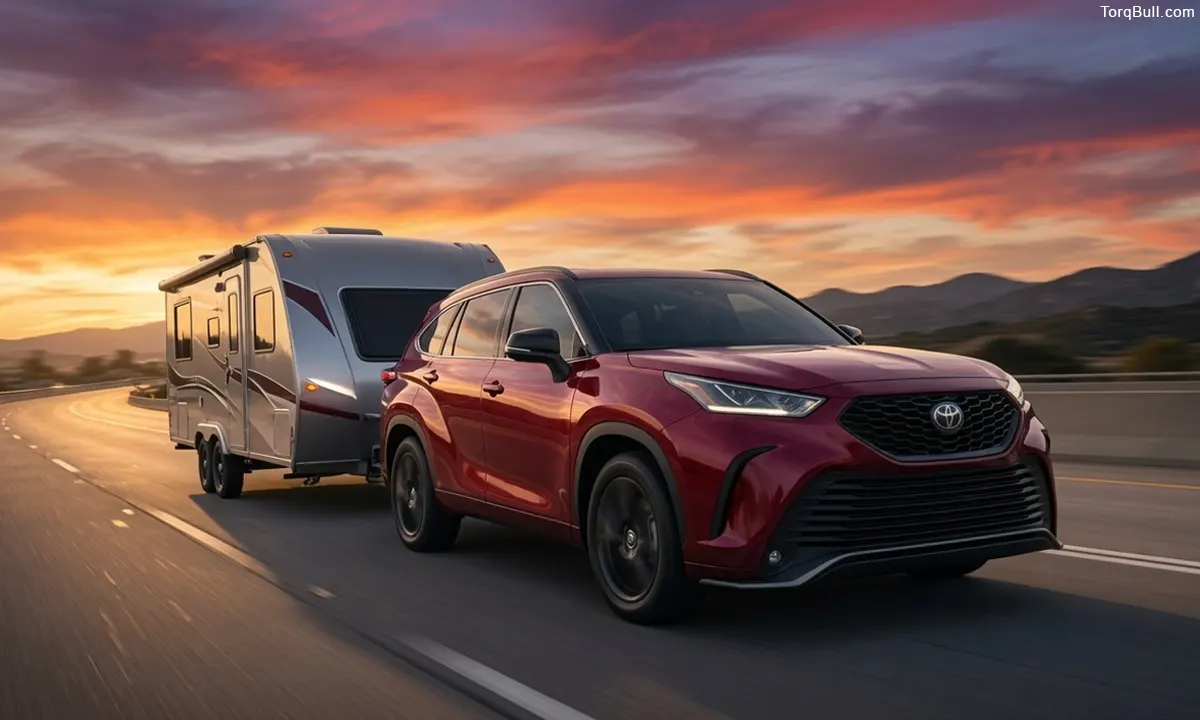
- The 2026 Toyota Highlander can tow up to 5,000 pounds when properly equipped with the towing package.
- Highlander Hybrid models are rated to tow up to 3,500 pounds.
- Standard AWD across the 2026 lineup enhances traction and stability for towing boats, campers and utility trailers.
The Toyota Highlander’s 5,000-pound maximum towing capacity is exactly where most family three-row SUV buyers need it to be — high enough to accommodate the recreational trailers, small boats, utility trailers and personal watercraft rigs that weekend outdoor family life regularly requires, while being honest about the Highlander’s positioning as a family hauler rather than a heavy-duty tow vehicle. Competitive analysis places this 5,000-pound rating as typical for the segment — matching the Kia Telluride and Hyundai Palisade gas ratings while trailing the Honda Pilot’s identical 5,000-pound maximum. Understanding not just the maximum rating but the specific equipment required to achieve it, the real-world conditions that reduce what can be safely towed and how the gas and hybrid models compare across every towing dimension is the practical knowledge that determines whether any specific trailer or recreational application falls safely within the Highlander’s working parameters. This complete guide provides all of it.
The 5,000-Pound Rating: What It Requires and What It Covers
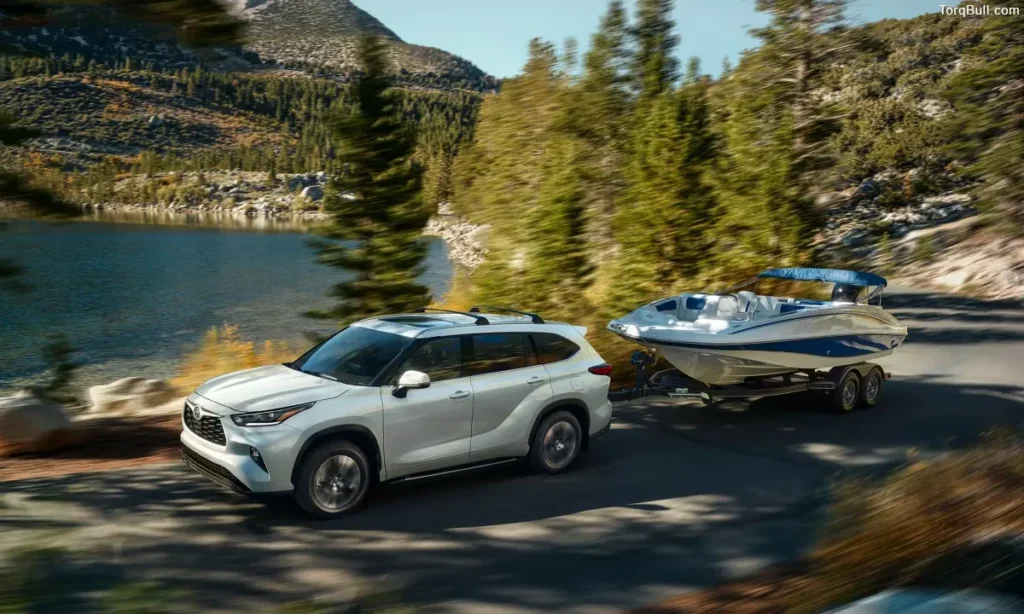
The 2026 Toyota Highlander gas model’s maximum towing capacity of 5,000 pounds is not a baseline capability delivered without additional equipment — it is a maximum that requires specific factory-installed towing package components to achieve safely and to maintain Toyota’s warranty coverage during towing operation.
The towing package that enables the 5,000-pound rating includes a heavy-duty radiator that manages the additional thermal load generated by towing operations, a transmission cooler that maintains transmission fluid temperature during sustained towing rather than allowing the heat buildup that can accelerate transmission wear and reduce fluid service life, a Class IV trailer hitch receiver rated for the tongue and gross trailer weight demands of 5,000-pound loads and the pre-wired trailer harness that provides the electrical connections that trailer lighting, brake controllers and auxiliary systems require.
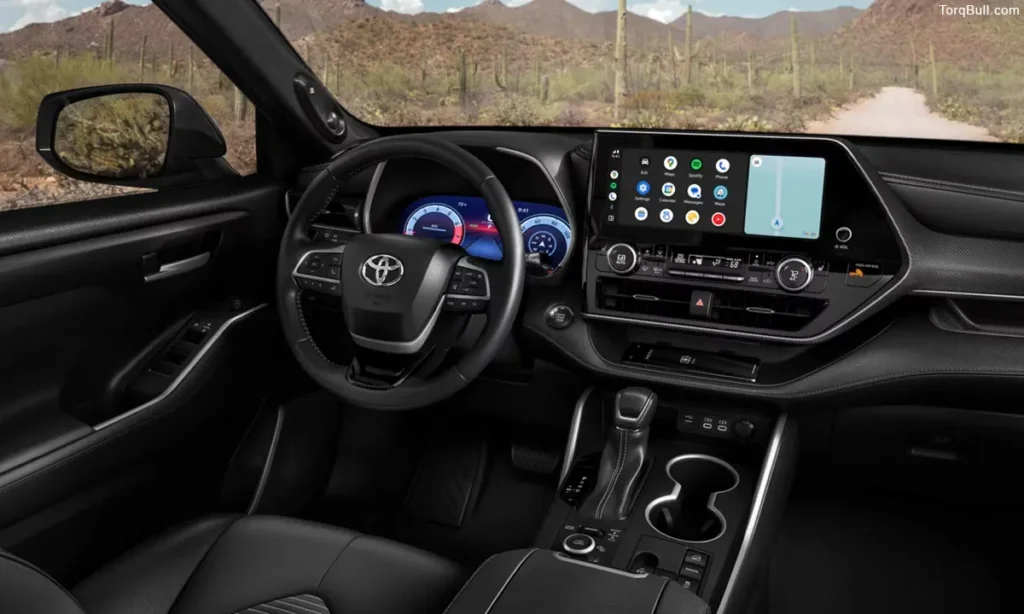
The trailer brake controller — standard on Limited and Platinum trims, optional on XLE — provides proportional brake signal output to electric trailer brakes, distributing braking effort between the tow vehicle and trailer in proportion to the deceleration demand. Toyota’s 2026 updated software for the integrated trailer brake controller provides smoother proportional braking and improved diagnostics accessible through the 12.3-inch touchscreen — an update that specifically improves the towing experience relative to previous model years.
The trailer sway control system is standard across all 2026 Highlander trims — using selective braking and torque management to stabilise a swaying trailer before sway becomes dangerous. This system is the most practically important active safety technology for towing and operates in the background of every towing event, activating automatically when sway is detected without requiring driver input.
Read: Toyota Highlander Insurance Cost 2026. What Owners Can Expect to Pay
Gas vs Hybrid: The Most Important Towing Specification Difference
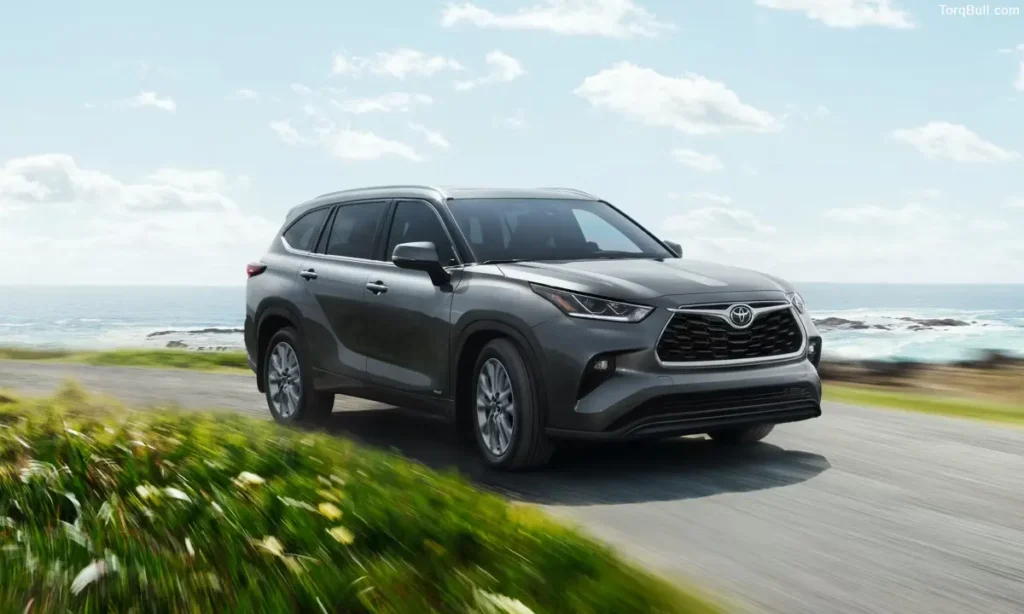
The towing capacity comparison between the 2026 Highlander gas model and Hybrid is the most financially and practically consequential specification difference for buyers who tow regularly — because the hybrid’s 3,500-pound towing limit is 30 percent less than the gas model’s 5,000-pound maximum.
The gas-powered Highlander’s 265 horsepower and 310 pound-feet of torque through the 8-speed automatic transmission provide the sustained pulling power that 5,000-pound towing demands across extended highway grades, mountain approaches and the variable load conditions that recreational towing produces across a typical season of use.
The Highlander Hybrid’s lower 3,500-pound towing limit reflects the hybrid battery system’s additional weight reducing the Gross Combined Weight Rating available for trailer tongue load. This 1,500-pound towing capacity reduction is a real operational constraint — not a minor specification footnote. A small travel trailer, a larger pontoon boat, a loaded horse trailer or a fully equipped cargo trailer commonly weighs between 3,500 and 4,500 pounds — placing these loads within the gas Highlander’s capability but above the hybrid’s rated limit.
For buyers who tow regularly and whose trailer weights consistently approach or exceed 3,500 pounds, the gas Highlander is the correct purchase decision regardless of the hybrid’s fuel economy advantages. For buyers whose towing is occasional and whose trailer weights fall comfortably below 3,500 pounds — small utility trailers, personal watercraft on a small trailer, lightweight camping trailers — the hybrid’s towing limit may be entirely adequate alongside its significant fuel economy advantage of 35 to 36 MPG combined.
Tongue Weight and the 10 to 15 Percent Rule\
The towing capacity rating refers to the maximum Gross Trailer Weight — the total weight of the loaded trailer — but it does not by itself determine safe towing without understanding tongue weight, which is the downward force the trailer’s hitch ball places on the Highlander’s receiver hitch.
Toyota’s guideline for the 2026 Highlander specifies tongue weight at 10 to 15 percent of the Gross Trailer Weight for SAE J2807-compliant trailers. For a 5,000-pound trailer, this means tongue weight should be between 500 and 750 pounds — the range that properly loads the Highlander’s rear suspension without either the underloading that produces trailer sway or the overloading that exceeds the hitch receiver’s tongue weight rating. The 2026 Highlander’s 5,000-pound maximum towing rating specifically applies only to SAE J2807-compliant trailers — a clarification Toyota emphasised in 2026 documentation that was not prominently featured in earlier model year towing guides.
Incorrect trailer loading that produces tongue weight below 10 percent of trailer weight — where too much trailer weight is positioned behind the axle — is the most common cause of trailer sway that destabilises towing combinations at highway speeds. Trailer sway control helps manage this situation when it occurs, but proper loading that achieves correct tongue weight prevents it from occurring in the first place.
Read: Toyota Highlander Reliability After 100,000 Miles. Common Issues, Maintenance and Longevity
Altitude Reduction: A Real-World Towing Consideration
The 2026 Toyota Highlander’s 5,000-pound gas maximum and 3,500-pound hybrid maximum are rated at sea level — and buyers who tow at altitude face a systematic reduction in effective towing capacity that the paper rating does not communicate.
Toyota specifically advises reducing maximum trailer weight by 10 percent for every 3,000 feet of elevation above sea level. Buyers who tow in Denver at approximately 5,280 feet should reduce their effective maximum by approximately 17 percent — reducing the gas Highlander’s effective maximum from 5,000 pounds to approximately 4,150 pounds. At 6,000 feet elevation, the effective maximum drops to approximately 4,500 pounds for the gas model and approximately 3,150 pounds for the hybrid.
This altitude reduction reflects the reduction in air density at elevation that reduces turbocharged engine output. The turbocharged 2.4-litre engine compensates for altitude better than a naturally aspirated engine would — the turbocharger provides a degree of altitude compensation that naturally aspirated alternatives cannot match — but turbocharger boost pressure limits mean this compensation is partial rather than complete.
2026 Toyota Highlander Towing Capacity — Complete Specifications Chart
| Configuration | Engine | Towing Package | Max Towing | Tongue Weight | Notes |
| Gas (XLE, XSE, Limited, Platinum) | 2.4L Turbo 265 hp | Required for max | 5,000 lbs | 500 to 750 lbs | SAE J2807 trailers only for max |
| Gas (base without towing package) | 2.4L Turbo 265 hp | Not equipped | 3,500 lbs | 350 to 525 lbs | Package required for 5,000 lb rating |
| Hybrid (all trims) | 2.5L Hybrid 243 hp | Required for max | 3,500 lbs | 350 to 525 lbs | Battery weight reduces GCWR |
| Gas at 3,000 ft elevation | 2.4L Turbo | Package equipped | approximately 4,500 lbs | 450 to 675 lbs | 10% reduction per 3,000 ft |
| Gas at 6,000 ft elevation (Denver) | 2.4L Turbo | Package equipped | approximately 4,000 lbs | 400 to 600 lbs | Turbo partially compensates |
| Hybrid at 6,000 ft elevation | 2.5L Hybrid | Package equipped | approximately 3,150 lbs | 315 to 473 lbs | Altitude reduction applies equally |
| GVWR (XLE curb weight basis) | 5,970 lbs | Curb weight 4,376 lbs, payload 1,594 lbs |
Read: Best Toyota Highlander Trim for Families. Which Model Delivers the Most Value In 2026?
What the Highlander Tows Well: Real-World Application Guide
The 5,000-pound gas Highlander rating comfortably accommodates the most common family recreational towing scenarios when the towing package is installed and the trailer is properly loaded.
A typical personal watercraft trailer with two mid-size jet skis weighs approximately 1,800 to 2,400 pounds loaded — well within the gas model’s capability and marginally within the hybrid’s rating depending on specific equipment. A small fishing boat or bowrider on an aluminium trailer commonly weighs 2,500 to 3,500 pounds loaded — gas model handles comfortably, hybrid approaches its limit. A lightweight folding camping trailer or pop-up camper weighs 1,500 to 2,500 pounds — gas and hybrid both handle confidently. A conventional travel trailer at 20 to 24 feet loaded weight of 4,000 to 5,000 pounds — gas model handles with the towing package equipped; outside the hybrid’s rating.
The Highlander gas model’s 5,000-pound towing capacity is described as typical for the segment and ready for any adventure — a characterisation that accurately reflects the majority of three-row family SUV towing use scenarios. For buyers whose towing needs routinely exceed 5,000 pounds, the full-size truck or body-on-frame SUV category provides the capability that the Highlander’s car-based platform appropriately does not attempt to replicate.