The Dawn of a New Era! Aston Martin Valhalla Explained
1,064 Horsepower, Three Electric Motors, Active Aerodynamics Generating 600 Kilograms of Downforce, Aston Martin's First Mid-Engine PHEV Supercar and Just 999 Examples — The Valhalla Is Not Simply a New Model. It Is the Complete Redefinition of What Aston Martin Means in the Modern Performance Landscape
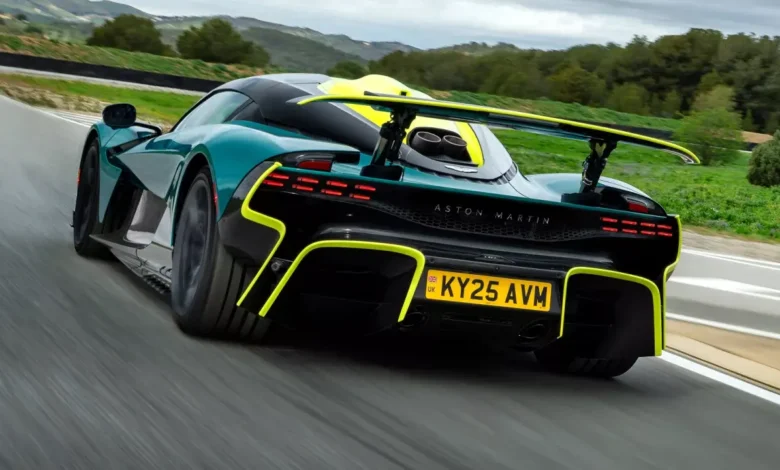
There are moments in a manufacturer’s history that define not merely a product cycle but an entire era — moments when a car arrives that makes everything that came before it feel like prelude and everything that will follow feel like consequence. The Aston Martin Valhalla is one of those moments. After more than six years from its initial announcement as the AM-RB 003 concept, through multiple powertrain revisions, design evolutions and a global pandemic that tested the patience of every buyer who had placed a reservation deposit, the Valhalla has arrived in production form and has done something that the automotive world rarely experiences from any manufacturer and almost never from a brand navigating the commercial challenges that Aston Martin has faced across this period — it has comprehensively exceeded expectations. Customer deliveries began in the second half of 2025, with 154 examples delivered to owners before the year concluded. The automotive press, granted access to the production car at Circuito Navarra in northern Spain, emerged from their driving evaluations with a consistency of assessment that Aston Martin could not have scripted more favourably: the Valhalla is extraordinary, it is genuinely different in character from its Italian rivals, and it represents a new beginning for a brand whose ambition has always outpaced its resources and which has, with this car, finally built something whose achievement is proportionate to its aspiration.
Gallery: Aston Martin Valhalla

Six Years, One Vision: The Tortured Journey to Production
Understanding the Valhalla requires understanding the journey that produced it — because the car that exists in 2026 is considerably more ambitious, considerably more technically complex and considerably more expensive than the car Aston Martin originally conceived when the project was publicly revealed in 2019. The original AM-RB 003 was announced as a plug-in hybrid supercar using a bespoke in-house 3.0-litre twin-turbocharged V6 engine alongside a Kinetic Energy Recovery System derived from the Valkyrie flagship, targeting a weight below 1,550 kilograms and a power output around 1,000 horsepower in combined specification. The aerodynamic design was conceived with Red Bull Racing’s input, reflecting the partnership between Aston Martin and the Formula 1 constructor that had already produced the radical Valkyrie. This was already a profoundly ambitious project for a manufacturer of Aston Martin’s scale and resource.
What eventually reached production was more ambitious still. The bespoke V6 was replaced by a heavily modified version of the Mercedes-AMG 4.0-litre twin-turbocharged flat-plane-crank V8 — not as a supplier relationship but as a genuine engineering collaboration that involved Aston Martin comprehensively reworking the engine’s intake system, exhaust architecture, internal components and thermal management to extract performance and packaging benefits that the standard AMG application of the same basic unit cannot approach. The flat-plane crankshaft arrangement — shared in concept with the engine used in the AMG GT Black Series, itself one of the most celebrated high-performance V8 applications of the modern era — produces a mechanical character and a sound signature sharper, more metallic and more immediately responsive than the cross-plane crankshaft V8s used by most high-performance road cars. In Valhalla specification, this V8 alone produces 817 horsepower, making it the most powerful V8 engine ever installed in a production Aston Martin — a statement that, in the context of the company’s history, carries genuine significance.
Three electric motors complete the powertrain architecture. Two motors are positioned at the front axle — one per wheel — enabling independent torque vectoring of exceptional precision and providing the front-axle traction management that allows the Valhalla’s prodigious combined torque to be deployed from rest without the wheelspin that would otherwise consume it. The third motor is integrated into the new eight-speed dual-clutch transmission — itself a first for Aston Martin — positioned between the combustion engine and the gearbox to provide instantaneous torque fill during the brief period between throttle application and peak turbo boost pressure, eliminating the lag that the V8’s turbocharging architecture would otherwise impose at low engine speeds. The combined system output of 1,064 horsepower and 811 pound-feet of torque is delivered to all four wheels through this architecture with a seamlessness that first-drive reviewers have consistently described as the Valhalla’s most impressive and most unexpected quality — the sensation of a naturally aspirated engine’s immediacy rather than a turbocharged unit’s delayed surge.
The Carbon Foundation: Architecture Worthy of the Ambition
The engineering foundation beneath the Valhalla’s powertrain is a purpose-built carbon fibre monocoque tub whose construction combines two manufacturing processes to achieve the optimal balance of structural integrity, manufacturing precision and cost efficiency. The lower tub section is produced through Resin Transfer Moulding — a more automated process capable of producing complex structural shapes with consistent material distribution at greater production volumes than traditional pre-preg construction. The upper section uses conventional pre-preg carbon fibre, where resin-impregnated fabric is laid by hand and cured under pressure and heat to achieve the maximum strength-to-weight ratio available from composite construction. Aluminium subframes front and rear complete the chassis architecture, providing the structural mounting points for the suspension and drivetrain components in a material whose repairability in the event of collision or track incident provides meaningful practical advantages over a fully carbon alternative.
The suspension geometry reflects a philosophy of mechanical precision over electronic complexity. Double-wishbone front suspension, positioned inboard to maximise the available space for aerodynamic underbody development, provides the geometric precision that the car’s performance demands without the additional weight and packaging complexity of active hydraulic or air spring systems. The rear multi-link arrangement, combined with a physical anti-roll bar, maintains the conservative mechanical foundation that Aston Martin’s engineers concluded was appropriate for a car whose electronic torque vectoring provides the dynamic intelligence that active suspension would otherwise supply. The Bilstein DTX dampers provide three levels of mechanical adjustment — a simple, reliable and driver-accessible system that requires no electronic management to reconfigure and that provides meaningful real-world ride quality adaptation between the car’s EV, Sport, Sport Plus and Race driving modes.
Active Aerodynamics: The Technology That Transforms at Speed

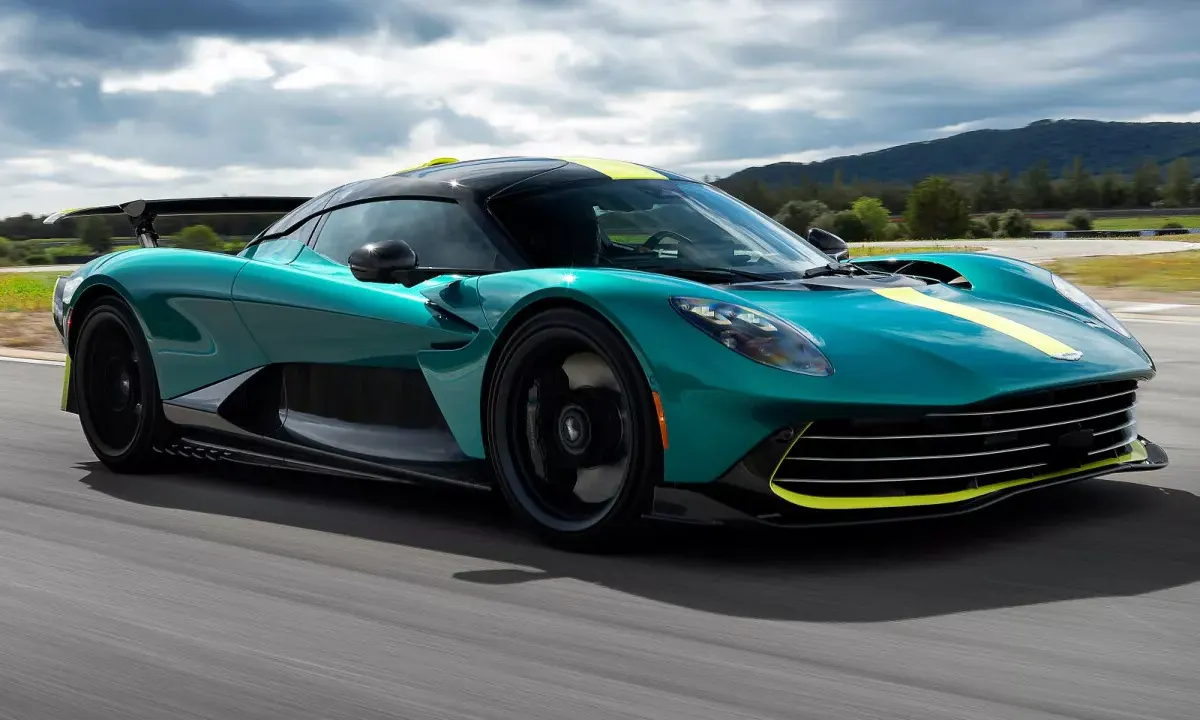
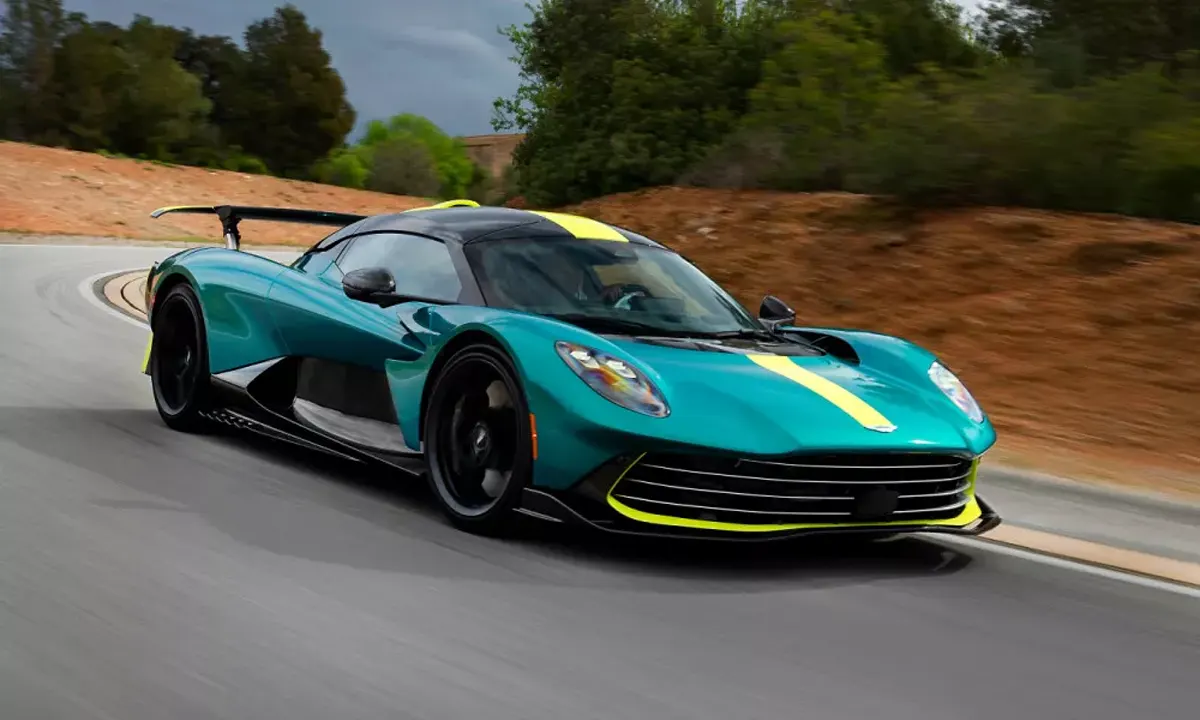
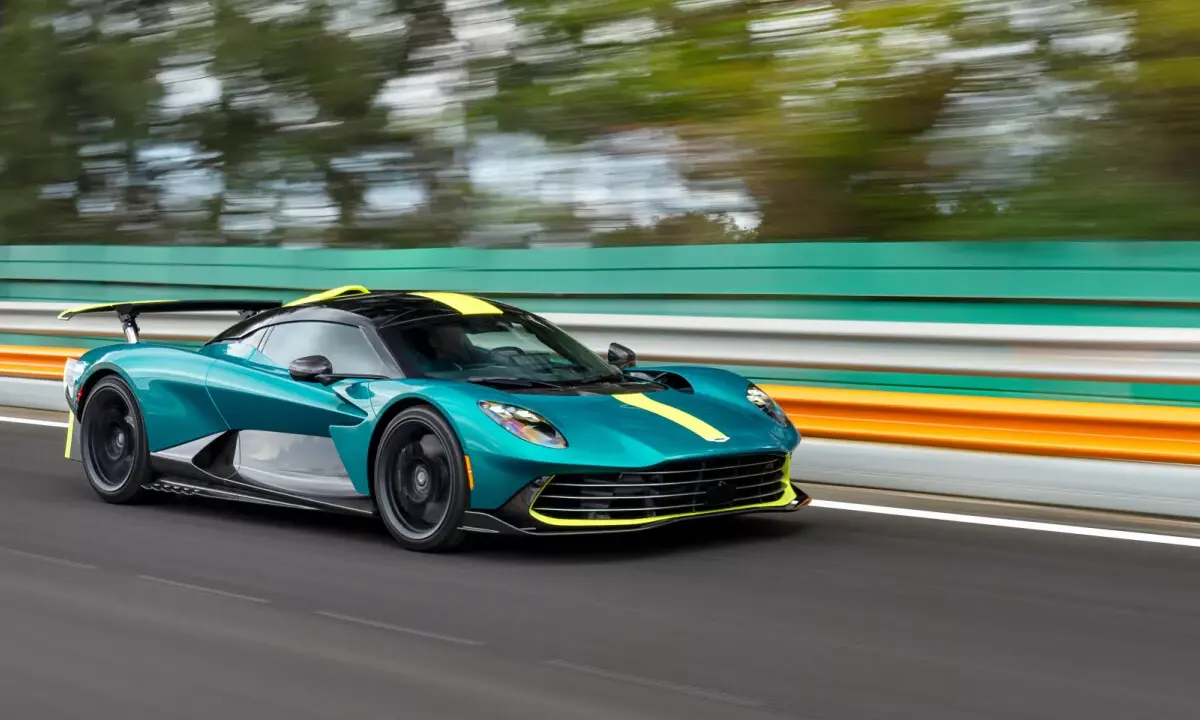
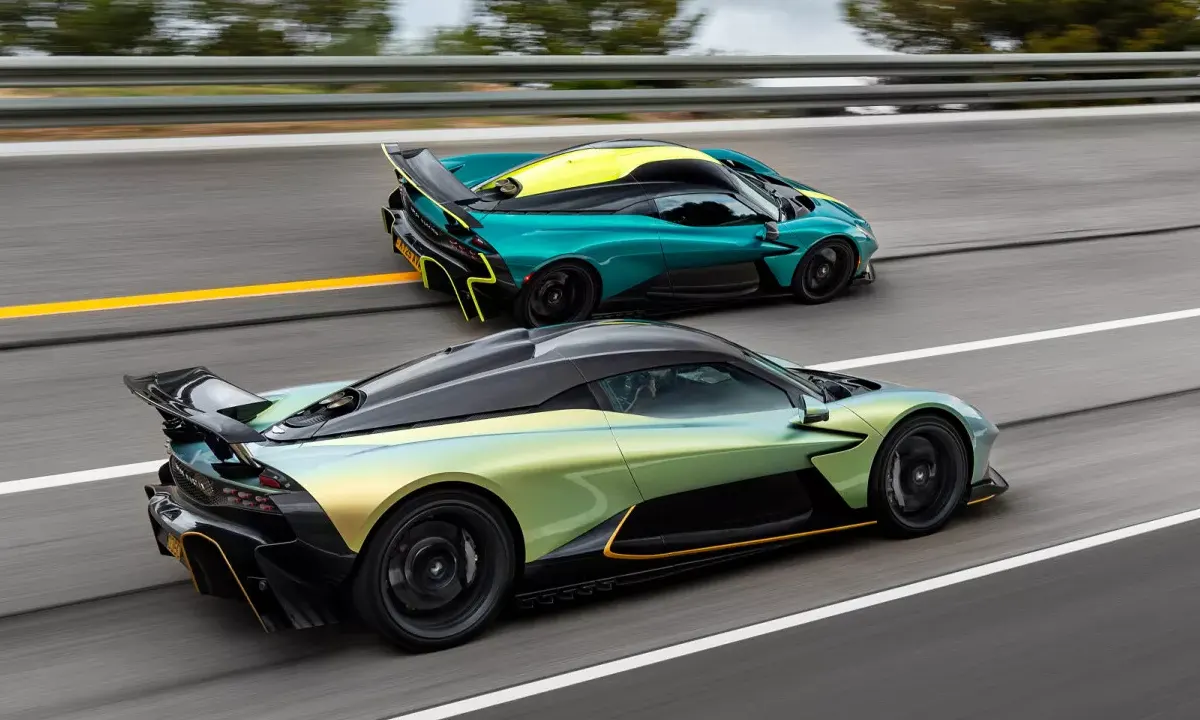
The aerodynamic system of the Valhalla is among its most technically sophisticated and most visually dramatic features — an active architecture whose components transform the car’s aerodynamic behaviour fundamentally between its road driving modes and Race mode, providing the downforce required for maximum circuit performance while maintaining a sufficiently low-drag configuration for the efficiency and top speed demands of road use. At the front, an active wing sits concealed behind the grille in road modes — deploying in Race mode to work in concert with underbody turning vanes and the front diffuser to generate meaningful front-axle downforce. At the rear, the active wing rises 255 millimetres on hydraulic stanchions in Race mode — visually and dramatically transforming the car’s appearance and aerodynamic profile simultaneously — pivoting between positions that function as an air brake, a drag reduction system and a variable downforce generator in response to speed, braking and driver-mode selection. The entire active aero system responds within 0.5 seconds to changing conditions, ensuring that its contribution to the car’s aerodynamic balance is continuously and accurately calibrated rather than static across different speed and loading situations.
The result is a car that generates over 600 kilograms of downforce at 150 miles per hour in Race mode — a figure that exceeds the vehicle’s own dry weight in most configurations and that provides the aerodynamic grip foundation for the cornering speeds that the Valhalla’s power output enables. The active system’s intelligence maintains this downforce figure across a range of speeds above 150 miles per hour rather than allowing it to increase without management — a calibration decision that prevents the rear tyres from becoming overloaded at the highest speeds and that maintains predictable, progressive aerodynamic behaviour for drivers exploring the car’s performance envelope at the circuit.
Inside the Cockpit: Function as Form
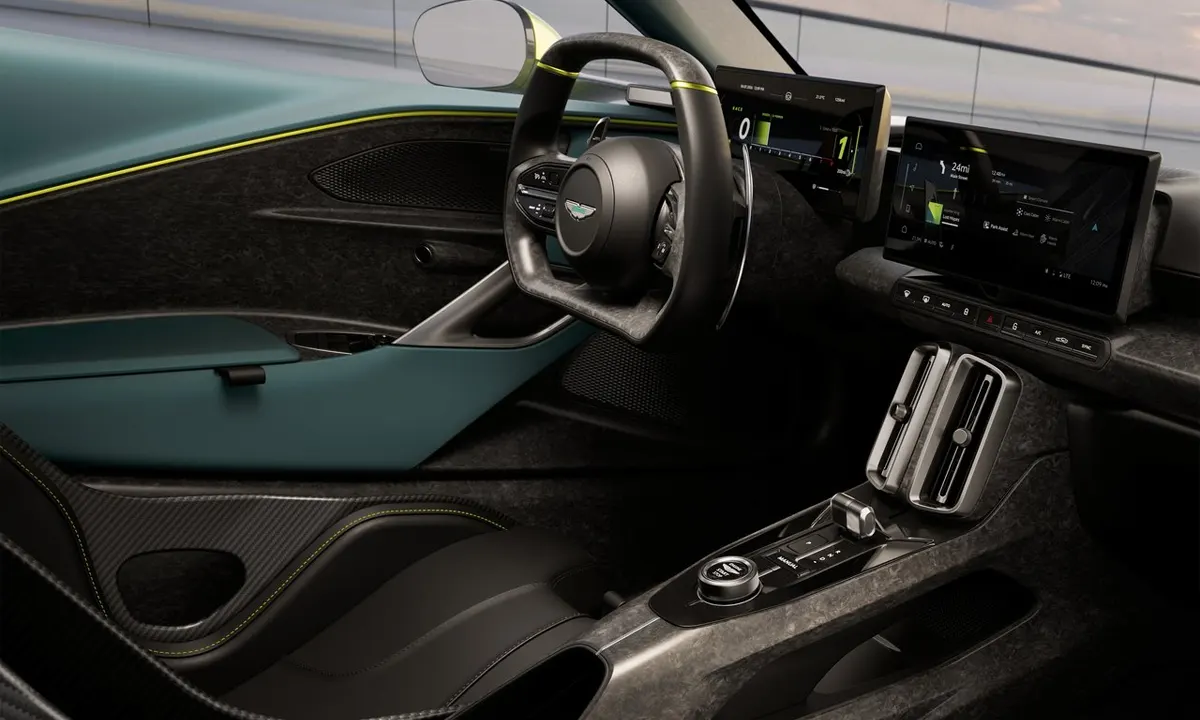
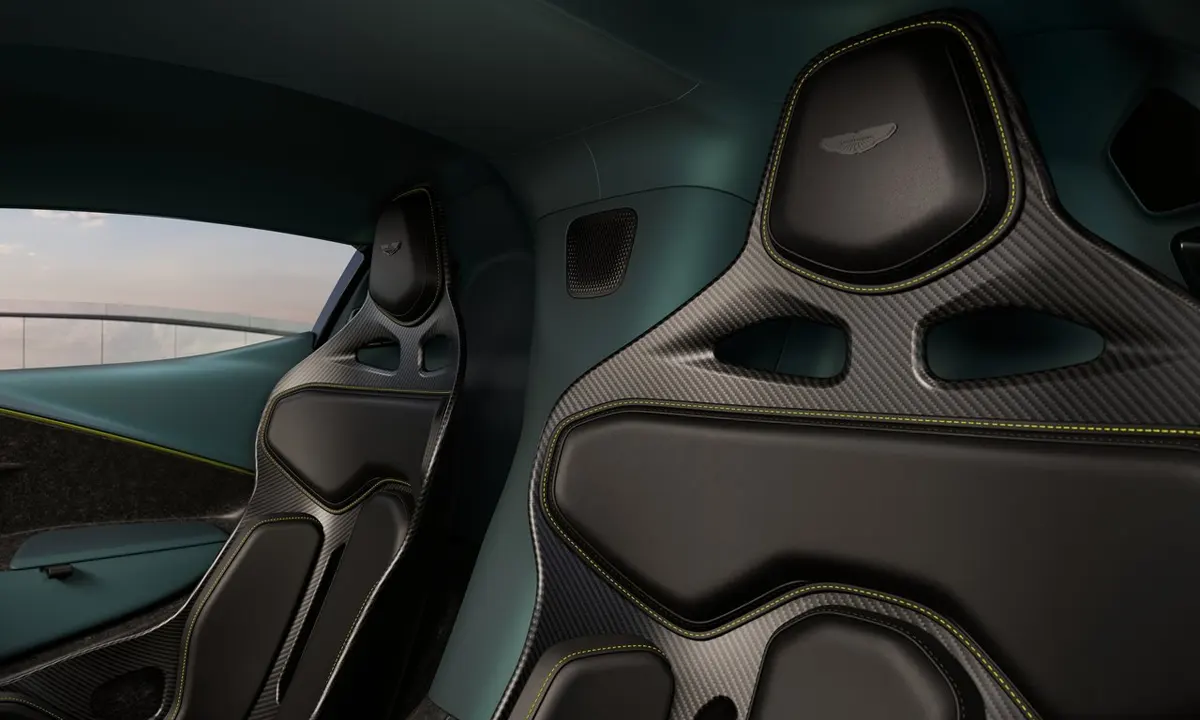
The Valhalla’s interior is the product of a design philosophy that prioritises driver engagement and clarity of information above luxury conventions — a cabin of genuine Le Mans prototype influence that makes no apology for the reclined seating position, the narrow interior dimensions and the functional rather than decorative orientation of every surface and control. The low, reclined seating position that immediately strikes every journalist who has described their first experience of the car contributes directly to the car’s aerodynamic architecture — lowering the roofline to reduce frontal area and improve aerodynamic efficiency in a manner that the comfort-led seating position of a conventional supercar would prevent. Despite this functional intent, the cabin has been designed with sufficient material quality — available in a range of colour combinations that extend from Ultramarine Black with Aston Martin F1 Green accents to the striking Andromeda Red Chromaflair with Cyber Magenta accents — to satisfy the luxury expectations of buyers investing one million dollars in their purchase.
The dihedral doors that cut into the roof — a design feature that simultaneously improves ingress and egress ease and reinforces the Valhalla’s visual drama — provide one of the most spectacular entry experiences available in any production car and contribute to the car’s unique visual identity alongside the four exhaust outlets that emerge from the rear — two from the conventional rear bumper position and two more from the rear deck, whose internal routing Top Gear’s engineers described as “mad” in its complexity but whose acoustic result provides the driving soundtrack appropriate to a car of this specification.
The Competitive Context: Where the Valhalla Stands
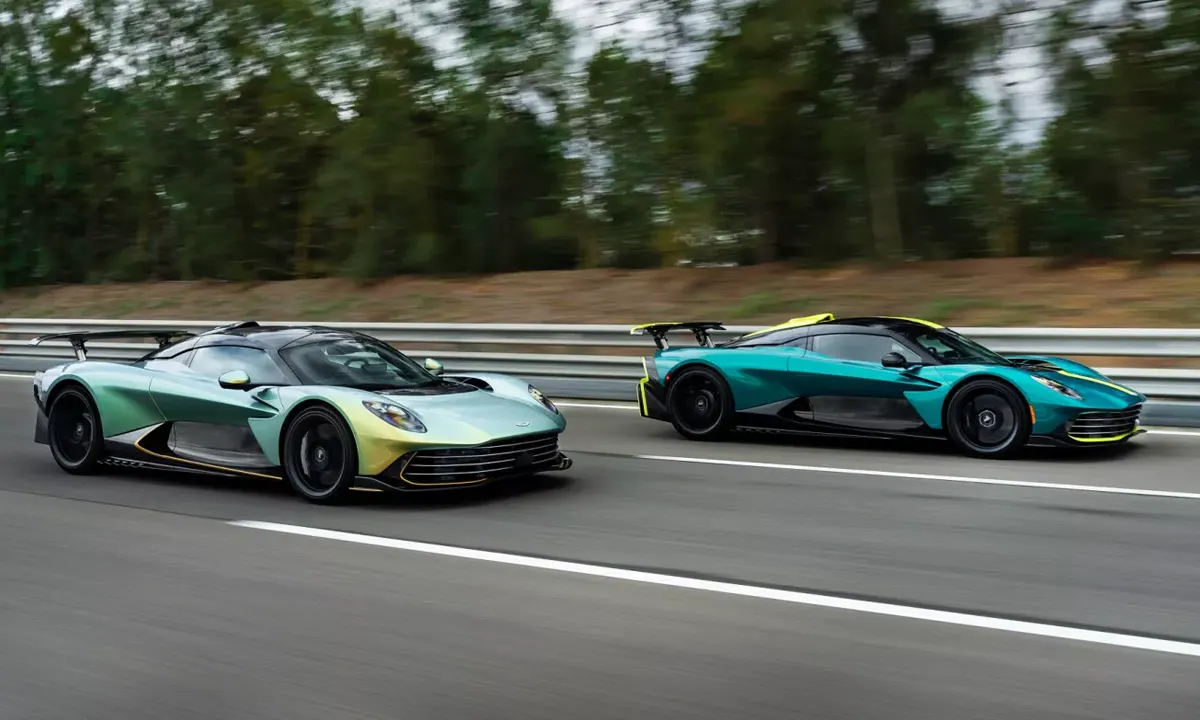
The Valhalla enters a competitive landscape populated by some of the most technically sophisticated production supercars ever built — the Ferrari SF90 XX, the Lamborghini Revuelto and the McLaren W1 — and positions itself at approximately one million dollars in the United States market, meaningfully below the Ferrari SF90 XX’s higher specification pricing and the McLaren W1’s substantially greater asking figure. Against the SF90 XX, the Valhalla’s most direct competitor by technical specification and approximate price, the Aston Martin offers a distinctly different character — what first-drive reviewers universally describe as a more mechanical, more communicative and more driver-focused experience than the Ferrari’s more digitally mediated approach to hypercar performance management. Against the Revuelto, the Valhalla offers comparable power output with what PistonHeads’ first-drive assessment describes as steering that sets the Valhalla apart from the Italian and a simplicity and ease of use that represents a genuinely different philosophical approach to making hypercar performance accessible to its driver without demanding specialist knowledge or physical commitment that the experience should not impose.
With 154 cars delivered before the 2025 year-end and production continuing toward the 999-unit total across 2026 and beyond, the Valhalla’s commercial reception has already exceeded the pace that its allocation required — validating both the engineering decisions and the patient development approach that delayed it repeatedly from its 2021 original target date. The wait, by every critical assessment of the finished product, was comprehensively and convincingly worthwhile.
Read: 2026 Toyota Prius Review: The Evolution of the World’s Most Famous Hybrid
Aston Martin Valhalla – Specifications & Performance Chart
| Category | Specification |
| Vehicle Type | Mid-Engine PHEV Hypercar |
| Production Volume | 999 Units (Limited Production) |
| Combustion Engine | 4.0-Litre Twin-Turbo Flat-Plane V8 (AMG-Derived / Heavily Modified) |
| V8 Output | 817 hp @ 6,700 rpm |
| Electric Motors | Three (Two Front Axle / One Integrated in DCT) |
| Electric Output | 247 hp Combined |
| Combined System Power | 1,064 hp / 811 lb-ft Torque |
| Transmission | 8-Speed Dual-Clutch (Aston Martin’s First DCT) |
| Drivetrain | All-Wheel Drive (First AWD Aston Martin Sports Car) |
| Torque Vectoring | Full Autonomous – Twin Front Motors (One per Wheel) |
| Battery Capacity | 6.1 kWh High-Performance Lithium-Ion |
| Electric-Only Range | Approx. 6–9 Miles |
| 0–62 mph | 2.5 Seconds |
| Top Speed | 217 mph |
| Dry Weight | Approx. 3,648–3,649 lbs (1,655 kg) |
| Chassis | Carbon Fibre Tub (RTM Lower / Pre-Preg Upper) |
| Subframes | Aluminium (Front and Rear) |
| Front Suspension | Inboard Double-Wishbone |
| Rear Suspension | Multi-Link with Physical Anti-Roll Bar |
| Dampers | Bilstein DTX (Three-Level Adjustment) |
| Front Axle Lift | 25mm (Available for Low-Speed Obstacles) |
| Max Downforce (Race Mode) | 600 kg @ 150 mph |
| Rear Wing Rise | 255mm (Hydraulic – Race Mode) |
| Active Aero Response Time | 0.5 Seconds |
| Driving Modes | EV / Sport / Sport Plus / Race |
| Reverse Gear | Electric Front Axle Only (247 hp / FWD) |
| Door Configuration | Forward-Hinging Dihedral (Roof Cut-Outs for Access) |
| Exhaust Configuration | Quad Outlets (Two Rear Bumper / Two Rear Deck) |
| Tyres (Standard) | Michelin Pilot Sport Cup 2 (Bespoke) |
| Starting MSRP (US) | Approx. $1,000,000 |
| Starting Price (UK) | Approx. £850,000 |
| Customer Deliveries Began | Second Half of 2025 |
| Units Delivered by End 2025 | 154 |
| Assembly | Gaydon, Warwickshire, England |