How Turbochargers Work in Modern Cars and Why Almost Every New Car Has This Technology
- Exhaust gases spin a turbine up to 300,000 RPM
- Compressor forces dense air into the engine
- Increases power and efficiency simultaneously
- Now standard in modern automotive powertrains
- Impacts driving style, maintenance and buying decisions
How Turbochargers Work in Modern Cars: Walk through any dealership in America in 2026 and attempt to buy a new car without a turbocharged engine. You will find the task surprisingly difficult. The four-cylinder engine that once produced 130 horsepower from 2.0 litres now produces 250 horsepower from the same displacement. The compact crossover that previously required a 3.5-litre V6 to feel adequately powered now manages identical performance from a 1.5-litre turbocharged four-cylinder that returns 30 miles per gallon. The performance car that demanded a 5.0-litre naturally aspirated V8 for genuine excitement now achieves greater output from a 3.0-litre twin-turbocharged inline-six. Turbocharging did not merely change how cars are engineered — it fundamentally transformed what is possible from a given package of displacement, weight and fuel consumption. This guide explains how the technology achieves this transformation, starting from first principles and building through every component, system and modern application that makes turbocharging the defining powertrain technology of the current automotive era.
The Fundamental Problem Turbocharging Solves
An internal combustion engine is, at its most basic level, an air pump. The power it produces is directly proportional to the quantity of air-fuel mixture it can combust in each cycle — and the quantity of air it can ingest is limited by the volume of its cylinders and the atmospheric pressure available to push that air into them. At sea level, atmospheric pressure is approximately 14.7 pounds per square inch. A naturally aspirated engine — one that relies solely on atmospheric pressure to fill its cylinders — can only ingest as much air as the atmospheric pressure available at that altitude pushes in during each intake stroke.
The logical solution to increasing power output is increasing displacement — making the cylinders larger so they can hold more air-fuel mixture in each cycle. But larger cylinders require larger engines, which are heavier, larger and less fuel-efficient. The alternative solution — and the one that turbocharging provides — is to increase the pressure of the air being forced into the existing cylinder volume. If a 2.0-litre engine’s cylinders can be filled with air at twice atmospheric pressure, they will ingest roughly twice the air mass per cycle and produce roughly twice the power from the same physical displacement. This is the core engineering principle behind every turbocharged engine ever built.
The Turbocharger’s Core Components: How a Turbine and Compressor Share a Shaft
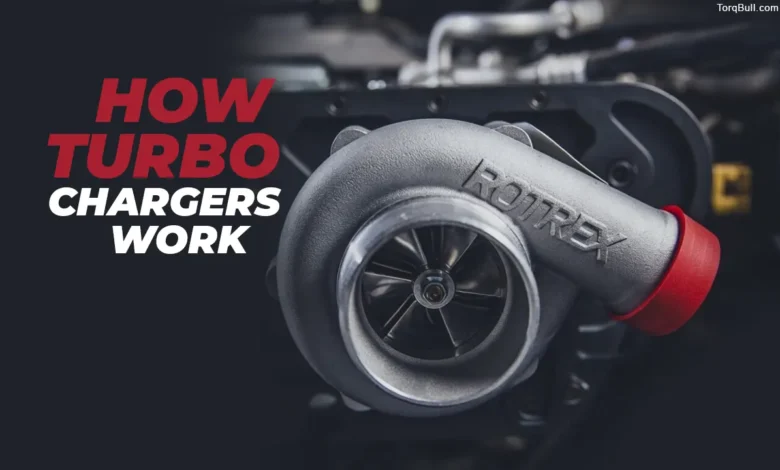
A turbocharger is fundamentally a device that extracts energy from exhaust gas and uses that energy to compress the intake air charge. It accomplishes this through an elegantly simple mechanical arrangement: two impeller wheels — a turbine wheel and a compressor wheel — mounted on a common shaft and housed in separate but connected casings.
The Turbine Section sits on the exhaust side of the engine. Hot exhaust gases, which exit the engine under pressure after combustion, are directed through a specifically shaped housing — the turbine housing — whose geometry accelerates the gas velocity as it approaches the turbine wheel. The high-velocity exhaust gas strikes the turbine wheel’s precisely angled blades, causing the wheel to spin at extraordinary speed — in modern turbos, 150,000 to 300,000 revolutions per minute. The energy that drives this rotation is energy that a naturally aspirated engine would simply expel through the exhaust system as wasted thermal and kinetic energy.
The Shaft connecting the turbine and compressor wheels transfers the rotational energy extracted from the exhaust side to the intake side. This shaft rotates within precision journal bearings lubricated by pressurised engine oil — the turbocharger has no independent lubrication system and depends entirely on the engine’s oil supply for cooling and bearing lubrication. This dependency on engine oil is one of the most important maintenance implications of turbocharged engine ownership.
The Compressor Section sits on the intake side of the engine. The compressor wheel — shaped like a small centrifugal fan — spins at the same speed as the turbine wheel because they share a common shaft. At 200,000 RPM, the compressor wheel accelerates ambient air outward by centrifugal force, and the compressor housing converts this kinetic energy into pressure energy. The result is air delivered to the engine’s intake manifold at significantly higher than atmospheric pressure — this pressure increase above atmospheric is called boost pressure, typically measured in pounds per square inch or Bar.
The Path of Air Through a Turbocharged Engine: Step by Step
Following the complete path of air through a modern turbocharged engine illustrates how all the components work together.
Ambient air enters through the engine’s air filter, which removes contaminants before the air reaches the turbocharger. From the filter, air travels to the compressor inlet — the entry point of the turbocharger’s compressor section — where it is accelerated and compressed. The compressed air exits the compressor at elevated pressure and temperature. This temperature increase is a direct consequence of compression — the same phenomenon that makes a bicycle pump get warm when air is compressed rapidly.
Hot compressed air passes through the intercooler — also called a charge air cooler — where it is cooled either by ambient airflow through a heat exchanger (air-to-air intercooling) or by a water-based cooling circuit (air-to-water intercooling). Cooling the compressed air before it enters the engine is essential for two reasons: cooler air is denser, meaning more oxygen molecules fit into the same volume, improving the quality of the combustion charge. And cooler intake air temperatures reduce the risk of pre-ignition — also called knock — which is the most common limiting factor in turbocharged engine performance and the primary concern of the engine management system.
From the intercooler, the cooled, compressed air enters the intake manifold and then the cylinders, where it is mixed with fuel, compressed further by the rising piston and ignited. The combustion products — hot exhaust gases — exit through the exhaust valves and are directed through the exhaust manifold to the turbine housing, where the cycle of energy extraction begins again.
Turbo Lag: What It Is, Why It Exists and How Modern Engineering Reduces It
Turbo lag is the most frequently discussed limitation of turbocharged engines — the delay between the driver applying throttle and the engine producing the requested power increase. Understanding why it occurs illuminates both the engineering challenge it presents and the technical solutions that modern turbos deploy to minimise it.
When a driver suddenly opens the throttle in a turbocharged engine at low RPM, the engine begins ingesting more air and producing more exhaust gas flow. But the turbocharger needs time to accelerate its turbine and compressor wheels to the speed required to build meaningful boost pressure. This spool-up time is the source of lag. A larger turbocharger with heavier rotating components takes longer to reach operating speed than a smaller, lighter unit — which is why early single large-turbo applications produced significant lag that modern multi-turbo and specifically engineered systems have largely eliminated.
Modern engineering addresses turbo lag through several parallel strategies. Smaller, faster-spooling turbine and compressor wheels made from titanium-aluminium alloys are significantly lighter than the steel or cast iron wheels used in older designs, reducing the rotational inertia that determines spool-up time. Twin-scroll turbine housings divide the exhaust gas feed into two separate channels, each handling the exhaust pulses from different cylinder groups, improving energy extraction efficiency and reducing lag by maintaining higher exhaust velocity at the turbine wheel.
Twin-turbocharger configurations combine two smaller turbos rather than one large unit, allowing each smaller turbo to spool more quickly. Sequential twin-turbo systems, used by BMW and several other manufacturers, operate one small turbo at low RPM for immediate response and bring a second larger turbo online at higher RPM for maximum power — providing the best attributes of small and large turbos simultaneously.
Electric turbochargers and electrified compressors represent the most recent advance in lag elimination. In these systems, a small electric motor powers the compressor wheel independently of turbine spin during the brief spool-up period, providing immediate boost pressure from the first moment of throttle application. Mercedes-AMG’s 48-volt mild-hybrid system uses an electrically assisted turbocharger in the AMG 53 engines, and the technology is spreading across the performance and mainstream segments rapidly.
The Wastegate: How Boost Pressure Is Controlled
Without a regulating mechanism, a turbocharger would continue building boost pressure as engine speed increases until the compressor outlet pressure exceeded safe levels for the engine’s internals. The wastegate prevents this by providing a bypass path for exhaust gas around the turbine wheel.
When boost pressure reaches the target level set by the engine management system, the wastegate valve opens — either through a pneumatic actuator controlled by boost pressure itself, or through a more sophisticated electronically controlled actuator on modern performance applications. Opening the wastegate allows a portion of the exhaust gas to bypass the turbine and exit directly into the exhaust system without driving the turbine wheel, reducing turbine speed and preventing further boost increase.
Electronically controlled wastegates, now standard on most performance turbocharged engines, allow the engine management system to vary boost pressure dynamically — increasing it for maximum performance in suitable conditions, reducing it to protect the engine in high intake temperature conditions, and calibrating it differently across different driving modes. The Ford EcoBoost, BMW TwinPower and Honda VTEC Turbo systems all use electronically controlled wastegate management as a core component of their boost regulation strategy.
Read: Why Manual Transmission Cars Are More Reliable Than Automatics. Three Pedals, Fewer Problems!
The Critical Role of Engine Oil in Turbocharger Maintenance
The turbocharger’s journal bearings rotate at speeds that no other component in the engine approaches — up to 300,000 RPM in high-performance applications — and they are lubricated exclusively by the pressurised engine oil that the engine’s oil pump circulates. The thermal environment surrounding these bearings is intense: the turbine side of the shaft operates in proximity to exhaust gases that may exceed 1,600 degrees Fahrenheit under sustained boost.
Two maintenance implications follow directly from these conditions. First, oil quality and change interval are more consequential for turbocharged engines than for naturally aspirated ones. Oil that has degraded through thermal cycling — the process by which oil molecules break down under repeated high-temperature exposure — provides reduced film strength at the bearing surfaces most critical to turbocharger survival. Turbocharged engines require full synthetic oil changed at the manufacturer’s specified interval without extension.
Second, the practice called a hot soak — running the engine at idle for 60 to 90 seconds before shutdown after sustained hard driving — allows the oil to continue cooling the turbocharger bearings before the oil pump stops. Shutting down a turbocharged engine immediately after high-load driving while the turbo is still spinning at elevated temperature causes the residual oil in the bearing galleries to cook and carbonise, gradually degrading bearing surfaces. Most modern turbocharged engines have turbo timers or water-cooled bearing housings that reduce but do not eliminate this concern.
Read: Boost or Breathe Free! Turbo vs Naturally Aspirated Performance Comparison
Modern Turbocharger Applications: From Commuter Cars to Supercars
| Application | Turbo Configuration | Typical Boost Pressure | Power Output | Key Benefit |
| Economy/Commuter (1.0L–1.5L) | Single small turbo | 10–14 PSI | 100–180 hp | Fuel efficiency + adequate power |
| Performance Sedan (2.0L–3.0L) | Single or twin-scroll | 15–22 PSI | 250–400 hp | Power density + low weight |
| Sports Car / AMG (3.0L–4.0L V8) | Twin turbo (biturbo) | 18–25 PSI | 400–650 hp | Maximum power with compact packaging |
| Diesel Truck/SUV | Single variable geometry | 18–28 PSI | 300–500 lb-ft torque | Massive low-RPM torque |
| Hypercar (electric turbo assist) | Twin turbo + electric motor | Variable | 700–1,000+ hp | Zero lag + maximum output |
| Hybrid Performance (e-turbo) | Electric-assisted turbo | Instantaneous boost | 400–700 hp | Lag elimination + efficiency |
How Turbocharging Affects Fuel Economy: The Efficiency Paradox
The relationship between turbocharging and fuel economy is counterintuitive to many drivers and misunderstood by many more. Turbocharged engines achieve better fuel economy than larger naturally aspirated engines producing equivalent power — but this advantage exists primarily under light-load conditions, which represent the majority of real-world driving.
When a turbocharged 2.0-litre engine is cruising at highway speed with minimal throttle, it is operating as a small-displacement engine with minimal boost, burning proportionally less fuel than the 3.5-litre V6 it replaced. The turbocharger is barely operating at this load level. Only when the driver demands significant acceleration does boost pressure increase substantially, and at that point fuel consumption rises to match the additional power output. The result is an engine that behaves economically under light loads and powerfully under high loads — precisely the combination that real-world driving patterns benefit from most.
This is the engineering bargain at the centre of the turbocharged era: smaller displacement, lower fuel consumption at typical driving loads and better specific power output from the displacement that is used, all achieved by recovering exhaust energy that naturally aspirated engines discard entirely as waste. It is the reason why turbocharged engines now power everything from $20,000 economy commuters to $300,000 supercars — and why understanding how they work is relevant to every car buyer and every driver navigating the 2026 automotive market.