What Happens If the Other Driver Is Uninsured or Underinsured? Your Legal Options Explained

- Uninsured motorist coverage protects you when the at-fault driver has no insurance, while underinsured motorist coverage helps when their policy limits are insufficient.
- Many drivers carry little or no insurance, making UM/UIM coverage an important financial safeguard after a serious accident.
- Suing the at-fault driver is possible, but it is generally worthwhile only if the driver has sufficient assets to satisfy a judgment.
Being struck by a driver who carries no insurance — or whose insurance cannot cover the full cost of the injuries they caused — is one of the most financially destabilising scenarios any accident victim encounters. The standard assumption underlying most car accident claims is that the at-fault driver carries adequate liability insurance and that their insurer will pay the verified damages up to the policy limit. When this assumption fails — either because the driver carries no insurance at all or because their policy limit is lower than the harm they caused — the entire compensation strategy must shift to different sources that many victims do not know they have available. This guide explains every available legal option, how each source works, what determines whether pursuing each option makes financial sense and what the 2025 and 2026 changes to minimum insurance limits mean for accident victims in states that have increased their requirements.
Option 1: Your Own Uninsured Motorist Coverage
The first and most immediately accessible compensation source when the at-fault driver is uninsured is your own auto insurance policy’s uninsured motorist coverage — assuming you carry this coverage.
Uninsured motorist coverage, commonly abbreviated as UM coverage, is specifically designed for this scenario. When an at-fault driver has no applicable insurance, your own insurance company steps into the shoes of the person who hit you — covering your medical expenses, lost income, pain and suffering and other compensable damages up to the limits of your UM coverage, as if their insurer were paying rather than yours. This coverage also applies to hit-and-run accidents where the at-fault driver cannot be identified — because an unidentifiable driver is effectively uninsured from the victim’s compensation perspective.
The critical detail that many accident victims learn at the worst possible moment is that uninsured motorist coverage must be purchased before the accident occurs. States vary in whether UM coverage is mandatory or optional. Many states require insurers to offer UM coverage but allow drivers to reject it in writing. Drivers who decline UM coverage at policy inception to reduce premiums discover when an uninsured driver injures them that the rejected coverage was exactly what they needed.
Most insurance companies impose a strict deadline for filing uninsured motorist claims — often as short as 30 days from the date of the accident in some states. Contact your own insurer immediately upon discovering that the at-fault driver is uninsured, regardless of how uncertain the situation feels in the early aftermath of a collision.
Read: 10 Mistakes That Can Destroy Your Car Accident Claim According to Attorneys
Option 2: Your Underinsured Motorist Coverage
Underinsured motorist coverage, designated UIM coverage, addresses the situation where the at-fault driver has insurance but their policy limit is insufficient to cover the full extent of your damages. This is the scenario that has become more prevalent as medical costs have risen dramatically while many drivers continue to carry minimum liability limits that were set years ago.
Even with the 2025 and 2026 minimum liability limit increases across multiple states — Massachusetts, North Carolina, California and others all raised minimum requirements in 2025 — the new minimums remain far below what serious injury medical costs rapidly accumulate. A hospitalisation for a fracture, a herniated disc requiring surgery or a traumatic brain injury produces medical bills that can reach $50,000 to $200,000 before the treatment is complete — costs that exceed even raised state minimums almost immediately for serious injuries.
When the at-fault driver’s policy is exhausted and your damages exceed their coverage, your UIM coverage activates to bridge the gap. Specifically, UIM coverage pays the difference between what the at-fault driver’s policy paid and your total verified damages — up to the limits of your own UIM policy. An at-fault driver with $50,000 in liability coverage whose negligence produces $200,000 in verified damages leaves a $150,000 gap that your UIM coverage would address up to your UIM limit.
The important distinction that many policyholders do not understand is that UIM coverage pays the gap between the at-fault driver’s actual policy payment and your damages — not the gap between their limit and your damages. An at-fault driver who has $50,000 in coverage must fully exhaust that coverage through payment to your claim before your UIM coverage activates.
Option 3: Collision Coverage for Vehicle Damage
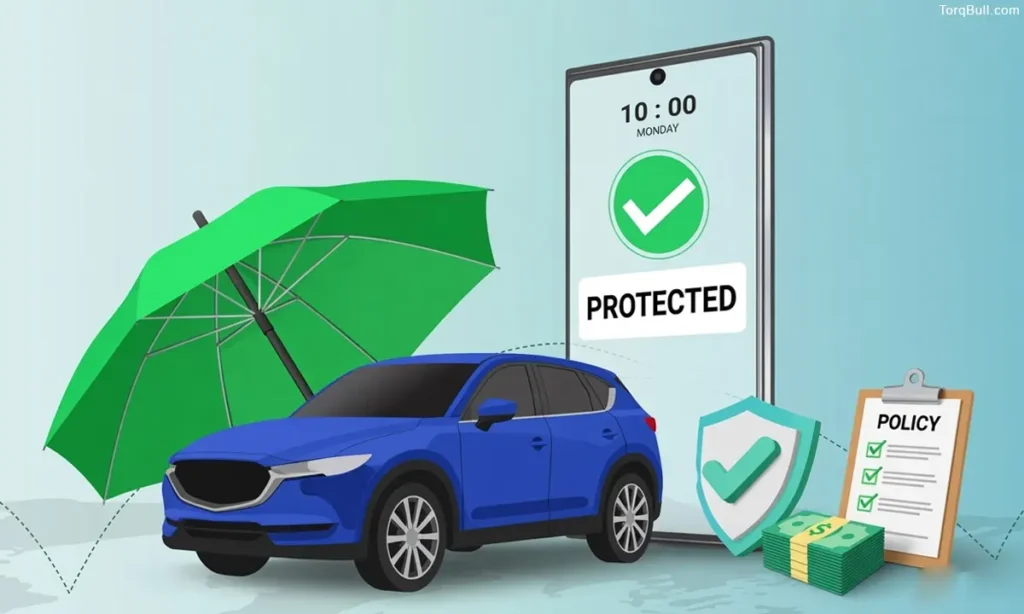
While uninsured and underinsured motorist coverage addresses personal injury damages, your vehicle’s repair or replacement cost when struck by an uninsured driver is addressed through your own collision coverage — assuming you carry it.
Collision coverage pays for vehicle damage regardless of fault — a feature that makes it specifically useful when the at-fault driver cannot pay. The deductible applies, reducing the net payment by the amount you selected when purchasing the policy. Some states and some insurers offer a collision deductible waiver when the at-fault driver is uninsured and identifiable — eliminating the deductible in this specific scenario without the need to file through uninsured motorist property damage coverage.
Uninsured motorist property damage coverage is a separate and distinct coverage from UM bodily injury coverage — it specifically addresses vehicle and property damage rather than personal injury, and it is available in some states as an alternative to collision coverage for the uninsured driver scenario.
Option 4: Suing the At-Fault Driver Directly
Every accident victim has the legal right to sue the uninsured at-fault driver directly through the civil court system — but the practical financial value of this option depends entirely on one factor that the right to sue does not guarantee: whether the at-fault driver has assets sufficient to satisfy a judgment.
Suing an uninsured driver will only be worth your time and effort if that driver has the assets to compensate you for your damages. Uninsured drivers are disproportionately likely to be in financial situations where substantial assets do not exist — which is often why they are uninsured in the first place. A civil judgment against a defendant with no meaningful assets, no real property and no significant bank accounts produces a legal victory without practical financial recovery.
Before pursuing litigation against an uninsured driver, a personal injury attorney can conduct an asset search through public records — identifying any real property ownership, business interests, investment accounts or other attachable assets that could satisfy a judgment. If this search reveals meaningful assets, litigation is financially rational. If it reveals nothing of value, pursuing other compensation sources — UM coverage, collision coverage and any third-party liability claims — may be more productive.
Read: Insurance Claim vs Lawsuit: Which One Is Right for Your Car Accident Case?
Option 5: Third-Party Liability Claims Beyond the At-Fault Driver
Accident victims who assume the at-fault driver is the only potentially liable party may miss additional compensation sources that experienced personal injury attorneys consistently identify.
If the uninsured at-fault driver was operating their vehicle in the course of employment — delivering goods, performing a work errand or otherwise acting within the scope of their job responsibilities — their employer may be liable under the legal doctrine of respondeat superior. A commercial defendant with meaningful insurance coverage and assets is a fundamentally different compensation scenario from an individual uninsured driver with minimal assets.
If the accident was caused in part by a defective vehicle component — a brake failure, a steering defect or a tyre failure that contributed to the collision — the vehicle manufacturer or component manufacturer may bear product liability responsibility for damages that the at-fault driver’s conduct alone would not produce. A municipality whose failure to maintain road conditions — unaddressed potholes, missing signage, defective traffic signals — contributed to the accident may bear governmental liability for resulting damages, subject to the specific notice requirements and sovereign immunity limitations that government entity claims carry.
These third-party liability sources are the compensation options that most unrepresented accident victims never identify or pursue — and their existence in specific cases can transform a financially unrecoverable situation into one where meaningful compensation is achievable.
Uninsured and Underinsured Driver Legal Options — Complete Reference Chart
| Legal Option | When It Applies | What It Covers | Limitation | Key Action Required |
| Uninsured Motorist (UM) coverage | At-fault driver has no insurance or is unidentified | Medical, lost income, pain and suffering, up to UM limit | Must own UM coverage before accident | File with your own insurer immediately; often 30-day deadline |
| Underinsured Motorist (UIM) coverage | At-fault driver’s policy insufficient for full damages | Gap between at-fault policy payment and total damages, up to UIM limit | At-fault policy must be exhausted first | File after at-fault insurer pays their limit |
| Collision coverage | Vehicle damage from any at-fault driver | Vehicle repair or replacement up to coverage limits | Deductible applies; does not cover injuries | File vehicle damage claim with your own insurer |
| Lawsuit against at-fault driver | At-fault driver has identifiable and attachable assets | Full damages assessed by court | Only financially viable if driver has assets | Asset search before litigation; statute of limitations applies |
| Employer liability (respondeat superior) | At-fault driver was acting in scope of employment | Employer’s commercial insurance coverage | Must establish employment scope at time of accident | Investigate employer relationship immediately |
| Product or road defect claim | Defective vehicle component or road condition contributed | Damages attributable to defect or condition | Must establish causal connection to defect | Preserve evidence; involve attorney promptly |
Read: How Long Does a Car Accident Case Take? Timeline From Claim to Settlement
The Insurance Coverage Decision That Prevents This Problem
The most financially consequential action any driver can take against the consequences of being struck by an uninsured or underinsured driver is carrying adequate UM and UIM coverage on their own policy before any accident occurs.
UM and UIM coverage cost relatively little in premium relative to the financial protection they provide — typically adding 5 to 15 percent to the overall policy premium. The value proposition is particularly strong because these coverages protect against the scenario that most drivers consider least likely — being seriously injured by a driver who cannot pay — while that scenario is statistically far more common than most drivers estimate at the time they make coverage decisions.
Carrying UM and UIM limits that match or exceed the liability limits you carry for your own potential at-fault scenarios is the coverage philosophy that personal injury attorneys consistently recommend — because if you would want $100,000 in liability coverage protecting you if you caused serious injury to another person, you should equally want $100,000 in UM and UIM coverage protecting you if an uninsured or underinsured driver causes serious injury to you.