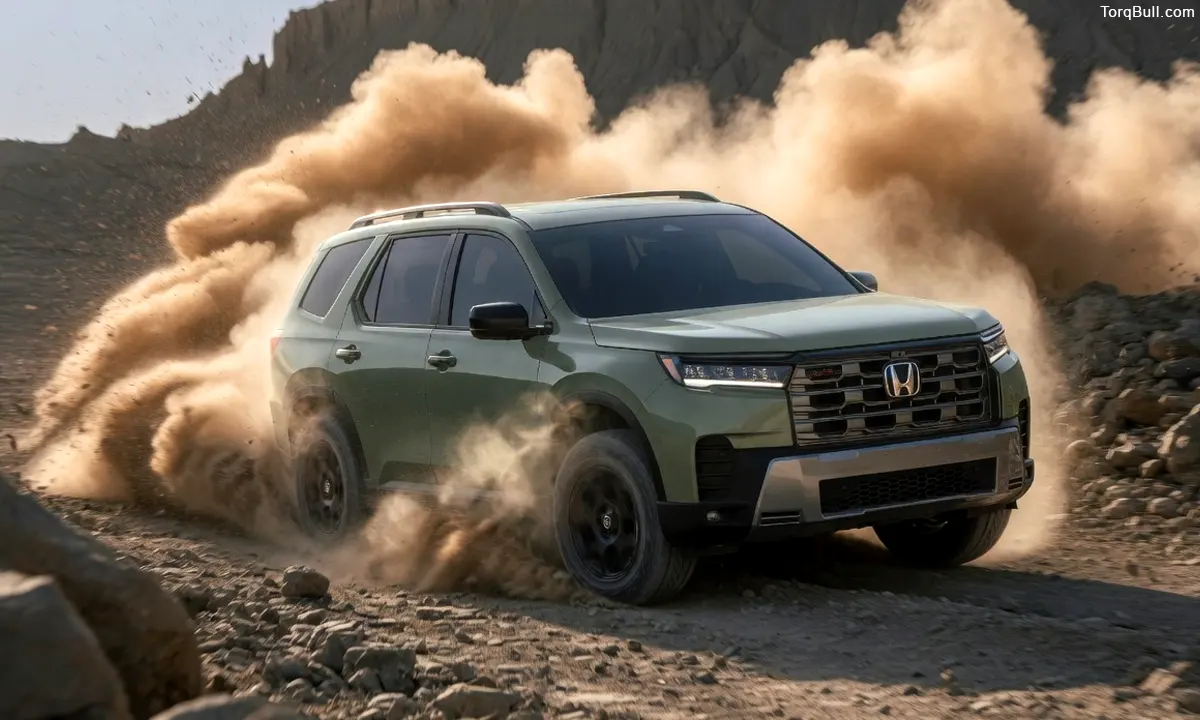
- The 2026 Honda Pilot uses a 285-horsepower 3.5-liter V6 across all trims.
- Independent testing recorded 0–60 MPH times between 7.0 and 7.7 seconds with AWD.
- Variable Cylinder Management improves fuel efficiency by deactivating three cylinders during cruising.
The 2026 Honda Pilot’s decision to continue with a naturally aspirated 3.5 litre V6 engine is Honda’s most deliberate and most debated powertrain choice in the three row midsize SUV segment — made at a time when competitors including the Toyota Highlander, Kia Telluride and Hyundai Palisade have transitioned to turbocharged four cylinders or hybrid systems. Honda’s rationale is straightforward: the V6’s naturally aspirated character produces refinement, smoothness and a linear power delivery that turbocharged alternatives achieve with more mechanical complexity and less acoustic serenity. The V6 is one of the Pilot’s most praised attributes across professional evaluations and owner reviews — described as smooth, powerful and one of the best driving mainstream easygoing crossovers available. But it is also the powertrain that produces fuel economy well below segment averages, peak power at higher revs than turbocharged alternatives and a performance ceiling that competing hybrid systems now exceed. This complete review covers every dimension of the 2026 Pilot’s engine performance.
The Engine Specification: Honda’s Commitment to Natural Aspiration
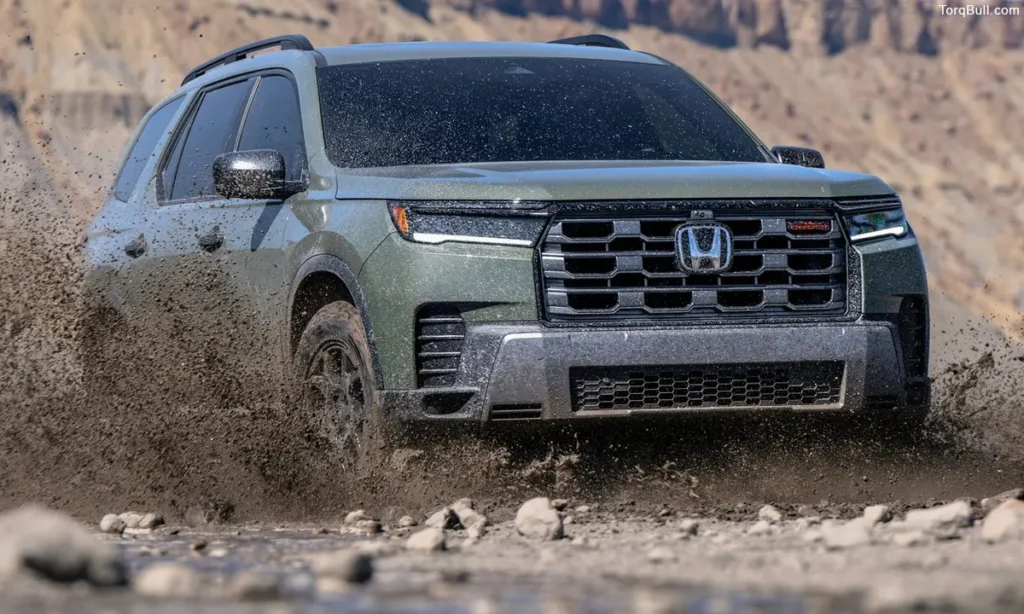
The 2026 Honda Pilot uses the same 3.5 litre DOHC V6 engine that has powered the fourth generation Pilot since its 2023 debut — a decision that Honda has maintained through the 2026 midcycle refresh without alteration to the fundamental powertrain specification. Producing 285 horsepower at 6,100 RPM and 262 pound feet of torque at 5,000 RPM, the engine is paired across every trim level with a 10 speed automatic transmission that Honda has specifically engineered for the Pilot’s weight and power curve.
The high RPM peaks for both power and torque are the engine’s most distinctive characteristic — and the one most consequential for its real world driving character. A naturally aspirated V6 that produces maximum torque at 5,000 RPM requires revving higher than a turbocharged alternative producing peak torque from 1,500 to 2,500 RPM to access its full capability. Professional evaluation describes this characteristic precisely: the V6 has an old school vibe that requires revving it out to get it to shift and to access full power. Under moderate acceleration demands, the V6 delivers smooth, linear power that feels effortless and refined. Under hard acceleration — specifically during highway entries and full throttle passing manoeuvres — the engine needs to build speed through its rev range rather than delivering instant torque at low RPM.
Variable Cylinder Management is the engine’s primary efficiency technology — a Honda system that deactivates a bank of three cylinders during steady state highway cruising, reducing fuel consumption during the sustained moderate load conditions that highway driving produces. During cylinder deactivation, the engine operates as an inline three cylinder, consuming approximately 20 to 25 percent less fuel than full six cylinder operation. The transition between six cylinder and three cylinder operation is described as generally smooth, though professional evaluations note occasional vibration during the transition events that some occupants notice under specific conditions.
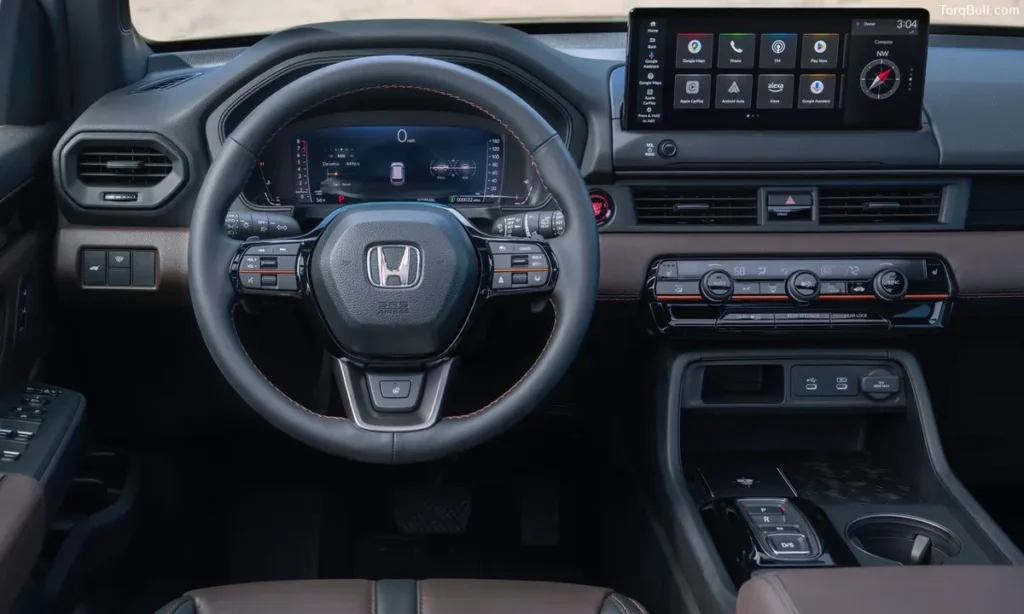
The 10 speed automatic transmission is consistently praised across every evaluation of the 2026 Pilot — described as sophisticated and well mannered, not hunting for the highest gear at the slightest opportunity and operating with a consistent lack of drama. The 4.167 to 1 final drive ratio produces confident launch behaviour, contributing to the Pilot’s relatively strong off the line feel despite peak torque arriving higher in the rev range than turbocharged alternatives. Paddle shifters on the steering wheel allow manual gear selection for drivers who want more direct control of the transmission’s ratio management during spirited driving or downhill descents. The transmission also features shift by wire technology — replacing the mechanical cable connection between the gear selector and transmission with an electronic signal that enables the clean console layout Honda specifically designed for the 2026 refresh.
Read: Should I Buy the Honda Pilot for Long Term Use? What Owners Say?
Acceleration Testing: What Instrumented Results Show
Professional instrumented testing provides the most objectively comparable performance data available for the 2026 Honda Pilot, translating the specification sheet into measured outcomes under controlled conditions.
The AWD configured Pilot achieved a 0-60 MPH time of 7.7 seconds in independent testing — a result described as placing the Pilot approximately mid pack in outright acceleration among three row midsize SUV competitors. A separate professional evaluation estimated a 0-60 time of 7.0 seconds for the Elite AWD configuration — suggesting some variation between test methodologies and conditions, with the Pilot’s real world acceleration performance falling between 7.0 and 7.7 seconds depending on road surface conditions, ambient temperature and exact vehicle specification. The quarter mile time from earlier testing of the same generation was 15.7 seconds at 90 MPH.
In competitive context, the Pilot’s 7.0 to 7.7 second 0-60 range is competitive with the naturally aspirated Kia Telluride at approximately 7.3 seconds and trails the turbocharged Toyota Highlander’s tested 7.4 second result by a modest margin. The Honda Pilot Elite and TrailSport are described as offering approximately 7 seconds to 60 MPH with AWD when conditions are favourable — positioning the Pilot as neither a segment leader nor a performance laggard in this category.
The most practically relevant performance assessment for a family three row SUV is not the 0-60 sprint time but the vehicle’s behaviour in the scenarios that daily driving actually produces: merging onto highways from acceleration ramps, overtaking slower vehicles on two lane roads and maintaining speed on sustained grades. Professional evaluation specifically addresses these scenarios: acceleration is confident when merging or passing, and the engine handles the Pilot’s weight well without drama, making everyday tasks like quick lane changes feel effortless. The consensus across professional evaluations is that 285 horsepower is adequate for confident family SUV driving without being exceptional in any specific performance scenario.
Engine Sound and Character: The V6’s Primary Advantage
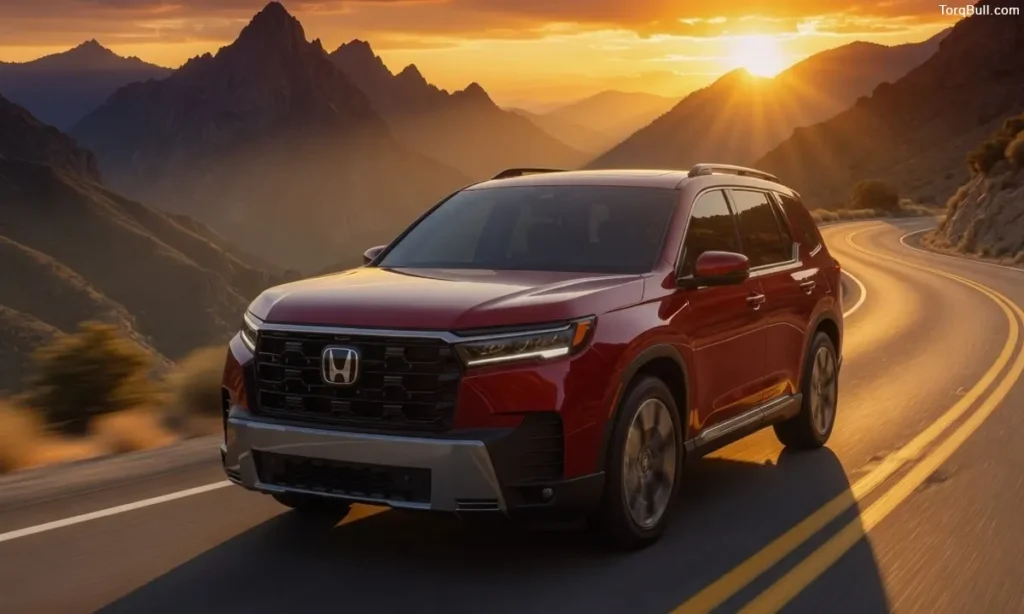
Beyond the specification numbers, the 2026 Pilot’s V6 delivers a driving character that professional evaluators and owners consistently distinguish from turbocharged four cylinder alternatives in qualitative terms that the power figures alone do not capture.
The engine stays remarkably hushed during normal driving at moderate throttle inputs — a specific characteristic of naturally aspirated V6 engines that produce their power through smooth combustion cycles rather than compressed boost events. During steady highway cruising, city driving and light acceleration, the Pilot’s V6 is inaudible in practical terms — the primary cabin sounds being tyre roar and wind noise rather than engine mechanical noise. This acoustic refinement contributes directly to the relaxed, unhurried character that multiple evaluators describe as the Pilot’s driving personality.
Under hard acceleration the behaviour changes materially. When floored during highway entry, the engine becomes noticeably loud — described specifically by one evaluation as getting loud when floored to enter the highway. This character change from serene to aggressive under full throttle is the acoustic trade off of natural aspiration at high revs: the engine’s power arrives through RPM buildup rather than boost pressure, and the sound tracks this progression upward through the rev range. For the majority of owners whose daily driving rarely involves full throttle acceleration events, this behaviour is irrelevant to the ownership experience. For owners who regularly merge aggressively or who use the Pilot in hilly terrain requiring frequent hard acceleration, the acoustic intrusion under full throttle is a more frequently experienced characteristic.
The i-VTM4 AWD System: Torque Vectoring for Handling
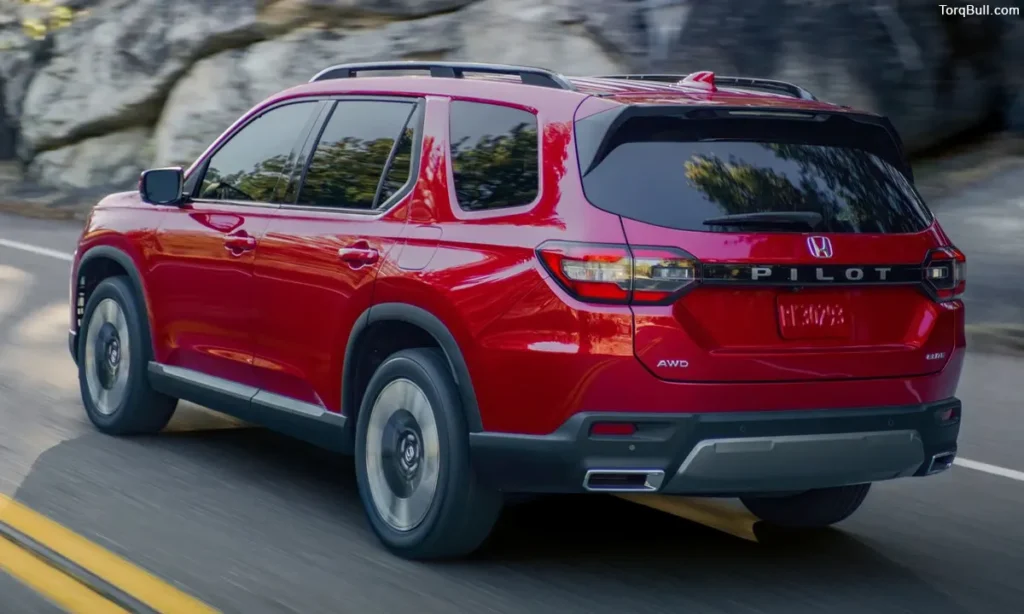
The available and on most trims standard i-VTM4 all wheel drive system is Honda’s torque vectoring AWD architecture — a system that goes beyond simple power distribution between axles to independently vary torque delivery to each rear wheel.
Under straight line acceleration from a standing start, i-VTM4 provides conventional AWD traction benefits — distributing power between front and rear axles to maximise traction on surfaces where front wheel drive would produce wheel spin. In cornering situations at higher speeds, the system can direct more torque to the outside rear wheel — the wheel covering more distance during a corner — which reduces understeer and produces a more neutral, more balanced cornering response than a conventional open differential AWD system delivers. Professional evaluation of the steering changes made for 2026 describes better feel delivered during the evaluation drive — a specific acknowledgment that the i-VTM4 system’s contribution to handling composure improved from the previous year’s calibration.
2026 Honda Pilot Engine Performance — Complete Specification Chart
| Specification | Detail |
| Engine | 3.5 litre DOHC naturally aspirated V6 |
| Horsepower | 285 hp at 6,100 RPM |
| Torque | 262 lb ft at 5,000 RPM |
| Transmission | 10 speed automatic |
| Drive Configurations | FWD (Sport, EX-L) or AWD (all other trims) |
| 0-60 MPH (AWD tested) | 7.0 to 7.7 seconds |
| Quarter Mile | 15.7 seconds at 90 MPH |
| Maximum Towing (AWD) | 5,000 lbs |
| EPA City (FWD) | 19 MPG |
| EPA Highway (FWD) | 27 MPG |
| EPA Combined (FWD) | 22 MPG |
| EPA Combined (AWD) | 21 MPG |
| Efficiency Technology | Variable Cylinder Management (3 cylinder deactivation) |
| AWD System | i-VTM4 torque vectoring AWD |
| Cylinder Count | 6 |
| Aspiration | Naturally aspirated |
| Fuel | Regular unleaded |
Towing and Hauling: The Engine’s Work Capability
The 2026 Honda Pilot’s maximum towing capacity of 5,000 pounds when properly equipped with AWD represents competitive capability for a three row family SUV — adequate for a typical travel trailer, a boat of moderate size or a tandem personal watercraft trailer. This capacity requires AWD specification and the appropriate trailer hitch package; front wheel drive Pilots carry a lower 3,500 pound towing rating that limits utility for heavier trailer applications. The V6’s torque curve, while peaking at 5,000 RPM rather than at the lower rev ranges that turbocharged engines achieve, is described as providing adequate towing performance within the rated capacity — though owners who regularly tow at or near the maximum will experience the engine’s tendency to rev higher than turbocharged alternatives under sustained towing load.
Read: Is the Honda Pilot Good for First-Time SUV Buyers? The Complete 2026 Guide
The Honest Performance Verdict
The 2026 Honda Pilot’s V6 engine delivers exactly what Honda designed it to deliver: a smooth, refined, linear power experience that prioritises acoustic refinement and mechanical simplicity over turbocharged responsiveness and efficiency. For the growing family whose primary performance requirement is confident highway merging and comfortable highway cruising — the daily reality for most three row SUV owners — 285 horsepower through a well matched 10 speed automatic is fully adequate. The engine is described across evaluations as one the Pilot’s genuine strengths rather than a limitation requiring justification.
The limitation is competitive: a turbocharged competitor producing similar power at lower RPM responds more immediately at light throttle, and a hybrid competitor achieves materially better fuel economy while approaching the Pilot’s power output. For buyers who prioritise fuel economy above all else, the Pilot’s 21 to 22 MPG combined trails hybrid competitors by 13 to 14 MPG — a financial disadvantage of approximately $700 to $800 per year at average mileage. For buyers who prioritise smoothness, reliability of a proven naturally aspirated engine and the daily acoustic refinement that the V6 delivers, the Pilot’s powertrain choice is a well reasoned one that its performance data consistently supports.