Tesla Model 3 vs Toyota Prius. Which Car Actually Wins In 2026?
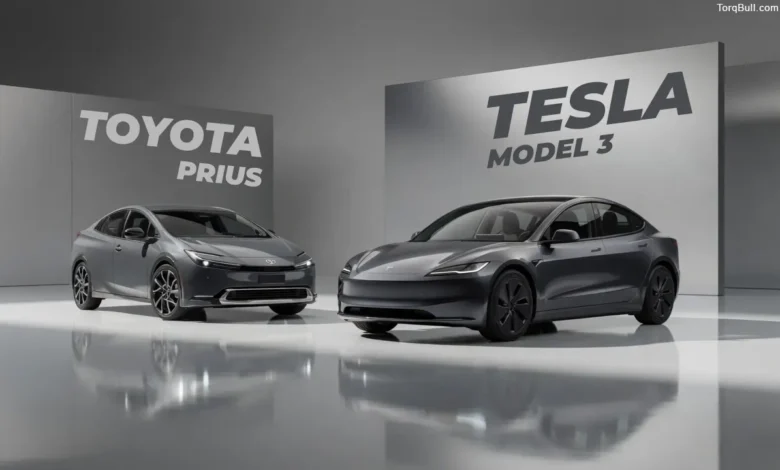
- Toyota Prius: 57 MPG and 600+ mile range
- Tesla Model 3: 137 MPGe and quick acceleration
- Hybrid vs EV efficiency and performance comparison
- No charging vs full electric ownership experience
- Cost, practicality and daily usability differences
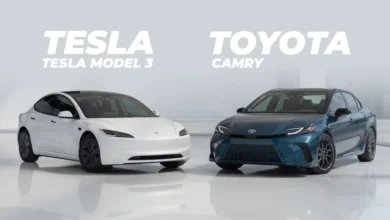
Tesla Model 3 vs Toyota Prius: The comparison between the Toyota Prius and the Tesla Model 3 is, on the surface, a comparison between two very different philosophies of personal transportation. The Prius is a hybrid — a gasoline engine and electric motor working in concert, filling a tank in four minutes at any of 150,000 American fuel stations, requiring no charging infrastructure, no planning around range and no change to a driver’s existing routine. The Tesla Model 3 is a fully electric vehicle — no combustion engine, no fuel costs, no oil changes, zero tailpipe emissions and performance that embarrasses sports cars costing three times as much. Yet InsideEVs notes that more new EV owners come from Toyota than from any other brand — meaning the Prius and Model 3 are cross-shopped by real buyers more often than their mechanical differences suggest. Both are compact sedans, both prioritise efficiency over driving drama on the surface, and both represent the most evolved version of their respective powertrains available to American buyers in 2026. This guide compares them across every dimension that matters to a real purchase decision.
Price and Value: A Significant Gap at Every Trim Level
The price comparison between the Toyota Prius and Tesla Model 3 begins with a gap that shapes every subsequent financial calculation in the comparison. TrueCar data confirms the standard Toyota Prius starts at $29,745 in 2026 — making it the more affordable vehicle by $8,635 at the base level against the Tesla Model 3’s $38,380 starting price. The Toyota Prius Prime plug-in hybrid variant starts at $33,775, narrowing the gap to $4,605 versus the base Model 3 but adding 44 miles of electric-only range to the Prius’s already impressive efficiency credentials.
The Tesla Model 3’s pricing extends upward through Long Range and Performance configurations. The Performance trim — capable of 0-60 in 3.1 seconds — exceeds $55,000, placing it in an entirely different market segment from any Prius configuration. The base Model 3 at $38,380 competes most directly with the top-end Prius Limited at approximately $35,000 or the Prius Prime XSE Premium at the upper end of the Prius Prime range.
The value equation shifts when total ownership cost replaces sticker price as the comparison metric. The Tesla Model 3 eliminates fuel costs, replaces them with electricity costs typically 40 to 60 percent lower per mile than gasoline, requires no oil changes, no exhaust system maintenance and no spark plugs. The Toyota Prius requires conventional hybrid maintenance — oil changes, coolant service, periodic inspection — at lower intervals and costs than a non-hybrid gasoline vehicle, but higher than a pure EV. Over a five-year, 75,000-mile ownership period, the Model 3’s running cost advantage partially offsets its purchase price premium — though the exact break-even depends on local electricity rates, gasoline prices and annual mileage.
Fuel Economy and Running Costs: Hybrid vs Electric Efficiency
The fuel economy comparison between the Prius and Model 3 requires understanding that the two vehicles measure efficiency on different scales — miles per gallon for the hybrid and miles per gallon equivalent for the electric vehicle — but the underlying financial comparison is straightforward when reduced to cost per mile.
The Toyota Prius base engine produces 194 horsepower and achieves 57 MPG combined — the highest combined fuel economy rating of any non-plug-in vehicle in the American market in 2026. At 15,000 annual miles and $3.32 per gallon, the Prius costs approximately $873 per year in fuel. The Toyota Prius Prime plug-in variant returns 127 MPGe when operating on a charged battery and 52 MPG when the battery is depleted, with 44 miles of electric-only range covering the majority of daily American commuting on electricity alone.
The Tesla Model 3’s base engine makes 425 horsepower and achieves approximately 137 MPGe combined — a figure that, translated to electricity cost at a national average residential rate of approximately $0.16 per kilowatt-hour, produces an annual energy cost of approximately $550 to $650 for 15,000 miles of driving charged at home. The Model 3’s annual energy cost advantage over the Prius is real but modest — approximately $220 to $320 per year — because the Prius’s 57 MPG is already so efficient that the cost-per-mile gap between a highly efficient hybrid and an electric vehicle is narrower than it is between an EV and an average gasoline car.
Range and Charging: The Fundamental Lifestyle Difference
The range and infrastructure comparison is where the Prius and Model 3 most fundamentally diverge — not just in numbers but in the daily experience of ownership.
The Toyota Prius carries a standard 11.3-gallon fuel tank that, at 57 MPG combined, delivers a theoretical maximum range of approximately 644 miles per fill. In real-world driving, the practical range exceeds 580 miles between fuel stops. The Prius Prime’s total range reaches approximately 600 miles combining its 44-mile electric range with hybrid gasoline operation. Refuelling takes four minutes at any of approximately 150,000 American fuel stations — a universally available, time-efficient process that requires no pre-planning, no range calculation and no change to the driver’s existing habits.
The Tesla Model 3 offers a maximum range of 363 miles in its Long Range configuration. The base Standard Range Model 3 is EPA-rated at approximately 272 miles. Tesla’s Supercharger network — approximately 2,000 stations across the United States — provides fast charging at rates that add 150 to 200 miles of range in approximately 25 to 30 minutes. Home charging on a Level 2 charger fully replenishes the Model 3 overnight. For buyers who charge at home and drive fewer than 200 miles daily, the Model 3’s range is practically unlimited — because the battery replenishes while the owner sleeps. For buyers who regularly make long-distance trips or lack home charging access, the Prius’s 600-mile gasoline range and four-minute fill time is a substantive lifestyle advantage.
Performance: Electric Acceleration vs Hybrid Refinement
The performance gap between the Tesla Model 3 and the Toyota Prius is one of the largest between any two vehicles nominally competing in the same compact sedan segment. The Prius’s 57 MPG hybrid system prioritises efficiency above all — its 194 horsepower delivers adequate but unexciting acceleration, with 0-60 times in the eight-second range depending on configuration. The driving experience is smooth, quiet and refined, with Toyota’s fifth-generation hybrid system managing the transition between electric and gasoline operation seamlessly and imperceptibly.
The Tesla Model 3 Performance trim can rocket from zero to 60 mph in less than three seconds — a figure that places it among the fastest accelerating production cars available at any price, competing with vehicles costing four to five times as much. Even the base Model 3 reaches 60 mph in approximately 5.8 seconds — significantly quicker than the Prius at any trim level. The Model 3’s instant torque delivery, characteristic of all electric motors, transforms everyday driving — highway merges, passing manoeuvres and urban acceleration feel effortless in a way that the Prius’s efficiency-optimised powertrain cannot replicate. For buyers who enjoy driving beyond basic transportation, the Model 3’s performance advantage is substantial and immediate.
Read: Tesla Model 3 Real-World Range at 75 MPH. Road Trip Planning Numbers You Actually Need
Technology and Interior: Minimalism vs Convention
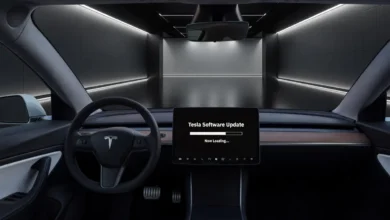
The technology and interior comparison reveals a philosophical divide as pronounced as the powertrain difference. The Tesla Model 3 has a minimalist interior design that is highly appealing to tech enthusiasts — a single 15.4-inch central touchscreen controls virtually every vehicle function from climate to mirrors to driving modes, supported by Tesla’s over-the-air software update capability that regularly adds features and improvements across the fleet. Tesla Autopilot — a suite of driver assistance features including adaptive cruise control, automatic lane keeping and automated lane changes — is standard on every Model 3. Notably, the Model 3 does not offer Apple CarPlay or Android Auto, a meaningful limitation for buyers whose smartphone ecosystem is central to their daily driving experience.
The Toyota Prius includes an 8-inch touchscreen standard, with a 12.3-inch screen available on higher trims, and full Apple CarPlay, Android Auto and Amazon Alexa compatibility. Toyota Safety Sense 3.0 — Toyota’s comprehensive driver assistance suite including adaptive cruise control, lane departure alert and automatic emergency braking — is standard across the Prius lineup. The Prius’s interior follows conventional automotive design logic with physical climate controls, a familiar switchgear layout and a heated steering wheel on upper trims. For buyers who value smartphone integration and conventional infotainment logic over Tesla’s screen-centric approach, the Prius’s technology offering is more familiar and arguably more intuitive for daily use.
Read: How Smart Is the Changan Deepal S05 Compared to Tesla and BYD?
Depreciation and Resale Value: Prius Holds Its Value Far Better
The Tesla Model 3 loses 57 percent of its value over five years and the Toyota Prius loses 35.6 percent of its value. This means the Toyota Prius retains 21.4 percentage points more of its value. On a $38,380 Model 3 purchase, the 57 percent five-year depreciation represents a loss of approximately $21,877 — compared to approximately $10,589 on a $29,745 Prius at 35.6 percent. The Prius’s depreciation advantage of approximately $11,288 over five years is the single largest financial difference between the two vehicles in total ownership cost — larger than the fuel savings, larger than the maintenance cost difference and larger than the purchase price gap when compared on a total cost of ownership basis.
The Model 3’s high depreciation reflects a combination of rapid technology evolution — each new Model 3 generation makes earlier versions feel dated — and the competitive pressure from an expanding EV field that has given used Model 3 buyers alternatives unavailable three years ago. The Prius’s exceptional resale value reflects its established reliability record, its broad appeal across buyer demographics and the simple fact that hybrid technology has been sufficiently proven and stable that a five-year-old Prius carries no meaningful technology obsolescence risk in the used market.
Read: 2026 Toyota Prius Review: The Evolution of the World’s Most Famous Hybrid
Tesla Model 3 vs Toyota Prius 2026 — Complete Comparison Chart
| Category | Toyota Prius | Toyota Prius Prime | Tesla Model 3 (Base) | Tesla Model 3 (Long Range) |
| Starting Price | $29,745 | $33,775 | $38,380 | ~$47,000 |
| Powertrain | Hybrid (gas + electric) | Plug-in Hybrid | Fully Electric | Fully Electric |
| Fuel Economy | 57 MPG combined | 127 MPGe / 52 MPG depleted | 137 MPGe | 131 MPGe |
| Total Range | ~600+ miles | ~600 miles (hybrid) | ~272 miles | ~363 miles |
| EV-Only Range | Minimal | 44 miles | 272 miles | 363 miles |
| System Power | 194 hp | 220 hp | 283 hp (RWD) | 346 hp (AWD) |
| 0-60 mph | ~8.0 sec | ~6.6 sec | ~5.8 sec | ~4.2 sec |
| Charging Time | N/A (4 min fuel stop) | 4 hrs (L2) / 11 hrs (120V) | ~8 hrs (L2 home) / 25 min (Supercharger) | ~10 hrs (L2) / 30 min (Supercharger) |
| Apple CarPlay | Yes (standard) | Yes (standard) | No | No |
| 5-Year Depreciation | ~35.6% | ~33% est. | ~57% | ~55% est. |
| NHTSA Safety Rating | 5 Stars | 5 Stars | 5 Stars | 5 Stars |
| Annual Fuel Cost (15K mi) | ~$873 | ~$400 est. | ~$550–$650 (home charging) | ~$600–$700 (home charging) |
| Oil Changes Required | Yes | Yes | No | No |
Which Car Should You Buy?
The decision between the Tesla Model 3 and the Toyota Prius is ultimately a decision about lifestyle, infrastructure and priorities — and both cars are genuinely excellent within their respective design philosophies.
The Toyota Prius is the correct choice for buyers who prioritise the lowest purchase price, the lowest five-year depreciation, unlimited range confidence without any charging infrastructure investment, Apple CarPlay connectivity and the ownership simplicity of a vehicle whose maintenance routine differs minimally from any other gasoline car. Its 57 MPG is extraordinary, its reliability record is industry-leading and its total cost of ownership over five years is competitive with or superior to the Model 3 for most buyer profiles when depreciation is included in the calculation.
The Tesla Model 3 is the correct choice for buyers who charge at home, commute within its range capability on most days, want zero tailpipe emissions, value performance acceleration as a daily driving pleasure and are comfortable with the technology-first ownership experience that Tesla’s screen-centric approach requires. Its running costs are marginally lower, its performance is dramatically superior and its technology is genuinely more advanced — at the cost of a higher purchase price, significantly steeper depreciation and permanent charging infrastructure dependency.
Both cars represent the best available expression of their powertrain technologies in 2026. The choice between them is not a choice between a good car and a better one — it is a choice between two compelling but fundamentally different answers to the same question of how a modern car should move its owner through the world.