Respect the Machine! Kawasaki’s 5 Fastest Motorcycles Only Experts Should Ride

- Supercharged inline-four engines producing up to 310 horsepower
- Carbon fibre bodywork inspired by World Superbike development
- Advanced electronic rider aids paired with raw rider demand
- Machines that require high skill and precision to master
- Among the most extreme and rewarding Kawasaki motorcycles ever built
Kawasaki has built its performance motorcycle reputation on a foundation of engineering extremity — a manufacturer whose willingness to produce machinery whose capability genuinely exceeds the skill level of the average rider reflects a specific philosophy about what a performance motorcycle should be. Where competitors increasingly mediate the relationship between rider and performance through electronic systems whose primary function is protection from the machine’s capability, Kawasaki’s most extreme offerings use electronics as a foundation rather than a substitute — systems that expand the accessible performance envelope for skilled riders while making no pretence that their sophistication removes the skill requirement that operating the hardware at its limit demands.
The five motorcycles on this list are not dangerous in the careless sense that poor engineering creates danger — they are demanding in the honest sense that genuine performance machinery demands genuine skill. Each represents Kawasaki’s engineering at its most ambitious, most technically sophisticated and most uncompromising. Each rewards the expert rider with an experience whose intensity, precision and mechanical involvement no mainstream motorcycle can replicate. And each will, in the hands of a rider whose skill level does not match its capability, reveal the consequences of the mismatch with the immediacy that 200-plus horsepower and chassis dynamics calibrated for expert use produce without diplomatic mediation.
1. Kawasaki Ninja H2R: 310 Horsepower of Supercharged Fury
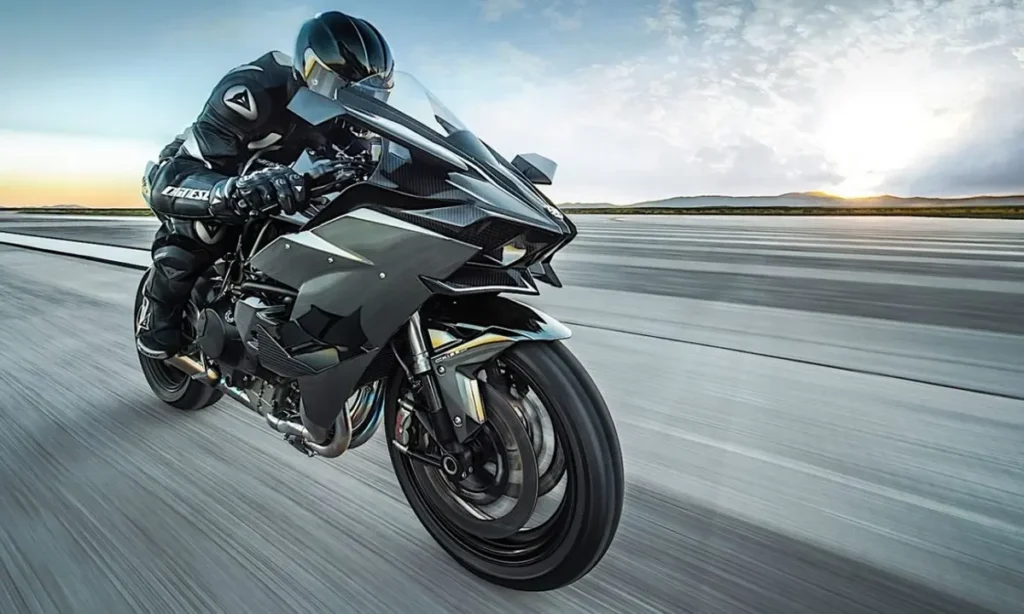
The Kawasaki Ninja H2R is not a road-legal motorcycle — a specification decision whose practical implication is that the machine’s 310-horsepower supercharged 998cc inline-four engine, whose capability was calibrated without the regulatory constraints that road-legal alternatives must accommodate, represents the most extreme performance output that Kawasaki’s engineering team has ever applied to a production motorcycle.
The H2R’s centrifugal supercharger — developed in collaboration with Kawasaki’s gas turbine engineering division whose aerospace experience provided the aerodynamic knowledge that the impeller’s efficiency requires — produces boost pressure that raises the inline-four’s effective displacement well beyond its 998cc physical measurement, enabling the 310-horsepower output at 14,000 rpm whose real-world consequence at a closed circuit is a top speed in excess of 400 kilometres per hour under appropriate conditions.
The chassis engineering that manages 310 horsepower requires a structural precision whose achievement reflects Kawasaki’s racing program investment — a trellis frame whose flex characteristics were engineered to specific values, aerodynamic winglets whose downforce contribution at extreme speeds maintains front wheel contact with the surface without which steering authority becomes theoretical rather than actual and the Kawasaki Electronic Control system’s full suite of traction control, launch control and engine braking management whose calibration assumes the rider possesses the physical responses and situational awareness that 300-plus kilometres per hour demands as baseline competencies.
The H2R is the benchmark — the machine against which every other Kawasaki performance motorcycle’s capability is measured and found moderate. Its position at the top of this list reflects the engineering reality that 310 horsepower on a track without the amateur rider’s presence is the only appropriate context for genuine engagement with its full capability.
2. Kawasaki Ninja H2: The Road-Legal Supercharged Benchmark
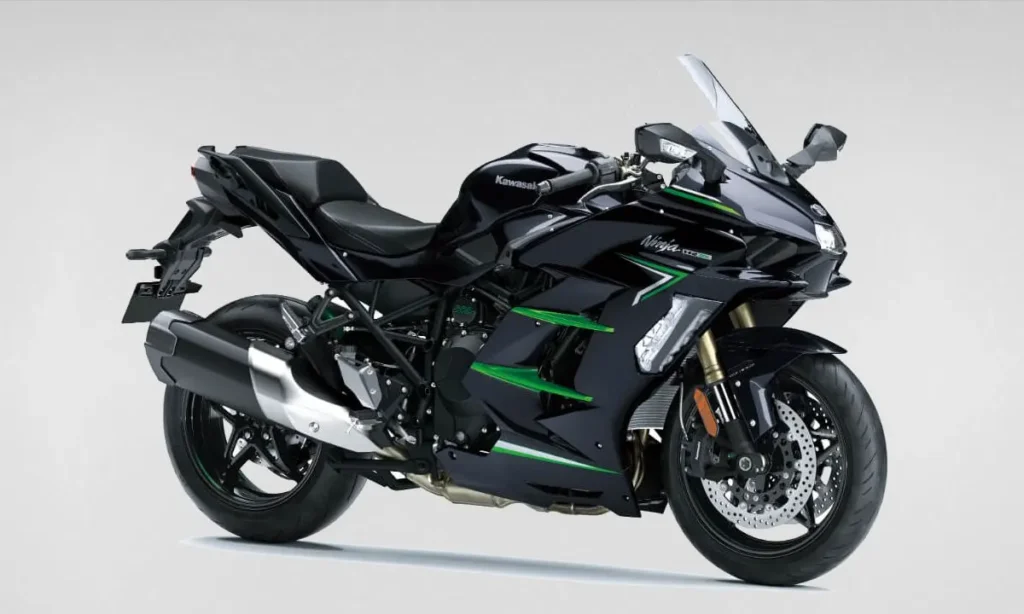
The Kawasaki Ninja H2 translates the H2R’s supercharged architecture into a road-legal package whose 231-horsepower output — reduced from the track-only variant’s 310 horsepower through the emission certification and noise regulation compliance that road legality requires — remains the most powerful road-legal production motorcycle engine that any mainstream manufacturer has produced in the supercharged category.
The H2’s power delivery character — whose supercharger’s boost pressure curve produces a specific sensation of continuous, building force rather than the turbocharged unit’s threshold surge — creates a performance character that experienced riders describe as simultaneously more manageable and more intense than the peak power figure alone suggests. More manageable because the supercharger’s progressive boost delivery provides earlier warning of the power approaching than the turbocharger’s sudden surge allows. More intense because the absence of the warning period that the turbocharger’s lag creates means the supercharged power arrives before the rider has completed the instinctive preparation that a fraction of additional time would enable.
The H2’s road use context adds the specific demands that public infrastructure imposes on extreme performance management — the unpredictability of other road users, the surface quality variation that no circuit presents and the cognitive load of traffic, navigation and legal compliance alongside the mechanical demands of managing 231 horsepower on a machine whose chassis was calibrated for the rider who approaches its performance consistently and deliberately rather than occasionally and reactively.
3. Kawasaki ZX-10RR: The World Superbike Homologation Special
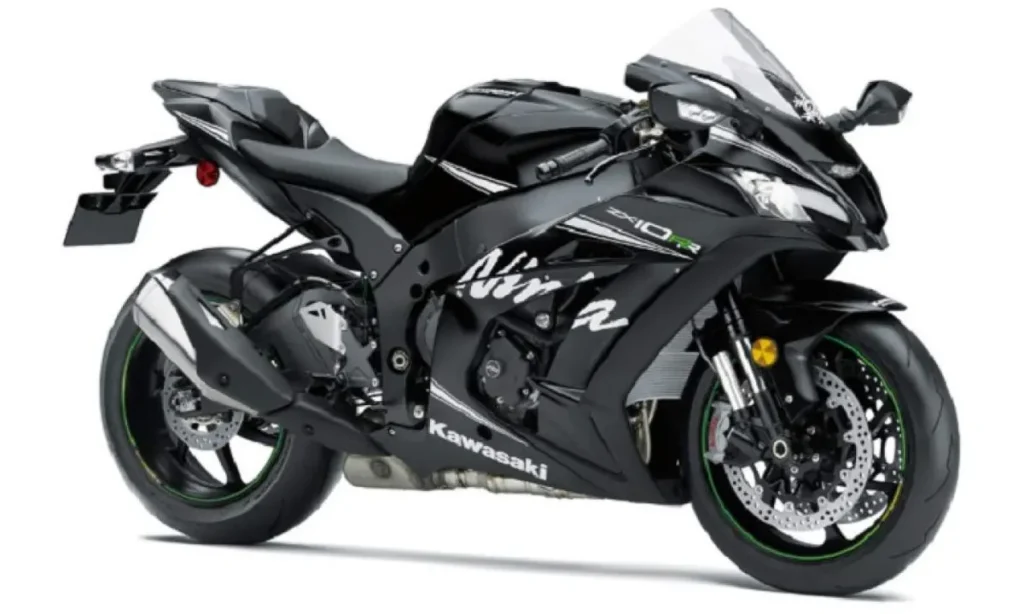
The Kawasaki ZX-10RR — whose RR designation identifies the homologation special produced in minimum numbers to satisfy World Superbike Championship regulations requiring production-based components in factory racing machinery — represents Kawasaki’s most directly racing-derived road-legal motorcycle whose specification reflects the engineering decisions made in the pursuit of World Superbike Championship victories rather than road-use comfort or broad rider accessibility.
The ZX-10RR’s 210-horsepower inline-four engine — whose titanium connecting rods, high-compression pistons and close-ratio gearbox ratios reflect the racing application’s specific requirements — produces its power through a delivery character that the racing-derived components’ tight tolerances and aggressive calibration make more demanding of precise throttle management than the standard ZX-10R’s more accessible power curve. The chassis geometry — whose rake, trail and swingarm pivot position were set to WorldSBK team specifications rather than the road-use compromise that standard superbike geometry represents — provides the corner-entry precision and mid-corner stability that Kawasaki’s factory racers require at race speeds whose management the geometry optimises at the cost of the stability margin that the rider operating below race pace expects as a safety buffer.
4. Kawasaki Z H2: Naked Supercharged Aggression
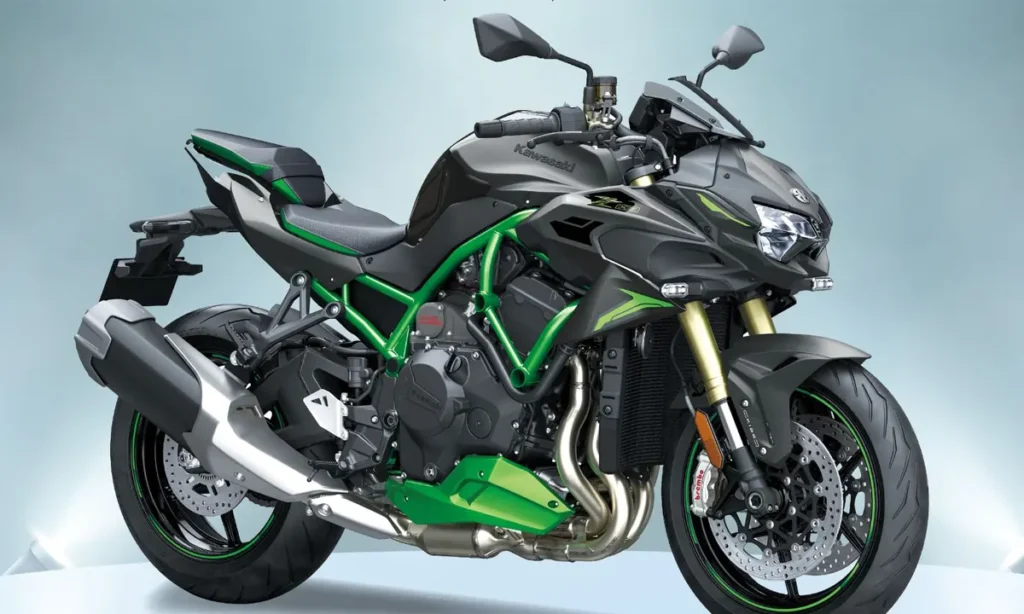
The Kawasaki Z H2 applies the supercharged inline-four’s 200 horsepower to a naked motorcycle format — removing the aerodynamic protection that the Ninja H2’s full fairing provides at high speeds and exposing the rider to the wind forces that supercharged performance at sustained velocity generates without the windscreen’s buffering. The practical consequence of this packaging decision is a motorcycle whose performance capability is indistinguishable from the Ninja H2’s equivalent speed range but whose physical demands at those speeds are substantially greater — the rider’s body managing wind forces that the faired alternative’s aerodynamic efficiency redirects without the rider’s involvement.
The Z H2’s naked format also exposes the rider’s inputs — steering corrections, weight shifts, throttle management — to the motorcycle’s chassis more directly than the faired alternative’s geometry, whose slightly different mass distribution produces marginally different sensitivity to rider input. This directness rewards the expert rider with a communication quality that the faired alternative’s slightly more filtered feedback cannot match — providing the chassis information whose granularity the skilled rider uses to manage the supercharged power with the precision that 200 horsepower on a naked motorcycle demands.
5. Kawasaki ZX-6R: The 636cc Track Weapon That Punishes Imprecision
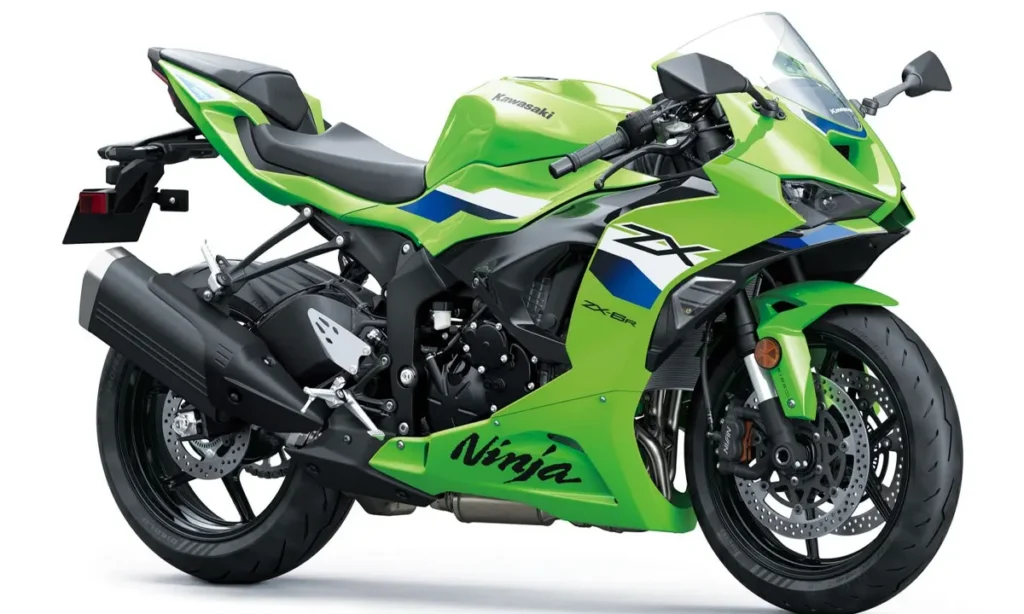
The Kawasaki ZX-6R’s position on a list of expert-only motorcycles alongside machines producing 200-plus horsepower reflects a performance characteristic whose danger is different in kind from the pure power that the other entries represent — the specific challenge of a supersport motorcycle whose 636cc inline-four engine’s 130 horsepower, narrow powerband and chassis calibrated for track use rather than road forgiveness demands the continuous, precise management that motorcycles with broader power curves and more road-oriented geometry do not require with equivalent consistency.
The ZX-6R’s 130 horsepower demands precise management in its upper rev range — the 10,500 to 14,000 rpm band where the inline-four’s power builds rapidly toward its peak — because the power delivery’s concentration in this narrow window requires the rider to maintain engine speed within the effective band through gear selection whose timing precision a broader powerband’s forgiveness does not demand. Below the power band, the ZX-6R is manageable — a characteristic that makes its transition into the power band’s abrupt arrival the specific moment whose management the expert rider’s throttle precision handles and the developing rider’s less calibrated response can mismanage with consequences that the chassis’s track-focused geometry amplifies rather than dampens.
Read: Forty Years of Dominance. The Suzuki GSX-R1000 The Superbike That Changed Everything
Kawasaki’s 5 Fastest Motorcycles Specification Comparison
| Model | Engine | Power Output | Top Speed | Legal Status | Skill Level Required |
| Ninja H2R | 998cc SC Inline-Four | 310 hp | 400+ km/h | Track Only | Elite / Professional |
| Ninja H2 | 998cc SC Inline-Four | 231 hp | ~340 km/h | Road Legal | Expert |
| ZX-10RR | 998cc Inline-Four | 210 hp | ~299 km/h | Road Legal | Expert / Advanced |
| Z H2 | 998cc SC Inline-Four | 200 hp | ~320 km/h | Road Legal | Expert |
| ZX-6R | 636cc Inline-Four | 130 hp | ~260 km/h | Road Legal | Advanced / Expert |


2 Comments