Faster Than Almost Everything. Suzuki Hayabusa Top Speed Tested. How Fast Is Too Fast?
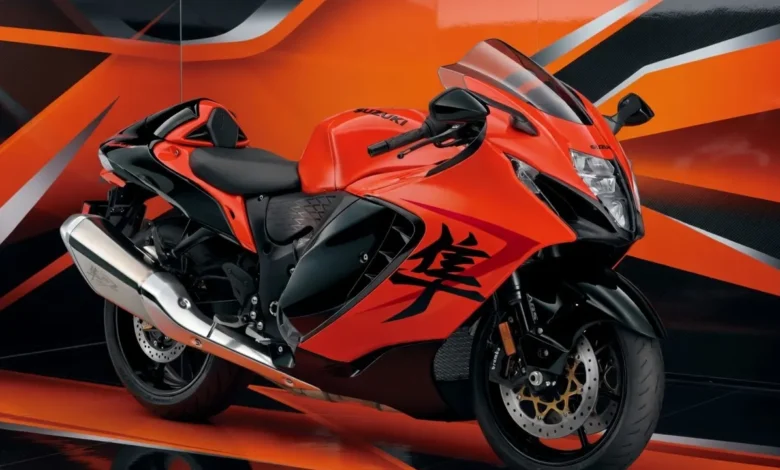
- 186 mph electronically limited top speed benchmark
- 1,340cc inline-four with refined high-performance engineering
- Highly optimized aerodynamic body developed over generations
- Iconic status in global high-speed motorcycle discussions
- Real-world experience defined by extreme speed and stability
There are motorcycles that are fast and there is the Suzuki Hayabusa — a machine whose relationship with velocity is so thoroughly considered, so completely engineered and so culturally embedded in the global motorcycling consciousness that the word fast feels inadequate as a descriptor for what it represents. The Hayabusa is not merely fast. It is the motorcycle that defined a specific category of speed — the category whose upper boundary the gentlemen’s agreement between major motorcycle manufacturers established at 300 kilometres per hour in response to the original Hayabusa’s 1999 introduction, whose 312 kilometres per hour unrestricted capability so alarmed European legislators that voluntary limitation became the industry’s preferred alternative to mandatory regulation.
That the Hayabusa’s name translates from Japanese as Peregrine Falcon — the bird whose 320 kilometres per hour hunting dive makes it the fastest animal on Earth — was either a coincidence of extraordinary appropriateness or a deliberate choice whose prescience in describing the motorcycle’s actual capability reflects engineering intent communicated through nomenclature. Understanding what the Hayabusa’s top speed actually means — what it feels like, what it requires from the rider who approaches it and whether any road context makes it relevant beyond the theoretical — requires an honest examination that the motorcycle’s cultural mythology has historically made more difficult to conduct than the question deserves.
The 186 mph Question: What the Electronic Limiter Does and Does Not Mean
The current third-generation Suzuki Hayabusa’s electronically limited top speed of 186 miles per hour — 299 kilometres per hour, positioned precisely at the gentlemen’s agreement boundary — is simultaneously the most and least important specification in the motorcycle’s character description. Most important because it establishes the Hayabusa as a motorcycle whose velocity ceiling exceeds the capability of every public road in every jurisdiction on Earth to accommodate safely. Least important because the electronic limiter’s presence means that the Hayabusa’s true aerodynamic and mechanical top speed capability remains unrealised in any standard production specification.
The unrestricted top speed that the third-generation Hayabusa’s 1,340cc inline-four engine and its carefully developed aerodynamic body would achieve without the electronic limiter’s intervention has been the subject of considerable speculation within the motorcycling community — with estimates ranging from 210 to 215 miles per hour based on the engine’s power output, the aerodynamic drag coefficient that the body’s wind tunnel development produced and the gearing whose final drive ratio the manufacturer selected. Whether these estimates are accurate is ultimately irrelevant to any legal riding context — but the knowledge that the limiter is the constraint rather than the engine or the aerodynamics adds a dimension to the Hayabusa’s character that its riders carry consciously.
The Engine: 1,340cc of Refined Intent
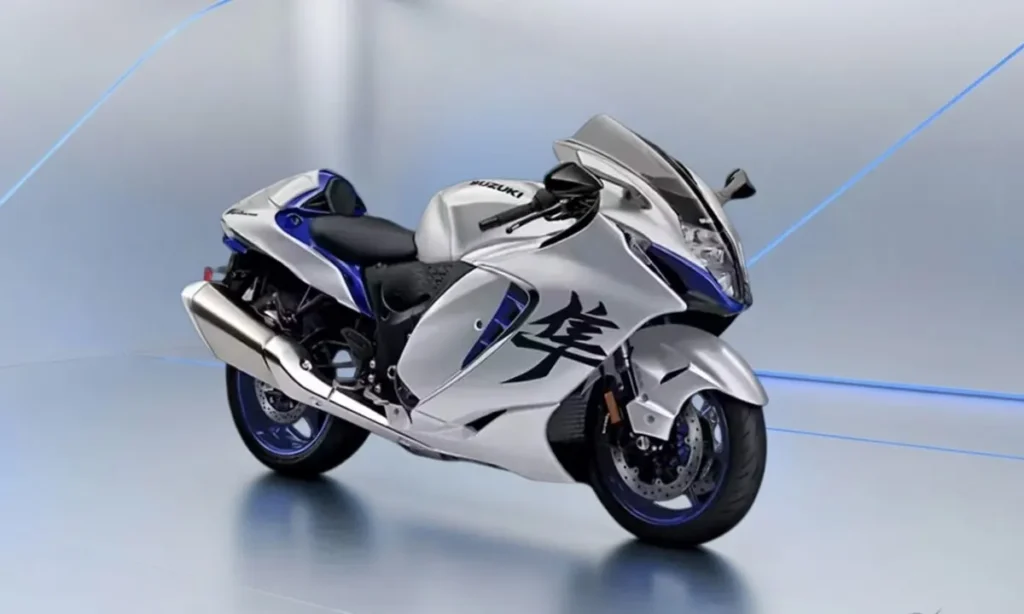
The Hayabusa’s 1,340cc inline-four engine — producing 190 horsepower at 9,700 rpm and 150 Newton-metres of torque at 7,000 rpm in the current specification — achieves its performance through a refinement philosophy rather than the extreme tuning approach that smaller displacement engines require to reach comparable output figures. The displacement strategy — using cubic centimetres to produce power rather than revving a smaller engine beyond its comfortable operating range — produces a power delivery character whose smoothness, tractability and mechanical integrity differ fundamentally from the high-strung character of more aggressively tuned smaller displacement alternatives.
The bore and stroke dimensions — 81mm bore, 65mm stroke — reflect a mildly oversquare configuration whose combination of adequate bore for breathing efficiency and sufficient stroke for torque production creates the specific character that the Hayabusa’s broad power curve delivers. The engine reaches its peak power at 9,700 rpm — accessible but not extreme by inline-four standards — and produces its peak torque at 7,000 rpm, a figure that reflects the engine’s genuine mid-range strength rather than a top-end power character whose exploitation requires constant high-rev riding.
The third-generation’s 190 horsepower represents a modest increase over the second generation’s 197 horsepower — a reduction that reflects the stricter Euro 5 emissions compliance requirements rather than any performance aspiration retreat, and whose real-world significance at the speeds where the Hayabusa operates is imperceptible to any rider whose sensitivity to 7-horsepower differences at 150-plus miles per hour is more theoretical than practical.
The Aerodynamics: Engineering Beauty as Speed Science
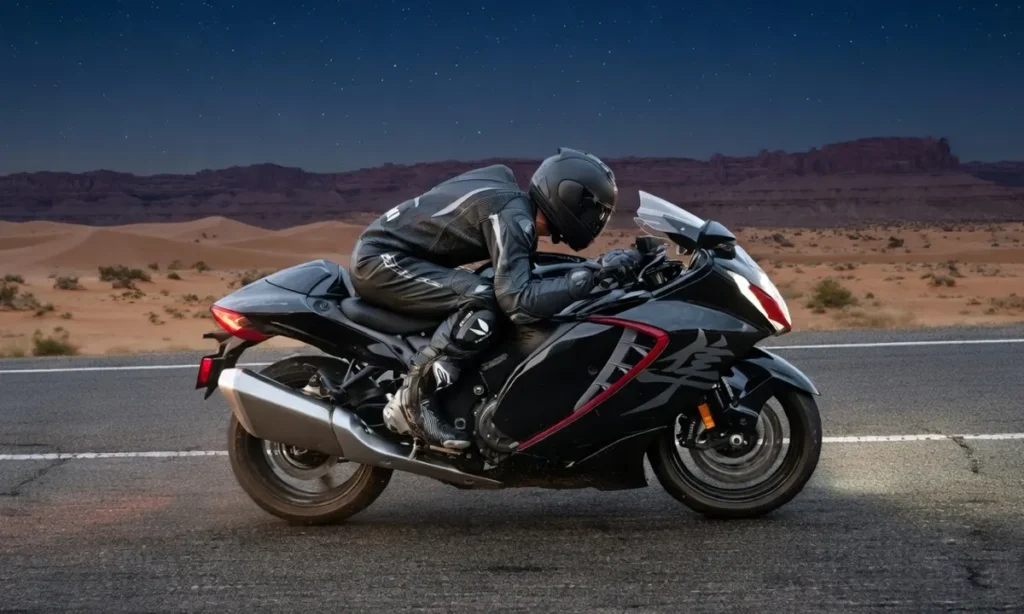
The Hayabusa’s distinctive body — whose organic, teardrop-influenced silhouette has been maintained across three generations with evolutionary rather than revolutionary changes — is not a styling exercise whose aerodynamic consequences were managed after the design was established. It is an aerodynamic solution whose visual character is the direct expression of wind tunnel optimisation whose priority has been consistent across every generation: minimise drag at the speeds where the Hayabusa operates while maintaining the downforce that high-speed stability demands.
The drag coefficient that Suzuki’s wind tunnel testing produced for the current Hayabusa body — not publicly disclosed with precision but estimated by independent aerodynamic analysis at approximately 0.37 Cd for the complete motorcycle-and-rider system — represents the most thoroughly optimised aerodynamic package applied to any production motorcycle whose primary design brief was road use rather than circuit racing. The fairing’s integration of the rider’s body into the aerodynamic profile — with the seat and tank dimensions calculated to place the rider in a position whose contribution to the overall aerodynamic package is minimised rather than merely accommodated — reflects the total system approach to aerodynamic development that circuit racing applies at considerable cost and that the Hayabusa applies to a motorcycle whose public road top speed makes the investment genuinely relevant.
What 186 mph Actually Feels Like: The Honest Account
The experiential reality of approaching the Hayabusa’s electronically limited top speed — on the closed-road or private facility contexts where the motorcycle’s full velocity can be legally and safely explored — is described by the riders whose documented accounts provide the most credible available evidence with a consistency whose specific details are worth examining rather than summarising.
The acceleration through the upper speed range — from 150 miles per hour toward the 186-mile-per-hour limiter — is experienced not as the dramatic, violent surge that lower-speed acceleration delivers but as a relentless, sustained push whose force is less immediately dramatic and whose duration before the limiter intervenes is shorter than the experience’s intensity suggests. The wind force at 186 miles per hour imposes loads on the rider’s body that require active resistance — the arms working against the aerodynamic force that attempts to remove the rider from contact with the motorcycle — and the concentration required to maintain the body position that the aerodynamic package’s optimisation assumes becomes the primary cognitive demand of the experience rather than the throttle management that lower-speed riding prioritises.
The distance that 186 miles per hour consumes — covering approximately 272 feet per second — transforms the perceptual environment fundamentally. Peripheral vision becomes irrelevant. Road surface changes arrive and pass before conscious processing completes. The horizon remains constant while everything between the rider and the horizon is consumed at a rate whose experiential quality is less exciting than the anticipation of it and more demanding than any prior riding experience prepares the rider to expect.
Read: The Lightest Panigale Ever Built. The 2025 Ducati Panigale V2 S Fully Explained
How Fast Is Too Fast? The Honest Answer
The question that the Hayabusa’s existence inevitably poses — how fast is too fast for a production motorcycle sold through normal commercial channels to buyers of varying experience levels — does not have an answer whose formulation the Hayabusa’s advocates and its critics agree on. What it has is an honest observation: the Hayabusa’s 186-mile-per-hour capability is too fast for every public road on Earth, relevant on a small number of private facilities whose surface quality and safety infrastructure accommodate the speeds at which the motorcycle operates at its limit and entirely irrelevant to the majority of Hayabusa owners whose actual riding never approaches the velocity whose pursuit the motorcycle’s engineering so completely serves.
The Hayabusa exists at the intersection of engineering aspiration and practical irrelevance — a motorcycle whose top speed exceeds what any legal riding context accommodates but whose pursuit required and produced engineering achievements whose benefits — the aerodynamic refinement, the engine character, the chassis stability at extreme speed — permeate the riding experience at every velocity below the limit that defines the machine’s identity.
How fast is too fast? On a public road, 186 miles per hour is too fast before the speedometer reaches it. On a closed circuit with appropriate safety infrastructure and a skilled rider whose experience matches the motorcycle’s capability — the Hayabusa’s top speed is precisely fast enough to justify the engineering that produces it.
Read: Ducati 1198 Review: The Last Pure Analog Superbike That Delivers Superbike Thrills on a Budget
Suzuki Hayabusa Full Specifications
| Category | Specification |
| Engine | 1,340cc DOHC Inline-Four |
| Power Output | 190 hp @ 9,700 rpm |
| Torque | 150 Nm @ 7,000 rpm |
| Compression Ratio | 12.5:1 |
| Bore x Stroke | 81mm x 65mm |
| Cooling | Liquid-Cooled |
| Transmission | 6-Speed |
| Clutch | Assist and Slipper |
| Electronic Limited Top Speed | 186 mph / 299 km/h |
| Estimated Unrestricted Speed | 210–215 mph (Est.) |
| 0–60 mph | Approx. 2.6 Seconds |
| 0–100 mph | Approx. 4.9 Seconds |
| Kerb Weight | 264 kg |
| Fuel Tank | 20 Litres |
| Riding Modes | A / B / C (Power Output) |
| Traction Control | 10-Level Suzuki Intelligent Ride System |
| ABS | Cornering ABS (Standard) |
| Launch Control | Standard |
| Wheelie Control | Standard |
| Frame | Twin-Spar Aluminium |
| Front Suspension | 43mm KYB Inverted Fork |
| Rear Suspension | Link-Type KYB Monoshock |
| Front Brake | 320mm Dual Disc — Tokico Radial |
| Generation | Third (2021–Present) |
| Starting MSRP (USA) | Approx. $18,599 |

3 Comments