Ferrari 12Cilindri Proves That Pure V12 Emotion Still Rules The Future of Performance
A Naturally Aspirated 819-Horsepower V12 Engine, Daytona-Inspired Design, Four-Wheel Steering and an All-New Aluminium Chassis Make the Ferrari 12Cilindri the Most Emotionally Compelling and Beautifully Engineered Front-Engined Ferrari in a Generation
There are moments in the history of automobile manufacturing when a single car manages to encapsulate everything a brand stands for — its heritage, its ambitions, its engineering philosophy, and its soul — within a single set of bodywork. The Ferrari 12Cilindri is precisely that car. Unveiled in Miami Beach on May 3, 2024, to coincide with the seventieth anniversary of Ferrari’s arrival in the American market, the 12Cilindri does not merely replace the 812 Superfast as the flagship front-engined Ferrari grand tourer. It redefines the entire concept of what a Ferrari V12 GT can and should be in the modern era — more refined, more resolved, more beautiful and more deeply rewarding to drive than anything that has carried the Prancing Horse badge on a front-engined platform in recent memory.
Gallery: Ferrari 12Cilindri
Named after the Italian word for twelve cylinders — pronounced “dodici cilindri” — the 12Cilindri wears its identity with absolute clarity and absolute pride. In an automotive world accelerating rapidly toward electrification and hybridization, Ferrari has produced a car that makes no apology for celebrating the naturally aspirated internal combustion engine in its most magnificent form. The 6.5-litre V12 at the heart of this machine represents the pinnacle of Ferrari’s F140 engine lineage — an evolution that traces its roots back to the legendary Enzo and has been progressively refined over two decades into one of the finest engines ever fitted to a production automobile. The 12Cilindri is offered in two distinct body styles: the Berlinetta coupe and the Spider convertible, both of which share the same mechanical architecture, design language and performance philosophy while offering meaningfully different open-road sensory experiences.
A Design That Bridges the Past and the Future
If the engineering of the Ferrari 12Cilindri speaks to the brand’s absolute commitment to mechanical excellence, the design of the car speaks to something even deeper — a cultural and emotional understanding of what makes a Ferrari transcend mere transport to become a genuine work of art. Ferrari Design Director Flavio Manzoni and the Ferrari Centro Stile team set out to radically transform the visual language of the brand’s previous front-engined V12 models, replacing the muscular aggression of the 812 series with a more precise, more geometric and ultimately more timeless aesthetic rooted in the minimalist principles of formal purity.
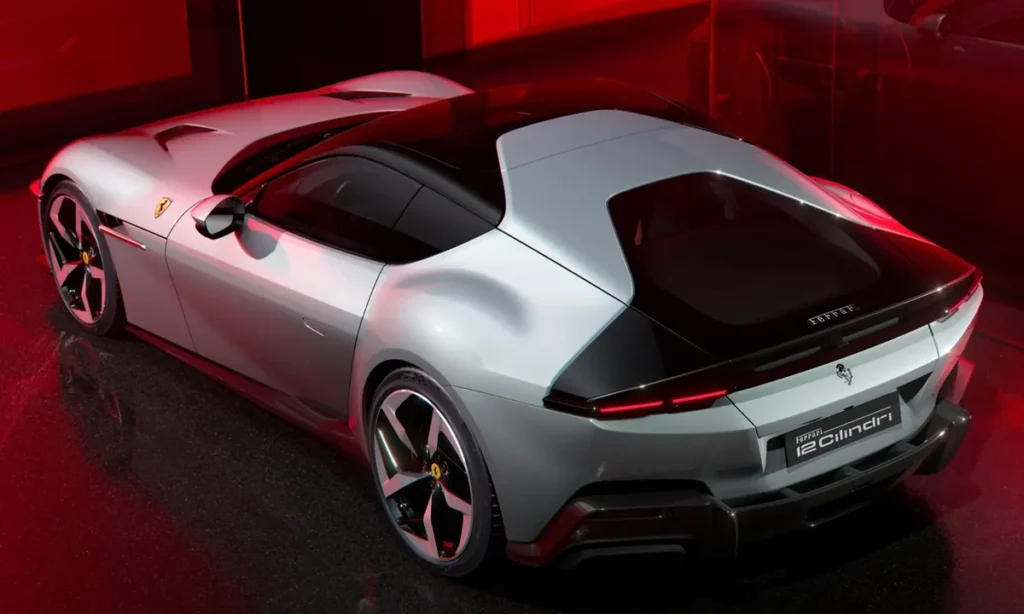
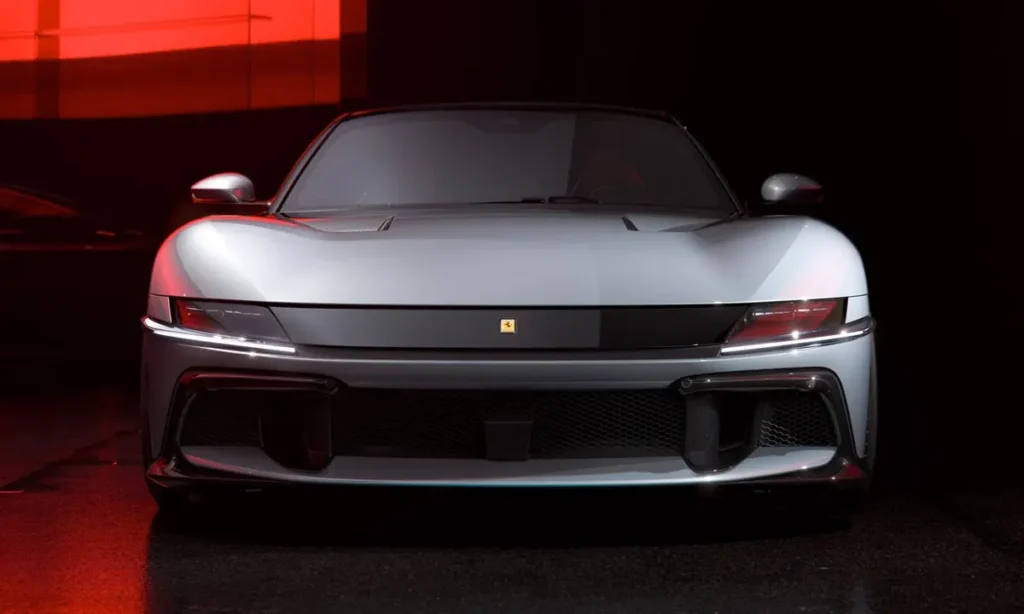
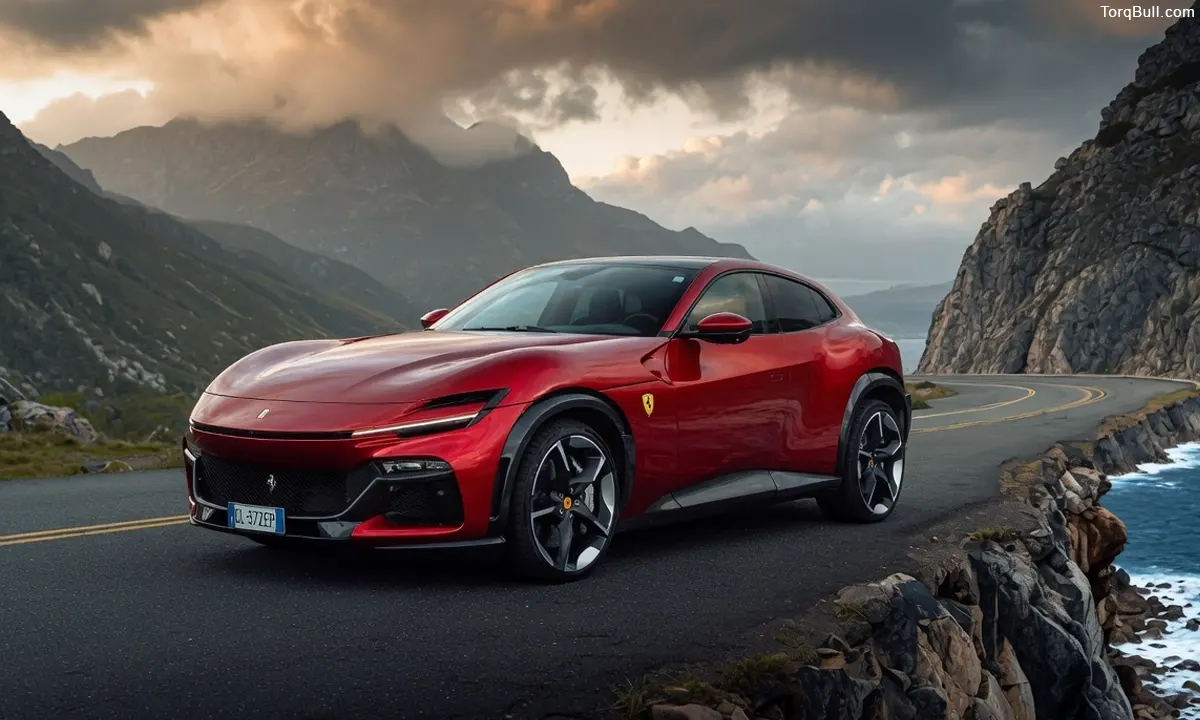
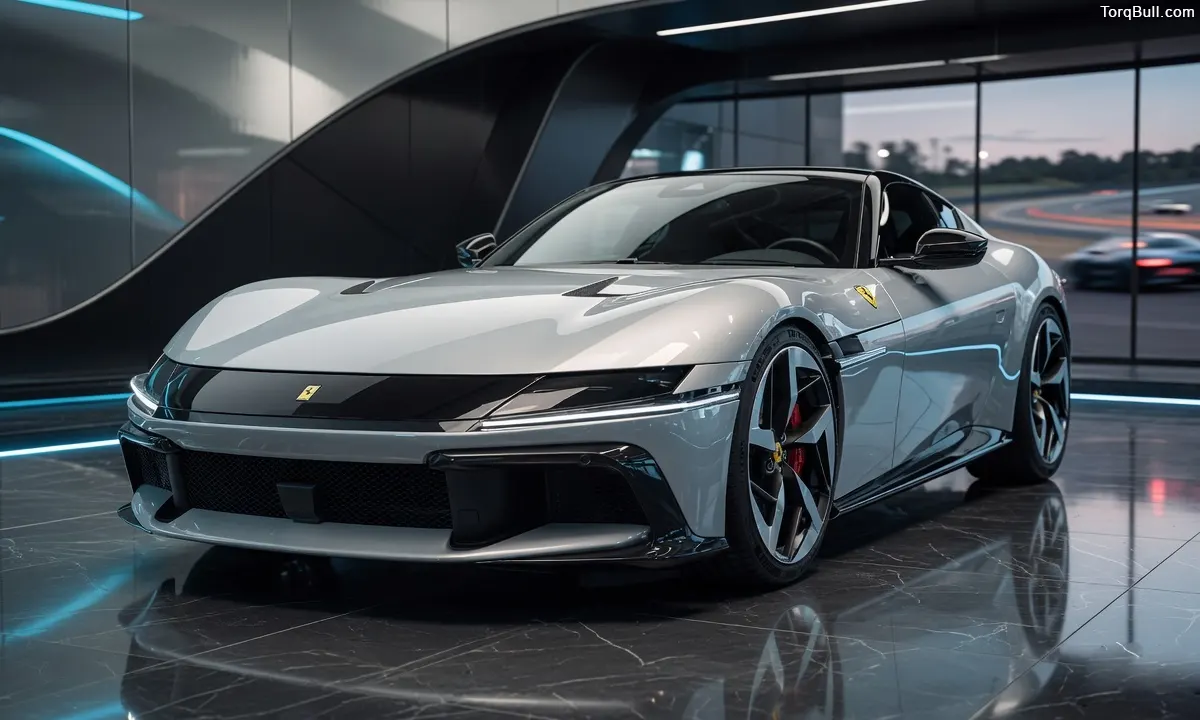
The 12Cilindri’s design is, at its most fundamental level, a tribute to the Ferrari 365 GTB/4 Daytona — widely considered one of the most beautiful automobiles ever produced and the definitive expression of the classic long-bonnet, short-tail grand tourer proportion. The black horizontal band across the nose, reminiscent of the full-width light panel that defined the Daytona’s face, is not a removable option or a customization feature — it is a permanent, structural element of the 12Cilindri’s identity, confirming the depth of the design’s homage. Yet where the Daytona was a product of its era’s formal language, the 12Cilindri projects those proportions into a sharper, more futuristic vocabulary that feels entirely contemporary rather than nostalgically retrospective.
The front fascia is dominated by a single blade-like LED headlight element set into a deeply recessed horizontal graphic, creating a light signature of extraordinary visual impact and technical precision. The bonnet is front-hinged — a deliberate design choice that exalts the presence and visibility of the V12 engine beneath and communicates the car’s mechanical priorities with absolute honesty. Ultra-clean flanks sweep rearward along the entire body from a dihedral section, uninterrupted by unnecessary surface decoration, allowing the purity of the compound curves and the quality of the light reflections they produce to communicate the craftsmanship of the body construction with quiet confidence.
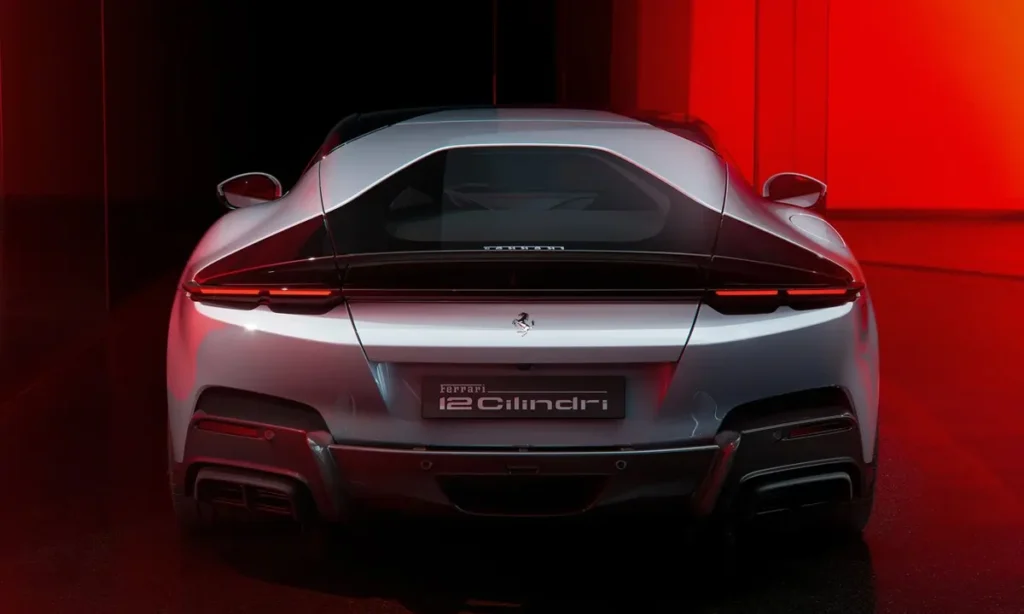
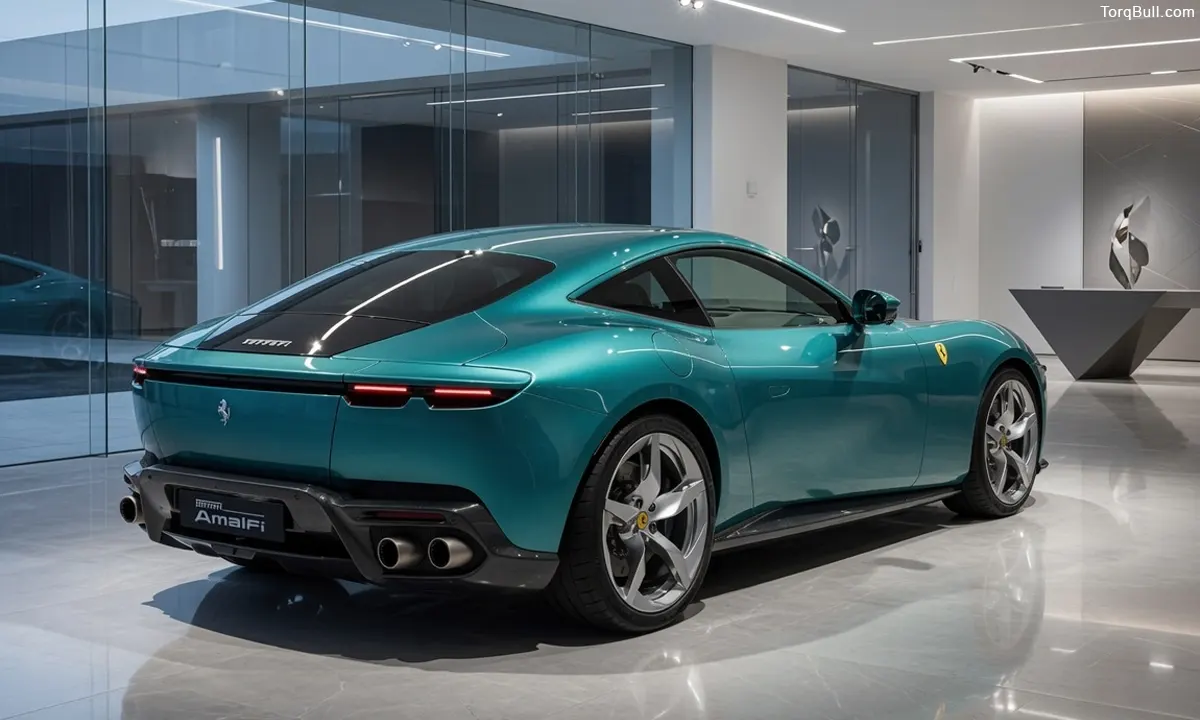
At the rear, the 12Cilindri deploys active aerodynamic elements integrated into the rear haunches in the form of two articulated flaps finished in black — a solution that generates up to 50 kilograms of negative lift at 155 mph while simultaneously serving as aerodynamic brakes, tilting up to ten degrees at speeds above approximately 38 mph to manage high-speed stability. The twin exhaust outlets, positioned centrally and finished with the characteristic cylindrical section associated with Ferrari’s V12 cars, provide a rear visual conclusion that is at once technically purposeful and emotionally arresting. The taillights span the full width of the rear in a single blade graphic, echoing the frontal light signature and ensuring that the 12Cilindri is as immediately recognizable from behind as it is from the front. Available in 21-inch wheel sizes front and rear, with tyre options of either Michelin Pilot Sport S5 or Goodyear Eagle F1 Supersport — the latter making its return to a Ferrari for the first time in thirty years — the 12Cilindri presents a visual totality that has earned it the prestigious Car Design Award from ADI in 2025.
The F140HD V12: An Engine That Demands Worship

No review of the Ferrari 12Cilindri can proceed without spending adequate time with the engine that gives the car its name, its character and, ultimately, its reason for existing. The F140HD is the latest and most refined iteration of Ferrari’s legendary V12 family — a 6,496cc, 65-degree naturally aspirated engine that traces its fundamental architecture back to the Enzo of 2002 and has been continuously evolved through the 599, 612, F12 Berlinetta, 812 Superfast, 812 Competizione and Purosangue to reach the extraordinary level of development it occupies today.
In 12Cilindri specification, the F140HD produces 819 horsepower at 9,250 rpm and 500 lb-ft of torque at 7,250 rpm — outputs that match those of the track-honed 812 Competizione and confirm the engine’s position as one of the most powerful naturally aspirated production car engines in the world. The redline is set at an extraordinary 9,500 rpm, a figure that requires the kind of precise engineering tolerances and material quality that few manufacturers outside Maranello are capable of achieving in a street-legal production engine. Crucially, these figures are achieved without any form of electrification, turbocharging or supercharging — without any compromise whatsoever to the purity and immediacy of naturally aspirated power delivery.
The technological content within the F140HD is extensive and reflects decades of accumulated knowledge. Titanium connecting rods reduce reciprocating mass, enabling the engine to spin to its extreme redline with less internal stress and greater mechanical security. A rigid valvetrain system employing roller finger followers replaces the conventional hydraulic lifter arrangement, providing more precise valve timing control at high revs and contributing to the engine’s ability to maintain full power delivery all the way to 9,500 rpm without mechanical hesitation. Equal-length exhaust tracts are employed for both cylinder banks, combined with a six-into-one manifold arrangement for each bank, ensuring that the firing-order harmonics combine optimally to produce the layered, complex and unmistakably operatic V12 exhaust note that is among the most celebrated acoustic experiences in the automotive world.
One of the 12Cilindri’s most technically significant innovations is Aspirated Torque Shifting — a software strategy that adjusts the maximum available torque depending on the gear selected. In third and fourth gears specifically, the system sculpts the torque delivery curve to provide a more progressive, satisfying build of power that enhances the sensation of acceleration without artificially restricting the engine’s ultimate output. The effect is subtle but genuinely meaningful in practice: mid-corner power application feels more linear and controllable, exits feel more organic and rewarding, and the engine’s already exceptional character gains an additional dimension of expressiveness that elevates the entire driving experience. Torque delivery reaches 80 percent of its maximum from as low as 2,500 rpm, ensuring the V12’s accessibility at everyday driving speeds while reserving its most theatrical qualities for the upper reaches of the rev range.
The cooling system underwent a comprehensive redesign for the 12Cilindri, with the front underbody sculpted to direct airflow specifically toward the brake system while the longitudinal chassis structure accommodates the radiators and condensers with precision. Dual oil radiators positioned ahead of the front wheels ensure consistent thermal management during the kind of sustained high-performance operation the car is engineered to deliver. This level of cooling system integration requires the vehicle’s aerodynamic, structural and thermal engineering to be developed as a unified system rather than as independent disciplines — an approach that reflects the depth of Ferrari’s investment in the 12Cilindri’s development.
Eight-Speed Dual-Clutch Transmission: The World’s Finest Gearbox

Paired with the F140HD V12 is an eight-speed dual-clutch transmission produced in collaboration with Magna — an entirely new gearbox that replaces the seven-speed transaxle used in the 812 series and brings the 12Cilindri’s transmission technology into alignment with the latest generation of Ferrari’s drivetrain architecture. First deployed in the SF90 Stradale and subsequently used in the Roma and 296 GTB, this dual-clutch unit has earned a reputation across multiple applications as one of the finest automated transmissions fitted to any production car, and its pairing with the 6.5-litre V12 in the 12Cilindri represents its most powerful and most emotionally compelling installation to date.
The transmission’s shift speed, smoothness and calibration represent the benchmark for the segment. In Comfort mode, gear changes are executed with such seamless refinement that they are virtually imperceptible, contributing to the 12Cilindri’s grand touring composure on long journeys. In Sport mode, the character transforms: shift times sharpen considerably, the transmission holds gears deeper into the rev range with greater insistence, and the mechanical snap of each change becomes part of the sensory theatre that the 12Cilindri so spectacularly delivers. In Race mode, shifts occur with race-car immediacy, allowing the driver to exploit the full performance envelope of the V12 with the transmission as a willing and precise accomplice rather than a limiting factor. The magnesium paddle shifters mounted behind the steering wheel provide a tactile and immediate interface with the transmission, their lightweight construction adding a further dimension of performance-focused quality to the driving experience.
A Completely New Aluminium Chassis: Engineering From First Principles

Underpinning the 12Cilindri is an all-new aluminium chassis developed specifically for this model — not a revision or adaptation of the 812 platform, but a fundamental reimagining of what a front-engined Ferrari grand tourer’s structural architecture should achieve in terms of torsional rigidity, weight and dynamic potential. Ferrari’s engineers focused particular attention on the geometry of cast aluminium components including the shock towers and the A and C pillars, optimizing these critical structural nodes to maximize torsional rigidity while simultaneously minimizing weight — two objectives that typically compete with each other and require exceptional engineering skill to balance successfully.
The 12Cilindri’s wheelbase measures 20 millimetres shorter than that of the 812 Superfast — a reduction that is modest in absolute terms but significant in its dynamic implications. Reducing the wheelbase of a front-engined grand tourer improves its yaw response, making the car feel more agile and more willing to change direction with the precision and immediacy that drivers familiar with mid-engined Ferraris have come to expect. Combined with the four-wheel steering system that adapts the effective wheelbase dynamically based on speed and driving conditions, the 12Cilindri achieves a level of handling responsiveness that represents a fundamental departure from the character of its predecessor. Weight distribution is near-ideal at 48.4 percent front and 51.6 percent rear — a balance that provides the stability and high-speed composure of a rear-biased layout while avoiding the chronic understeer tendency that historically afflicted front-engined cars with less carefully considered weight distribution.
Four-Wheel Steering and Side Slip Control 8: Intelligence That Amplifies Ability

The Ferrari 12Cilindri’s dynamic electronics represent the absolute state of the art in production car chassis management, bringing to the grand touring segment a suite of technologies that in several cases were previously available only in Ferrari’s most exclusive and performance-focused special series models. The four-wheel steering system — originally developed for the 812 Competizione — allows the rear wheels to be steered independently of each other, providing a degree of individual axle control that enables more precise yaw management in cornering than any conventional rear-wheel steering system can achieve. At low speeds, the rear wheels steer in the opposite direction to the fronts, reducing the car’s effective turning radius and enhancing agility. At higher speeds, they steer in the same direction, increasing stability and improving high-speed composure during rapid directional changes.
Side Slip Control 8 — the most advanced iteration of Ferrari’s proprietary traction and stability management system — operates by calculating the vehicle’s instantaneous slip angle with extraordinary speed and accuracy, comparing the actual dynamic state of the car with its ideal target state, and intervening with precision adjustments to torque delivery and braking force at individual wheels to maintain the desired balance. The system’s eighth generation brings meaningfully faster sensor reading and response times compared with its predecessor, enabling it to manage the 12Cilindri’s considerable power with finer resolution and allowing experienced drivers greater latitude to explore the car’s dynamic envelope with confidence. The ABS Evo controller, first introduced on the 296 GTB, manages braking force distribution across the four wheels with similarly precise granularity, supported by a brake-by-wire system that enables the ABS calibration to be optimized more freely than is possible with a conventional hydraulic braking arrangement.
The Manettino switch on the steering wheel — Ferrari’s iconic driver mode selector — provides access to Wet, Comfort, Sport, Race and ESC Off settings, each of which adjusts the calibration of the chassis electronics, engine responsiveness and transmission logic to suit the driving environment and the driver’s preference. Crucially, as Ferrari’s own engineers have noted, the 12Cilindri’s character can be modulated simply and intuitively through the Manettino without the need to navigate complex digital menus — the car responds to its driver’s inputs in a natural, progressive and readable manner that rewards driver skill without ever becoming intimidating for those who approach it with appropriate respect.
Driving Dynamics: A Grand Tourer That Rewards Every Mood

The performance figures of the Ferrari 12Cilindri establish its credentials with considerable authority: the coupe reaches 62 mph from rest in 2.9 seconds, 124 mph in 7.9 seconds, and continues to a top speed exceeding 211 mph. These numbers place the 12Cilindri in the absolute upper echelon of road car performance, competing directly with the Lamborghini Revuelto and Aston Martin Vanquish and surpassing the majority of what the broader hypercar market can offer. Yet as with every great Ferrari, the numbers represent only the beginning of the car’s story.
What reviewers consistently identify as the 12Cilindri’s most significant achievement is its ability to be simultaneously more composed, more refined and more accessible than the 812 Superfast it replaces, while losing nothing of the emotional engagement and mechanical drama that define the Ferrari V12 experience. Where the 812 could feel overwhelming on challenging roads — its extreme power and sensitivity demanding a level of concentrated attention that occasionally compressed the enjoyment available to all but the most expert drivers — the 12Cilindri distributes that same performance through a more intelligently managed chassis and a more nuanced aerodynamic and electronic package to produce a car that is not merely faster on a closed circuit but more rewarding on every public road it encounters.
The steering, carrying the same ratio as the 812 Superfast at less than two turns between locks, manages to feel neither nervous nor hyperactive despite its quickness. There is a measured calmness to its response, a smooth and light-to-medium weight that communicates front tyre loading without demanding constant correction. This quality is the product of the reduced front axle friction achieved through the chassis redesign, the influence of the four-wheel steering system on the car’s yaw balance, and the overall coherence of the chassis engineering — a coherence that allows each individual system to operate with greater effectiveness because it is not working against the limitations of adjacent systems.
The Ferrari 12Cilindri Spider adds an entirely different dimension to the model’s appeal. The electrically operated retractable hardtop, which opens or closes in just 14 seconds at speeds of up to 27 mph, transforms the car’s sensory experience with the roof lowered in a manner unique to naturally aspirated V12 cars. Without the insulation of bodywork above and behind the occupants, the engine note enters the cabin with an immediacy and richness that amplifies the already extraordinary acoustic experience of the F140HD — every intake breath and every exhaust bark audible with a presence and texture that the closed Berlinetta, superb as its sound engineering is, cannot fully replicate. For drivers who consider the V12 soundtrack one of the primary reasons for choosing this car, the Spider’s open-air experience is not merely an alternative — it is the definitive version.
Interior and Technology: Italian Elegance Meets Digital Intelligence


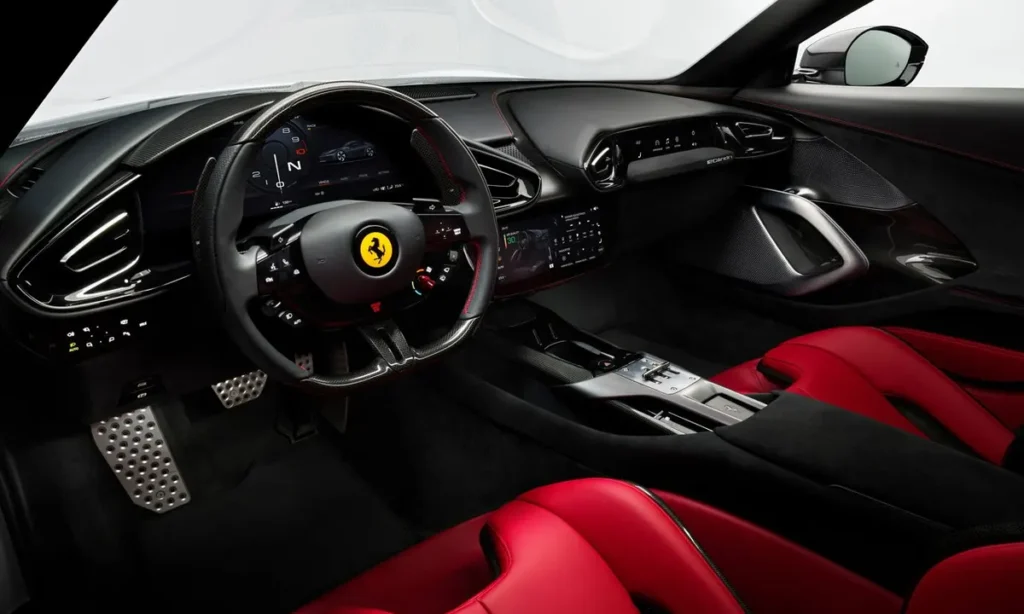
Inside the Ferrari 12Cilindri, the cabin environment reflects the same design philosophy that governs the exterior — a commitment to formal precision, material quality and driver focus that results in an interior of exceptional character. The dual-cowl dashboard architecture, inspired by elements introduced in the Purosangue, creates a distinct visual separation between the driver’s cockpit and the passenger’s space while maintaining a unified aesthetic coherence. The instrument binnacle is cowled separately, focusing the driver’s visual environment on the 15.6-inch digital instrument cluster that presents speed, engine data, navigation and driving mode information with Ferrari’s characteristic combination of technical precision and visual elegance.
A 10.25-inch central touchscreen provides access to navigation, climate control, connectivity and vehicle settings, while a dedicated 8.8-inch display positioned on the passenger side of the dashboard gives the front passenger access to independent controls and information — an unusually generous provision that acknowledges the front passenger as an active participant in the driving experience rather than a passive occupant. The steering wheel employs Ferrari’s latest capacitive touch technology, with controls redesigned for improved intuitiveness and haptic feedback that communicates the activation of functions without requiring the driver to look away from the road. Apple CarPlay and Android Auto connectivity is managed through the central display, while the optional Burmester premium audio system — a 15-speaker, 1,600-watt installation developed specifically for the 12Cilindri’s cabin acoustics — provides an audio quality commensurate with the car’s overall standard of excellence.
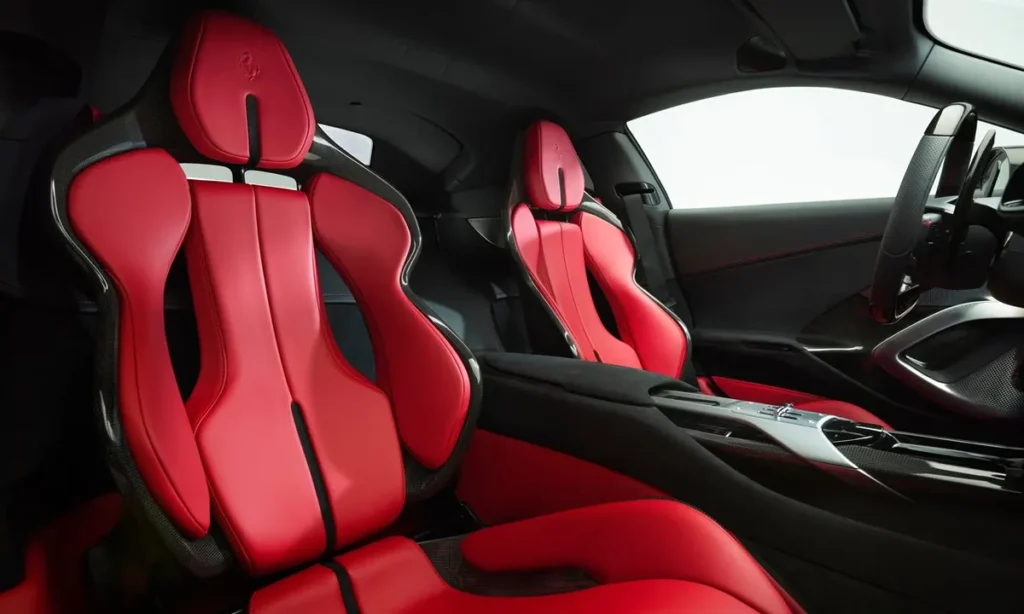
Standard comfort seats deliver the blend of support and long-distance comfort appropriate to a grand touring car, while optional carbon-shell sport seats provide enhanced lateral bolstering for drivers who use their 12Cilindri more aggressively or on occasional track visits. Material quality throughout the cabin is high — leather, Alcantara and carbon fibre are deployed with the restraint and precision that distinguishes genuine luxury from its imitation, and the fit and finish reflect the handcraft investment that Ferrari’s production process commits to every car that leaves Maranello. The driver assistance systems — Automated Emergency Braking, Blind Spot Monitoring, Lane Departure Warning and Adaptive Cruise Control — are integrated without compromising the car’s sporting character, providing a safety net appropriate to a vehicle of this capability and this price point.
The Ferrari 12Cilindri’s Place in Automotive History
The Ferrari 12Cilindri arrives at a moment of genuine historical significance. As Ferrari prepares to launch its first all-electric vehicle and continues to expand the hybrid technology deployed in the SF90 series, the 12Cilindri stands as the most fully realized and most beautifully resolved expression of the naturally aspirated V12 grand touring philosophy in the brand’s entire history. It is, in the most positive sense, a swan song — a definitive statement of what this specific engineering and cultural tradition can achieve when pursued without compromise and without distraction.
Whether or not the 12Cilindri proves to be the last naturally aspirated V12 Ferrari will produce in this configuration remains to be seen. What is certain is that if it does represent the end of this particular era, Ferrari has chosen to conclude it with a car of extraordinary beauty, mechanical magnificence and driving depth. The 12Cilindri has already been awarded the Car Design Award by ADI, has placed fourth at the prestigious evo Car of the Year competition, and has generated the kind of universal critical and enthusiast acclaim that confirms its position as one of the greatest cars of its generation regardless of powertrain type, body style or price category. For those with the means and the passion to experience it, the Ferrari 12Cilindri is not merely a purchase — it is an encounter with the highest form of the automotive art.
Read: Ferrari Amalfi Spider Open-Top Italian Elegance Meets Hybrid Supercar Performance
Ferrari 12Cilindri — Specifications and Performance Chart
| Category | Specification |
| Body Styles | Berlinetta Coupe / Spider Convertible |
| Engine | 6.5-Litre Naturally Aspirated V12 (F140HD) |
| Engine Configuration | 65-Degree V12, Front Mid-Mounted |
| Horsepower | 819 hp (830 PS / 610 kW) at 9,250 rpm |
| Torque | 500 lb-ft (678 Nm) at 7,250 rpm |
| Redline | 9,500 rpm |
| Torque at 2,500 rpm | 80% of Maximum |
| Special Torque Feature | Aspirated Torque Shifting (3rd and 4th Gear) |
| Transmission | 8-Speed Dual-Clutch (Magna-Produced) |
| Drivetrain | Rear-Wheel Drive |
| 0–62 mph | 2.9 seconds |
| 0–124 mph | 7.9 seconds |
| Top Speed | 211+ mph (340+ km/h) |
| Weight Distribution | 48.4% Front / 51.6% Rear |
| Dry Weight (Coupe) | 3,439 lbs (1,560 kg) |
| Dry Weight (Spider) | 3,571 lbs (1,620 kg) |
| Wheelbase | 106.3 inches (270 cm) — 20mm shorter than 812 Superfast |
| Length | 186.2 inches (473 cm) |
| Width | 78.0 inches (198 cm) |
| Height | 50.8 inches (129 cm) |
| Chassis | All-New All-Aluminium |
| Suspension (Front) | Double Wishbone |
| Suspension (Rear) | Multi-Link |
| Steering | Four-Wheel Independent Steering (4WS) |
| Chassis Control | Side Slip Control 8 |
| Braking | Brake-by-Wire with ABS Evo |
| Brake Rotors (Front) | 398mm |
| Brake Rotors (Rear) | 360mm |
| Tyres | Michelin Pilot Sport S5 or Goodyear Eagle F1 Supersport |
| Wheel Size | 21-inch Front and Rear |
| Front Tyres | 275/35ZR21 |
| Rear Tyres | 315/35ZR21 |
| Aerodynamic Modes | Low Drag (LD) / High Downforce (HD) |
| Maximum Downforce (Rear Flaps) | 50 kg at 155 mph |
| Instrument Cluster | 15.6-inch Digital |
| Central Display | 10.25-inch Touchscreen |
| Passenger Display | 8.8-inch |
| Audio System | Optional Burmester — 15 Speakers / 1,600 Watts |
| Spider Roof Operation | 14 seconds, up to 27 mph |
| Boot Capacity | 270 litres |
| Seating | Two Seats |
| Driver Aids | AEB, Blind Spot Monitoring, Lane Departure Warning, Adaptive Cruise |
| Starting Price (Coupe) | from $423,000 / €395,000 |
| Starting Price (Spider) | from $466,000 / €435,000 |
| Assembly | Maranello, Italy |
| Design Award | ADI Car Design Award 2025 |
| Unveiled | Miami Beach, May 3, 2024 |