AUTO BLOG

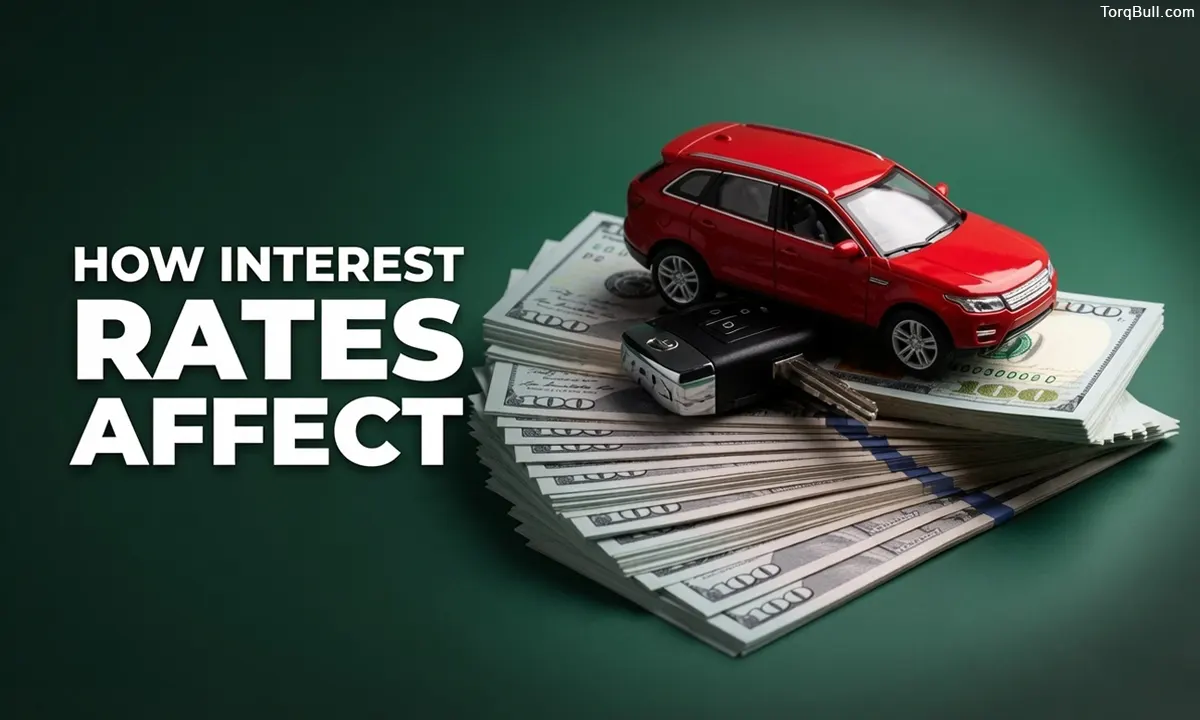
How Interest Rates Affect Your Monthly Car Payment. The Complete 2026 Calculation Guide

  • Small interest rate changes significantly impact total loan cost
  • 1% rate difference can exceed $1,000 over loan term
  • Super-prime (~4.66%) vs subprime (~16%) gap costs ~$9,500+
  • Loan term and credit score heavily influence payments
  • Strategies can help secure lower interest rates

How Interest Rates Affect Your Monthly Car Payment: Most car buyers concentrate their negotiation energy entirely on the vehicle’s sticker price. They research fair market value, compare dealer offers and fight for every hundred dollars of reduction — then accept the financing offer presented at the dealership without applying the same discipline to the interest rate that will govern their total loan cost for the next four to six years. This is one of the most consequential and most common financial errors in the American car-buying process. In the 2026 auto loan market — where the average new car loan balance has reached $43,582, the average new car monthly payment sits at approximately $767 and interest rates range from 4.66 percent for the best-credit borrowers to 16.01 percent for the highest-risk tier — the rate applied to a car loan frequently has a larger long-term financial impact than any negotiated discount on the vehicle price itself. This guide explains precisely how auto loan interest rates work, what determines them, what they cost at every level and what every buyer can do to secure the most competitive rate available.

Please note: This article provides general financial information for educational purposes only. Actual loan rates, payments and terms vary by lender, creditworthiness, state, vehicle type and prevailing market conditions. Consult a qualified financial advisor for guidance specific to your personal situation.

How Car Loan Interest Actually Works: The Mechanics Behind Every Monthly Payment

An auto loan interest rate — expressed as an Annual Percentage Rate or APR — represents the annual cost of borrowing money as a percentage of the outstanding loan balance. Every monthly car payment is calculated from three inputs: the principal amount borrowed, the interest rate and the loan term in months. Standard amortising loan mathematics distributes the combined cost of principal repayment and interest charges across the loan term in equal monthly amounts — which is why the payment is identical every month despite the proportion of interest and principal shifting as the balance declines.

The monthly payment formula is: Monthly Payment = P × [r(1+r)^n] ÷ [(1+r)^n – 1], where P is the loan principal, r is the monthly interest rate (annual rate divided by 12) and n is the number of monthly payments. For practical purposes, the relationship between these variables produces consistent, predictable patterns: higher interest rates produce higher monthly payments and substantially higher total interest paid. Lower rates produce lower monthly payments and meaningfully reduced total cost. Longer loan terms reduce the monthly payment while dramatically increasing total interest paid over the life of the loan.

Understanding this mechanics is essential because it clarifies where the real financial leverage in car buying sits — and it sits far more powerfully in the interest rate than most buyers appreciate when focused on sticker price negotiation.

2026 Auto Loan Rates: The Current Market Landscape

The average auto loan interest rate for a 60-month new car loan sits at 7.00 percent in April 2026 according to Bankrate’s weekly market survey — representing the midpoint rate available to borrowers with solid but not exceptional credit. This figure has stabilised following the Federal Reserve’s sustained rate-hike cycle between 2022 and 2024 that pushed auto loan rates to their highest levels in over a decade, with the fed funds target rate currently at 3.50 to 3.75 percent as of the most recent FOMC meeting.

The spread across credit tiers in 2026 is substantial. According to Experian’s State of the Automotive Finance Market report for the fourth quarter of 2025, the average new car auto loan rate for super-prime borrowers — those with credit scores of 781 and above — was 4.66 percent. Prime borrowers at 661 to 780 received an average rate of approximately 6.89 percent. Near-prime borrowers at 601 to 660 averaged approximately 10.12 percent. Subprime borrowers at 501 to 600 averaged approximately 13.47 percent. Deep-subprime borrowers below 500 paid an average rate of 16.01 percent. The 11.35 percentage point spread between the best and worst rate tiers on identical vehicle prices represents the most significant financial variable in the entire car-buying transaction for most Americans.

For used car loans, rates run consistently higher across all credit tiers. Edmunds data from March 2026 places the average used car loan interest rate at 11 percent APR — approximately 4 percentage points above the equivalent new car rate — reflecting the higher collateral risk associated with older vehicles.

The Real Dollar Impact: What Each Rate Level Costs on a $35,000 Loan

The most practical way to understand how interest rates affect monthly car payments is to examine specific payment calculations across the full range of 2026 market rates on a fixed loan amount. Using a $35,000 loan — close to the average amount financed for used vehicles and well below the average for new vehicles — over a 60-month term:

At 4.66 percent APR (super-prime), the monthly payment is approximately $654 and total interest paid over 60 months is approximately $4,257. At 7.00 percent APR (market average), the monthly payment rises to approximately $693 and total interest paid increases to approximately $6,574. At 10.12 percent APR (near-prime), the monthly payment is approximately $745 and total interest paid reaches approximately $9,686. At 13.47 percent APR (subprime), the monthly payment climbs to approximately $802 and total interest paid increases to approximately $13,112. At 16.01 percent APR (deep-subprime), the monthly payment reaches approximately $848 and total interest paid over the same 60 months is approximately $15,897.

The comparison between the super-prime borrower and the deep-subprime borrower on the identical $35,000 vehicle is stark: the difference in monthly payment is $194, and the difference in total interest paid over five years is $11,640. Two buyers purchasing the same car at the same price will have paid costs differing by nearly twelve thousand dollars purely because of the interest rate applied to their financing.

How Loan Term Length Amplifies the Interest Rate Effect

How Interest Rates Affect Your Monthly Car Payment. The Complete 2026 Calculation Guide

The interaction between interest rate and loan term length is the second most important cost variable in auto loan mathematics — and it is one that the 2026 market has made increasingly relevant as average loan terms have extended to 68 months industrywide, with 84-month terms becoming more common as vehicle prices remain elevated.

Extending a loan term reduces the monthly payment while dramatically increasing total interest paid — and this effect is amplified when interest rates are higher. Consider a $30,000 loan at 7 percent APR across different term lengths: over 48 months, the monthly payment is $718 and total interest paid is $4,464. Over 60 months, the monthly payment falls to $594 but total interest paid rises to $5,640. Over 72 months, the monthly payment drops to $513 but total interest paid reaches $6,933. Over 84 months, the monthly payment is $452 but total interest paid grows to $7,968.

The buyer who extends from 48 to 84 months to make the monthly payment feel affordable pays $3,504 more in interest on a $30,000 loan at 7 percent — while simultaneously spending 36 additional months in debt and facing a significantly higher probability of becoming upside-down on the loan, meaning they owe more than the vehicle is worth as depreciation exceeds payoff pace.

What Determines the Interest Rate a Lender Offers You

Five primary factors determine the specific interest rate any individual borrower receives from any specific lender in the 2026 auto loan market.

Credit score is the most powerful single variable, as the tier data above demonstrates. The credit score’s influence on rate is not linear — improvement from deep-subprime to subprime produces a larger rate reduction than improvement from prime to super-prime, but both improvements translate to meaningful monthly payment reductions. Lenders use the three major credit bureaus’ scores, and some weight specific credit factors differently, making rate comparison across multiple lenders valuable regardless of credit tier.

Loan-to-value ratio — the relationship between the loan amount and the vehicle’s appraised value — significantly affects rate. A borrower financing 120 percent of a vehicle’s value because they rolled negative equity from a previous loan into the new purchase is a higher-risk proposition than one financing 80 percent with a substantial down payment, and lenders price that risk into the offered rate accordingly. A 20 percent or greater down payment consistently produces rate improvement beyond what credit score alone achieves.

Loan term length affects rate directly: lenders charge higher rates on longer loan terms because longer periods create greater uncertainty and repossession risk. The rate difference between a 48-month and a 84-month loan from the same lender for the same borrower can be 1 to 2 percentage points — meaning extending a term to reduce monthly payment produces a compounded penalty through both longer time at interest and a higher rate applied to that extended period.

Vehicle age and type influence rate because they determine the collateral quality underlying the loan. New vehicles receive the most favourable rates because they have known value, full manufacturer warranty coverage and predictable depreciation. Used vehicles — particularly those over five years old or with high mileage — carry higher rates that reflect the higher uncertainty in their residual value if repossession becomes necessary.

Lender type produces meaningful rate variation. Credit unions consistently offer lower auto loan rates than banks or dealership financing arms, because their nonprofit structure and member ownership model allows them to pass lower margins to borrowers. In April 2026, the best credit union rates for super-prime borrowers on new vehicles begin at approximately 3.89 percent — below the Experian-reported average for the same tier through all lender types. Shopping exclusively through the dealership’s financing office without comparing credit union alternatives is one of the most reliably expensive financing decisions a car buyer can make.

Read: 2026 Car Insurance Cost By State USA Comparison

Interest Rate Impact on Monthly Car Payment — Complete Comparison Chart

Credit TierCredit Score RangeAvg New Car APRMonthly Payment ($35K / 60mo)Total Interest PaidMonthly Payment ($30K / 60mo)Total Interest Paid
Super Prime781–8504.66%~$654~$4,257~$561~$3,650
Prime661–780~6.89%~$689~$6,363~$591~$5,454
Near Prime601–660~10.12%~$745~$9,686~$639~$8,302
Subprime501–600~13.47%~$802~$13,112~$688~$11,238
Deep SubprimeBelow 500~16.01%~$848~$15,897~$728~$13,626
Market Average (new)Mixed7.00%~$693~$6,574~$594~$5,640
Market Average (used)Mixed11.00%~$761~$10,619~$652~$9,102

Calculations are approximate and for illustrative purposes. Actual payments depend on lender terms, fees and individual circumstances.

How the Federal Reserve Influences Auto Loan Rates — And What It Means in 2026

The Federal Reserve does not set auto loan rates directly, but its federal funds target rate — the rate at which banks lend to each other overnight — functions as the foundation on which all consumer lending rates are built. When the Federal Reserve raises the federal funds rate, banks’ cost of capital increases and they pass those costs through to consumer loan rates including auto loans. When the Fed cuts rates, the transmission to consumer lending markets typically follows within weeks to months.

The Fed rate-hike cycle that ran from early 2022 through late 2024 pushed auto loan rates from the historic lows of 3 to 4 percent that characterised the pandemic-era financing environment to the 7 to 9 percent range that defined 2024. The Fed funds rate currently sits at 3.50 to 3.75 percent, and experts forecast relatively stable auto loan rates through the first half of 2026 with a possibility of modest decreases later in the year if economic conditions permit further easing. For buyers who purchased vehicles at peak 2023 or 2024 rates and have since improved their credit or whose original rate reflected the elevated market rate environment, refinancing deserves active consideration in 2026 — rate reductions of 2 to 3 percentage points are achievable for borrowers who have consistently made on-time payments and whose credit scores have improved since the original loan was written.

Read: 2026 EV Tax Credit Eligibility In USA. Buyer Needs To Know Before Signing A Purchase Agreement

Five Strategies That Directly Reduce the Interest Rate You Pay

Strategy One — Build credit before buying. A credit score improvement from 650 to 720 can reduce a new car loan rate by 3 to 4 percentage points and save thousands in total interest. For buyers without an urgent need to purchase, a six-to-twelve-month period of disciplined credit management — paying all existing accounts on time, reducing credit card utilisation below 30 percent and avoiding new credit applications — can produce a rate improvement whose financial value far exceeds the convenience of purchasing immediately.

Strategy Two — Get pre-approved by a credit union before visiting any dealership. Credit unions consistently offer the market’s most competitive auto loan rates for members across all credit tiers. Obtaining pre-approval from a credit union before entering a dealership establishes a firm baseline rate that the dealership’s financing office must compete against rather than be the sole source of. The competitive pressure of a documented alternative loan offer is one of the most reliable mechanisms for securing improved dealership financing terms.

Strategy Three — Increase the down payment. Every additional dollar of down payment reduces the loan-to-value ratio — improving the lender’s risk assessment and directly producing rate improvement in most cases. A 20 percent or greater down payment qualifies for the most favourable rate tiers at most lenders, while simultaneously reducing the loan balance and therefore the total interest paid across the term.

Strategy Four — Choose a shorter loan term. Accepting a higher monthly payment in exchange for a 48-month rather than 72-month term produces rate reduction and dramatically reduced total interest paid. The buyers most financially harmed by auto lending in the 2026 market are those who have extended to 84-month terms at subprime rates on vehicles purchased at or above market value — a combination that produces negative equity within months and interest payments that significantly exceed the vehicle’s actual depreciating value.

Strategy Five — Compare at least three lenders before accepting any offer. The rate variation between lenders for the same borrower and vehicle on the same day can exceed 2 percentage points — a difference worth hundreds of dollars annually on a typical auto loan balance. Applications for rate comparison purposes within a 14-day window are treated as a single credit inquiry by most credit scoring models, meaning rate shopping carries no credit score penalty when done within this window.

Show More

Leave a Reply

Your email address will not be published. Required fields are marked *

Back to top button