- 2.5L turbo: 290 hp and 311 lb-ft torque
- 8-speed wet dual-clutch transmission
- ~16.3 cu ft trunk space and ~$37,000 price
- Strong straight-line performance in segment
- Limited by tyre grip and no LSD for handling
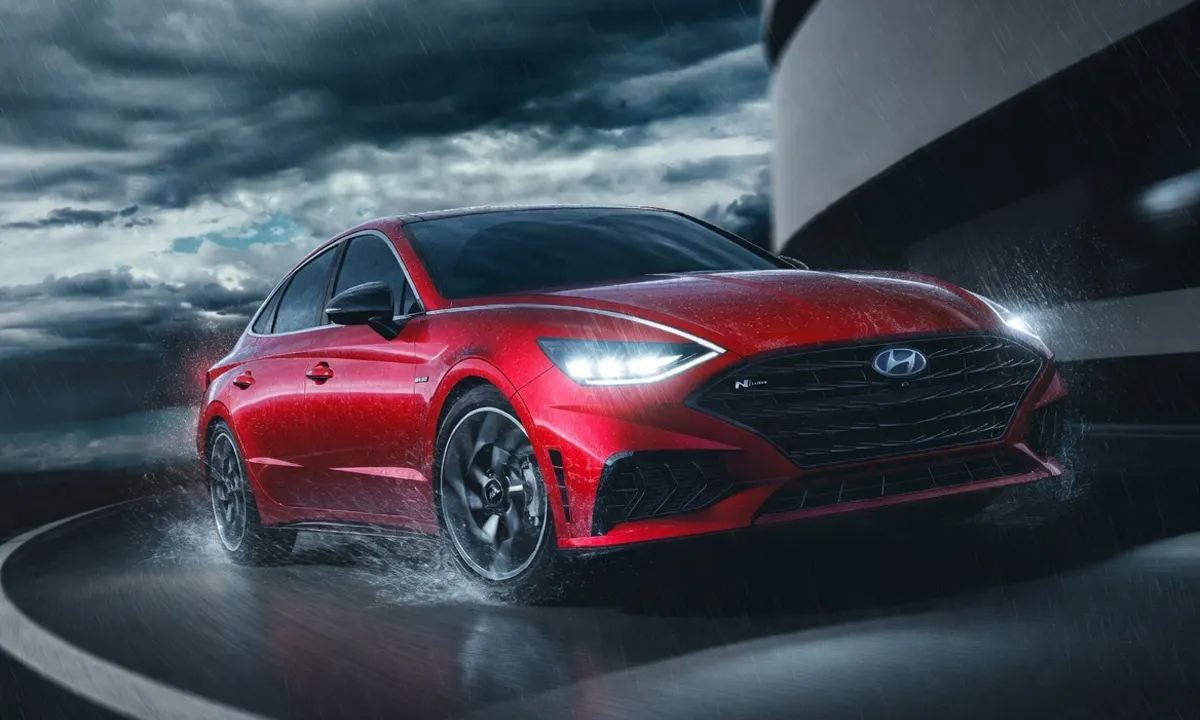
The affordable performance midsize sedan has all but disappeared from the American automotive landscape. The Toyota Camry TRD was discontinued after 2024. The Honda Accord no longer offers anything sporting beyond hybrid efficiency. The Nissan Altima has been discontinued entirely. The Ford Fusion Sport, MazdaSpeed6 and Volkswagen Passat GT are automotive history. In 2026, if you want four doors, near-300-horsepower performance and a price below $40,000, there is essentially one answer left: the Hyundai Sonata N Line. This is the review it deserves — not as a niche product competing against a full field of rivals, but as a genuinely rare surviving example of a category that the market has systematically abandoned, evaluated on its own considerable merits and its specific, honest limitations.
The Powertrain: 290 Horsepower That Demands Respect
The 2026 Hyundai Sonata N Line is powered by a turbocharged 2.5-litre four-cylinder engine producing 290 horsepower and 311 pound-feet of torque — 99 horsepower more than the base Sonata’s naturally aspirated 2.5-litre unit. The engine is paired exclusively with an eight-speed wet dual-clutch transmission that drives the front wheels. No manual transmission option and no all-wheel drive are available on the N Line — the DCT is the sole transmission, and front-wheel drive is the only drivetrain configuration.
The wet dual-clutch deserves specific attention because it addresses the most common DCT reliability concern: heat management under sustained performance driving. A wet DCT uses transmission fluid to cool and lubricate the clutch packs, enabling more robust high-performance use than dry DCT designs that air-cool the clutches. The eight-speed configuration performs over 500 calculations per second to determine optimal shift timing, factoring in throttle position, vehicle speed, drive mode selection and driving pattern history. In Sport mode, shifts are aggressive and precise — the kind of rapid, committed changes that make the car feel engaged and willing. In Normal mode, the DCT is smoother and more comfortable, though it can feel slightly hesitant and jerky at very low speeds in heavy stop-and-go traffic — a characteristic of DCT designs generally and one that JD Power specifically notes, advising owners against extended clutch creeping in traffic as this accelerates wear.
The engine’s performance character is genuinely impressive. CarBuzz’s test drive of the 2025 N Line specifically notes that in-gear acceleration is rapid and the engine loves corners with minimal body roll thanks to sport-tuned suspension. JD Power’s reviewer describes Sport mode as commanding the engine to deliver power with the most aggressive throttle curve — meaning full power arrives with minimal accelerator travel, producing the urgent, committed character that performance sedan buyers specifically seek. The only octane requirement is 87 — a meaningful operating cost advantage over true performance cars requiring 91 or 93 premium fuel.
Fuel economy sits at an EPA-rated 23 MPG city, 32 MPG highway and 27 MPG combined — a modest reduction from the base Sonata’s 25/36/29 MPG that reflects the turbocharged engine’s power output rather than dramatic inefficiency. For a vehicle producing 290 horsepower, 27 MPG combined is a genuinely competitive fuel economy figure.
Read: Size Isn’t Everything! Compact Sedan vs SUV, Which Is Actually Better for You?
The Chassis and Dynamics: Grand Tourer Rather Than Track Tool
The Sonata N Line’s chassis dynamics are where the vehicle’s specific identity — and its most clearly documented limitation — become apparent. Multiple professional reviews have reached the same conclusion: the N Line is a Grand Tourer whose sporting character is most fully expressed on smooth highways and flowing A-roads, rather than a dedicated sport sedan whose hardware enables aggressive back-road performance.
CarBuzz specifically notes the sport-tuned suspension as acceptably soft — a characterisation that simultaneously captures its highway refinement strength and its back-road limitation. The suspension handles road imperfections gracefully and the cabin remains comfortable over typical road surfaces. Where it falls short is when the engine’s 311 pound-feet of torque arrives without adequate front-end traction management to deploy it cleanly. Edmunds identifies this directly: the N Line lacks the basic hardware — specifically a limited-slip differential — needed to handle the engine’s considerable output. The result is measurable wheelspin even under normal acceleration, which compromises both on-road performance feel and driver confidence in corners.
This is the single most consistent criticism across professional evaluations and it deserves a direct response: the Sonata N Line is not attempting to be an Elantra N. The full Elantra N has an electronic limited-slip differential, adjustable valved exhaust and track-specific driving modes. The Sonata N Line is a large, comfortable, well-appointed midsize sedan with a significantly more powerful engine than any direct competitor — not a homologation special with dedicated track hardware. Understood in that context, the absence of an e-LSD is a calibrated product decision rather than a cost-cutting failure. The steering, while not as heavy as some enthusiast reviewers prefer, is precise and informative — JD Power’s reviewer describes it as linear and smooth with highway jaunts requiring low effort.
The Interior: Premium Content at Every Touchpoint
The 2026 Sonata N Line’s interior is a genuine strength that carries the vehicle’s case beyond the powertrain numbers. At approximately $37,000, it represents one of the most feature-complete interiors available in any segment at that price point.
The centrepiece is the Panoramic Curved Display — a single, subtly curved panel housing both a 12.3-inch digital instrument cluster and a 12.3-inch central infotainment touchscreen. This integrated display creates a modern, high-technology aesthetic that punches significantly above the Sonata N Line’s price point and exceeds many vehicles costing $20,000 more in visual sophistication. The infotainment system leads the midsize sedan class in standard screen size and responsiveness according to Edmunds, with wireless Android Auto and Apple CarPlay pairing described as quick and easy. Voice controls handle natural speech commands effectively for radio, navigation and phone. A wireless charging pad and USB-C ports in the front are standard.
Audio is delivered through a standard 12-speaker Bose Premium Audio system — a specification that most midsize sedans reserve for their highest trim levels, where the Sonata N Line receives it as part of its comprehensive standard equipment package. Rear seat legroom at 35.6 inches is competitive with the Honda Accord’s equivalent figure, providing genuine adult accommodation in the back rather than nominal rear seat provision. Boot space at 16.3 cubic feet is identical to the standard Sonata — the performance upgrades do not compromise practicality.
N Line-specific interior elements include bolstered front sport seats, unique interior trim and the red-highlighted Engine Start/Stop button that provides a subtle but satisfying acknowledgement of the car’s performance character every time the driver enters. The steering wheel shifter — replacing the traditional console-mounted shifter of earlier Sonatas — takes some adjustment but frees console space and provides a cleaner interior layout.
Safety Technology: Comprehensive as Standard
The 2026 Sonata N Line includes Hyundai’s full SmartSense safety suite as standard equipment across the lineup. Standard features include forward collision avoidance assist with pedestrian and cyclist detection, lane keeping assist, lane departure warning, driver attention warning, high beam assist and blind-spot collision avoidance assist. Rear cross-traffic collision avoidance is standard, and a rear occupant alert system reminds drivers to check the back seat after parking.
One active recall affects the 2026 Sonata: a software-related recall addressing instrument panel display failures where the speedometer or warning lights may fail to display correctly. Hyundai’s resolution is an over-the-air software update or dealer software revision at no cost, with owner notification letters mailed in March 2026. This recall is specific to a software component and does not represent a mechanical reliability concern, though buyers of new or recent-production 2026 examples should confirm the update has been applied.
2026 Hyundai Sonata N Line — Complete Specification Chart
| Specification | 2026 Sonata N Line | Standard Sonata SE | Honda Accord Sport | Toyota Camry TRD (disc.) |
| Engine | 2.5L Turbo 4-cyl | 2.5L NA 4-cyl | 1.5L Turbo 4-cyl | 3.5L V6 (discontinued) |
| Horsepower | 290 hp | 191 hp | 192 hp | 301 hp (discontinued) |
| Torque | 311 lb-ft | 181 lb-ft | 192 lb-ft | 267 lb-ft (discontinued) |
| Transmission | 8-spd Wet DCT | 8-spd Automatic | CVT | 8-spd Automatic |
| 0-60 MPH (est.) | ~5.5 sec | ~7.8 sec | ~7.0 sec | ~5.8 sec (discontinued) |
| Fuel Economy | 23/32/27 MPG | 25/36/29 MPG | 29/37/32 MPG | 22/31/25 MPG (discontinued) |
| Limited-Slip Diff | No | No | No | No (Torsen on some) |
| AWD Available | No | Yes (SE, SEL) | No | No |
| Standard Screen | 12.3″ + 12.3″ Panoramic | 8″ + 8″ | 12.3″ | 12.3″ |
| Starting Price | ~$37,000 | ~$27,450 | ~$28,800 | Discontinued |
| Boot Space | 16.3 cu ft | 16.3 cu ft | 16.7 cu ft | 15.1 cu ft |
| Bose Audio | Standard | Not available | Not standard | Not standard |
The Competition Context: What Makes the N Line Unique
The Sonata N Line’s competitive positioning in 2026 is perhaps its most compelling story — because the competition that would normally contain and contextualise its case no longer exists. The Toyota Camry’s TRD trim was discontinued. The Honda Accord offers no performance variant — its high-output 2.0-litre turbocharged engine is a hybrid unit that prioritises efficiency over sporting character. The Kia K5 GT shares the Sonata N Line’s 2.5-litre turbocharged engine and DCT in an identical configuration — making it effectively the closest competitor but from the same corporate family rather than an independent alternative.
The result is that the Sonata N Line stands, as one automotive reviewer characterised it, virtually unchallenged as the only truly performance-oriented midsize sedan option in the accessible price bracket. At $37,000 with 290 horsepower, a 12-speaker Bose system, 24-inch panoramic display, comprehensive safety technology and standard performance hardware — it delivers a specification that would require $55,000 or more from a German luxury brand.
Read: Hyundai Palisade Sets New Standards for Comfort in Three-Row SUVs
The Honest Verdict
The 2026 Hyundai Sonata N Line is a genuinely compelling vehicle that deserves far more attention than the sedan segment’s declining market share allows it to receive. Its 290-horsepower turbocharged engine, quick-shifting wet DCT, comprehensive technology package and distinctive design deliver a driver experience unavailable at its price point from any other mainstream manufacturer in 2026.
It is not a track car. The absence of a limited-slip differential means wheelspin under hard acceleration and less confidence than the engine’s output justifies in aggressive corner exits. The DCT’s low-speed manners in heavy traffic require some driver adaptation to avoid the clutch shudder and jerkiness that it can produce when operated like a conventional automatic in bumper-to-bumper conditions. And the performance sedan market’s contraction means that resale values and owner community support are thinner than they would be for a higher-volume performance vehicle.
But for the buyer who wants near-300-horsepower performance, a beautiful panoramic interior, a practical 16.3 cubic foot boot, standard Bose audio and a Camry-rivalling fuel economy figure — all for $37,000 in a segment where such a combination simply does not otherwise exist — the 2026 Sonata N Line is the easiest recommendation available. It is exactly what it claims to be: the last affordable performance sedan, keeping the category alive while everyone else gave up.