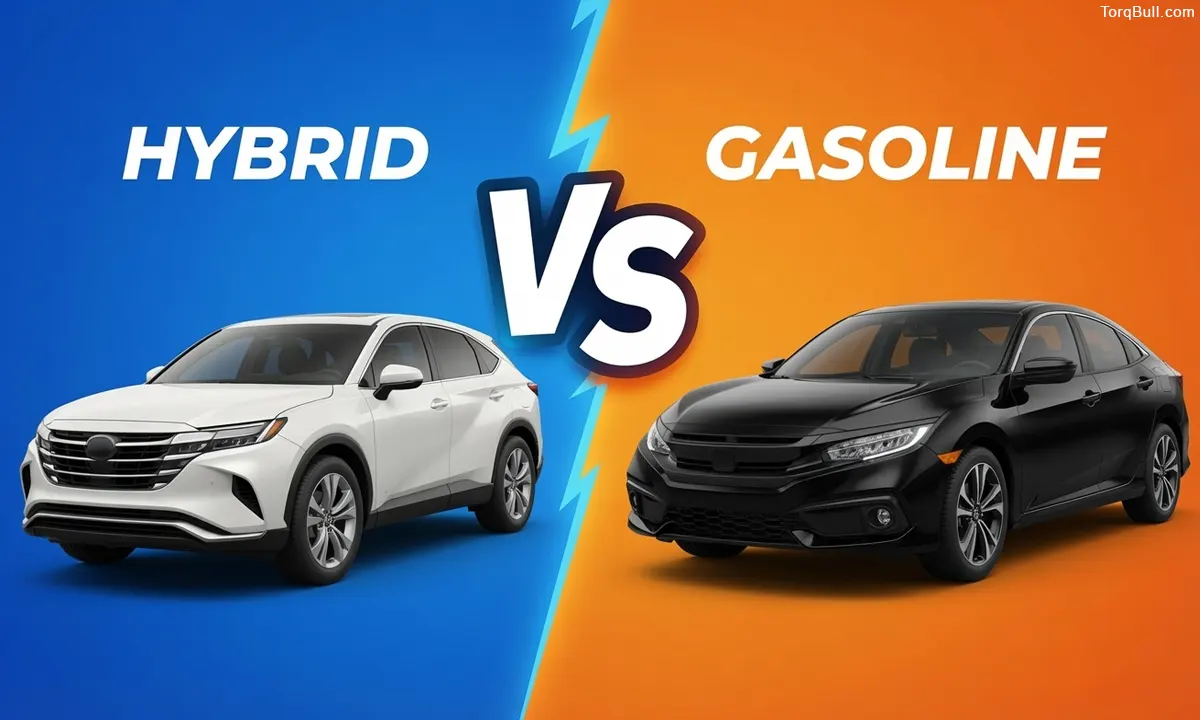
Gas prices tick up, you start eyeing that hybrid version of the car you want, and the salesperson assures you it will “pay for itself” in fuel savings. Sounds great. But here is the uncomfortable question nobody at the dealership wants you to dwell on: what if it doesn’t? What if that shiny hybrid premium takes so long to earn back that you sell the car before you ever break even?
That is the difference between a smart buy and overpaying, and the wild part is that most people never actually run the numbers. They go on vibes and gas-price anxiety. But the truth is, whether a hybrid saves you money or costs you money comes down to one simple calculation you can do on a napkin.
So let me hand you that calculation. I will show you the exact formula, walk through real 2026 examples, and reveal the magic number that tells you instantly whether you are saving or overpaying. Quick note, this compares purchase price and fuel cost, the two biggest factors, and it is general guidance rather than personalized financial advice, so run your own numbers before you buy.
The One Formula That Answers Everything
Here is the whole game, distilled into a single line. It is called the break-even point, and it tells you how many years it takes for your fuel savings to pay back the extra you spent on the hybrid.
The math is refreshingly simple. Subtract the gas car’s price from the hybrid’s price to find the premium, subtract the hybrid’s annual fuel cost from the gas car’s annual fuel cost to find the annual savings, then divide the premium by the savings to get the exact number of years it takes to break even. In plain English:
Break-even years = (Hybrid price − Gas price) ÷ (Annual gas savings)
That is it. If the answer is a small number, you are saving money. If it is a big number, you are overpaying. Everything else is just figuring out the inputs, so let’s do that.
The Three Inputs That Decide It
To run your calculation, you need three things, and each one swings the result dramatically.
First, the hybrid premium, meaning how much more the hybrid costs than the comparable gas model. The good news for 2026 is that this gap has shrunk. While the price difference between hybrid and gas vehicles isn’t as dramatic as it was a few years ago, hybrid models are still noticeably more expensive, typically running about 5 to 6 percent more than their gas counterparts.
Second, the fuel economy gap between the two. Hybrids shine here, often returning 50 mpg where the gas version manages 34. The bigger that gap, the faster you save.
Third, your driving reality: how many miles you drive a year and what gas costs. The average American drives around 13,500 miles a year, many calculators use 15,000 as a benchmark, and the national average price of regular fuel recently sat around $3.32. Plug those into the annual fuel cost formula, which is miles driven divided by mpg, times the gas price, and you have everything you need.
Worked Example One: The Compact Car
Let’s make this real with an actual 2026 comparison. Take the Toyota Corolla, America’s default sensible car.
The base 2026 Corolla LE costs $24,595 including destination, while the Corolla Hybrid LE costs $25,970, about 5.5 percent more, and the hybrid returns 50 mpg combined versus 34 mpg for the gas model. Now run the numbers at 15,000 miles a year. The gas model has an annual fuel cost of $1,434, while the hybrid costs $975 per year to fuel, for a savings of $459 per year.
So the premium is $1,375, and you save $459 a year. Divide one by the other and it would take around three years to recoup the extra purchase price of the hybrid. Three years. Since most people keep a car far longer than that, this hybrid is a clear win. Every year past year three is pure money in your pocket. Not overpaying, saving.
Worked Example Two: The SUV
Now let’s try a crossover, since that is what most Americans actually buy. Say the gas SUV is $30,000 and gets 25 mpg, while the hybrid SUV is $32,500 and gets 38 mpg. You drive 15,000 miles a year, and gas is $3.50 a gallon.
The gas SUV costs $2,100 per year to fuel, while the hybrid costs about $1,381, for annual savings of roughly $719. The premium is $2,500, so dividing $2,500 by $719 gives a payback period of about 3.48 years. Again, well under the typical ownership window. Another win. This hybrid buyer is not overpaying either.
The Magic Number: Six Years
So how do you know instantly whether your result means “save” or “overpay”? There is a simple threshold. Since the average driver keeps a new car for about six years, you should aim for a break-even point of less than six years. Beat that number and the hybrid pays for itself before you move on. Miss it and you are effectively subsidizing a badge.
Here is the cautionary flip side, straight from the math. If a hybrid costs $3,000 more but only saves you $200 a year in fuel, it would take 15 years to break even, and if you plan to sell in 5 years, that hybrid is functionally a poor financial investment despite being better for the environment. That is what overpaying looks like on a spreadsheet. Fifteen years to break even on a car you will not own in five.
Read: How to Increase Your Car Resale Value in America 2026
How the Scenarios Stack Up
Here is how different situations change the payback math.
| Scenario | Hybrid Premium | Annual Savings | Break-Even | Verdict |
| Compact car, 15k mi/yr | $1,375 | $459 | ~3 years | Save |
| SUV, 15k mi/yr | $2,500 | $719 | ~3.5 years | Save |
| Low-mileage driver, 6k mi/yr | $2,500 | ~$290 | ~8.6 years | Overpay |
| Big-premium model | $5,000 | $500 | 10 years | Overpay |
See the pattern? The premium and your annual mileage are the two levers that flip the answer. Cheap premium plus lots of miles equals fast payback. Big premium plus few miles equals overpaying.
The Variables That Flip Your Answer
A few real-world factors can dramatically change your personal result, so account for them. The biggest is how and where you drive. Hybrids employ electric motors that handle much of the workload at low speeds and in stop-and-go traffic, so they make a lot of sense for people who do most of their driving around town. But highway commuters and people who regularly drive long distances see a smaller fuel economy benefit, because hybrids have to rely on the gas engine at higher speeds. A city dweller breaks even far faster than a highway warrior.
Your annual mileage is the other giant lever. More driving means faster break-even, less driving means slower break-even. If you barely drive, even a modest premium may never pay back. And one specific warning: be extra careful with plug-in hybrids, whose bigger premiums often take so long to recoup that many buyers never come out ahead unless they diligently charge and drive on electricity daily.
The Factors the Calculator Ignores (That Favor Hybrids)
Here is the honest nuance. The basic calculation includes purchase price and fuel cost only, leaving out insurance, maintenance, and resale value, which can vary widely. But those omitted factors mostly tilt further in the hybrid’s favor.
Hybrids often hold their value better than gas-only counterparts in used-car markets, so you recoup more when you sell. Regenerative braking reduces wear on pads and rotors, often extending their service life and lowering maintenance costs. And there are quality-of-life perks the calculator can’t price: a quieter cabin, instant electric torque off the line, and smoother stop-start behavior. So if your basic break-even lands close to that six-year line, these hidden factors probably push the real answer into “worth it” territory.
Verdict: Run the Numbers, but Most Hybrids Win in 2026
So, are you overpaying for that hybrid? The honest answer is that you now have the tool to know for certain instead of guessing. Take the price difference, divide it by your annual fuel savings, and if the result is under about six years, you are saving money, not overpaying. If it is well over six years, you are paying a premium the fuel savings won’t recover in time.
And here is the encouraging 2026 reality: for most mainstream hybrids driven average miles, the math comes out strongly in your favor. With the hybrid premium shrunk to around 5 percent and gas hovering near $3.30, popular models like the Corolla, RAV4, CR-V, and Camry Hybrid typically break even in just three to four years, comfortably inside the ownership window. Factor in the better resale value and lower brake wear that the basic calculator ignores, and the case gets even stronger. Most hybrid buyers today are genuinely saving, not overpaying.
But do not assume, because the exceptions are real. If you drive very few miles, spend most of your time on the highway, are eyeing a model with an unusually fat hybrid premium, or plan to sell in a couple of years, the numbers can absolutely flip to overpaying. That is exactly why you run the calculation for your specific two models, your actual mileage, and your local gas price, rather than trusting a salesperson’s “it pays for itself” line. The whole decision comes down to 30 seconds of simple division. Premium divided by annual savings equals your break-even. Beat six years and buy the hybrid with confidence. Miss it badly and pocket the savings by sticking with gas. Either way, you will know exactly what you are doing with your money, and you will never have to wonder whether you overpaid again. Now go run your numbers. The answer is right there waiting for you.