Ducati 1198 Review: The Last Pure Analog Superbike That Delivers Superbike Thrills on a Budget
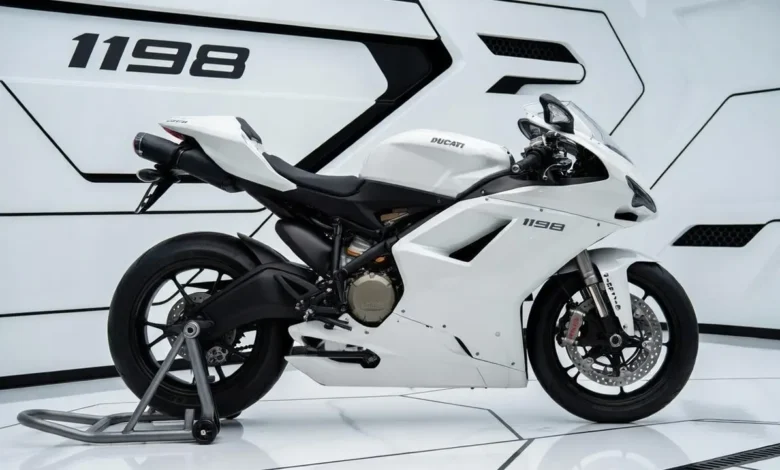
- 170 hp Testastretta 11° L-twin with aggressive, characterful power delivery
- Rigid trellis frame delivering precise and confidence-inspiring cornering
- Iconic dry clutch with distinctive mechanical sound
- Pure, rider-focused experience with minimal electronic intervention
- Final era of Ducati’s raw, uncompromised superbike philosophy
There are motorcycles that perform and motorcycles that communicate — machines whose relationship with the rider extends beyond the mechanical transaction of acceleration, braking and cornering into a continuous conversation whose vocabulary is vibration, sound, chassis feedback and throttle response. The Ducati 1198 belongs emphatically to the second category. Produced between 2009 and 2011 as the culmination of the 1098’s evolutionary line and the final expression of Ducati’s Superbike formula before the Panigale’s monocoque chassis architecture replaced the trellis frame that had defined the Bologna manufacturer’s high-performance identity across three decades of production, the 1198 represents a specific moment in superbike history — the moment when Ducati’s traditional engineering philosophy reached its highest development before the fundamental architectural change that the subsequent generation required.
Understanding the 1198 requires understanding what it concluded as much as what it achieved — because the motorcycle’s significance in 2026, long after its production ended and as its surviving examples appreciate toward the collector market values that its historical position justifies, rests as much on its place in Ducati’s developmental narrative as on the performance figures that made it the most capable superbike the Bologna manufacturer had produced at the time of its introduction.
The Engine: Testastretta Eleven-Degree at Its Peak
The 1198’s 1,198cc Testastretta Eleven-Degree L-twin engine — whose designation references the 11-degree valve overlap angle that distinguished it from the earlier Testastretta’s 25-degree arrangement and whose narrower overlap improved rideability without compromising the peak performance that the original’s aggressive timing had produced at the cost of urban usability — represents the most thoroughly developed version of the desmodromic valve actuation system that Ducati has maintained as a defining engineering commitment across its racing and road motorcycle history.
The desmodromic system — whose positive opening and positive closing of the valves through dedicated rocker arms eliminates the valve spring whose return force becomes insufficient at high revs and whose mechanical precision allows higher revving without the float that spring-return systems suffer — produces the 1198’s 170 horsepower at 9,750 rpm with a mechanical character that the conventional spring-valve engines of the Japanese parallel four-cylinder rivals cannot replicate in feel regardless of their ability to match the number. The desmo’s mechanical signature — a slightly different quality of throttle response, a specific acoustic texture at high revs and the knowledge that the engine’s operation depends on machined precision rather than spring tension — contributes to the 1198’s character in ways that specification comparisons cannot quantify.
The 90-degree V angle between the two cylinders — Ducati’s defining L-twin configuration whose perfect primary balance eliminates the first-order vibration that narrower V angles produce and whose firing interval creates the irregular combustion pulse that distinguishes the Ducati sound from every other motorcycle engine architecture — produces the torque delivery characteristic that 1198 owners consistently identify as the most addictive dimension of the machine’s performance. The torque peak of 132 Newton-metres arrives at 8,000 rpm — a figure whose magnitude in a motorcycle weighing 173 kilograms dry produces a power-to-weight ratio that the Japanese litre-class rivals could match in absolute terms but not in the specific character of its delivery.
The Trellis Frame: The Last of Its Kind at the Top Level
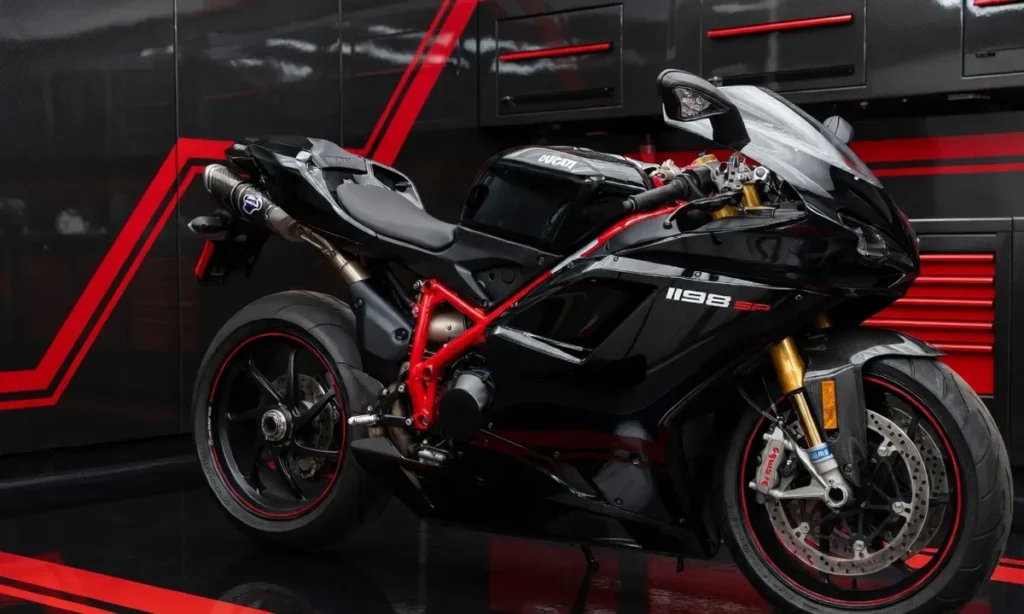
The 1198’s steel trellis frame — whose network of welded steel tubes provides the structural rigidity that the engine’s torque demands while maintaining the specific flex characteristics whose contribution to the motorcycle’s feel under hard cornering reflects Ducati’s accumulated understanding of how chassis compliance affects rider feedback — was already an engineering philosophy under competitive pressure at the time of the 1198’s introduction. The Japanese manufacturers’ aluminium twin-spar frames provided measurable stiffness-to-weight advantages whose implications for lap time comparison were real. Ducati maintained the trellis because the feedback it provided was considered an essential dimension of the riding experience that the numerically superior aluminium alternative could not replicate with equivalent intimacy.
The trellis frame’s contribution to the 1198’s character is most apparent at the limit of cornering — in the specific way the front end communicates tyre load, in the chassis’s response to mid-corner throttle application and in the feedback quality that allows a skilled rider to exploit the 1198’s performance envelope with a confidence that the more isolated feel of stiffer alternative chassis architectures makes more difficult to build. This is the quality that MotoGP riders who transitioned from trellis-framed Ducatis to aluminium alternatives described as the most significant experiential change — the loss of information rather than the gain of stiffness that the material change nominally represented.
The Dry Clutch: Theatre as Engineering
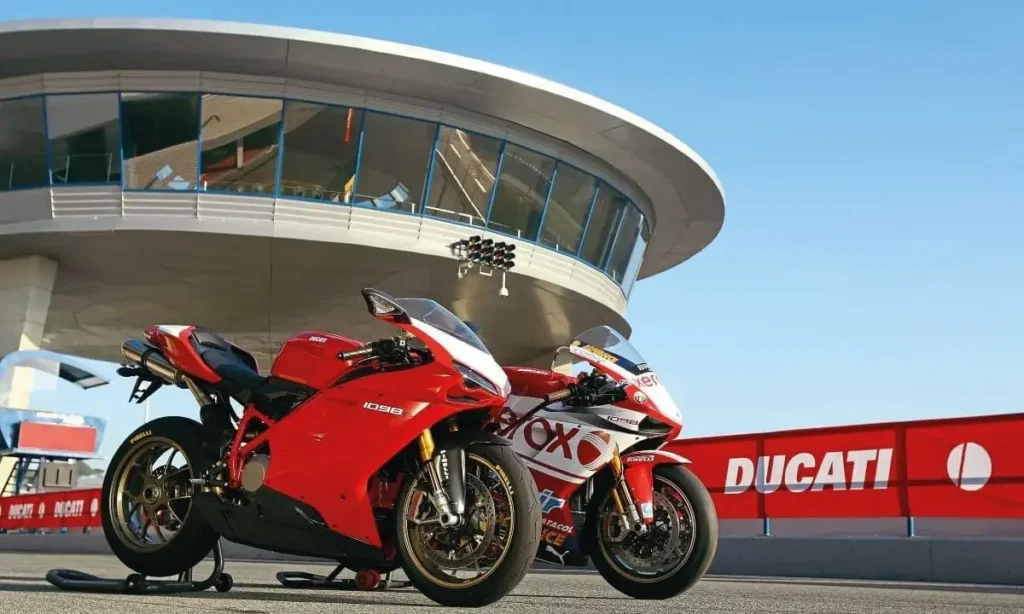
The 1198’s dry clutch — whose exposed operation behind a cover that the standard specification omitted in favour of an open view of the spinning clutch pack — provided the most immediately apparent acoustic dimension of the Ducati ownership experience and the detail whose absence from subsequent Ducati models has been mourned by the ownership community with a consistency that reflects genuine sensory loss rather than nostalgic exaggeration.
The dry clutch’s mechanical chatter at idle — produced by the clutch plates’ non-lubricated contact whose metallic sound fills urban riding environments with a mechanical soundtrack that announces the Ducati’s presence before it is seen — contributes to the 1198’s theatrical character in a manner that the wet clutch’s quieter, smoother operation that Ducati adopted for subsequent models cannot replicate. The dry clutch’s engagement feel — more abrupt than a wet clutch’s progressive take-up, more demanding of precise throttle and lever coordination from the rider — adds a layer of mechanical engagement whose mastery rewards the skilled rider with a satisfaction that the more forgiving wet clutch’s easier operation does not provide with equivalent intensity.
Performance That Defined the Superbike Standard
The 1198’s performance figures — 170 horsepower, 132 Newton-metres of torque, a 173-kilogram dry weight and a claimed top speed of 299 kilometres per hour — established the superbike segment’s benchmark at the time of its introduction and reflected Ducati’s specific philosophy of achieving maximum performance through the combination of high power and minimal mass rather than the parallel four-cylinder approach of high power from engines whose weight penalty the power output partially offset.
The 0-100 kilometres per hour time of approximately 3.1 seconds — achieved with the throttle management that the 1198’s immediate, urgent power delivery demands from the rider at low speeds — reflects a performance capability whose exploitation requires skill and commitment that the electronically managed alternatives’ intervention systems reduce to a more accessible threshold. The 1198’s performance is not particularly forgiving — the torque delivery that makes it exceptional also makes it demanding — and the riding skill that extracting its capability rewards is precisely the engagement mechanism that defines the machine’s character.
Read: Forty Years of Dominance. The Suzuki GSX-R1000 The Superbike That Changed Everything
The 1198 in the Collector Market: Appreciation Confirmed
The Ducati 1198’s current collector market position — whose well-documented, low-mileage examples in original specification command prices that have appreciated meaningfully above their original purchase figures and whose appreciation trajectory continues as the trellis frame Ducati superbike becomes increasingly recognised as the final expression of a specific engineering philosophy — reflects the automotive and motorcycle collector community’s reliable pattern of assigning premium values to the last examples of significant mechanical traditions.
The 1198 S — whose Öhlins suspension specification, Marchesini forged wheels and full electronics package represent the model’s most complete expression — carries the strongest appreciation evidence within the range, with documented examples in original specification achieving prices that contextualise the standard 1198’s own appreciation within a model family whose collector recognition is established rather than anticipated. The 1198 R — the homologation special produced in limited numbers for World Superbike competition eligibility — occupies the collector market’s most rarefied tier within the family, with documented values that reflect both its performance specification and its production scarcity.
Read: The Lightest Panigale Ever Built. The 2025 Ducati Panigale V2 S Fully Explained
Ducati 1198 — Full Specifications
| Category | Specification |
| Engine | 1,198cc Testastretta 11° L-Twin |
| Valve System | Desmodromic (4 Valves Per Cylinder) |
| Power Output | 170 hp @ 9,750 rpm |
| Torque | 132 Nm @ 8,000 rpm |
| Compression Ratio | 12.5:1 |
| Cooling System | Liquid-Cooled |
| Clutch Type | Dry Slipper Clutch |
| Transmission | 6-Speed |
| Frame | Steel Trellis |
| Front Suspension | 43mm Showa (Standard) / Öhlins (S/R) |
| Rear Suspension | Sachs Monoshock (Standard) / Öhlins (S/R) |
| Front Brake | 330mm Dual Disc — Brembo Monobloc |
| Dry Weight | 173 kg |
| Fuel Capacity | 15.5 Litres |
| Top Speed | ~299 km/h |
| 0–100 km/h | ~3.1 Seconds |
| Production Years | 2009–2011 |
| Variants | 1198 / 1198 S / 1198 R |
| Original Price (US) | Approx. $19,995 (Standard) |


One Comment