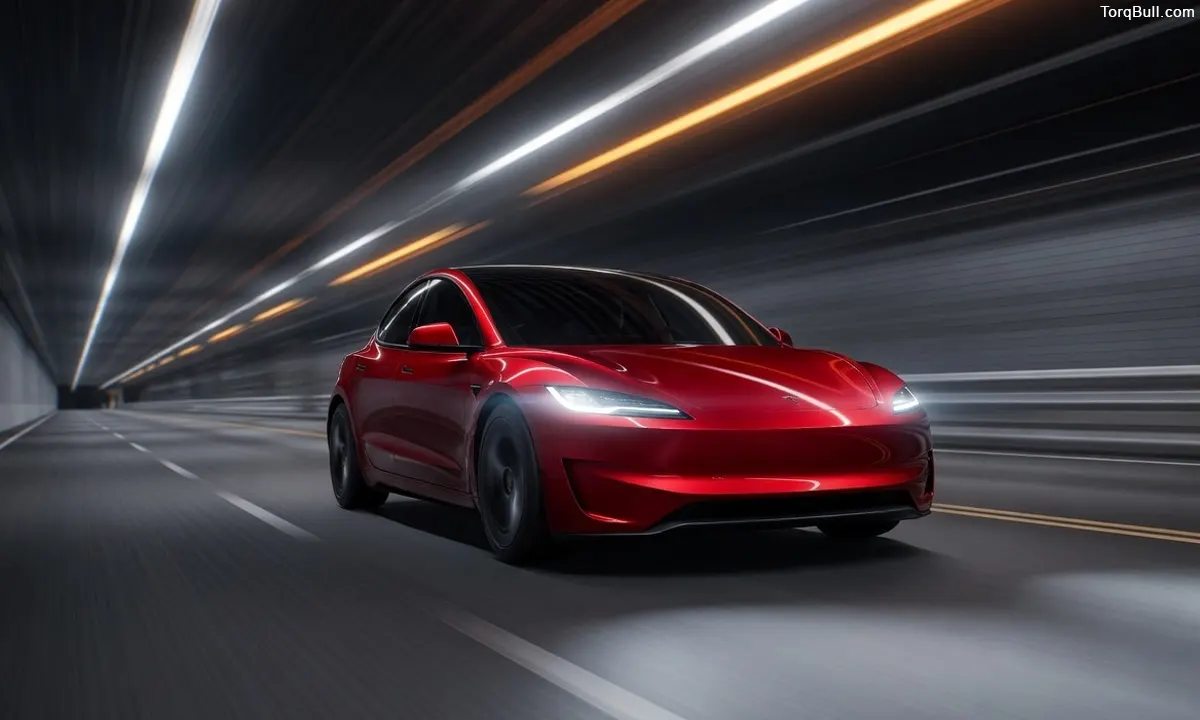
- Model 3 home charging ~4.3¢ per mile (avg rate)
- Honda Accord ~9.3¢ per mile at 33 MPG
- Off-peak/solar charging as low as ~1.5¢ per mile
- Supercharger peak rates up to ~12¢ per mile
- Costs vary by location, electricity rates and usage
Tesla Model 3 Charging Cost: The cost per mile to charge a Tesla Model 3 is the single most important operating cost figure for any current or prospective owner — because it determines the monthly fuel saving relative to a gasoline vehicle, calculates the annual operating advantage of EV ownership and reveals which charging strategy produces the greatest financial benefit across the lifetime of the vehicle. Unlike a gasoline car’s fixed fuel cost structure where the primary variable is local pump price, the Model 3’s cost per mile is genuinely variable — ranging from as little as 1.5 cents at off-peak electricity rates to as much as 12 cents at a peak-hour DC fast charger. Understanding the full range, and the specific decisions that place any owner at the low end rather than the high end, is the most practically valuable piece of Tesla ownership economics available. This guide provides every number, every calculation and every strategy.
The Foundation: How the Model 3’s Energy Efficiency Determines Cost Per Mile
Every cost-per-mile calculation begins with the Model 3’s energy consumption figure — the kilowatt-hours consumed per mile of driving — because this number, multiplied by the electricity rate, produces the cost per mile at any given charging source.
The 2026 Tesla Model 3 lineup spans three efficiency profiles that differ meaningfully based on powertrain configuration and wheel size. The Model 3 Premium RWD delivers approximately 4.1 miles per kilowatt-hour, translating to 244 watt-hours per mile — the most efficient configuration in the lineup. The Model 3 Long Range AWD delivers approximately 3.8 miles per kilowatt-hour, or 263 watt-hours per mile, with the front motor adding modest drivetrain losses at highway speed. The Model 3 Performance AWD, with its dual motors, 20-inch performance wheels and performance-oriented tyre specification, delivers approximately 3.4 miles per kilowatt-hour, or 296 watt-hours per mile — the least efficient configuration, reflecting the aerodynamic and rolling resistance penalty of its larger wheel and tyre package.
For general cost-per-mile calculations, a working figure of approximately 250 watt-hours per mile — 0.25 kilowatt-hours per mile — represents the most popular configurations accurately and is used as the primary reference throughout this guide. The formula is straightforward: cost per mile equals the electricity rate in cents per kilowatt-hour multiplied by 0.25, plus a 10 percent charging efficiency loss that accounts for heat generated during the charging process. The efficiency loss factor means that charging 75 kilowatt-hours into the battery requires approximately 82.5 kilowatt-hours of grid energy — a realistic 90 percent Level 2 charging efficiency figure.
Home Charging Cost Per Mile: The National Picture

Home charging is where the Tesla Model 3’s cost-per-mile advantage over gasoline vehicles is most compelling and most consistently realised. The national average residential electricity rate in the United States in 2026 is approximately $0.17 per kilowatt-hour according to U.S. Energy Information Administration data — though this figure masks significant state-level variation that produces very different ownership economics across the country.
At $0.17 per kilowatt-hour and 0.25 kilowatt-hours per mile with 90 percent charging efficiency, the Model 3’s home charging cost per mile is approximately 4.7 cents. Autoblog’s March 2026 analysis of the 2026 Model 3 confirms 4.3 cents per mile as the home charging cost for the Premium RWD variant at the national average rate — a figure that has been independently verified across multiple sources and represents the most widely cited reference for Model 3 operating economics.
For a driver covering 13,500 miles annually — the approximate national average — the annual electricity cost at 4.3 to 4.7 cents per mile is approximately $580 to $635, or approximately $48 to $53 per month. The average American spending $150 to $200 per month on gasoline saves approximately $100 to $150 per month simply by switching from a typical gasoline vehicle to a home-charged Model 3 — a saving of $1,200 to $1,800 per year before any maintenance cost difference is considered.
The comparison to a specific gasoline competitor makes the per-mile cost advantage concrete. A Honda Accord at 33 MPG with gasoline at $3.08 per gallon costs approximately 9.3 cents per mile to fuel — more than double the Model 3’s 4.3 cent home charging figure. A Toyota Camry at 32 MPG costs approximately 9.6 cents per mile. A Honda CR-V at 30 MPG combined costs approximately 10.3 cents per mile. The Model 3 out-performs all of them on fuel cost per mile when charged at home, by a margin of 4.6 to 6 cents per mile that accumulates to $621 to $810 in annual fuel savings against these specific competitors at 13,500 annual miles.
How State Electricity Rates Change the Cost Per Mile Dramatically
The national average masks state-level electricity rate variation that produces some of the largest regional differences in Model 3 ownership economics available across any vehicle category. A driver’s state of residence is, after their choice of charging method, the most significant determinant of their per-mile charging cost.
In low-rate states, the Model 3’s cost-per-mile advantage is at its greatest. Louisiana and Oklahoma average approximately $0.11 to $0.12 per kilowatt-hour — producing a Model 3 charging cost of approximately 3.1 to 3.3 cents per mile and a full Long Range charge cost of approximately $8.25 to $9.00. In Washington State, where abundant hydroelectric power keeps rates near $0.10 per kilowatt-hour in many utility territories, the cost per mile drops to approximately 2.8 cents — a figure that makes the Model 3 approximately 70 percent cheaper to fuel per mile than a 33 MPG gasoline vehicle at $3.08 per gallon. In North Dakota at approximately $0.13 per kilowatt-hour, the per-mile cost is approximately 3.6 cents.
In high-rate states, the per-mile advantage narrows significantly. California’s average residential electricity rate of approximately $0.29 per kilowatt-hour in 2026 produces a Model 3 charging cost of approximately 8.1 cents per mile — still cheaper than a 33 MPG gasoline vehicle at California’s average pump price of approximately $4.65 per gallon (approximately 14.1 cents per mile), but a much narrower margin than low-rate states provide. In Hawaii, where electricity rates can exceed $0.35 per kilowatt-hour, the per-mile cost rises to approximately 9.7 cents — approaching the operating cost of an efficient gasoline vehicle at mainland fuel prices. California owners who enrol in time-of-use rate plans and charge exclusively during off-peak overnight hours can access rates as low as $0.09 to $0.13 per kilowatt-hour, reducing their effective per-mile cost to 2.5 to 3.6 cents regardless of the daytime grid rate.
Tesla Model 3 Cost Per Mile — Complete Chart by Charging Method and State
| Charging Method / Location | Rate Per kWh | Cost Per Mile (RWD) | Cost Per Mile (LR AWD) | Cost Per Mile (Perf.) | Annual Cost (13,500 mi) |
| Off-peak TOU / solar home | $0.06–$0.09 | ~1.7–2.5¢ | ~1.8–2.7¢ | ~2.0–3.0¢ | ~$230–$338 |
| Low-rate state home (LA, OK, WA) | $0.10–$0.12 | ~2.8–3.3¢ | ~2.9–3.5¢ | ~3.3–4.0¢ | ~$378–$446 |
| National average home ($0.17/kWh) | $0.17 | ~4.3–4.7¢ | ~4.8–5.1¢ | ~5.4–5.8¢ | ~$580–$635 |
| California average home ($0.29/kWh) | $0.29 | ~8.1¢ | ~8.6¢ | ~9.7¢ | ~$1,094 |
| Tesla Supercharger (avg. $0.35/kWh) | $0.35 | ~9.7¢ | ~10.3¢ | ~11.6¢ | ~$1,310 |
| Tesla Supercharger (peak $0.42/kWh) | $0.42 | ~11.7¢ | ~12.3¢ | ~13.9¢ | ~$1,580 |
| Third-party DC fast charger ($0.45/kWh) | $0.45 | ~12.5¢ | ~13.2¢ | ~14.9¢ | ~$1,688 |
Calculations use 90% charging efficiency. RWD = 244 Wh/mi, LR AWD = 263 Wh/mi, Performance = 296 Wh/mi. Annual costs at 13,500 miles.
Gasoline vs Model 3: The Per-Mile Cost Comparison That Matters
The most financially relevant context for any Model 3 cost-per-mile figure is direct comparison to the gasoline vehicles it replaces — because the per-mile fuel saving, multiplied by annual mileage, is the number that appears in the owner’s bank account.
| Vehicle | Fuel Economy | Fuel Cost | Cost Per Mile | Annual Cost (13,500 mi) | vs Model 3 Home |
| Tesla Model 3 RWD (home, nat’l avg.) | 137 MPGe | $0.17/kWh | ~4.3¢ | ~$581 | Baseline |
| Tesla Model 3 RWD (off-peak TOU) | 137 MPGe | $0.08/kWh | ~2.2¢ | ~$297 | −$284/yr |
| Honda Accord (33 MPG) | 33 MPG | $3.08/gal | ~9.3¢ | ~$1,255 | +$674/yr |
| Toyota Camry (32 MPG) | 32 MPG | $3.08/gal | ~9.6¢ | ~$1,296 | +$715/yr |
| Toyota RAV4 (30 MPG) | 30 MPG | $3.08/gal | ~10.3¢ | ~$1,391 | +$810/yr |
| Toyota Camry Hybrid (52 MPG) | 52 MPG | $3.08/gal | ~5.9¢ | ~$797 | +$216/yr |
| Tesla Supercharged only ($0.40/kWh) | 137 MPGe | $0.40/kWh | ~10.0¢ | ~$1,350 | +$769/yr vs home |
Gas price: $3.08/gallon national average, October 2025. Model 3 electricity: $0.17/kWh national average at home.
The comparison between the home-charged Model 3 and the Toyota Camry Hybrid is particularly instructive — because it represents the narrowest gap between a Model 3 and its most fuel-efficient gasoline competitor. At national average home charging rates, the Model 3 saves approximately $216 per year in fuel versus the Camry Hybrid. At off-peak TOU rates, that saving expands to approximately $500 per year. At California grid rates without TOU optimisation, the Model 3 actually costs more per mile to operate than the Camry Hybrid — a scenario that illustrates why high-rate state owners should prioritise off-peak charging programmes.
Read: Tesla Model 3 Real-World Range at 75 MPH. Road Trip Planning Numbers You Actually Need
The Supercharger Cost Per Mile: Why It Matters for Road Tripping Owners
The Tesla Supercharger’s average rate of approximately $0.35 to $0.42 per kilowatt-hour produces a cost per mile of approximately 9.7 to 11.7 cents for the Model 3 RWD — two to nearly three times the home charging rate and comparable to the fuel cost of a 25 to 30 MPG gasoline vehicle at $3.08 per gallon. This comparison is critical context for road-tripping Model 3 owners who rely heavily on Supercharging during long-distance travel.
An owner who home-charges for 90 percent of their annual mileage and Supercharges for 10 percent — a reasonable representation of most Model 3 road-trip users — achieves a blended per-mile cost of approximately 5.2 cents at national average rates. An owner who Supercharges 30 percent of their annual mileage sees their blended cost rise to approximately 6.1 cents — still cheaper than most gasoline competitors but meaningfully less advantageous than an exclusively home-charged fleet. Supercharging is an indispensable road trip tool, but its per-mile cost makes it a poor substitute for home charging in everyday driving economics.
Read: Average Lifespan of Tesla Model 3 Battery in Hot Climates. The Hidden Data Every Owner Needs In 2026
Four Decisions That Lower Your Model 3 Cost Per Mile Today
Enrol in a time-of-use electricity plan. This is the highest-impact zero-cost action available to any Model 3 owner — reducing effective per-mile cost by 30 to 50 percent relative to a flat-rate plan. Most American utilities offer these plans, and the Tesla app’s scheduled charging feature automates compliance without any daily owner involvement.
Choose 18-inch wheels over larger options. The Model 3 Performance’s 20-inch wheels increase energy consumption by approximately 17 to 20 percent relative to the RWD’s 18-inch specification — the equivalent of adding 0.7 to 0.9 cents per mile purely from wheel choice. Owners who select 18-inch Photon wheels on Long Range configurations achieve the best balance of range efficiency and ride quality.
Maintain correct tyre pressure monthly. Each 10 PSI of under-inflation increases rolling resistance by approximately 1 percent, adding approximately 0.04 to 0.05 cents per mile. A monthly tyre pressure check costing 5 minutes of time is one of the easiest efficiency maintenance tasks available.
Limit Supercharging to road trips. Replacing Supercharging sessions with home Level 2 charging wherever possible reduces the blended per-mile cost toward the home charging figure. For owners whose workplace offers Level 2 charging — free or at modest rates — using workplace charging during the day and arriving home with a partially depleted battery that needs only a modest overnight top-up further reduces effective per-mile cost below the standard home rate.