- ~87% range retained at 32°F with heat pump
- Drops to ~60–70% in sub-zero temperatures
- Extreme cold increases energy use by ~36%
- Real-world range can fall to ~215 miles
- Driving habits and preconditioning help recover range
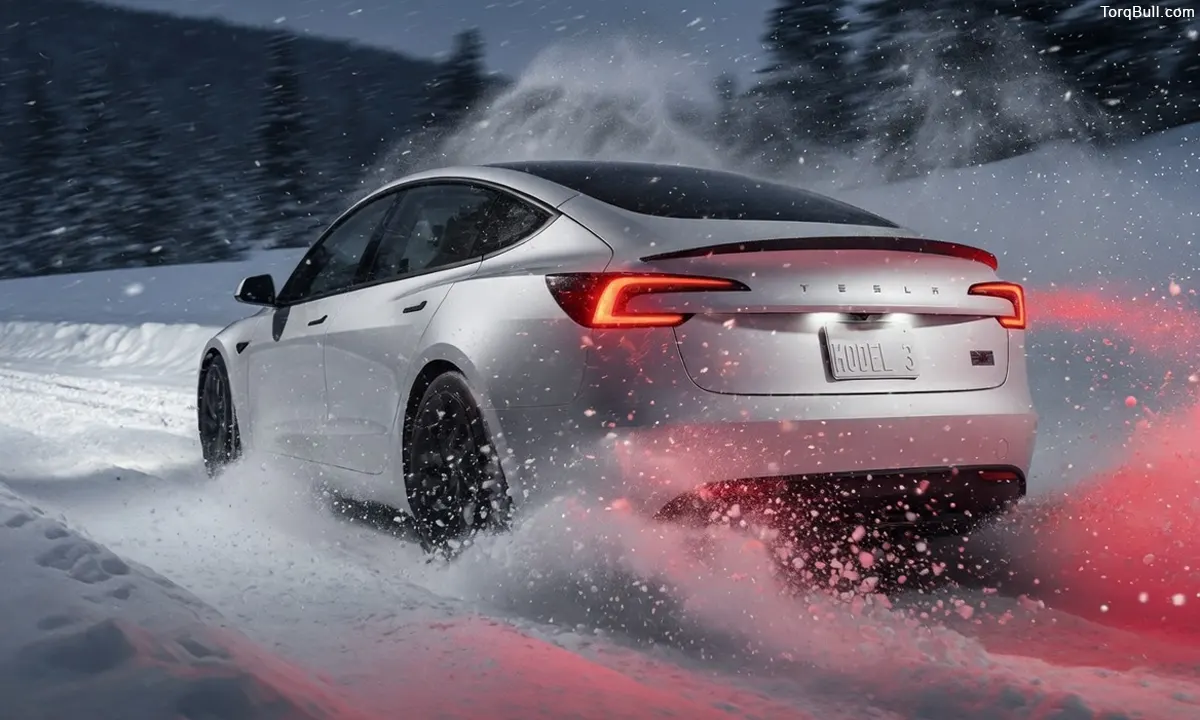
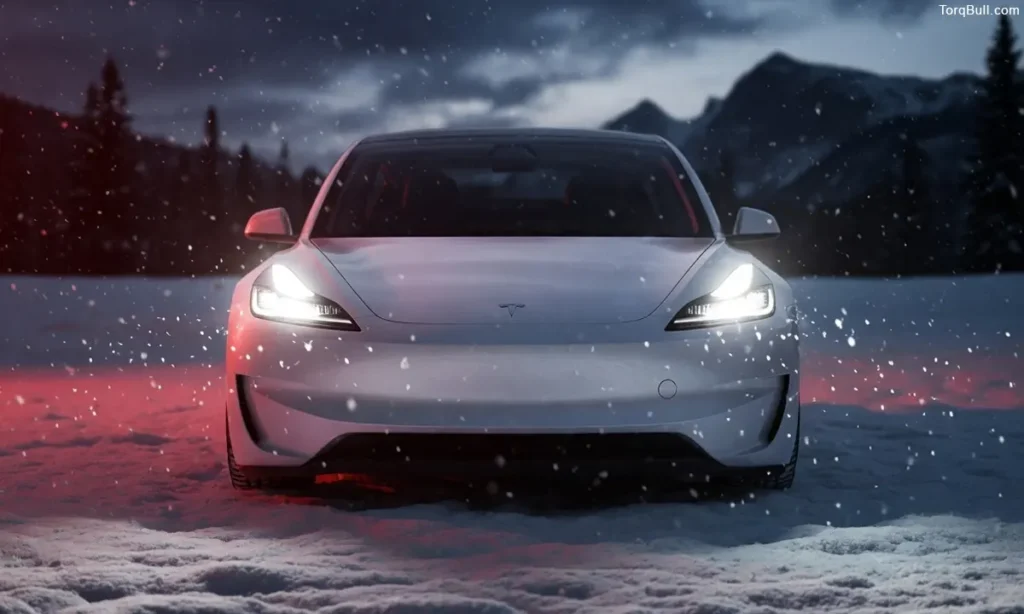
Tesla Model 3 Winter Range Loss: Cold weather is the most significant real-world variable affecting Tesla Model 3 range — more impactful than highway speed variations, heavier than cargo loads and more reliably predictable than driver behaviour differences. Every electric vehicle loses range in winter, but the Model 3’s specific combination of active liquid thermal management, heat pump HVAC on newer variants and Tesla’s sophisticated battery preconditioning system means it handles cold weather better than most EV competitors at equivalent price points. Understanding exactly how much range is lost at specific temperatures, why the loss occurs and what owners can do to reclaim it is the most practically useful winter knowledge available to any Model 3 driver in the northern United States. This guide provides all of it.
The Physics of Winter Range Loss: Why Cold Reduces EV Range
Cold weather reduces electric vehicle range through three simultaneous mechanisms, each of which consumes battery energy that would otherwise drive the wheels.
The first and most fundamental mechanism is reduced battery efficiency. Lithium-ion cells are electrochemical devices whose internal reactions slow at low temperatures, reducing the rate at which they can deliver energy. A battery at 20 degrees Fahrenheit delivers less usable power per charge cycle than the same battery at 70 degrees Fahrenheit, and it accepts charge more slowly at cold temperatures as well. The cells’ internal resistance increases with cold, consuming more energy as heat within the pack itself during discharge and reducing the effective capacity available to the drivetrain.
The second mechanism is cabin heating. A gasoline vehicle heats its cabin almost for free — the engine’s waste heat is the energy source for the heater, and that heat would be generated regardless of whether climate control is running. An electric vehicle has no combustion engine producing waste heat. Every British thermal unit of cabin warmth comes directly from the battery pack. On older Model 3 variants — those produced before Tesla’s heat pump rollout beginning in 2020 — cabin heating used resistive electric elements similar to a space heater, consuming energy in direct proportion to the temperature difference between the ambient air and the desired cabin temperature. In very cold weather, resistive cabin heating alone can consume 3 to 5 kilowatts — equivalent to adding 10 to 15 percent of the vehicle’s total energy consumption for every hour of cold-weather driving.
The third mechanism is increased rolling resistance and aerodynamic load. Cold, dense air is more resistant than warm air at equivalent speeds, increasing aerodynamic drag. Winter tyres, where fitted, add rolling resistance compared to summer compound tyres. Cold rubber in general is stiffer and less pliable, requiring more energy to deform at road contact points.
The Heat Pump Difference: Why Model Year Matters for Winter Range
The single most impactful engineering change Tesla has made to the Model 3’s cold-weather efficiency is the heat pump HVAC system, introduced across the lineup starting in 2020 and now standard on all Highland-generation variants. Understanding the difference between heat pump and resistive heating explains why two Model 3 owners in the same Minneapolis winter can have very different range experiences depending on their vehicle’s model year.
A heat pump does not generate heat directly by consuming electrical energy — it moves heat from one location to another using a refrigerant cycle, similar to how an air conditioner moves heat out of a building. In heating mode, it extracts thermal energy from the ambient air and concentrates it into the cabin, achieving a coefficient of performance greater than one — meaning it delivers more heat energy to the cabin than it consumes in electrical energy. At temperatures around 32 degrees Fahrenheit, a well-designed heat pump delivers 2 to 3 times more heat per kilowatt-hour of electrical consumption than a resistive heater. At sub-zero temperatures, the coefficient of performance decreases as the ambient air contains less thermal energy to extract, but a hybrid approach — combining the heat pump with limited resistive supplemental heating — maintains meaningful efficiency advantages even in very cold conditions.
Recharged’s analysis of winter fleet data quantifies the difference: heat-pump-equipped Model 3s retain approximately 87 percent of their warm-weather range at 32 degrees Fahrenheit, while older resistive-heating Model 3s retain approximately 79 percent at the same temperature — a difference of 8 percentage points that, on a Long Range RWD rated at 358 miles, represents approximately 28 miles of additional winter range from the heat pump alone. For buyers in the northern United States shopping used Model 3 examples, a heat-pump-equipped variant is a meaningful cold-weather advantage worth specifically identifying.
Real-World Winter Range Tests: The Specific Numbers
The most useful winter range data comes not from EPA testing — which is conducted at moderate temperatures and does not capture winter conditions — but from real-world tests conducted by automotive media and owner communities in actual cold-weather conditions.
A TFLEV cold-weather test of a Model 3 Long Range in Denver at temperatures of minus 3 degrees Fahrenheit produced one of the most cited cold-weather range results in the North American EV community. The vehicle — driven normally with cabin climate control active — showed battery consumption 36 percent higher than its established warm-weather baseline over the test loop. This translates to a theoretical full-charge range of approximately 215 miles under those conditions, compared to the vehicle’s warm-weather highway range of approximately 270 to 290 miles. The same vehicle parked overnight at minus 15 degrees Fahrenheit lost approximately 4 percent of its battery charge from standby consumption — the battery management system actively warming the pack to prevent permanent cold-damage.
Recharged’s fleet data analysis, drawing on thousands of Model 3 winter driving records, places the typical range retention at specific temperature thresholds. At 32 degrees Fahrenheit — a typical mild winter day in the Mid-Atlantic states and the Pacific Northwest — heat-pump Model 3s retain approximately 87 percent of warm-weather range, with resistive-heating older variants at approximately 79 percent. At 14 degrees Fahrenheit — common in the Midwest during January — range falls to approximately 70 to 75 percent for heat-pump vehicles, representing a loss of approximately 25 to 30 percent from the warm-weather baseline. At single-digit and sub-zero temperatures — standard January conditions in Minnesota, upstate New York and Montana — range falls to 60 to 70 percent of warm-weather figures, with drivers on Tesla Motors Club forums routinely reporting 30 percent drops on highway runs at 70 miles per hour in these conditions.
The Recurrent auto winter study of more than 30,000 vehicles in the United States for the 2025 to 2026 winter season confirms that Tesla consistently ranks among the best-performing brands for winter range retention — a result that reflects Tesla’s early and significant investment in thermal management technology, including the Octovalve system that premiered in the Model Y and migrated to the Model 3 Highland. Among EVs from major manufacturers, Tesla’s winter range retention consistently places in the top tier of real-world performance.
Read: Best Level 2 Home Charger for Tesla Model 3 With Solar Panels
Tesla Model 3 Winter Range Loss — Complete Temperature Reference Chart
| Temperature | Heat-Pump Model 3 Range Retention | Resistive Heating Model 3 Retention | Est. Range (Long Range RWD, 358 mi warm-weather) | Real-World Winter Range |
| 50°F (10°C) | ~95% | ~93% | ~340–352 miles | Minimal impact |
| 32°F (0°C) | ~87% | ~79% | ~283–311 miles | Noticeable but manageable |
| 20°F (-7°C) | ~80–85% | ~72–77% | ~258–304 miles | Plan charging stops earlier |
| 14°F (-10°C) | ~70–75% | ~65–70% | ~250–268 miles | Significant planning required |
| 0°F (-18°C) | ~65–70% | ~60–65% | ~215–250 miles | Conservative trip planning essential |
| -10°F (-23°C) | ~60–65% | ~55–60% | ~199–233 miles | Very challenging; preconditioning critical |
Estimates based on highway driving with cabin heat active. City driving with regenerative braking may retain slightly more range in cold conditions. All figures are approximations — individual results vary with speed, wind and charging habits.
Why City Driving Loses Less Range Than Highway in Winter
One counterintuitive aspect of Tesla Model 3 winter range that surprises many new EV owners is that city driving often loses proportionally less range to cold than highway driving — a reversal of the usual efficiency relationship that applies in warm weather.
In warm conditions, the Model 3 is significantly more efficient in city driving than at highway speed, because regenerative braking recovers energy during urban stop-and-go cycles that is simply lost as aerodynamic drag at highway speed. In very cold conditions, the cabin heating load is constant regardless of driving pattern — it costs the same battery energy to heat the cabin whether the car is moving at 25 miles per hour in city traffic or 70 miles per hour on an interstate. At low city speeds, aerodynamic drag is minimal, meaning the heating load represents a smaller proportion of total energy consumption proportionally. At high highway speeds, aerodynamic drag climbs significantly, adding to the already substantial heating load and compounding the total range reduction.
The practical implication is that winter commuters with primarily urban and suburban routes experience less severe winter range reduction than those making sustained highway trips in cold conditions. A Model 3 owner whose typical January day involves 20 miles of city and suburban driving from a warm garage may see only 10 to 15 percent range reduction. The same car driven 150 miles on an unprotected interstate at minus 10 degrees Fahrenheit at 70 miles per hour may experience 35 to 40 percent reduction.
Read: Average Lifespan of Tesla Model 3 Battery in Hot Climates. The Hidden Data Every Owner Needs In 2026
Five Strategies That Recover the Most Winter Range
Precondition while plugged in, every time. This is the single most effective winter range strategy available and it costs nothing beyond remembering to plug in each evening. Tesla’s Scheduled Departure feature — set in the app — warms the battery and cabin to operating temperature using grid electricity rather than battery energy before the owner’s departure time. Arriving at a warmed battery in a preheated cabin means the car begins its journey in an efficient operating state rather than spending the first 5 to 10 miles warming itself at the expense of range. Recharged’s analysis confirms that home charging with scheduled preconditioning is “the single biggest lever” available to reduce winter range loss, easily recovering 5 to 15 percentage points of winter range in everyday driving.
Use heated seats and heated steering wheel instead of full cabin heat. The heated seat elements in a Model 3 consume approximately 50 to 150 watts per seat — negligible relative to the battery’s capacity. Full cabin heat at cold temperatures on a resistive-heating system consumes 3,000 to 5,000 watts — a 20- to 100-fold difference for comparable occupant warmth. Setting the cabin temperature to a lower setpoint — perhaps 65 degrees Fahrenheit rather than 72 — and relying on the heated seat and steering wheel for personal warmth significantly reduces heating energy draw.
Display state of charge percentage rather than projected miles in winter. The Model 3’s projected mile estimate uses recent driving data and EPA-calibrated assumptions that are not adjusted for current weather conditions. A car that shows 200 miles of projected range on a minus-10 degree morning may genuinely have only 160 to 170 miles of practical range under those conditions. Switching to percentage display and planning based on known energy consumption per mile in current conditions produces more reliable trip planning than trusting a software-estimated mileage that was calibrated for moderate conditions.
Arrive at Superchargers with a low but not critically low state of charge. Cold batteries charge more slowly than warm batteries — Supercharger throughput in very cold conditions can be 20 to 40 percent lower than in warm weather until the battery reaches operating temperature. Arriving at a Supercharger with a very low state of charge in cold conditions means accepting slower initial charging rates. Arriving with 15 to 20 percent remaining allows sufficient battery energy for the thermal management system to warm the pack during the last miles of approach — particularly effective when the Supercharger destination is set in navigation, which triggers automatic battery preconditioning.
Maintain tyre pressure at or slightly above the manufacturer’s specification. Cold air causes tyre pressure to drop approximately 1 PSI for every 10 degrees Fahrenheit of temperature decrease. A tyre inflated to 45 PSI at 70 degrees Fahrenheit may read 42 PSI at 40 degrees and 38 PSI at 10 degrees — well below the efficient operating range. Under-inflated tyres increase rolling resistance, worsening the winter range penalty that cold temperatures already impose. A monthly tyre pressure check using a quality gauge, performed when the tyres are cold, and inflation to the door jamb specification prevents this silent range drain.