- Starting price and value comparison
- Engine performance and fuel efficiency differences
- Interior quality and comfort levels
- Technology and infotainment features
- Safety systems and driver assistance
- Warranty coverage and ownership benefits
- Long-term ownership cost analysis
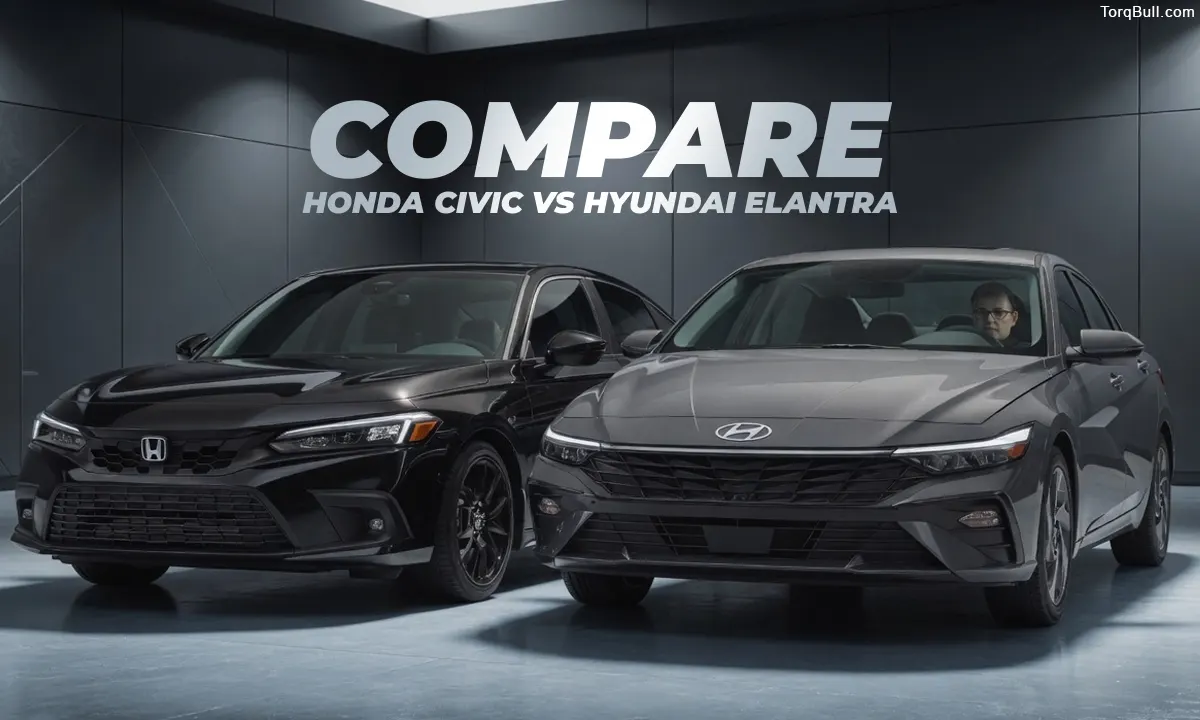
Honda Civic vs Hyundai Elantra: Two names have defined the compact sedan category in the United States for longer than most of their current buyers have been driving. The Honda Civic has held its position as the segment’s benchmark reliability pick for over five decades, earning a reputation for long-term mechanical dependability, engaging driving dynamics and resale values that depreciate more slowly than almost any other car in its class. The Hyundai Elantra has spent the past decade methodically closing the gap — arriving with sharper design, more generous standard feature lists, lower starting prices and a warranty structure that makes the Civic’s coverage look conservative by comparison. In 2026, both cars receive updates that make the contest more interesting than it has ever been, and the question of which one is better no longer has a simple or obvious answer.
The honest response, as is almost always the case when two genuinely good cars are compared at this level, is that it depends — but that it depends on specific and clearly definable priorities. This complete comparison covers every dimension that matters to a compact sedan buyer and provides a clear verdict for each category and for each buyer profile.
Price and Value: Elantra Wins at the Sticker, Civic Wins Long Term
The Hyundai Elantra enters the 2026 model year with a starting price of approximately $22,625, making it one of the most affordable compact sedans in the American market. The Honda Civic starts at approximately $24,950 in its base LX configuration — a gap of roughly $2,300 that represents a meaningful difference when both cars are being evaluated as value propositions.
The price advantage extends through the trim hierarchy. At equivalent feature levels, the Elantra consistently undercuts the Civic by $1,500 to $2,500, and the standard feature content at each Elantra trim level is frequently more generous than its Civic equivalent — including more speaker audio systems, larger touchscreens at entry level and a broader array of standard safety features. For buyers operating on a specific budget ceiling, the Elantra makes more car financially accessible.
The long-term calculation is more nuanced. The Honda Civic holds meaningfully stronger resale values — consistently placing among the top three compact sedans in long-term value retention — which partially offsets the higher initial purchase price for buyers who sell or trade within five to seven years. For buyers who keep cars for a decade or more, the equation shifts differently again, as explored in the warranty section below.
Engine and Performance: Civic Is Faster, Elantra Is More Efficient
Both cars share a broadly similar powertrain baseline in standard form. The Honda Civic LX and Sport trims use a naturally aspirated 2.0-litre four-cylinder producing 150 horsepower and 133 lb-ft of torque, connected to a continuously variable transmission. The Hyundai Elantra SE base trim uses a 2.0-litre four-cylinder producing 147 horsepower and 132 lb-ft of torque, connected to a six-speed intelligent variable transmission.
The performance numbers are nearly identical in standard form — but the character of how each car delivers its power is meaningfully different. The Civic’s CVT has drawn consistent criticism from automotive reviewers for the rubbery, disconnected sensation it creates under hard acceleration, where engine speed increases rapidly without a corresponding sense of forward momentum. The Elantra’s six-speed IVT does not fully resolve this fundamental characteristic of the transmission type, but its operation is generally perceived as more natural and less intrusive than the Civic’s implementation.
At the higher end of the powertrain hierarchy, the gap widens considerably in the Civic’s favour. The Civic Si — powered by a 1.5-litre turbocharged four-cylinder producing 200 horsepower — offers genuinely engaging performance that the Elantra N Line (available with 201 horsepower from a turbocharged 1.6-litre unit) closely matches. The Civic Type R, however, is in a different category entirely: its 315-horsepower turbocharged 2.0-litre four-cylinder makes it the fastest front-wheel-drive production car ever tested by multiple automotive publications, a title the Elantra N challenges without fully defeating. For driving enthusiasts, the Honda Civic’s performance range extends significantly higher.
Fuel Economy: Elantra Hybrid Wins Decisively at This One Category
In standard naturally aspirated form, the fuel economy contest is essentially a draw. The standard Civic returns approximately 32 city and 41 highway miles per gallon. The Elantra SE returns approximately 31 city and 40 highway — a difference too small to influence any practical purchasing decision.
The hybrid comparison produces the most dramatic divergence in the entire contest. The Honda Civic Hybrid produces 200 combined system horsepower and is rated at approximately 43 city and 47 highway miles per gallon — an impressive figure that significantly outperforms the standard Civic while delivering noticeably more performance. The Hyundai Elantra Hybrid Blue trim achieves approximately 51 city and 58 highway miles per gallon — a highway figure that is among the highest of any non-plug-in hybrid compact sedan sold in the United States. The trade-off is acceleration: the Elantra Hybrid’s 139 combined horsepower produces a 0–60 time approaching nine seconds, compared to the Civic Hybrid’s 6.1 seconds.
Buyers choosing between the two hybrids face a direct choice between fuel economy maximisation and hybrid performance capability — and both cars execute their respective positions with genuine competence.
Read: Best Commuter Cars for Gas Savings In 2026. Maximum MPG, Minimum Cost, Complete Rankings
Interior Quality and Technology: Civic Feels More Premium
The Honda Civic’s interior has been consistently rated above the Elantra’s in material quality and perceived refinement by most automotive publications. The Civic cabin uses soft-touch surfaces extensively, its switchgear has a satisfying weight and precision, and the overall dashboard design balances visual simplicity with functional clarity in a way that makes the car feel more expensive than its price suggests. The Civic Touring and Sport Touring trims include a 9-inch touchscreen with Google Built-in integration — a system that provides enhanced Google Maps, Google Assistant voice controls and Play Store app compatibility, and which stands among the most intuitive systems in the compact class.
The Elantra counters with a larger standard screen — an 8-inch display at the base SE level compared to the Civic LX’s smaller standard display — and offers a 10.25-inch touchscreen upgrade that covers more of the upper dashboard in a sweeping dual-screen layout. This visual statement impresses on first encounter, and the Elantra’s infotainment interface is genuinely competitive in responsiveness and feature depth. The Elantra also offers more front head and legroom than the Civic, and its rear seat is marginally more spacious in several dimensions — a point of practical relevance for buyers who regularly carry adult rear passengers.
Trunk space slightly favours the Civic at 14.8 cubic feet for the sedan compared to the Elantra’s 14.2. The Civic’s available hatchback body style adds meaningful cargo versatility that the Elantra’s sedan-only lineup cannot match.
Safety Technology: Elantra Has the Edge in Standard Content
Both cars include comprehensive standard safety suites. The Honda Sensing package on every Civic covers adaptive cruise control, collision mitigation braking, lane departure warning, lane keeping assist and road departure mitigation. The Hyundai SmartSense suite on every Elantra provides comparable coverage, and Edmunds’ safety technology testing has consistently rated the Elantra’s implementation as marginally more effective — specifically noting that its adaptive cruise control accelerates and brakes more smoothly and naturally, its alerts are better calibrated to produce fewer false positives and its overall driver-assistance character feels more mature and less intrusive.
The Elantra also includes safe exit alert warning — notifying occupants of approaching vehicles when opening doors — as a standard feature across more of its trim range than the Civic provides comparable functionality. For buyers who weight safety technology heavily in their decision, the Elantra’s edge in this category is real and consistently documented.
Read: Hybrid Cars With Lowest Maintenance Costs In USA. Complete 2026 Guide
Warranty and Reliability: A Critical Distinction
The warranty comparison is the most decisive single advantage the Elantra holds over the Civic. Hyundai provides a 5-year, 60,000-mile bumper-to-bumper warranty and a 10-year, 100,000-mile powertrain warranty as standard on every Elantra. Honda provides a 3-year, 36,000-mile bumper-to-bumper warranty and a 5-year, 60,000-mile powertrain warranty on every Civic.
For buyers who intend to keep their car beyond the 60,000-mile mark — a threshold typically reached in four to five years at average annual mileage — the Elantra’s powertrain warranty continues to provide coverage for twice the distance. This is not merely a specification comparison: it represents meaningful financial risk reduction during years six through ten of ownership, when powertrain repair bills can reach $2,000 to $8,000.
The counterpoint that Honda advocates correctly make is that the Civic’s long-term reliability record — backed by decades of documented high-mileage ownership — means that warranty coverage is often theoretical rather than practically applied. Consumer Reports and J.D. Power consistently place the Civic among the most reliable vehicles in its segment. The Elantra’s reliability has improved significantly over the past five years, earning above-average scores in recent J.D. Power Initial Quality studies — but the Civic’s long-term dependability track record remains the deeper and more extensively documented of the two.
2026 Honda Civic vs Hyundai Elantra — Complete Comparison Chart
| Category | Honda Civic | Hyundai Elantra |
| Starting Price | ~$24,950 | ~$22,625 |
| Base Engine | 2.0L 4-cyl — 150 hp / 133 lb-ft | 2.0L 4-cyl — 147 hp / 132 lb-ft |
| Transmission | CVT | 6-Speed IVT |
| Standard Fuel Economy | 32 city / 41 hwy mpg | 31 city / 40 hwy mpg |
| Hybrid Option | Yes — 200 hp, 43/47 mpg | Yes — 139 hp, 51/58 mpg (Blue) |
| Performance Peak | Civic Type R — 315 hp | Elantra N — ~276 hp |
| 0–60 (Hybrid) | ~6.1 seconds | ~9.0 seconds |
| Base Touchscreen | 7-inch (LX) | 8-inch (SE) |
| Top Touchscreen | 9-inch + Google Built-in | 10.25-inch dual-screen |
| Trunk Space | 14.8 cu-ft | 14.2 cu-ft |
| Rear Legroom | 37.4 inches | 38.2 inches |
| Body Styles | Sedan, Hatchback | Sedan only |
| Bumper-to-Bumper Warranty | 3 years / 36,000 miles | 5 years / 60,000 miles |
| Powertrain Warranty | 5 years / 60,000 miles | 10 years / 100,000 miles |
| Complimentary Maintenance | 2 years / 24,000 miles | 3 years / 36,000 miles |
| Resale Value | Excellent | Good — below Civic |
| Interior Material Quality | Above average — soft-touch extensive | Average — competitive |
| Safety Suite Standard | Honda Sensing — all trims | SmartSense — all trims |
| Safety Tech Effectiveness | Very good | Excellent (Edmunds rated superior) |
| Reliability Track Record | Excellent — decades documented | Good — improving |
| KBB Best Compact Car 2026 | Winner | Runner-up |
| Available as Hatchback | Yes | No |
The Verdict: Which One Is Actually Better?
The Honda Civic is better for buyers who prioritise driving dynamics, long-term proven reliability, interior refinement, stronger resale values and the option of a more practical hatchback body style. Kelley Blue Book named it the Best Compact Car for 2026 — a recognition that reflects its consistently balanced execution across every fundamental that compact sedan buyers prioritise. The Civic Hybrid’s combination of 200 horsepower and 47 highway miles per gallon makes it arguably the most complete powertrain in the segment.
The Hyundai Elantra is better for buyers who prioritise starting price, warranty length and coverage depth, rear passenger space, hybrid fuel economy maximisation and the assurance of more generous standard safety content from the first trim upward. For buyers who intend to own their car for close to or beyond 100,000 miles, the 10-year powertrain warranty is not a minor benefit — it is a substantive financial protection that the Civic cannot match.
In a segment where both cars have reached a level of competence that genuinely narrows the gap between them, neither answer is wrong. The Civic earns its reputation and its continued position at the top of most comparison tests through consistent, well-rounded excellence. The Elantra earns its growing market share through genuine value, competitive technology and the industry’s most generous warranty. The better car is the one that matches your priorities — and understanding those priorities clearly is the most useful outcome this comparison can provide.