The 2027 Kia Telluride marks the most significant generational leap in the nameplate’s fuel economy history — introducing the first-ever Telluride Hybrid alongside a redesigned 2.5-litre turbocharged four-cylinder that replaces the previous generation’s 3.8-litre V6. The result is two very different fuel economy profiles within the same vehicle family: a gas-only Telluride that performs similarly to its V6 predecessor in city driving but improves on the highway, and a hybrid Telluride that Edmunds describes as a massive leap in efficiency for a big family hauler that seats eight. Understanding the city versus highway breakdown for both powertrains determines the real-world annual fuel cost for any specific buyer’s driving pattern.
2027 Kia Telluride Gas Engine: City vs Highway Breakdown
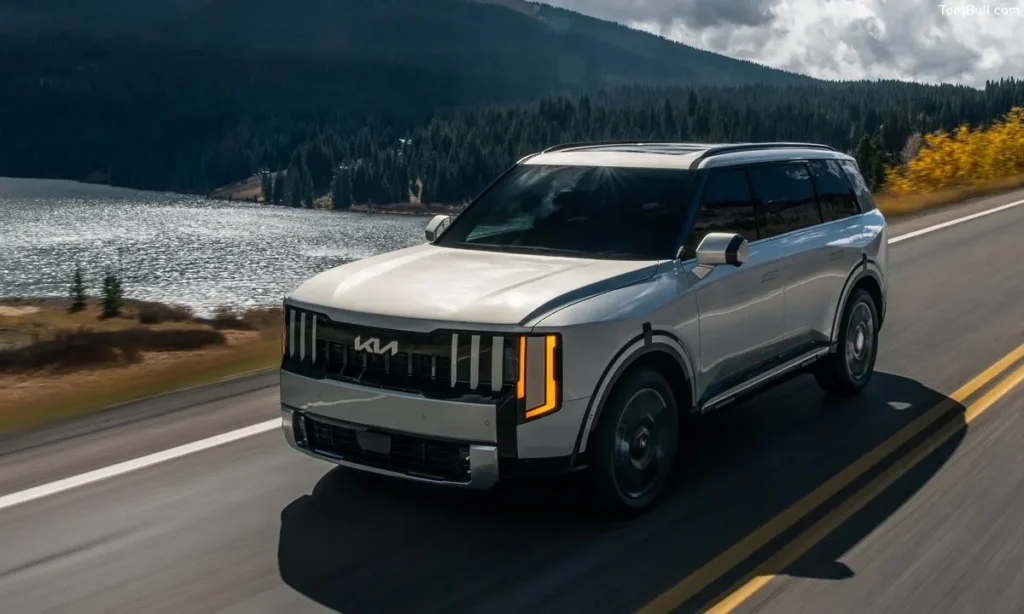
The 2027 standard Telluride uses a 2.5-litre turbocharged four-cylinder producing 274 horsepower and 311 pound-feet of torque, paired with an eight-speed automatic transmission. All-wheel drive is available across the lineup alongside front-wheel drive.
The EPA fuel economy estimates for the gas Telluride place city driving at approximately 18 MPG and highway driving at approximately 24 MPG — producing a combined figure of approximately 20 to 22 MPG depending on drivetrain configuration. The 6 MPG gap between city and highway figures follows the conventional pattern of a turbocharged gasoline engine: more efficient at sustained highway speeds where the engine operates near its peak efficiency range, and less efficient in stop-and-go city conditions where the turbocharger cannot sustain boost pressure continuously.
A real-world highway test published in May 2026 — specifically designed to answer whether the 2027 gas Telluride could exceed its EPA highway figure of 24 MPG — produced results confirming the turbo four-cylinder performs better than expected in steady-state highway driving. This suggests the EPA highway figure may be conservatively calibrated, and that owners who maintain moderate highway speeds of 65 to 70 MPH in typical conditions can approach or modestly exceed the 24 MPG estimate on flat terrain.
Read: Kia Telluride vs Toyota Highlander: Which Three-Row SUV Is Actually Better?
2027 Kia Telluride Hybrid: The City vs Highway Reversal

The 2027 Telluride Hybrid’s city versus highway fuel economy profile follows the pattern characteristic of all hybrid systems — and it is one of the most practically significant aspects of the hybrid’s real-world ownership case.
Kia’s official EPA estimates for the Telluride Hybrid FWD configuration reach approximately 34 MPG city and 36 MPG highway — producing a 35 MPG combined figure. AWD configurations carry an EPA estimate of approximately 31 MPG combined. The FWD Hybrid’s city-favoured efficiency profile — 34 MPG city against 36 MPG highway — produces only a 2 MPG gap between the two environments, reflecting how effectively the hybrid’s regenerative braking system converts city deceleration events into stored electrical energy.
Edmunds confirms the Telluride Hybrid’s EPA-estimated fuel economy at up to 35 MPG combined for front-wheel drive versions and 31 MPG combined with all-wheel drive — noting this as up to 13 MPG better than the regular gas-powered Telluride. Kia’s official website confirms the 35 MPG combined headline for the most efficient configurations.
For families whose driving pattern is primarily urban — school runs, errands and suburban commutes with frequent stops — the hybrid’s city efficiency advantage over the gas model is most pronounced. The gas Telluride at 18 MPG city versus the hybrid’s 34 MPG city is a 16 MPG difference in the environment where most families accumulate most of their daily mileage.
Read: 2027 Kia Telluride Driving Comfort on Highways. Is It The Best In Class?
2027 Kia Telluride Fuel Economy — Complete City vs Highway Chart
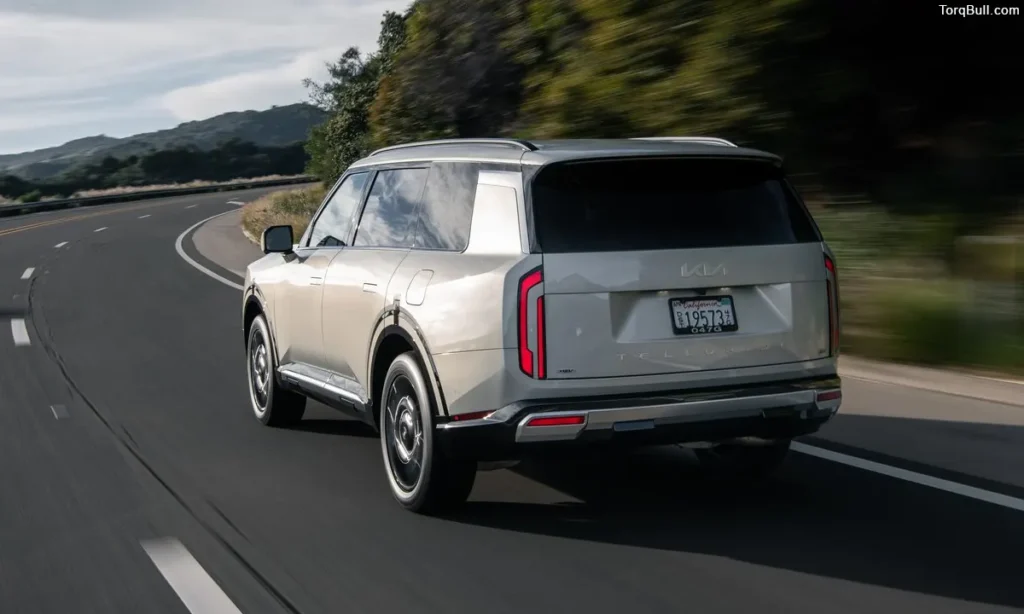
| Configuration | EPA City | EPA Highway | EPA Combined | Annual Fuel Cost* | Best For |
| Gas FWD (2.5L Turbo) | ~19 MPG | ~24 MPG | ~22 MPG | ~$2,100 | Towing-priority buyers |
| Gas AWD (2.5L Turbo) | ~18 MPG | ~24 MPG | ~20 MPG | ~$2,310 | AWD + simple ownership |
| Hybrid FWD (2.5L Turbo + electric) | ~34 MPG | ~36 MPG | ~35 MPG | ~$1,320 | City commuters, fuel savings |
| Hybrid AWD (2.5L Turbo + electric) | ~30 MPG | ~32 MPG | ~31 MPG | ~$1,492 | All-weather + efficiency |
Annual fuel cost calculated at $3.08/gallon and 15,000 miles per year at respective EPA combined figures.
What the City vs Highway Gap Means for Your Annual Budget
The practical financial consequence of the 2027 Telluride’s city versus highway split becomes clear when annual mileage is applied to both powertrains.
A family driving 15,000 miles annually at a mix of 60 percent city and 40 percent highway at the gas model’s figures — approximately 18 MPG city and 24 MPG highway — achieves a blended real-world average of approximately 20 MPG. At $3.08 per gallon, annual fuel cost is approximately $2,310. The Hybrid FWD in the same driving pattern achieves a blended average of approximately 34.8 MPG — an annual fuel cost of approximately $1,328. The annual hybrid fuel saving is approximately $982, accumulating to approximately $4,910 over five years. The hybrid powertrain’s approximately $5,000 to $7,000 premium over the equivalent gas configuration therefore achieves effective fuel payback within five to seven years at current fuel prices — a reasonable long-term value proposition for buyers planning extended ownership.
For buyers in states with higher gasoline prices — California, Hawaii and parts of the Northeast where regular gasoline frequently exceeds $4.00 per gallon — the hybrid payback period shortens proportionally and the annual fuel saving against the gas model can exceed $1,400.
Read: 2027 Kia Telluride Redefines the Modern Family SUV with Hybrid Power
The Hybrid’s City Advantage: Why Stop-and-Go Driving Favours the Telluride Hybrid

The 2 MPG gap between the Telluride Hybrid’s city and highway figures — compared to the gas Telluride’s 6 MPG gap — reflects the fundamental operating advantage of hybrid technology in urban environments. The hybrid system pairs the 2.5-litre turbocharged engine with two electric motors and a lithium-ion battery that captures kinetic energy during braking — energy that the gas Telluride dissipates entirely as heat.
In city driving with frequent deceleration events at traffic signals and intersections, this regenerative recovery meaningfully supplements battery charge that powers electric motor assistance during subsequent acceleration. The electric motors reduce how much the combustion engine must contribute at low speeds, producing the 34 MPG city figure that is substantially better than the 36 MPG highway figure on a proportional basis despite the higher inherent energy demands of stop-and-go versus steady-state driving.
Kia’s hybrid battery is covered under a 10-year, 100,000-mile warranty — the industry’s most comprehensive hybrid battery coverage — providing long-term ownership confidence that complements the fuel economy advantage across the full anticipated ownership period.