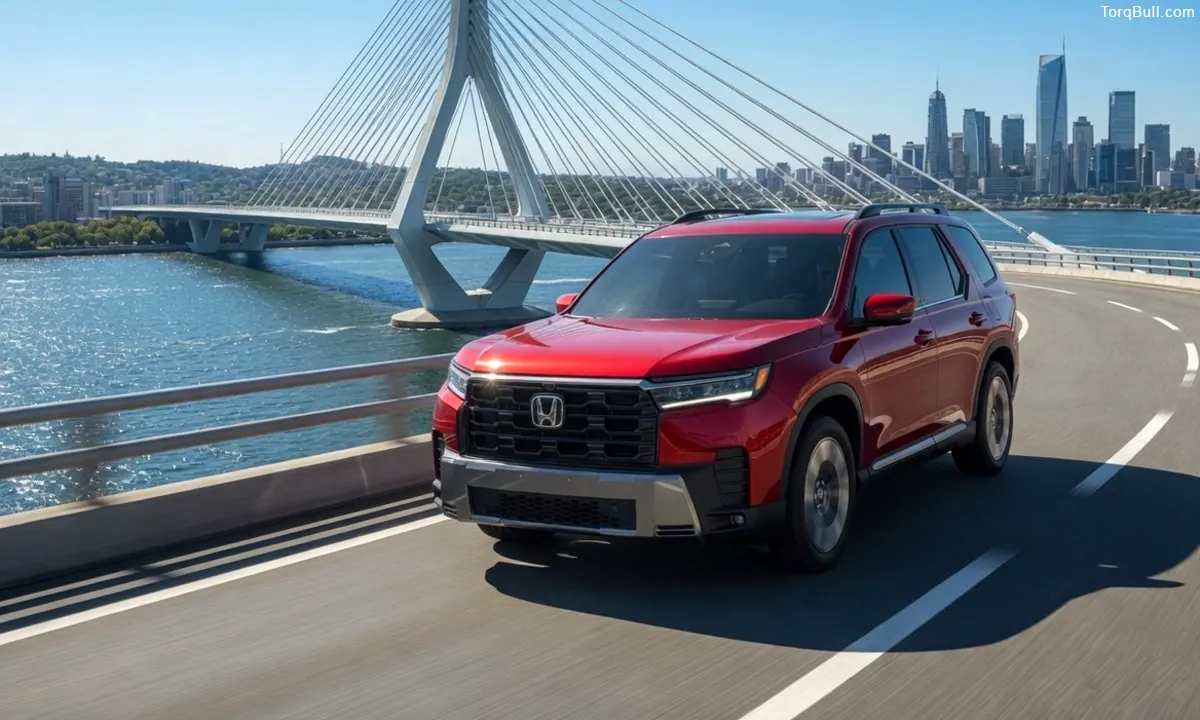
- 2026 Honda Pilot starts at $43,690, seats up to 8, and delivers ~22 MPG combined (FWD)
- Strong family focus: standard Honda Sensing safety tech and practical, family-oriented design
- Key drawbacks: no hybrid option, higher starting price vs rivals, and reported brake/software issues
Choosing a first three-row SUV is one of the most significant automotive decisions a growing family makes — and the Honda Pilot is consistently one of the first vehicles that appears in the research process, because the Honda name carries a reliability association that first-time SUV buyers find reassuring. The 2026 Pilot’s fourth-generation design is a genuine advancement over its predecessors: a quieter cabin, improved steering feel, larger screens, standard power tailgate across all trims and wireless Apple CarPlay and Android Auto now standard. For a first-time SUV buyer transitioning from a sedan or smaller crossover, the Pilot represents a comprehensive, well-established family hauler whose core competencies — passenger space, safety technology and everyday usability — are genuinely strong. But the first-time buyer who enters this purchase without understanding the Pilot’s specific limitations and higher price relative to competitors may arrive at a purchase decision that a more complete picture would have modified. This guide provides that complete picture.
Why the Honda Pilot Appeals to First-Time SUV Buyers
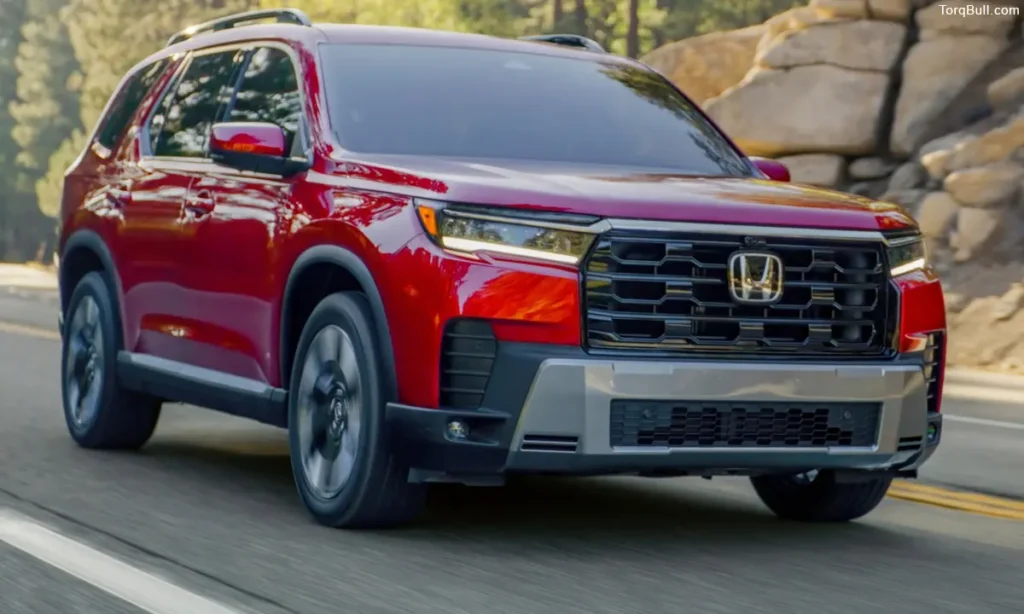
The Safety Technology Foundation Every First-Time Buyer Needs
For a buyer who has never owned a three-row SUV, Honda Sensing as standard equipment across every 2026 Pilot trim is the most immediately reassuring feature in the lineup. Honda Sensing covers automatic emergency braking with pedestrian detection, lane departure warning with lane-keeping assist, adaptive cruise control with stop-and-go capability, road departure mitigation and front and rear parking sensors across applicable trims. This comprehensive safety suite — available without requiring upper-trim selection — means the first-time SUV buyer receives genuine collision prevention technology regardless of which Pilot configuration fits their budget.
The U.S. News safety score for the 2026 Pilot reflects this comprehensive safety standard equipment alongside NHTSA’s crash test results, placing the Pilot among the better-performing vehicles in its class for passive safety as well as active avoidance technology. For buyers making their first purchase of a vehicle substantially larger than their previous car, the confidence that Honda Sensing provides during lane changes, parking manoeuvres and highway merges is particularly relevant and genuinely useful during the adaptation period to a longer, wider vehicle.
Interior Space That Families Actually Use — All Three Rows
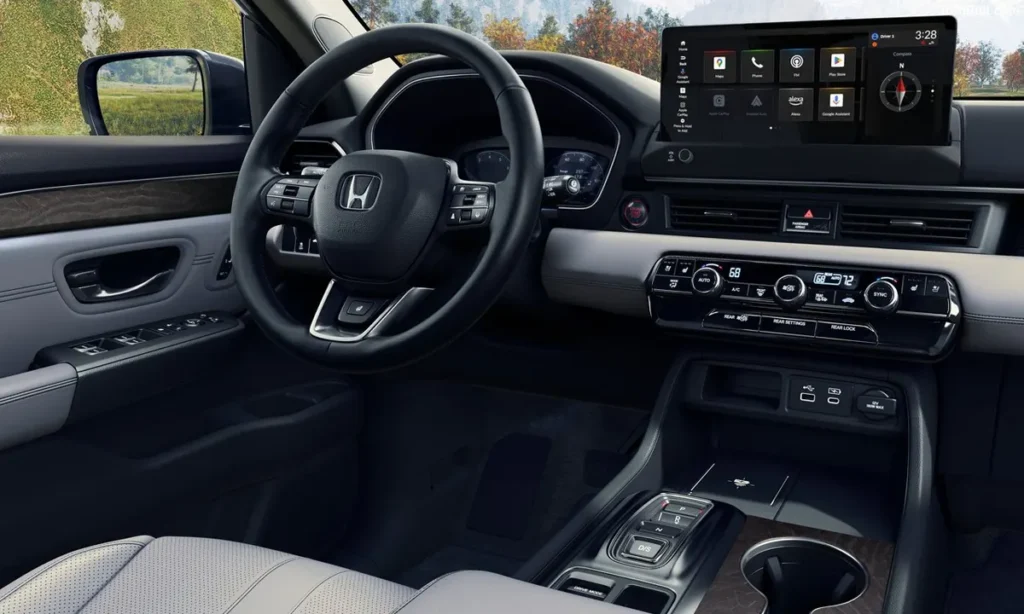
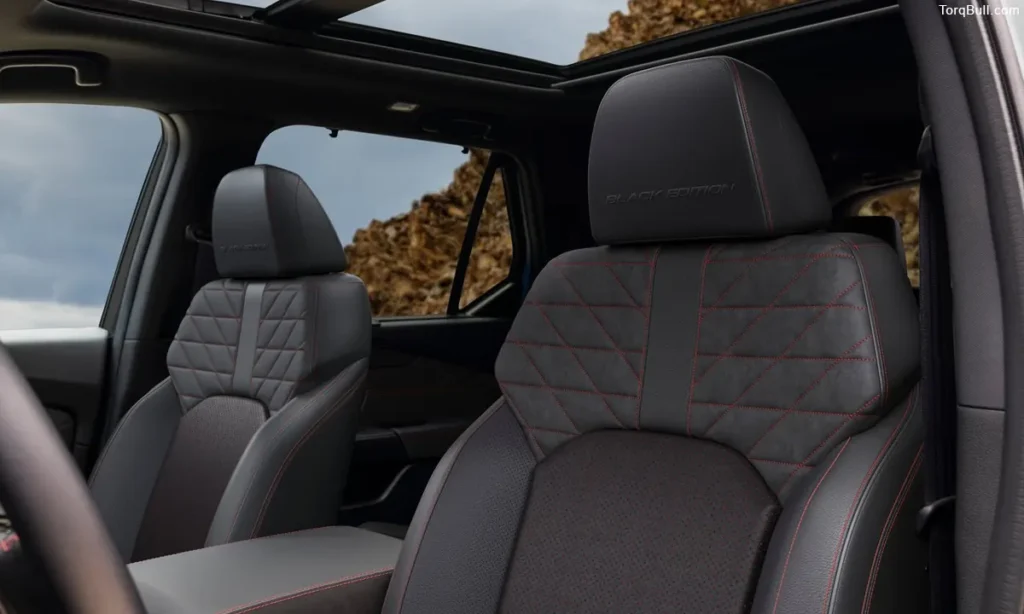
The most consistent and most consequential praise in Honda Pilot professional and owner reviews is its interior packaging — specifically the fact that all three rows can actually accommodate adults. Autoblog’s 2026 Pilot review notes the surprising discovery that all three rows can fit adults, with even the third row avoiding the padded oubliette description that applies to so many three-row competitors. The Pilot provides 154 cubic feet of total passenger volume — one of the largest interior volumes in the class — with 87 cubic feet of cargo space with the back two rows folded.
The removable second-row centre seat is the feature that JD Power’s expert reviewer specifically identifies as the Pilot’s killer app — noting it is the only SUV in the segment, except the related Acura MDX, with a seat that removes entirely and stows under the cargo floor rather than simply folding flat. This flexibility allows the Pilot to serve as a seven-passenger captain’s chair SUV, an eight-passenger bench-configured vehicle or a wide-aisle people-mover depending on the moment — a versatility that families with varying passenger counts appreciate across the ownership period. For a first-time SUV buyer with children, this seating flexibility is a genuinely daily-useful feature.
Driving Ease That Makes the Size Manageable
A first-time SUV buyer’s most immediate practical challenge is managing a vehicle substantially larger than their previous car in parking lots, urban streets and tight residential neighbourhoods. The Pilot’s driving character — specifically its light steering, smooth ride quality and accessible visibility from the elevated seating position — makes this transition more approachable than many competing three-row SUVs of equivalent dimensions.
Autoweb’s extended test describes the Pilot as a big, softly sprung SUV where comfort and refinement came first — a characterisation that specifically benefits new SUV drivers who are more concerned with manageable everyday usability than with sporting dynamics. CarBuzz’s 2026 first drive records a 0-60 time of 7.67 seconds — adequate and unsurprising for a family hauler of this size — alongside praise for the Pilot’s willingness to change direction with decisive eagerness for a big honking SUV. Autoblog’s reviewer specifically notes the light steering encourages responsible adult behaviour — exactly the character that new SUV owners adapting from smaller vehicles find most comfortable initially.
Read: Which Honda Pilot Variant Offers the Best Value? The Complete 2026 Trim-by-Trim Breakdown
Where the Honda Pilot Creates Challenges for First-Time Buyers
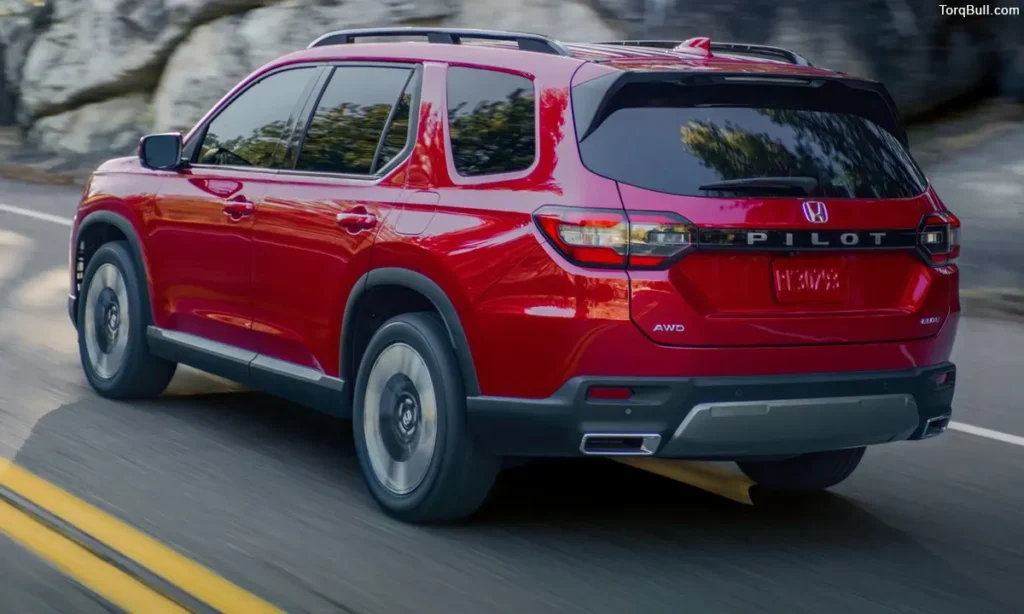
Higher Starting Price Than Direct Competitors
The 2026 Honda Pilot starts at $43,690 for the Sport trim — more expensive than several segment competitors that offer comparable or greater feature content at lower entry prices. The 2027 Kia Telluride starts below the Pilot. The Toyota Grand Highlander provides more interior space and cargo volume at comparable pricing. CarBuzz’s first drive review specifically identifies pricing as a concern, and Autoblog confirms the base price starts noticeably higher than its similarly family-friendly competition.
For first-time SUV buyers working within a specific budget, the Pilot’s higher starting price means less feature content per dollar spent at equivalent configurations relative to Korean and even some American alternatives. Buyers paying the Pilot’s premium should be confident they specifically value the Honda reliability heritage and ownership experience rather than assuming the higher price necessarily translates to superior features or performance across all categories.
No Hybrid Option in a Segment Where Hybrids Are Increasingly Standard
The 2026 Honda Pilot’s most consistent competitive disadvantage — noted by virtually every professional review — is the absence of a hybrid powertrain in a segment where Toyota, Hyundai, Kia and Mazda all offer hybrid alternatives. At 22 MPG combined FWD and 21 MPG combined AWD, the Pilot trails the Toyota Highlander Hybrid’s 35 MPG combined by 13 MPG — a difference that accumulates to approximately $700 in annual fuel savings at average American mileage.
For a first-time buyer focused on long-term operating costs, this fuel economy gap means the Pilot’s total cost of ownership over five years includes substantially more in fuel spending than hybrid alternatives would require. CarBuzz notes this limitation directly, and the Autoblog review states plainly that the Pilot’s lack of a hybrid powertrain continues to hold it back. A buyer choosing the Pilot in 2026 is accepting a conventional V6 ownership experience — smooth and reliable but not efficient — in a market where comparable vehicles have moved to hybrid technology.
Software and Water Ingress Complaints in Owner Reviews
Edmunds’ aggregated owner review summary for the 2026 Pilot notes mixed overall sentiment — with many owners praising the smooth ride and spacious interior while others document serious complaints about faulty brakes, software glitches, water leaks and poor customer service response. One verified Edmunds owner who purchased a new 2026 Pilot describes discovering water in the driver’s floorboard after the first rain and water in the lower trunk space from heavy leaking — attributing the issue to seal quality. The same owner later found equivalent water ingress in the dealer’s loaner 2025 Pilot, raising concern about whether the issue is production-wide.
Software glitches including infotainment system freezes are also documented in multiple reviews. For a first-time SUV buyer who expects a new vehicle to perform reliably from delivery — and who may not have previous experience evaluating warranty claim processes — these documented quality concerns represent a meaningful consideration that should be understood before purchase.
2026 Honda Pilot: First-Time Buyer Assessment Chart
| Category | Rating | First-Time Buyer Relevance |
| Honda Sensing standard safety | Excellent | Confidence-building for new large-SUV drivers |
| Three-row adult seating | Very Good | Autoblog: all three rows fit adults |
| Removable 2nd-row centre seat | Excellent | Only SUV in class with this flexibility |
| Ease of driving / steering | Very Good | Light, smooth; manageable for first-time buyers |
| Starting price ($43,690) | Below average | Higher than Telluride, Grand Highlander at entry |
| Hybrid powertrain availability | Poor | No hybrid option; 22 MPG combined vs 35 MPG hybrid rivals |
| Fuel economy (21–22 MPG) | Below average | Competitive disadvantage in era of segment hybrids |
| Cargo space (87 cu ft max) | Very Good | Competitive; Grand Highlander has more |
| Towing capacity (5,000 lbs) | Good | AWD required; competitive with segment |
| Owner review quality concerns | Moderate | Water leaks, software glitches documented |
| 10-speed automatic smoothness | Good | Smooth shifting; downshift hesitation noted |
| Standard power tailgate (2026) | Very Good | New for 2026; all trims now included |
| Interior material quality | Average | CarBuzz notes competitors feel more premium |
Read: Toyota Highlander vs Honda Pilot Reliability. News Scores and the Complete 2026 Verdict
The Honest Verdict: Is the Pilot Right for Your First SUV?
The Honda Pilot is a genuinely good choice for first-time SUV buyers who prioritise specific attributes: Honda’s reliability heritage, a straightforward and manageable driving experience in a large three-row body, genuinely adult-friendly interior packaging including the segment-exclusive removable second-row seat and comprehensive standard safety technology. For buyers who value the Honda brand’s documented long-term reliability track record and want a no-frills family workhorse that handles the daily logistics of family life without requiring driver adaptation beyond vehicle size, the Pilot delivers what it promises.
It is a less appropriate first SUV for buyers whose priority is maximum value per dollar at entry price — where the Kia Telluride and Toyota Grand Highlander provide comparable or superior feature content at lower prices. It is also a questionable choice for fuel-economy-conscious first-time buyers who have tracked hybrid SUV efficiency improvements and want to capture the 35 MPG combined that the market’s best hybrid three-row SUVs now achieve. And buyers who want a premium interior feel commensurate with a $45,000 to $55,000 price point may find the Pilot’s interior materials and perceived quality below expectations compared to Hyundai Palisade or Mazda CX-90 alternatives.
The JD Power assessment captures the most balanced and most accurate verdict: overall more than adequate for most drivers, but not particularly impressive — well suited to its role as a family SUV. For first-time buyers whose primary requirement is a reliable, safe and spacious family vehicle from a brand with a track record they trust, this adequacy is exactly what they are buying. For buyers who want more than adequacy, the competitive landscape in 2026 offers alternatives that are worth examining before committing.