Air Suspension vs Traditional Suspension: Which Is Better for Your Car in 2026?
- Air suspension auto-levels and adjusts ride height instantly
- Provides superior comfort and load handling
- Traditional springs are simpler, cheaper and more durable
- Maintenance and repair costs differ significantly
- Choosing depends on usage, comfort needs and budget
Air Suspension vs Traditional Suspension: Every vehicle on the road sits on a suspension system whose fundamental job has not changed in a century of automotive engineering: absorb road imperfections, keep the tyres in contact with the road surface and provide the occupants with a ride quality that makes the journey tolerable. What has changed dramatically — particularly in the last decade — is the sophistication with which that job can be accomplished. Air suspension, once restricted to air-ride limousines, heavy commercial trucks and a handful of ultra-premium passenger cars, has migrated steadily down the market into mainstream luxury SUVs, high-riding trucks and even performance sedans, where its ability to adapt continuously to road conditions and loading requirements has made it genuinely transformative. Traditional steel-spring suspension, meanwhile, remains the dominant system across the vast majority of vehicles sold globally, valued for its mechanical simplicity, long-term reliability and low maintenance cost. Understanding what each system actually delivers — and what each costs to own over time — is one of the most practically useful pieces of knowledge any car buyer can carry into a purchase decision.
How Traditional Suspension Works
Traditional suspension systems use steel coil springs, leaf springs or torsion bars as the primary load-bearing elastic element — a passive mechanical component that compresses under load and rebounds to its natural length when load is removed. The spring rate — a measure of how much force is required to compress the spring by a given distance — is fixed at the point of manufacture and determines the fundamental ride and handling character of the vehicle. A stiffer spring rate provides better body control during cornering but transmits more road surface variation to the occupants. A softer spring rate provides a more compliant ride over rough surfaces but allows more body roll during directional changes. Every conventional suspension design is a compromise between these competing demands, made once at the engineering stage and fixed for the life of the component.
Dampers — commonly called shock absorbers — work alongside the springs to control the rate at which the suspension moves. They convert the kinetic energy of suspension movement into heat through hydraulic resistance, preventing the vehicle from continuing to oscillate after encountering a bump. Traditional dampers are hydraulic devices filled with oil, requiring no electrical power, no sensors and no control systems. Together, a steel spring and a conventional hydraulic damper form one of the most mechanically reliable assemblies in automotive engineering — a system with no electronic components to fail, no compressed air to leak and no complex control algorithms to develop faults.
How Air Suspension Works
Air suspension replaces the steel spring with an air spring — a reinforced rubber bellows filled with compressed air from an onboard compressor. The fundamental elastic element is not steel but air pressure: varying the pressure within the air spring changes the effective spring rate and the ride height of the vehicle simultaneously. An electronic control system — typically receiving inputs from ride height sensors at each corner of the vehicle, vehicle speed, steering angle and driver-selected modes — manages compressor operation and valve positions to maintain the desired ride height and adapt the suspension character to changing conditions continuously.
Modern air suspension systems, such as those fitted to the Range Rover, Mercedes-Benz GLE, BMW 7 Series and Audi A8, adjust ride height in response to speed — lowering the vehicle at highway speeds to reduce aerodynamic drag and improve stability, raising it at lower speeds to improve ground clearance on uneven surfaces. They automatically compensate for passenger and cargo load, maintaining a consistent ride height regardless of whether the vehicle carries one person or five, an empty boot or a full load. And they can adjust the effective spring rate dynamically — softening for rough road surfaces and stiffening for spirited driving — in ways that no passive steel spring can replicate regardless of its specification.
Ride Quality: Where Air Suspension Wins Most Convincingly
The most immediately perceptible difference between air and traditional suspension is ride quality — and on this dimension, a well-calibrated air suspension system delivers a superiority that is not subtle or marginal. The ability to soften the effective spring rate for low-speed urban driving while maintaining the body control necessary for higher-speed highway travel, without the driver needing to select a mode or make any input, produces a ride quality that passive spring systems simply cannot match. Road and Track’s long-term vehicle evaluations consistently describe the air-suspended Range Rover and Mercedes S-Class as delivering a quality of ride isolation that vehicles with conventional springs in the same price bracket cannot approach.
The load-levelling function is particularly significant for SUV and truck buyers. A conventional leaf-spring or coil-spring rear suspension sags visibly when loaded — changing the vehicle’s geometry, its headlight aim and its handling balance in ways that require driver compensation. Air suspension maintains consistent ride height under any load condition automatically, with no driver input and no geometric compromise. For buyers who regularly carry heavy loads, tow trailers or frequently transport a full complement of passengers, this capability has practical value that extends beyond comfort into safety.
Handling and Performance: Traditional Suspension’s Counter-Argument
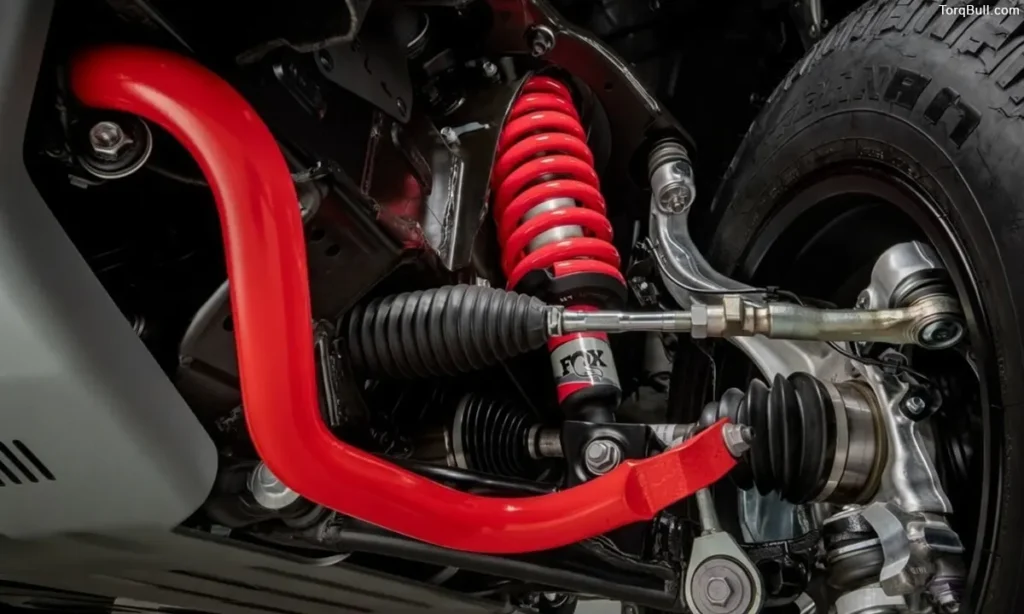
The area where traditional suspension defends its position most effectively against air suspension is in pure handling performance — and the defence is strongest in dedicated sports cars and performance vehicles where the predictability, consistency and weight of the suspension system are primary engineering concerns.
A fixed steel spring with a known spring rate responds identically to every input in every condition. It carries no compressor weight, no valve weight, no sensor weight and no control system weight — relevant advantages in vehicles where unsprung mass and total weight are optimised for dynamic performance. The Porsche 911, the Toyota GR86, the Honda Civic Type R and every other dedicated driver’s car in the performance segment uses traditional spring-and-damper systems — frequently upgraded with adaptive dampers that adjust hydraulic resistance electronically — because the mechanical purity and feedback of a well-engineered conventional suspension is what communicates road information to the driver with the accuracy that performance driving demands.
Adaptive damper systems — such as Porsche’s PASM, Mercedes’s ADS+ and BMW’s Adaptive M Suspension — provide much of air suspension’s adjustability in the damping domain without replacing the spring with air, offering a middle-ground technology that delivers meaningful ride quality adaptation while preserving the mechanical integrity of the traditional suspension architecture. Many contemporary performance vehicles combine conventional springs with electronically controlled adaptive dampers as the optimal balance between adjustability and dynamic performance.
Read: AWD vs RWD Performance Track Comparison. The Track Tells The Truth
The Reliability and Maintenance Reality: What Air Suspension Actually Costs
The fundamental long-term ownership trade-off between air and traditional suspension is reliability and maintenance cost — and the data from real ownership is clear. Air suspension systems are substantially more expensive to repair when they fail than traditional suspension components, and they fail more frequently because they contain more components that can malfunction.
The air compressor — which runs regularly to maintain pressure in the air springs — is subject to wear and eventual failure, with replacement costs typically ranging from $400 to $900 depending on vehicle. Air spring bladders — the reinforced rubber bellows that contain the pressurised air — develop leaks over time, particularly in cold climates where the rubber becomes less flexible, with individual air spring replacement costs ranging from $300 to $700 per corner. The ride height sensors, control module, air distribution valves and associated wiring all represent additional failure points that traditional suspension systems do not contain.
A vehicle with failed air suspension may sit at an incorrect ride height, produce a harsh and uncomfortable ride as it defaults to a rigid state, or illuminate warning lights and restrict vehicle operation until the fault is addressed. Traditional steel spring failure — a broken spring or a worn damper — is both less common and less operationally disruptive when it does occur, typically manifesting as a gradual change in ride character rather than an immediate system fault requiring urgent attention.
Over a ten-year, high-mileage ownership period, the total maintenance cost difference between an air-suspended luxury vehicle and a comparable conventionally-sprung vehicle can reach $3,000 to $8,000 in air suspension-specific repair costs — a figure that is material in any total cost of ownership calculation.
Read: Regenerative Braking Efficiency Comparison In 2026 That Reveals Which Cars Waste the Least Energy
Air Suspension vs Traditional Suspension — Complete Comparison Chart
| Category | Air Suspension | Traditional Suspension |
| Ride Quality | Superior — adapts continuously | Good to excellent — fixed compromise |
| Load Levelling | Automatic, seamless | Manual adjustment or geometry change |
| Ride Height Adjustment | Yes — speed, load and mode dependent | No — fixed at manufacture |
| Handling Feedback | Good — varies by calibration | Excellent — mechanical directness |
| System Weight | Higher — compressor, tanks, sensors | Lower — springs and dampers only |
| Failure Points | Multiple — compressor, bladders, sensors, valves | Minimal — spring and damper |
| Average Repair Cost | $600–$2,500+ per incident | $150–$600 per incident |
| Long-Term Reliability | Lower | Higher |
| Best For | Luxury SUVs, load-carrying vehicles, comfort | Sports cars, budget vehicles, long-term ownership |
| Available On | Range Rover, Mercedes GLE/S-Class, BMW 7 Series, Audi A8, Ram 1500 | Toyota, Honda, Subaru, Porsche 911, most mainstream vehicles |
| Cold Weather Performance | Bladder vulnerability — reduced lifespan | Unaffected by temperature |
Which Suspension System Should You Choose?
The correct choice between air and traditional suspension depends on the type of vehicle you are buying, how you will use it and how long you plan to own it.
For the buyer of a premium luxury SUV or large truck — particularly one who regularly carries varying passenger and cargo loads, who values exceptional ride quality as a primary ownership attribute and who plans to maintain the vehicle within its warranty period before moving on — air suspension is the correct and obvious choice. The Range Rover, Mercedes GLE and RAM 1500 with air suspension deliver a quality of ride comfort, load management and height adaptability that steel spring alternatives simply cannot replicate at any price, and the maintenance cost differential is manageable within a typical luxury vehicle ownership period.
For the buyer who plans to own their vehicle for ten or more years, who accumulates high mileage and who values long-term reliability and low maintenance cost above premium ride quality, traditional suspension with a quality adaptive damper system — as fitted to the majority of Toyota, Honda and Subaru vehicles — provides a more durable and financially predictable ownership experience. And for the enthusiast buyer whose priority is driver engagement, handling precision and mechanical feedback from the road, the traditional spring-and-damper system in its modern form remains the correct technical choice for the same reasons that Porsche, Lotus and every serious performance car manufacturer continues to use it.
Air suspension is not universally better. Traditional suspension is not outdated. Both are optimised for different priorities — and choosing correctly between them is simply a matter of knowing which priorities apply to you.