Here’s a question that could save you four grand: does your car have a timing belt or a timing chain? If you just shrugged, don’t feel bad. Most drivers have no idea, and that ignorance is exactly where the trap springs shut. This is one of the most overlooked, least understood, and most brutally expensive corners of car ownership, and it hides in plain sight on the spec sheet of nearly every car you’ll ever look at.
Both parts do the identical job. Both are invisible. But one comes with a scheduled countdown timer and a guaranteed bill, while the other can quietly ride along for the life of the car or, if you get unlucky, blindside you with a repair that makes a belt look like pocket change. Let me pull the cover off and show you what’s really spinning in there, because understanding this one thing can steer your entire next car purchase.
What This Little Part Actually Does
Deep in your engine, the crankshaft and camshaft have to stay in perfect lockstep. The crankshaft spins as the pistons pump, and the camshaft opens and closes the valves. If those two fall out of sync even slightly, your engine runs rough. If they lose sync completely, things get violent. The part keeping them dancing in perfect time is either a rubber belt or a metal chain, looping around sprockets like the chain on a bicycle.
That’s the whole job. Keep the top and bottom of the engine synchronized. Simple in concept, catastrophic when it fails. And the material that does the syncing, rubber versus metal, changes absolutely everything about your ownership costs.
Team Belt: Cheap, Quiet, and On the Clock
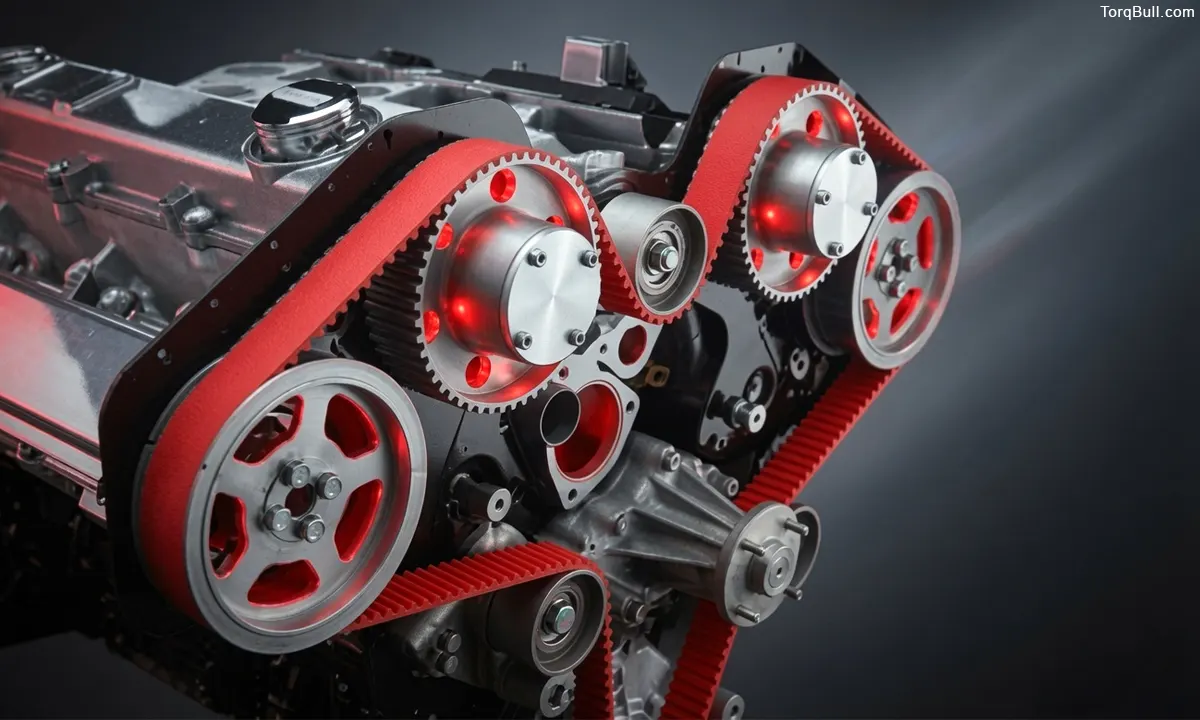
The timing belt is made of reinforced rubber with molded teeth. Automakers love belts because they’re quiet, lightweight, and cheap to build, which is why so many Hondas, Toyotas, and Audis of the past ran them. From behind the wheel, a belt-driven engine is smooth and hushed.
But here’s the catch, and it’s a big one. Rubber degrades. It dries out, cracks, and weakens with heat, age, and miles, whether you drive hard or baby it. That means a belt comes with a hard replacement interval, typically every 60,000 to 100,000 miles or roughly 7 to 10 years, whichever hits first. This is not optional maintenance. It’s a scheduled bill you will absolutely pay if you keep the car.
The good news is the price is predictable. A belt replacement usually runs $500 to $1,000, and any good shop should replace the tensioner, idler pulleys, and often the water pump at the same time since they’re already deep in there. Spend a little more to do it all at once. Skipping those companion parts is how people end up back in the shop a year later.
Team Chain: Tough, Pricey, and Mostly Silent About It
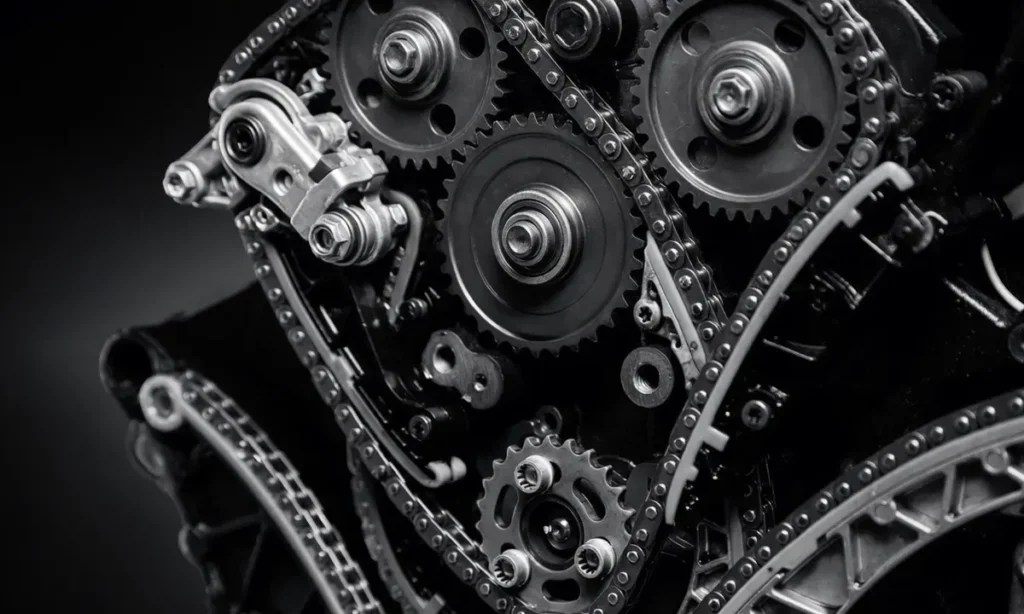
The timing chain is a metal roller chain that lives inside the engine, bathed in your motor oil. Because it’s steel instead of rubber, it’s built to last, often the entire life of the engine, 150,000, 200,000 miles, sometimes more. Most modern engines have swapped to chains for exactly this durability, and they’ve gotten quiet enough that you’d never know the difference from the driver’s seat.
Sounds like the clear winner, right? Mostly, yes, but read the fine print. A chain has no scheduled replacement, which feels like free money until one actually fails. Because it lives buried inside the engine, getting to it means serious teardown, and the bill reflects that. A timing chain job commonly runs $1,500 to $4,000 depending on the engine, two to three times a belt. The saving grace is that a well-maintained chain rarely needs replacing at all.
But that phrase, well-maintained, is doing heavy lifting. A chain lives and dies by your oil. Skip oil changes and let dirty, sludgy oil circulate, and the chain and its guides and tensioners wear fast. A stretched chain can jump a tooth, throw off your timing, and trigger everything from a rattling cold start to a wrecked engine. One mechanic described a neglected chain that rattled like coins in a tin can, a $1,200-plus repair that a string of $50 oil changes would have completely prevented.
The Scary Part: Interference Engines
Now for the detail that turns a bad day into a totaled car, and almost nobody knows to ask about it. It comes down to whether your engine is an interference or non-interference design.
In an interference engine, the valves and pistons pass through the same space at different moments, and only that perfect timing keeps them apart. If the belt or chain snaps, the pistons slam straight into open valves. Bent valves, damaged pistons, cracked cylinder head, sometimes a ruined engine. That’s a $3,000 to $7,000 repair, enough to total an older car outright. In a non-interference engine, there’s enough clearance that a failure just stops the engine with no internal carnage. You tow it, replace the part, and drive on.
Here’s why this matters so much: the overwhelming majority of modern engines are interference designs, because that layout delivers better power and efficiency. So if you’ve got an interference engine with a timing belt, and most belt engines built after 2000 are interference, blowing past that replacement interval isn’t a fender-bender of a mistake. It’s a car-totaling one. That scheduled belt service suddenly looks less like a nuisance and a lot more like cheap insurance.
Read: The $4,000 Air Suspension Trap: Why Traditional Springs Win the Long Game
Belt vs. Chain at a Glance
| Timing Belt | Timing Chain | |
| Material | Reinforced rubber | Metal |
| Location | Outside engine, plastic cover | Inside engine, oil-bathed |
| Lifespan | 60,000 to 100,000 miles | Often the life of the engine |
| Scheduled replacement | Yes, mandatory | No, only on failure |
| Typical cost | $500 to $1,000 | $1,500 to $4,000 |
| Your job | Replace on schedule | Change oil religiously |
| Failure risk | Predictable if ignored | Rare if oil is maintained |
How to Know Which One You Have
This takes about two minutes and could save you thousands, so do it before you buy any car. Crack open the owner’s manual and find the maintenance schedule. If there’s a line item that says replace timing belt at a specific mileage, congratulations, you have a belt and a deadline. If there’s no such listing anywhere, you almost certainly have a chain. You can also pop the hood and peek at the front of the engine. A black plastic cover usually means a belt, while a metal cover integrated into the block typically means a chain. Still unsure? A quick search of your exact year, make, model, and engine settles it instantly.
One warning: don’t confuse the timing belt with the serpentine belt. That’s the accessory belt snaking around the outside of your engine driving the alternator and AC, and it’s a cheap $100 to $250 swap. Totally different animal.
The Bottom Line: Know Before You Owe
So which is better? Honestly, a well-maintained chain edges it for most people who keep cars a long time, because it usually means never facing this bill at all. But a belt isn’t a bad thing, it’s just an honest one. It tells you exactly when it needs attention, and a belt replaced on schedule will never, ever let you down. The real trap isn’t belt or chain. It’s not knowing which you’ve got. The buyer who ignores a belt interval on an interference engine is playing a four-thousand-dollar game of roulette, and the buyer who skips oil changes on a chain engine is slowly sawing through their own timing system. Both fates are completely avoidable. Pop that manual, learn which part is spinning under your hood, and give it what it asks for. In this corner of car ownership, a few minutes of knowledge is the difference between a routine bill and a repair that sends your car to the junkyard.