Pop the hood of almost any new car and you’ll find one. That “T” badge on the trunk, the “EcoBoost” or “TSI” or “T-GDI” stamped on the engine cover, it all points to the same quietly brilliant device: the turbocharger. Once the exotic toys of Porsches and race cars, turbos are now everywhere, bolted to everything from a base Honda commuter to a Corvette to a Ferrari.
And here’s the magic that hooked the whole industry: a turbo lets a small, thrifty engine punch way above its weight, delivering the muscle of a much bigger motor while sipping less fuel. It sounds like a free lunch, horsepower conjured from thin air. Is it actually free? Not quite, and the “almost” is where this gets fascinating. Let me show you how this spinning little marvel really works.
The Free Lunch Nobody Was Eating
Start with a simple truth about engines. To make power, a cylinder needs three things: fuel, a spark, and air. Lots of air. In fact, air is usually the bottleneck. A regular engine, what gearheads call naturally aspirated, just sucks in air at whatever pressure the atmosphere provides. It’s limited by its own lungs. Want more power the old way? Build a bigger engine with bigger cylinders to gulp more air. More displacement, more thirst, more weight.
Now here’s the insight that makes a turbo genius. Every time your engine fires, it blasts hot exhaust gas out the tailpipe at tremendous speed and energy. For a century, that energy just went to waste, roaring off into the muffler and out into the air behind you. The turbocharger looks at that wasted exhaust and says: why not put it to work?
Two Fans and a Shared Shaft
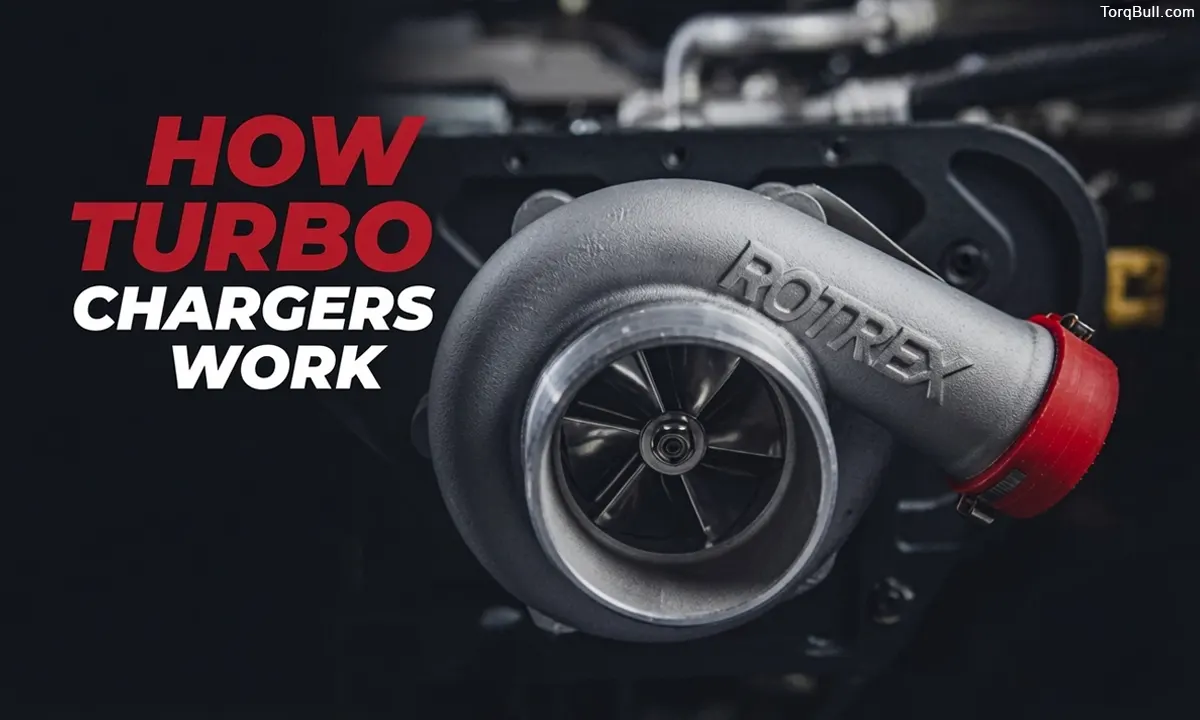
At its heart, a turbo is stunningly simple. It’s two fans joined by a single shaft. Picture a metal dumbbell with a pinwheel on each end.
One fan, the turbine, sits in the exhaust stream. As your engine dumps out those hot exhaust gases, they slam into the turbine blades and spin them furiously. That spinning shaft whirls the second fan on the other end, the compressor, which sits in your engine’s air intake. The compressor grabs ordinary outside air, squeezes it hard, and rams it into the cylinders at far higher pressure than the atmosphere alone could manage.
More air crammed into the cylinder means you can add more fuel, and more air plus more fuel equals a bigger bang. A bigger bang means more power from the very same size engine. That’s the whole trick. You’re using energy that was already leaving your tailpipe for free to force-feed your engine and multiply its output.
And these things work hard. A turbocharger routinely spins at 150,000 to well over 350,000 rpm, many times faster than the engine itself, in temperatures hot enough to glow. It’s one of the most ferociously stressed components in your entire car, and it’s often no bigger than a grapefruit.
The Catch: Meet Turbo Lag
So where’s the “not quite free” part? It’s a gremlin called turbo lag, and it’s the turbo’s oldest enemy.
Here’s the problem. When you stab the throttle, the turbine needs a rush of exhaust gas to spin up before it can deliver boost. But at low engine speeds, there isn’t much exhaust flowing yet. So there’s a beat of dead time, a hesitation, between your foot hitting the pedal and the shove of power arriving as the turbo finally spools up. Early turbo cars were infamous for it. The old BMW 2002 Turbo was so laggy it felt like flipping a light switch with a delay, nothing, nothing, then a wild surge. That abruptness made early turbos genuinely tricky to drive smoothly.
The engineers have spent decades hunting this gremlin, and modern cars have gotten remarkably good at killing it. Which brings us to the clever hardware that separates a modern turbo from its jerky ancestors.
The War on Lag
Automakers attack lag from several angles, and the solutions are genuinely ingenious.
The twin-scroll turbo is one of the smartest fixes. Instead of dumping every cylinder’s exhaust into one messy inlet where the pulses clash and cancel each other out, a twin-scroll splits the cylinders into two groups feeding two separate channels. On a four-cylinder firing 1-3-4-2, cylinders 1 and 4 feed one scroll while 2 and 3 feed the other. Keeping those exhaust pulses from colliding lets the turbine spin up sooner and cleaner, so boost arrives earlier with less lag. It’s a single turbo that behaves far better than its simple ancestors.
Then there’s twin-turbocharging, popular on bigger engines. Some setups run two identical turbos in parallel, each fed by half the cylinders, common on V6 and V8 engines like the Corvette’s. Others go sequential: a small turbo spools up fast for instant low-end punch, then hands off to a big turbo that takes over up top for maximum power. Small turbo kills the lag, big turbo delivers the muscle. Best of both worlds.
Little touches help too, like swapping the turbo’s journal bearings for ball bearings, which lets it spin up roughly 15 percent faster. Every fraction of a second counts in the war on lag.
The 2026 Game Changer: Electric Turbos
Here’s where it gets exciting, because the newest tech may finally kill turbo lag for good. The electric turbocharger adds a small electric motor right on the turbo’s shaft. That motor spins the compressor up instantly, from the very moment you touch the throttle, before the exhaust gases have even built up. No waiting for spool. Boost is simply there, right now.
This is the frontier in 2026, and the numbers are eye-opening. Recent hybrid turbo systems, which pair electric assist with exhaust power and can even recover energy, have shown up to a 70 percent cut in that laggy response delay, around a 50 percent bump in low-rpm torque, and 8 to 12 percent better fuel efficiency. They even spool the compressor on a freezing cold start before exhaust flow builds. Once exotic and expensive, this tech is trickling down from premium and heavy-duty machines toward mainstream cars as costs fall. The marriage of electric motors and turbochargers is quietly rewriting what small engines can do.
Read: The Maintenance Trap: How Timing Belt vs. Timing Chain Changes Your Repair Bill
Turbo Types at a Glance
| Type | How It Helps | Typically Found On |
| Single turbo | Simple, cheap power boost | Everyday commuters |
| Twin-scroll | Splits exhaust pulses, less lag | Modern daily drivers, sport sedans |
| Parallel twin-turbo | One turbo per cylinder bank | V6 and V8 performance cars |
| Sequential twin-turbo | Small turbo low, big turbo high | Performance and sports cars |
| Electric/hybrid turbo | Near-instant spool, no lag | Newest premium and hybrid models |
So Is It Really Free Horsepower?
Time for the honest verdict. No, turbo power isn’t quite free, and any enthusiast who tells you otherwise is skipping the fine print. That reclaimed exhaust energy does create a bit of back pressure, the added heat and boost stress engine components harder, and a turbo engine genuinely worked hard demands religious oil changes and good maintenance to live a long life. Those hot, fast-spinning bearings punish neglect. Push the fuel and boost too far and you wear out valves and turbine blades quicker. There’s always a price somewhere.
But as free lunches go, this one is about as close as engineering gets. You’re harvesting energy that was quite literally blowing out your tailpipe and converting it into real, usable power, letting a compact, efficient, lighter engine do the work of a big thirsty one. That’s why the turbo went from exotic rarity to nearly universal, and why the naturally aspirated engine is now almost an endangered species. Add the electric-turbo revolution arriving right now, and the humble turbocharger isn’t just surviving the age of electrification. It’s thriving in it. Not bad for a grapefruit-sized snail feasting on your exhaust.