Three Wheels Divided The Internet. Is The Polaris Slingshot Worth It or Just a Gimmick?
- Three-wheeled autocycle usable with a standard car licence
- Up to 203 hp ProStar four-cylinder engine
- Unique open-air driving experience unlike traditional sports cars
- Price range between $20,000 and $35,000
- Strong value proposition in the competitive recreational vehicle segment
There are vehicles that exist comfortably within established categories — products whose purpose, capability and value proposition are immediately legible against the standards of the segment they occupy. And then there are vehicles that resist categorisation entirely — machines whose combination of characteristics creates an ownership experience that no comparison to existing products fully captures and whose value must be assessed against criteria that the buyer themselves must define before the purchase decision can be made rationally. The Polaris Slingshot is emphatically the second kind of vehicle — a three-wheeled autocycle that is simultaneously not quite a car, not quite a motorcycle and not quite anything that most prospective buyers have encountered before in a form that prepared them for what ownership actually involves.
The gimmick question that follows the Slingshot everywhere it goes reflects the legitimate uncertainty that its unusual configuration creates in the minds of buyers who have never experienced one and who must therefore evaluate it against the categories they know rather than the category it actually occupies. Resolving that question honestly — acknowledging both the genuine limitations that the Slingshot’s design philosophy imposes and the genuine pleasures that its configuration uniquely enables — is the purpose of this assessment.
What the Polaris Slingshot Actually Is
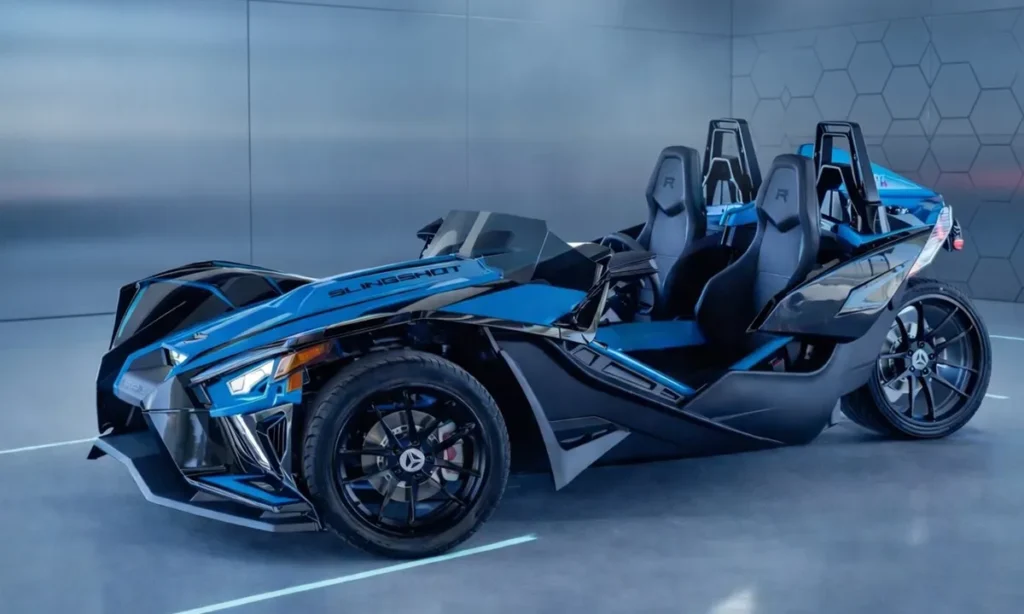
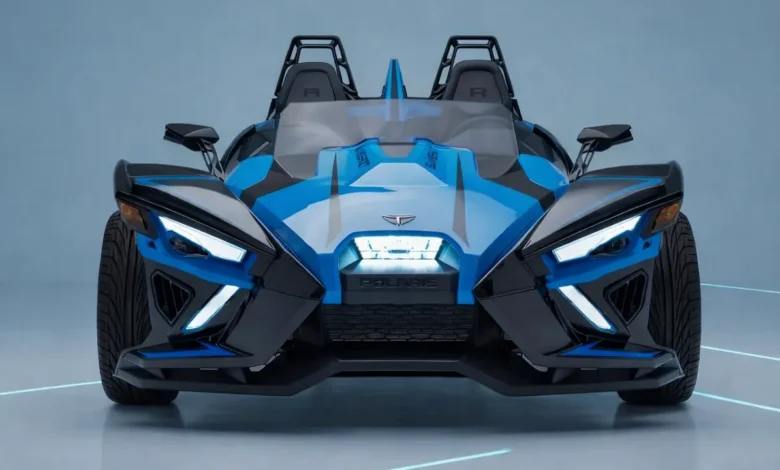
The Polaris Slingshot is a three-wheeled autocycle — two wheels at the front, one at the rear — whose side-by-side seating for two occupants, steering wheel, pedal controls and roll cage structure give it the ergonomic familiarity of a car while its open-air exposure, rear-wheel-drive configuration and the visceral sensory experience its open cockpit provides align it more closely with the motorcycle experience than any conventional sports car delivers.
The autocycle classification has practical significance beyond mere nomenclature — in most American states, the Slingshot’s three-wheel configuration qualifies it as an autocycle rather than a motorcycle, requiring a standard driver’s licence rather than a motorcycle endorsement for legal operation. This regulatory distinction removes the licensing barrier that prevents many prospective buyers from accessing the performance motorcycle experience and broadens the Slingshot’s potential ownership demographic to include buyers who have never ridden a motorcycle and have no intention of doing so.
The current lineup spans from the Slingshot S at approximately $20,000 to the Slingshot R at approximately $33,000 — with the R variant’s 203-horsepower ProStar 2.0-litre four-cylinder engine representing the performance flagship whose power-to-weight ratio, in a vehicle weighing approximately 1,300 pounds, produces acceleration that genuinely surprises buyers whose frame of reference is a conventional sports car of equivalent price.
The Performance Case: What the Slingshot Does Genuinely Well
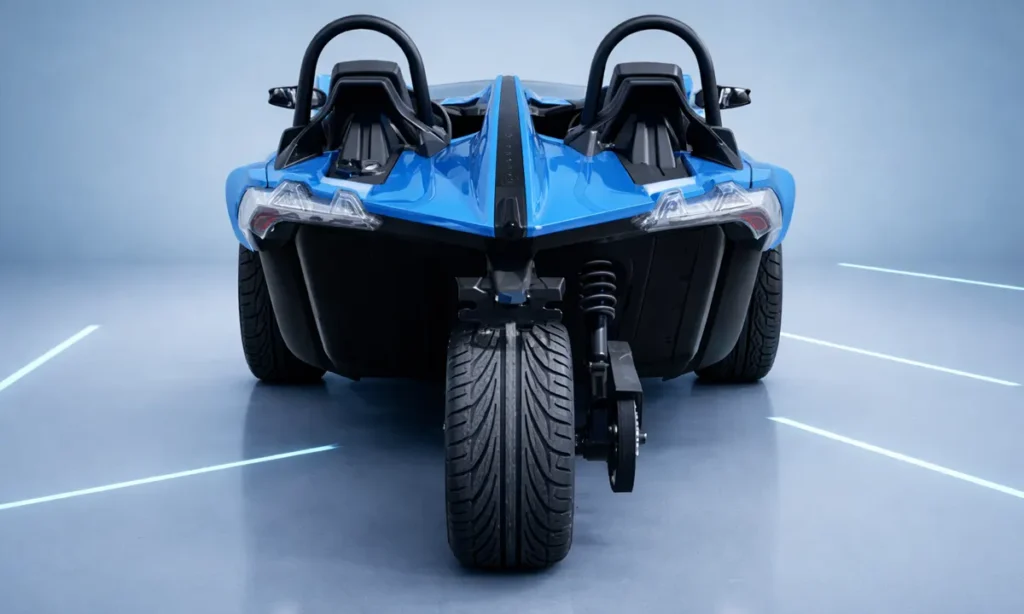
The Polaris Slingshot’s performance credentials in its R specification are more substantive than its recreational vehicle positioning might suggest — delivering zero to 60 miles per hour in approximately 4.9 seconds from its 203-horsepower ProStar engine and a driving experience whose open-air character transforms the sensory impact of that acceleration figure into something that feels considerably more dramatic than a closed-cockpit car with equivalent performance numbers would deliver.
The front-engine, rear-wheel-drive configuration produces handling characteristics whose balance and adjustability reward driver skill in a manner that the front-wheel-drive configuration of most vehicles in the Slingshot’s price range cannot approach. The wide front track — whose visual drama is the Slingshot’s most immediately recognisable aesthetic characteristic — provides the lateral stability that allows the driver to explore the vehicle’s handling limits with a progressive, communicative feedback that builds confidence rather than concealing the dynamic limits behind electronic intervention.
The five-speed manual gearbox available on certain Slingshot configurations provides the driver engagement that the autocycle experience demands — connecting the driver to the mechanical reality of the powertrain in a manner that the automatic alternative’s convenience cannot replicate for buyers whose enthusiasm for the Slingshot experience extends to its driving involvement rather than merely its visual spectacle.
The Limitations: Where the Gimmick Criticism Has Legitimate Grounding
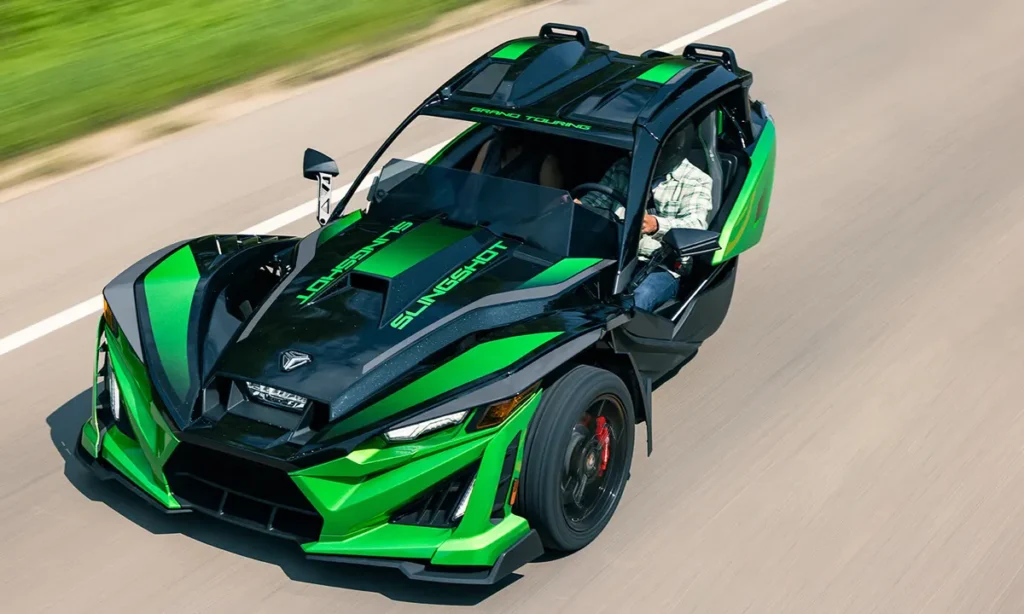
The honest assessment of the Polaris Slingshot requires acknowledging the limitations whose cumulative effect determines whether the vehicle’s ownership experience sustains the enthusiasm of initial purchase or gradually reveals the compromises whose acceptance the unusual configuration demands.
The weather exposure that defines the Slingshot’s open-air character — and that provides the sensory richness that distinguishes it from enclosed alternatives — is simultaneously the characteristic that most constrains its practical utility as a primary transportation vehicle. Rain, cold temperatures and the debris exposure that highway driving at speed produces in an open cockpit create driving conditions whose discomfort limits the Slingshot’s useful operational window in every American market outside the perpetually warm climates of Florida, Southern California and the desert Southwest. For buyers in northern markets whose annual driving season includes meaningful cold and precipitation, the Slingshot’s practical utility as anything other than a fair-weather recreational vehicle is severely constrained.
The single rear wheel’s traction limitation — whose practical consequence is most apparent during hard acceleration from rest and during cornering with simultaneous power application — requires driver awareness and throttle discipline that the vehicle’s car-like controls might not immediately suggest to new owners transitioning from conventional automotive experience. The rear tyre’s accelerated wear rate under enthusiastic driving conditions creates a replacement cost recurring expense whose frequency surprises owners unaware of the single rear wheel’s exposure to the full driving force that the 203-horsepower engine generates.
The storage capacity — effectively non-existent beyond the minimal behind-seat space that the Slingshot’s compact dimensions allow — confirms the vehicle’s identity as a recreational experience rather than a practical transportation tool. No grocery run, airport journey with luggage or extended touring trip is practically accomplished without the addition of aftermarket storage solutions whose visual integration with the Slingshot’s dramatic styling varies between acceptable and unfortunate.
The Value Question: $20,000 to $35,000 for What, Exactly?
The Slingshot’s value proposition becomes most coherent when it is assessed not against conventional sports cars of equivalent price — against which its weather exposure, storage limitations and regulatory ambiguity make the comparison unfavourable — but against the recreational vehicle category whose ownership model it most closely resembles.
A buyer who approaches the Slingshot as a recreational vehicle — a machine purchased specifically for the experience its open-air, three-wheeled, rear-drive configuration provides rather than as a practical transportation alternative — finds a value proposition whose price-to-experience ratio is genuinely compelling. At $20,000 to $33,000, the Slingshot delivers a driving experience that no conventional vehicle at equivalent pricing replicates — the combination of car-licence accessibility, side-by-side seating for shared experience, dramatic visual presence and the sensory richness of open-air motoring at performance car acceleration rates creates something that the buyer who values those specific characteristics simply cannot find elsewhere at any price.
The gimmick accusation most frequently originates from buyers who evaluate the Slingshot against transportation needs it was never designed to meet — and dissolves when the evaluation criteria shift to the recreational experience it was designed to provide.
Is the Polaris Slingshot Worth It? The Verdict
The Polaris Slingshot is worth its purchase price for a specific buyer profile — and genuinely poor value for others. The buyer whose ownership model includes a primary transportation vehicle alongside which the Slingshot serves as a fair-weather recreational machine, whose geography provides sufficient dry, warm driving days to justify the purchase, whose enthusiasm for the open-air driving experience is genuine rather than novelty-driven and whose social dimension of ownership — the Slingshot attracts attention and enables shared passenger experiences that few vehicles of any price replication — is valued alongside the driving experience itself will find the Slingshot rewarding across multiple ownership years.
The buyer expecting a practical sports car alternative, a year-round primary vehicle or a machine whose performance credentials justify its price against conventional sports car competition will find the Slingshot’s limitations more apparent than its pleasures — and will likely conclude that the gimmick criticism was more accurate than the ownership community’s enthusiasm suggested.
The Slingshot is not a gimmick. It is a vehicle with a very specific purpose that it serves extraordinarily well — and a very specific buyer for whom that purpose represents genuine and sustained value.
Read: Godzilla Lives! The Legend Prepares to Return. Everything We Know About the Next-Gen Nissan GT-R R36
Polaris Slingshot 2026 Model Comparison
| Category | Slingshot S | Slingshot SL | Slingshot R |
| Engine | 2.0L ProStar I4 | 2.0L ProStar I4 | 2.0L ProStar I4 |
| Power Output | 178 hp | 178 hp | 203 hp |
| Transmission | 5-Speed Manual / Auto | 5-Speed Manual / Auto | 5-Speed Manual / Auto |
| 0–60 mph | Approx. 5.5 sec | Approx. 5.5 sec | Approx. 4.9 sec |
| Drivetrain | Rear-Wheel Drive | Rear-Wheel Drive | Rear-Wheel Drive |
| Seating | 2 (Side-by-Side) | 2 (Side-by-Side) | 2 (Side-by-Side) |
| Kerb Weight | Approx. 1,300 lbs | Approx. 1,300 lbs | Approx. 1,330 lbs |
| Licence Requirement | Car Licence (Most States) | Car Licence (Most States) | Car Licence (Most States) |
| Audio System | Basic | Premium | Premium+ |
| Starting MSRP | ~$20,000 | ~$26,000 | ~$33,000 |
| Best For | Entry Experience | Daily Recreational | Performance Focus |