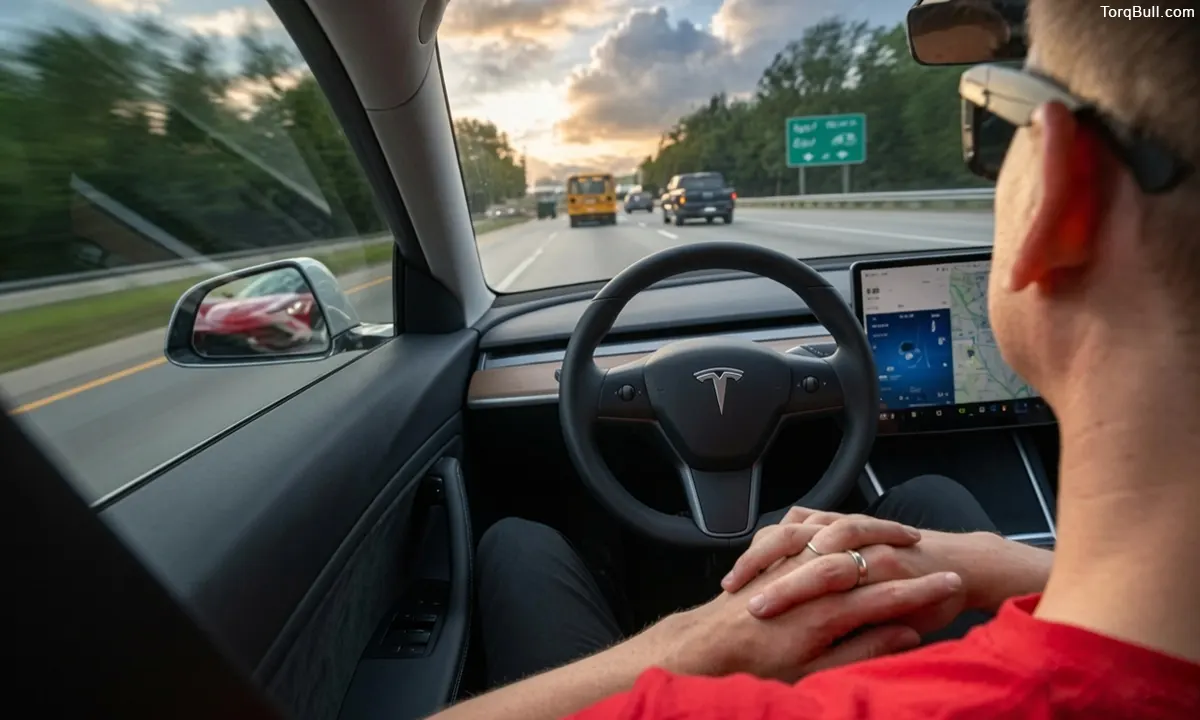
Remember when cruise control was the height of driving convenience? You set a speed, took your foot off the gas, and felt like you were living in the future. That future looks quaint now. Today’s best cars don’t just hold a speed. They steer, brake, change lanes, watch your eyes, and in a couple of cases, let you stop watching the road entirely.
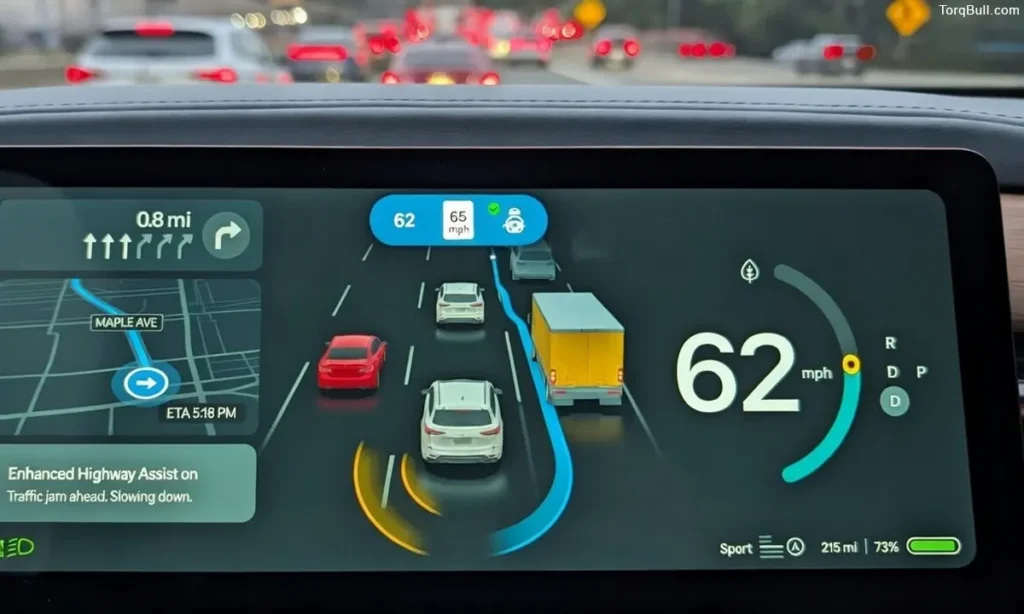
We’ve gone from cruise to co-pilot, and the gap between the best systems and the average ones has never been wider. Every automaker slaps a confident name on its tech and promises the moon, but only a handful actually earn the hype. I’ve spent real seat time sorting the genuine game changers from the glorified lane keeping. Here’s who’s leading the pack right now, and exactly what you’re getting for your money.
Ford BlueCruise: The People’s Champ
If I had to hand someone the keys to a hands-free car today and trust them not to get scared, it would be a Ford running BlueCruise. This is the system that keeps winning independent safety comparisons, and it wins because it nails the boring stuff. The lane centering is smooth and confident, the adaptive cruise reads traffic naturally, and the infrared driver-facing camera is genuinely good at making sure your eyes stay where they belong.
BlueCruise works hands-free in what Ford calls Blue Zones, which now cover more than 130,000 miles of divided highway across the U.S. and Canada. That’s roughly 97 percent of the controlled access highways you’d actually road trip on. The latest version, BlueCruise 1.5, adds Automatic Lane Change that moves you around slower traffic without you touching the wheel, and it’s rolling out on the 2026 Explorer and the Mustang Mach-E.
The best part is the price. You get a 90 day trial, then it’s $49.99 a month, $495 a year, or a one time buy of $2,495 that covers you for at least seven years. You’ll find it across the Mustang Mach-E, F-150, F-150 Lightning, Expedition, and Explorer. For most Americans, this is the sweet spot of capability and value.
GM Super Cruise: The Mileage King
If BlueCruise is the safe pick, Super Cruise is the one I trust most on a long haul. General Motors mapped its roads with LiDAR down to the lane, and the result is a system that seems to know what’s coming rather than just reacting to it. Set it loose on an interstate and it feels almost telepathic through curves and traffic.
The headline number is the network. Super Cruise runs hands-free on more than 600,000 miles of compatible roads, roughly four times Ford’s coverage, and it includes both divided highways and plenty of two lane roads. It changes lanes on its own or when you tap the signal, and it’s the only system I know of that stays hands-free while you’re towing a trailer, automatically stretching your following distance for the extra weight.
For 2026, GM added Google Maps integration and a slick automatic handoff between hands-on assist and full hands-free driving as you move between mapped and unmapped roads. You get three years of connectivity baked in, after which you’ll need an OnStar plan to keep it alive. It’s spread across a huge lineup now, from the Cadillac Escalade and Lyriq to the Chevy Silverado EV and Equinox EV. If your life is highway miles, this is the one to beat.
Tesla FSD: The Wild Card That Goes Everywhere
Here’s where things get spicy. While BlueCruise and Super Cruise politely wait for the highway, Tesla’s Full Self-Driving Supervised will attempt the whole drive. City streets, stoplights, roundabouts, four way stops, your neighborhood cul de sac. No other system sold to the public even tries to do this.
And when it works, it’s jaw dropping. A Tesla owner recently drove coast to coast, more than 2,700 miles, without a single intervention on the latest software. Tesla’s fleet has now logged billions of FSD miles, and that data advantage is enormous. It costs $99 a month or $8,000 outright, and it’s available on every Tesla you can buy.
But I have to be straight with you. FSD leans entirely on cameras, no radar or LiDAR backup, and independent safety testers have long docked Tesla for weak driver monitoring compared to the eyeball tracking cameras in a Ford or GM. Federal regulators have an open investigation into how the system performs in low visibility. It’s the most ambitious tech in any showroom, and also the one that demands the most vigilance from you. Thrilling, but not a system to get lazy with.
Rivian’s Promising Rookie Season
The newcomer worth watching is Rivian. In late 2025 it pushed out Universal Hands-Free to its second generation R1T and R1S, and it immediately claimed the largest hands-free network of anyone at 3.5 million miles of road. Reviewers keep describing it with the highest compliment you can give this tech: boring. It stops smoothly, follows lanes cleanly, and drives like a cautious human.
It runs on ten cameras and five radars, costs $2,500 to buy or $49.99 a month, and Rivian says true point to point driving that rivals Tesla is coming before the end of 2026, with LiDAR arriving on the R2. It’s not there yet, and it’s essentially useless in stop and go city traffic today. But as a first swing, it’s impressively polished, and Rivian is refreshingly honest about what it can’t do.
Mercedes Drive Pilot: The Only One That Lets You Look Away
Everything above is Level 2. You can take your hands off, but never your eyes. Mercedes Drive Pilot is the lone exception, the only certified Level 3 system you can buy in America. Under the right conditions it legally lets you take your eyes off the road entirely. You can watch a video or play a game on the dash while the car drives.
The catch is a big one. It only works in daytime, in good weather, in traffic jams at 40 mph or less, on specific mapped freeways, and only in California and Nevada. It lives on the S-Class and EQS by subscription. It’s a genuine glimpse of the future, backed by redundant LiDAR, radar, and camera hardware. But the operating window is so narrow that most owners will rarely get to use it. Worth noting too: Mercedes is quietly shifting its newest flagships toward a more flexible Level 2 setup, so this eyes-off party may pause before it spreads.
How They Stack Up
| System | Best Feature | Hands-Free? | Eyes-Off? | Network | Price |
| Ford BlueCruise | Value and polish | Yes | No | 130,000+ mi | $495/yr or $2,495 |
| GM Super Cruise | Biggest map, towing | Yes | No | 600,000+ mi | 3 yrs free, then OnStar plan |
| Tesla FSD | Goes anywhere | Yes | No | Nearly everywhere | $99/mo or $8,000 |
| Rivian UHF | Smooth newcomer | Yes | No | 3.5 million mi | $49.99/mo or $2,500 |
| Mercedes Drive Pilot | Legal eyes-off | Yes | Yes (limited) | CA and NV only | Subscription |
The Honest Truth About “Self-Driving”
None of these cars drive themselves, no matter what the badge implies. Every one of them, including the Level 3 Mercedes, needs a responsible human ready to take over. The camera-only Teslas can get confused in rain and glare. The mapped systems from Ford and GM simply switch off the moment you leave their approved roads, and frost or a dirty sensor can drop them mid drive. Rivian still can’t handle a busy downtown. And the more relaxed a system feels, the easier it is to zone out, which is exactly when trouble finds you.
Treat this tech as a brilliant co-pilot, not a chauffeur. Used that way, it turns a soul crushing commute or a marathon interstate slog into something genuinely restful.
Read: ADAS Features Explained in Modern Cars 2026. Why Understanding Them Could Save Your Life
The Verdict: Which Co-Pilot Should Ride Shotgun
If you want the smartest all around pick, buy a Ford and get BlueCruise. It’s the best blend of capability, safety, and price on the market. If you’re a highway warrior who racks up serious miles or tows, Super Cruise and its massive LiDAR network is unmatched. If you’re a tech obsessive who wants your car to attempt everything and you’ll stay sharp behind the wheel, Tesla FSD is still in a class of one for ambition. Rivian is the exciting long shot, and Mercedes is a fascinating peek at a hands-off, eyes-off tomorrow that hasn’t quite arrived.
The leap from cruise to co-pilot is real, and it’s the most useful thing to happen to daily driving in decades. Just remember who’s still legally in charge. Spoiler: it’s you.