- Max towing capacity: 6,500 lbs (2.4L i-Force)
- Real-world towing MPG: ~9.5–12.4 MPG
- Mountain towing can drop efficiency below 10 MPG
- Fuel stops every ~150–180 miles while towing
- Real-world performance differs significantly from EPA estimates
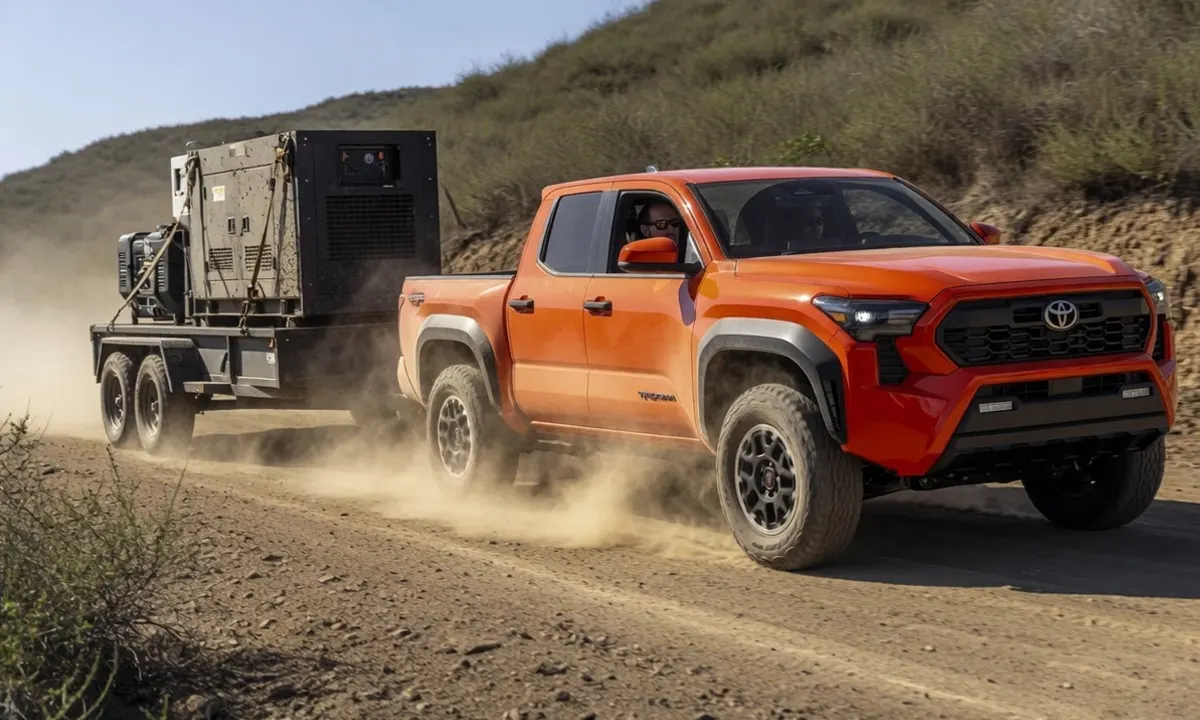
Towing capacity numbers on a window sticker tell buyers what the truck is rated to pull — they do not tell buyers what the experience of pulling that weight actually feels like, what the fuel economy becomes when a trailer is attached, how frequently refuelling stops are required or whether passing other vehicles at interstate speeds remains comfortable with a load behind the truck. For the 2026 Toyota Tacoma — America’s best-selling midsize truck at 274,638 units in 2025 — understanding the difference between the manufacturer’s 6,500-pound rating and what professional testers and real owners experience when they actually hook up a trailer is the most practically useful towing knowledge available. This guide provides exactly that, drawing on instrumented professional tests, owner forum data and the specific real-world findings that reveal how the Tacoma performs as a tow vehicle under realistic conditions.
The Official Numbers: Maximum Towing Capacity by Configuration
The 2026 Toyota Tacoma’s towing capacity varies significantly by engine, transmission, cab style, bed length and drivetrain combination — and the gap between the most and least capable configurations is large enough to make specific truck identification essential before making a towing purchase decision.
The maximum towing capacity of 6,500 pounds is achievable only with specific configurations: the SR5 XtraCab or TRD PreRunner XtraCab with the i-Force 2.4-litre turbocharged gas engine, the 8-speed automatic transmission and the 6-foot bed in either RWD or 4WD specification. This maximum figure requires Toyota’s towing package — a Class IV trailer hitch receiver with wiring harness — which comes standard on most Tacoma trims but must be confirmed for the specific vehicle being purchased.
The i-Force MAX 2.4-litre hybrid powertrain, despite producing 326 horsepower and 465 pound-feet of torque — dramatically more than the gas engine’s 278 horsepower and 317 pound-feet — carries a lower maximum towing rating of 6,000 pounds across most configurations, dropping to 5,950 pounds on the Trailhunter with a 6-foot bed. This counterintuitive result reflects the hybrid system’s additional weight, which reduces the Gross Combined Weight Rating available for trailer tongue weight. The base SR trim with the 8-speed automatic is rated at only 3,500 pounds — illustrating how dramatically the configuration affects the Tacoma’s towing capability.
For buyers expecting the 6,500-pound maximum, the configuration requirement chart is essential reading before purchase. Choosing a TRD Pro or Trailhunter with the hybrid powertrain — the most expensive and most capable-appearing Tacoma variants — actually produces lower towing ratings than the SR5 gas configuration at maximum towing capacity.
The Real-World Test: 1,000 Miles of Towing From Houston to Colorado
The most comprehensive real-world towing test of the current-generation Tacoma was conducted by The Fast Lane Truck (TFL), who drove a 2024 TRD Off-Road Tacoma 1,000-plus miles from Houston, Texas to Boulder, Colorado — picking up an off-road camping trailer in Dallas partway through. This test is the most practically informative data point available for understanding the fourth-generation Tacoma’s real towing experience because it combines highway towing, mountain grade towing and the practical range implications of the Tacoma’s 18-gallon fuel tank under load.
Without the trailer, the TFT TRD Off-Road Tacoma achieved 24.2 MPG on the flat, straight highway sections between Houston and Dallas — comfortably above the EPA estimate of 21 MPG combined for the 4WD configuration. This empty truck fuel economy result aligns with Edmunds’ own 22.6 MPG evaluation route result and confirms that the fourth-generation Tacoma’s turbocharged 2.4-litre performs well on fuel economy when not under towing load.
With the Sasquatch Expedition Campers Highland 60 trailer — which has a dry weight of approximately 1,784 pounds and, in loaded configuration, exceeds 2,000 pounds — the fuel economy dropped dramatically to 11.5 to 12.4 MPG depending on conditions. TFL explicitly noted the practical consequence: combined with the Tacoma’s modest 18-gallon fuel tank, towing produces a practical range of approximately 150 to 180 miles before refuelling. For comparison, the empty truck achieves approximately 440 miles of highway range.
TFL noted that the turbo four-cylinder lacked sufficient power to make passing at interstate speeds a comfortable, confident decision while towing — describing the truck as capable of towing but not particularly happy about it, particularly at elevation. At Denver’s one-mile altitude and above — where the naturally aspirated section of any turbocharged engine’s operating range is affected by reduced air density — passing manoeuvres while towing required planning rather than casual throttle application.
The Cars.com Mountain Grade Test: 9.5 MPG on a Challenging Route
Cars.com conducted a dedicated towing test of the 2024 Tacoma Limited — rated at 6,300 pounds — pulling a 4,770-pound trailer on a route that included freeway, highway, flat ground and significant elevation gain from approximately 4,500 feet to over 6,200 feet. This test specifically targeted the mountain grade towing scenario that flat-terrain fuel economy numbers do not address.
The result was 9.5 MPG over the test route — a figure that Cars.com noted was approximately 2.6 MPG worse than the previous V6-powered Tacoma on the same route. The analysis acknowledges that the 4,770-pound trailer’s nearly 80 square feet of frontal area is large for a midsize truck and contributes disproportionately to aerodynamic drag relative to its total weight. Trailers with lower profiles and equivalent weights would likely produce better fuel economy figures on the same route.
Despite the fuel economy finding, Cars.com specifically praised the towing feel improvement of the new turbocharged four-cylinder over the previous V6: the reviewer noted that the tow experience no longer feels like a fight to climb a hill while towing, and that overall towing feel and confidence is now on par with the best in the segment. This qualitative assessment — that the experience of towing has improved dramatically even if the fuel economy result disappointed — reflects the turbocharged engine’s torque advantage over the previous naturally aspirated V6’s 265 pound-feet.
Read: Toyota Tacoma Fuel Economy Real World MPG. Every Number Every Owner Needs to Know
What the Hybrid Adds to Real-World Towing
The i-Force MAX hybrid powertrain’s 465 pound-feet of torque is its most practically significant towing advantage — not fuel economy, which the EPA rates only modestly better than the gas engine at equivalent speeds, but the availability of instant, maximum torque from low engine speeds that makes loading, launching and hill climbing with a trailer substantially more effortless than any gasoline-only equivalent.
Owner forum data from the T@B RV community — whose members frequently use midsize trucks for lightweight camper towing — confirms this characterisation. Multiple owners note that the hybrid powertrain’s city fuel economy advantage is meaningful, but that its primary towing benefit is the electric motor’s instant torque delivery that reduces the turbocharger’s contribution requirement at low speeds and in slow traffic. One owner’s report of achieving 15 to 16 MPG on straight, flat roads with a trailer — against the non-hybrid’s 11 to 12 MPG in equivalent conditions — suggests a meaningful hybrid towing economy advantage in specific flat-terrain scenarios that the mountain tests do not fully capture.
The hybrid’s 6,000-pound rating versus the gas engine’s 6,500-pound maximum is the specific compromise hybrid buyers must accept — a 500-pound reduction in the maximum rated capacity that reflects the additional hybrid system weight rather than reduced engine capability.
Read: Toyota Tacoma vs Ford Ranger Reliability Comparison. The Complete Head-to-Head Analysis
Toyota Tacoma Towing — Complete Configuration and Real-World Data Chart
| Configuration | Max Tow Rating | Fuel Economy (Empty) | Fuel Economy (Towing) | Practical Range Towing | Passing Confidence |
| Gas 2.4L 4WD Auto (max config) | 6,500 lbs | ~20–22 MPG | ~11–14 MPG | ~150–180 miles | Adequate; requires planning |
| Gas 2.4L RWD (most efficient) | ~6,500 lbs | ~22–24 MPG | ~12–15 MPG | ~180–210 miles | Adequate |
| i-Force MAX Hybrid 4WD | 6,000 lbs | ~20–22 MPG | ~14–17 MPG (flat) | ~190–225 miles (flat) | Very good (instant torque) |
| Gas 2.4L (mountain grade, heavy trailer) | Up to 6,500 lbs | ~22 MPG | ~9.5–12 MPG | ~135–160 miles | Requires planning at elevation |
| Base SR (any config) | 3,500 lbs | ~20 MPG | ~12–15 MPG | ~150–180 miles | Adequate for light loads |
| i-Force MAX TRD Pro 4WD | 6,000 lbs | ~20–21 MPG | ~13–16 MPG | ~175–205 miles | Excellent low-speed confidence |
All fuel economy and range figures are based on real-world test results and owner-reported data. Actual results vary with trailer weight, aerodynamic profile, elevation change, speed and driving style.
Towing Technology: What the 2026 Tacoma Provides Standard
The 2026 Tacoma’s towing technology package addresses the most common real-world towing challenges beyond the rated capacity number — and these systems contribute meaningfully to the confidence and safety of actual towing use.
Trailer Sway Control is integrated into the Tacoma’s stability control system, using individual brake application to detect and counteract trailer sway — the oscillating movement that can develop when a trailer is buffeted by crosswinds or passes large vehicles at highway speeds. Toyota specifically recommends using a sway control device for trailers above 2,000 pounds and a weight-distribution hitch for trailers over 5,000 pounds, but the Tacoma’s integrated system provides a base level of sway management regardless of trailer equipment.
The Integrated Trailer Brake Controller — available on higher trim levels — provides customisable trailer brake gain adjustment that is preferable to aftermarket afterthought installations. Owners in the T@B forum specifically note the Tacoma’s built-in controller, automatic trailer detection, tow mode transmission settings, trailer light test mode and sway control capability as meaningful advantages over competing trucks that require aftermarket additions for equivalent functionality. A Tow/Haul mode adjusts transmission shift logic to prevent the hunting between gears that standard mode produces on grades — holding lower gears longer on uphills and using engine braking more aggressively on downhills.
The Trailer Backup Guide and Blind Spot Monitor Camera system — available additions — assist with the parking and lane-change situations that experienced tow vehicle operators find most demanding. The 3D Panoramic View Monitor on upper trims provides a top-down view during hitch connection that simplifies the reverse and align process that trailer hitching requires.
The Honest Towing Verdict: What the Tacoma Does Well and Where It Falls Short
The 2026 Toyota Tacoma is a capable and confidence-inspiring tow vehicle for loads up to approximately 4,000 to 4,500 pounds — the range where its 317 to 465 pound-feet of torque (depending on powertrain) can manage grades, acceleration and passing manoeuvres without placing the driver in planning-intensive situations. In this load range, the towing experience is comfortable and its fuel economy — while reduced to 14 to 17 MPG — maintains a practical refuelling interval of 200-plus miles.
For loads approaching the rated maximums of 6,000 to 6,500 pounds, the Tacoma’s real-world performance is more demanding. Fuel economy drops to 9 to 12 MPG in mountain terrain and 11 to 14 MPG on flat highways, reducing practical range to 150 to 180 miles per tank from the already-modest 18-gallon fuel tank. Passing at interstate speeds requires advance planning rather than casual throttle response, particularly at altitude. The turbocharged engine’s power delivery is adequate — as Cars.com confirmed, it no longer feels like a fight to climb hills — but it is not effortless at maximum load in challenging terrain.
Edmunds puts the assessment in direct competitive context: the Tacoma’s 6,500-pound maximum towing capacity is more average for the class — the Chevrolet Colorado maxes out at 7,700 pounds, for example — but the Tacoma should handle most small to midsize trailers adequately. For the majority of Tacoma buyers who tow boats, jet skis, ATVs, small campers and utility trailers well below the maximum rating, the real-world towing experience is fully adequate and well-supported by the available technology. For buyers who regularly approach the maximum rating with heavy-profile recreational trailers in mountainous terrain, the Tacoma’s 18-gallon tank and the turbocharged four-cylinder’s altitude sensitivity are genuine planning considerations.